


TLDR: Anthropic’s new study shows AI is doing a fraction of what it theoretically could. But that gap is closing, and the disruption is already underway through three distinct mechanisms that are currently conflated. I propose a framework to more clearly distinguish them: task substitution (what the Anthropic study measures) is compressing white-collar work from within; middleman compression is quietly dismantling the coordination layer of modern organizations, the roles built to manage human-to-human handoffs, now structurally redundant as agents handle the work beneath them; and process optimization is reducing labor demand in white and blue-collar sectors without touching a single job description. The workpocalypse isn’t a moment. It’s a condition. The jobs data doesn’t properly capture all three mechanisms, but it will eventually catch up. By then, the restructuring will already be substantially complete.
For two years, the debate over artificial intelligence and employment has been driven by a peculiar combination of executive announcement and collective anxiety. CEOs declare that chatbots have replaced hundreds of workers. Layoffs are framed as a technological inevitability. Productivity gains are proclaimed without being measured. And the financial press, caught between the genuine and the theatrical, has struggled to separate signals from noise.
Last week (2–8 March 2026), Anthropic made the most methodologically serious attempt yet to cut through confusion. In a paper drawn from millions of real interactions between users and its Claude AI system, the company introduced a new concept: observed exposure. This concept is designed to distinguish what AI tools are demonstrably doing in professional settings today from what they could theoretically do. The result is a map of the gap between potential and reality.
That gap tells the real story of AI and work.
What the study reveals is not a tale of mass replacement, nor of harmless augmentation. It is a more unsettling picture: an economy beginning to reorganize itself around AI, unevenly, invisibly, and along lines that the standard ways of measuring employment are poorly equipped to capture.
The white-collar apocalypse is not happening on the schedule that its most breathless advocates suggest. But it would be wrong to suggest that nothing is happening.
What is happening is structural. And it is already beginning to compound.
What Does Anthropic’s Spider Chart Show?
Two areas are drawn against each other: blue for what language models could theoretically do to each occupational category; red for what they are doing. In Computer and Mathematical occupations, theoretical exposure runs at c.94%. Observed exposure: 33%.
Previous research on AI and labor markets measured theoretical capability. Under frameworks such as a study conducted by OpenAI and the University of Pennsylvania (Eloundou et al.) in 2023, roughly 80% of the U.S. workforce could see at least 10% of their tasks affected by LLMs, depending on whether the technology could theoretically speed them up.
Anthropic’s approach differs in a critical respect. The company mapped millions of Claude interactions from its Economic Index onto roughly 800 occupations in the O*NET database, producing a measure of observed exposure. Rather than asking what LLMs could theoretically do, the index asks which tasks that are theoretically feasible are actually being performed with AI in practice. The measure also weights automated uses more heavily than augmentative uses and focuses on interactions that appear to correspond to work-related tasks.
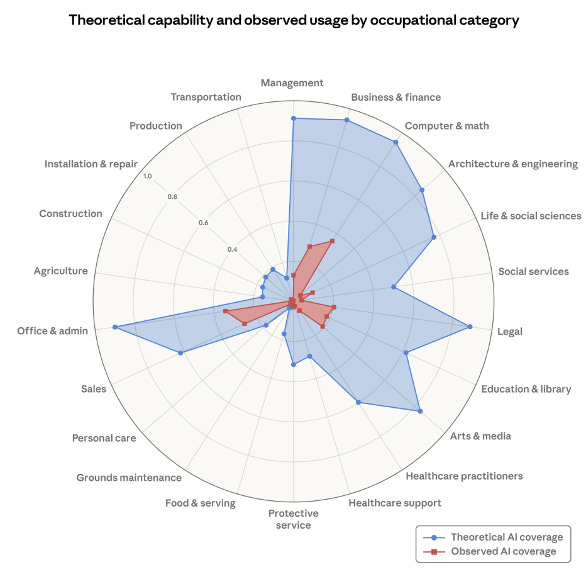
The gap between the blue and red areas is the most important finding in the report, and the least cited.
Consider the numbers:
In Computer and Mathematical occupations, theoretical exposure runs at c.94%. Observed exposure: 33%.
Office and Administrative Support: 90% theoretical, roughly a quarter observed.
Legal occupations: 80% theoretical capability, a fraction of that actually deployed.
Across every category, real deployment is a small fraction of what capability would allow.
What explains the gap is not a lack of technology. The Anthropic methodology itself offers a clue. The study distinguishes between two modes of AI use: augmentative, in which a human uses Claude to complete tasks more quickly, and automated, in which Claude executes tasks with minimal human involvement.
Automated use is weighted more heavily in the observed exposure measure precisely because it is more predictive of employment impact. The fact that observed exposure remains so far below theoretical capability across every occupational category tells us that most organizations are still operating in the augmentative mode: AI assisting workers, not replacing workflows.
The deployment ceiling is not technological. It is organizational: legal constraints, verification requirements, integration costs, and institutional inertia are holding the red area well inside the blue. When those constraints ease (and they will), the gap closes. That is when the employment signal sharpens.
Among the most exposed occupations in the Anthropic data, computer programmers sit at the top with c.75% coverage. Customer service representatives follow closely. At the other end, 30% of blue-collar workers, such as cooks, mechanics, bartenders, and dishwashers, register zero coverage. Embodied labor remains, for now, a genuine moat.
The headline employment signal from the study is notably calibrated. There has been no statistically significant increase in unemployment among workers in high-exposure occupations since late 2022. No Great Recession for white-collar workers has (yet) materialized in the aggregate data.
But one figure in the report carries a sharper warning. Among workers aged 22 to 25, the job-finding rate into high-exposure occupations has declined roughly 14 per cent relative to the pre-ChatGPT baseline, while entry into low-exposure occupations remains stable. The jobs themselves still exist. The doors into them are beginning to close.
It is, in my view, the sharpest early warning the data contain. It points to a structural consequence whose implications extend well beyond what the unemployment rate captures.
How Does AI Cut Jobs Beyond Task Substitution?
But there is a deeper problem. Not with Anthropic’s methodology, which is genuinely rigorous, but with what any task-substitution framework can see.
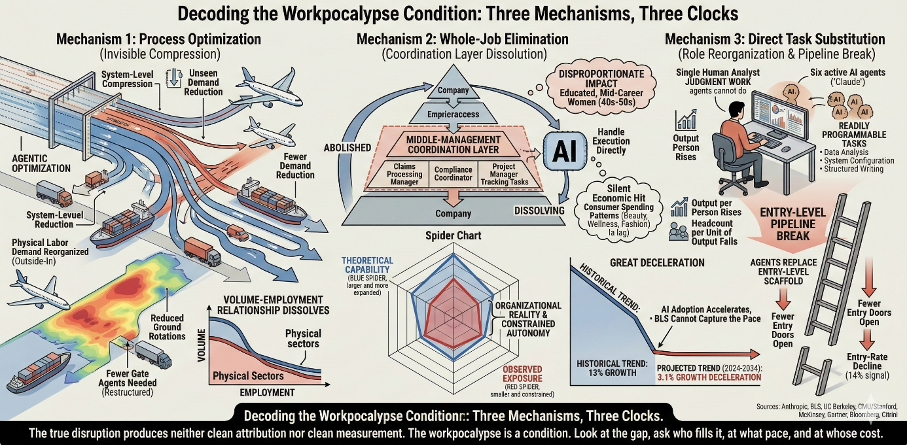
Observed exposure captures one mechanism by which AI disrupts employment. I would argue the inference economy operates through at least three. The other two are architecturally invisible to the kind of task-level analysis Anthropic has conducted, and they operate on very different timescales. The Three Mechanisms are:
process optimization
middle-man compression
task substitution.
Without distinguishing between them, it is nearly impossible to make sense of the increasingly dramatic corporate claims about AI-driven restructuring, or to distinguish genuine transformation from what one financial analyst recently called “organizational bloat wearing an AI costume.”
Klarna offers an unusually transparent window into all three.
The Swedish buy-now-pay-later company reduced its headcount from 4,352 employees in 2023 to 2,831 by the end of last year, a contraction its chief executive, Sebastian Siemiatkowski, has explicitly attributed to AI. When he disclosed in early 2025 that the company’s chatbot was performing the work of 700 full-time customer service agents, the figure entered the cultural record as a landmark data point in the AI displacement debate and received global attention.
However, Klarna’s AI journey, on closer examination, crosses all three mechanisms to some extent:
The first mechanism is process optimization. It is slow, invisible, and already running. Agents do not need to perform a job to reduce the number of people employed in it. They need only optimize the system within which that work occurs, thereby compressing how often tasks must be performed.
If we broaden the lens from there, consider airline operations: the challenge of matching aircraft to routes across crew schedules, fuel loads, maintenance windows, and disruption management has historically required systematic overcapacity. Agentic optimization compresses that overhead, not by replacing pilots, but by reducing the number of rotations and ground-handling events needed.
McKinsey reports that AI-driven logistics optimization, an early application area for agentic systems, can reduce logistics costs by more than 20 percent, bringing them to roughly four-fifths of their previous level. The U.S. Bureau of Labor Statistics projects that employment in transportation and warehousing will grow by 3% through 2034. That projection was calibrated before agentic optimisation reached full deployment. The assumed relationship between volume and headcount may not hold.
At Klarna, this mechanism is visible in its 2025 annual report’s description of AI managing global compliance, banking operations, and fraud screening “more centrally and consistently.” That is not replacing a single worker at a desk. It is redesigning the underlying systems so that fewer exceptions, handoffs, and duplicative processes require human labor at all, reducing the frequency with which certain tasks need to occur rather than automating them one-for-one.
Blue-collar workers appear at the bottom of every AI vulnerability ranking, yet this mechanism is silently reorganizing the structural demand for their work from outside the job itself. It registers almost nowhere in task-level data.
The second mechanism is middleman compression . It moves faster and operates at the organizational level rather than the task level as agentic AI and orchestration layers are implemented.
Modern organizations contain a large coordination layer. Roles such as compliance coordinator, document review supervisor, claims processing manager, and project manager, whose value resided in tracking tasks across spreadsheets, exist because intelligence-heavy work has historically not flowed autonomously. Someone had to oversee the transitions. Someone had to manage the friction of human execution. When the work below this layer migrates to agents, there is no augmented version of these roles waiting on the other side. The analyst survives because judgment remains. The compliance coordinator does not, because the work it coordinated no longer requires human coordination.
The role is not restructured. It is abolished.
The clearest evidence for this mechanism is not found in restructuring announcements but in the organizational architecture of new companies. AI coding platform Cursor reached approximately $500 million in annual recurring revenue with fewer than 50 employees. Lovable became Europe’s fastest-growing unicorn with 45 people. Dario Amodei, Anthropic’s chief executive, recently placed the odds of a one-person billion-dollar company at 70 to 80 per cent by 2026 !
The coordination architecture that employed millions was built to manage the friction of human execution. Remove the friction that once required multiple layers of human coordination with agentic AI coordination, and the architecture is no longer needed.
At Klarna, Siemiatkowski has said explicitly that the company can add products and scale without requesting additional headcount. The annual report describes “high operating leverage” from centralized product development and AI-driven efficiency, with revenue per employee rising sharply. Under this framework, Klarna is not simply helping existing workers do their jobs faster. It is thinning the organizational layer that historically coordinated growth through fewer vendor managers, fewer support supervisors, and fewer compliance-processing tiers.
This is where companies cross from “AI helps workers” to “the org chart no longer needs as many coordinators.” And on the current trajectory, Siemiatkowski projects headcount falling below 2,000 even as the company continues to grow.
The third mechanism is task substitution within a role. This is what the Anthropic paper measures and the mechanism most people picture when they think about AI and employment, which is part of why the public debate has remained so incomplete.
The logic: within a surviving role, AI replaces specific tasks while humans retain responsibility for judgment, oversight, and higher-order decision-making. One human, several agents. The analyst who spent three days building a model now has an agent build it in three hours and spends the remainder of the week on work that agents cannot do. Output per person rises. Headcount per unit of output falls. The role does not disappear. It upgrades, concentrates, and shrinks around what remains beyond automation.
Research from Carnegie Mellon and Stanford puts numbers on this: agents complete readily programmable tasks such as data analysis, system configuration, structured writing, and computational work up to 88% faster and at 90 to 96% lower cost.
This is where Klarna’s headline figure lives, and where the company overreached most visibly.
The chatbot was genuinely doing the measurable work of 700 agents. But Klarna had automated the programmable layer without measuring the outcomes that depend on the judgment layer: customer satisfaction rates fell. The system was fast but generic, incapable of the nuanced problem-solving customers needed when something went wrong.
Siemiatkowski acknowledged the misstep and brought in remote human agents for edge cases. “From a brand perspective,” he told Bloomberg, “I just think it is so critical that you are clear to your customer that there will always be a human if you want.”
This is not evidence that AI cannot perform customer service. It is a demonstration of Mechanism Three deployed without respecting the boundary between programmable tasks and judgment tasks. Klarna had misclassified too much work as programmable, removing the human layer that protects trust, exception handling, and tacit knowledge. The company’s own annual report flags the residual risk: “generative AI can produce inaccurate, biased, or misleading outputs and could create operational, reputational, legal, and regulatory harm.”
The lesson is not that automation fails. It is that the task-level classification problem is harder and more consequential than it looks.
The balance between middleman compression and task substitution depends, at least for now, on how much of a given role is genuinely programmable.
Where the non-programmable remainder is substantial, for instance, in areas like strategic judgment, relationship management, and creative direction, then task substitution amplifies the value of the human worker. Where it is thin, the logic shifts toward elimination.
In every sector, the threshold exists. The practical question for any organization is where it falls.
Klarna vs Block: Real Restructuring or AI Narrative?
Before the framework can be applied usefully, there is a prior problem: separating genuine transformation from corporate theater.
Block CEO Jack Dorsey last week announced 4,000 job cuts, nearly half the company, framing the decision as proactive realignment ahead of AI-driven structural change. The contrast with Klarna is instructive. Block had grown from 4,000 to 13,000 employees during the pandemic hiring surge and had already undergone multiple rounds of restructuring before Dorsey’s announcement.
It clearly had a bloated structure, and the announcement of the cuts was not accompanied by any new AI strategic roadmaps. And yet Block’s stock rose 24 per cent on the news.
In contrast, Klarna's headcount reduction has come almost entirely through attrition, according to the company. It implemented the new AI-first strategy first, then rebuilt its hiring headcount practices around it based on productivity results. (Again, noting that it was not 100% flawless). Despite the more substantiated AI narrative, Klarna has fallen sharply since its IPO.
The market signal is uncomfortable. Investors are struggling to distinguish between companies covering up strategic mismanagement with a technology narrative and companies genuinely repositioning to capture value. The incentive structure around that confusion is powerful: the CEO who wants a technology narrative for a cost-cutting move; the investor who rewards AI-attributed efficiency with multiple expansions.
Gartner found that most 2025 layoffs were unrelated to AI, and that a significant fraction of those attributed to AI involved companies cutting in anticipation of gains that had not yet materialized. The signal and the noise are travelling together. The Three Mechanisms offer a way to begin separating them.
But that is only possible if the analytical work is done before the announcement, not after.
Why BLS Jobs Data Misses AI’s Labor Impact?
The confusion at the company level has a structural counterpart in how we read macro data. We keep reaching for temporary explanations when the underlying picture may be telling us something more durable.
Last week’s jobs report was the latest example. The US economy shed 92,000 nonfarm payrolls in February, against consensus expectations of a gain of around 50,000. Healthcare lost 28,000 jobs, almost entirely due to a Kaiser Permanente strike in California and Hawaii, which sidelined more than 30,000 workers during the survey week.
Strip out the strike, and the picture was, in one analyst’s words, “still a poor jobs number.” The information sector shed 11,000 jobs. Transportation and warehousing shed another 11,000. Neither has anything to do with a healthcare strike in California.
One month’s data is one month’s data. But the pattern now has a framework.
The US Bureau of Labor Statistics projects employment to grow 3.1% through 2034. The prior decade recorded 13 per cent growth. That deceleration is happening at the precise moment AI adoption is accelerating, a coincidence that the BLS’s own technical notes acknowledge may be struggling to capture.
Within the aggregate, the distributional picture is sharp. Healthcare grows by 8.4%, driven largely by demographics, independent of AI. Computer and mathematical occupations are projected to grow by 10.1%, driven by demand for engineers building AI infrastructure. Meanwhile, claims adjusters are projected to fall by 5.15%, medical transcriptionists by 4.9%, and office and administrative support is declining broadly.
These are the visible mechanisms already apparent in the data enough to be included in official projections. What is missing are mechanisms one and two.
The transport and warehousing growth projection does not model per-unit labor demand compression. The coordination-layer collapse will register only slowly, distributed across thousands of middle-management titles. The genuine deceleration in labor demand may already be steeper than the headline figure of 3.1% suggests, and more concentrated among mid-career, mid-income workers than the headline implies.
There is also a structural consequence that deserves separate emphasis. Programmable tasks are, in most professions, the entry-level work.
They are the scaffold of professional formation, the accumulated experience that produces the senior professional’s judgment over time. Agents are not replacing senior professionals. They are removing the rungs from the ladder. The 14% decline in entry-rate hiring among workers aged 22 to 25 in high-exposure occupations is the early signal of a cohort problem that will compound for a decade: workers five years behind on experience accumulation, qualifying for fewer of the roles that remain.
The Three Mechanisms also operate on different timescales. Task substitution within roles is happening now, in programming, customer service, and financial analysis, with the entry-level pipeline already thinning. Middleman compression follows with a lag of 12 to 24 months, as organizations first automate the underlying work and then restructure the management overhead above it. Process optimisation is already in operation in logistics and supply chains, but it appears almost nowhere in current data.
Between 2027 and 2029, the compression of the coordination layer should accelerate. Wage polarization should widen. Aggregate unemployment may remain broadly stable while the composition of work shifts meaningfully. From 2029 forward, as partially programmable work disaggregates further, the judgment layer concentrates. The entry-ladder problem compounds.
This is not a collapse. It is a condition.
What the Three Mechanisms Mean for Investors
The workpocalypse, the fear of sudden, sweeping AI-driven job destruction, is a misconception. Not because AI poses no threat to employment, but because it misidentifies both the mechanism and the timeline.
The more accurate picture is considerably more complex. White-collar knowledge work is being reorganized around the inference layer, faster and more fundamentally than the aggregate data shows.
But blue-collar work is not exempt. It faces structural demand compression from process optimisation that is invisible to task-level analysis and absent from official projections. The impact is not confined to any one category of work, skill level, or demographic. It is operating across the entire economy through mechanisms that work at different speeds and that current analytical frameworks are not yet equipped to measure simultaneously.
The question for organizations is not whether they will be affected, but through which mechanism and at what point. The executive announcing AI-driven headcount reductions may be deploying task substitution with genuine rigor, or using it as a technology narrative to support decisions made on other grounds entirely. The investor rewarding the announcement may be capturing real structural efficiency or buying a story. Without a framework to distinguish between them, the market will continue to misprice both leaders and laggards.
The Anthropic study is a genuine methodological contribution, the most careful attempt yet to measure what AI is actually doing rather than what it could theoretically do. But it was designed to answer one question: which tasks within which roles are being replaced by AI today? The other two questions — how process optimization compresses labor demand at the system level, and how middleman compression reshapes organizational hierarchies — remain largely unanswered.
What the blue and red spider charts represent is not merely a forecasting gap. It is the space in which the economy is reorganizing itself: between the tasks that AI can theoretically perform and the organizational, legal, and relational constraints that determine whether it actually does.
Understanding who occupies that space, how quickly it closes, and which firms are genuinely restructuring around it rather than narrating around it is the real analytical task of the inference economy.
The jobs data will eventually catch up. By then, the structural shift will already be substantially complete.
AI’s main effect on work is not task automation.
It is organizational compression.
When agents handle coordination and execution simultaneously, the management layers built to manage human handoffs become structurally unnecessary.