


TL;DR: The run rate is four things multiplied together: how much AI work there is, how much of it needs a frontier model, what the frontier charges, and who captures the dollar. All four are moving at once, and not in the same direction.
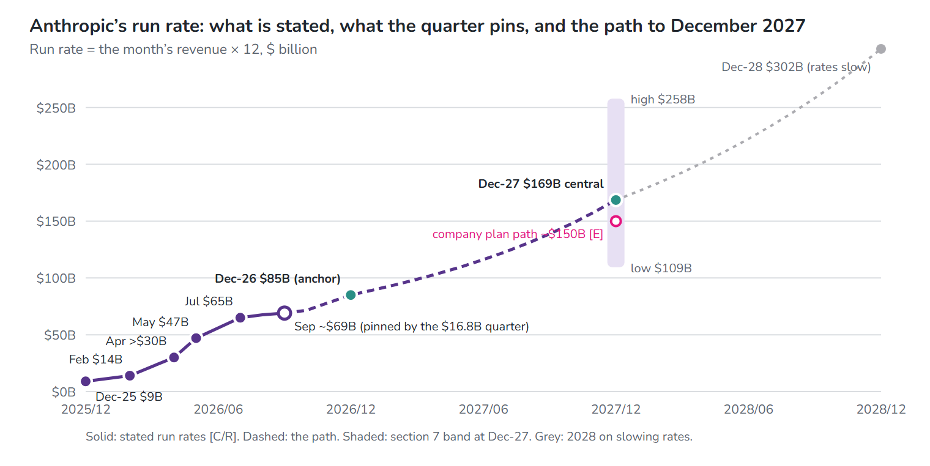
Central estimate: $85 billion of run rate at December 2026 and $160 to 180 billion at December 2027, with about $123 billion of revenue in calendar 2027. The cases I would defend run from $136 billion, if the software around the model ends up owned by independent agent companies such as Cursor and Cognition rather than by Anthropic, so that it sells them raw tokens and loses the premium its own products earn, to $196 billion, if the agents keep refilling the frontier.
The work behind it nearly quadruples in 2027, because agents now run for hours without a person at the keyboard, and enterprise budgets slow that rather than stop it. The run rate only doubles, because most new work lands below the frontier and the price of a token falls by almost half.
Anthropic's own agent products keep the top of the ladder full. On my path, they approach half of metered revenue by the end of 2027, and the fight for that layer is worth a fifth of the estimate.
At $2 trillion, Anthropic trades at 11 to 12.5 times the December 2027 run rate and about 16 times 2027 revenue, on a gross basis.
The prospectus and the fourth-quarter figures are the first two tests.
The Wall Street Journal reported on October 20 that Anthropic generated $16.3 billion of revenue in the first half of 2026, up from $1.1 billion a year earlier, and that the draft prospectus it reviewed describes more than $600 billion of future infrastructure commitments, with a further $150 billion of computing deals under negotiation.
The third quarter alone, reported to investors a week earlier, brought in more revenue than that first half.
It is tempting to read those two figures as proof the boom is unstoppable, or that the labs have overbuilt. They prove neither. Revenue says how much customers are spending. It does not say what work they are buying, whether that work needs a frontier model, how long the spending will last, or which company keeps the economics.
The prospectus doesn't answer those questions. A filing shows 2025 and the first half of 2026, perhaps the third quarter, and it carries no forecast. At the $2 trillion under discussion, which is 17 to 20 times the $100 to 120 billion run rate investors were reported in August to expect for this December, a buyer of the listing is paying for growth well beyond the filing, and the first number that growth has to deliver is the revenue pace at the end of 2027.
The computing has been financed against the same years. Amazon and Google, the chipmakers that supply them, and the data-center builders beneath them are spending through 2026 and 2027 to be paid from 2027 and 2028 revenue, and the builders’ lenders have underwritten the difference. On October 8, a $20 billion gap between two figures for OpenAI’s run rate, on two accounting bases, moved Nvidia, Oracle and CoreWeave in a day.
The largest fixed-cost build I know of is priced off two private top lines, and the figures in circulation for them at December 2027 run from the companies’ own forecasts to north of $600 billion.
I wanted to publish a method for choosing among those figures. Every revenue and growth forecast I know of for this company, including its own, has been surpassed, and the market has responded by compounding the latest base. That is the exercise this essay replaces.
Part I of this series argued that neither lab has recurring revenue: the run rate is rent, re-won monthly. Part II asks how much rent there will be at the end of 2027, and builds the answer from four observable things: how much AI work there is, how much of it needs a frontier model, what the frontier charges, and who captures the dollar.
Anthropic’s $169 Billion Forecast: What Is the Model Assuming?
My central estimate is a run rate of $160 to 180 billion by December 2027, with about $123 billion in revenue for calendar 2027.
The range is narrow on purpose. It is what the path gives when any one of its nearby assumptions is moved modestly: the December 2026 starting point between $80 and $90 billion, the growth of work inside the agent products or through the API a little faster or slower than the path assumes, the ladder’s prices falling by a fifth or by a third at the top with the lower tiers moved in step.
The path’s central case, $169 billion, sits in the middle. Outside the range sit two cases I would still defend: $136 billion if the independent agent companies, Cursor, Cognition’s Devin and GitHub Copilot among them, become the harness through which enterprises run their AI work, so that Anthropic sells them raw tokens through the API and the premium its own agent products earn is competed away, and $196 billion if the agents keep refilling the frontier at a pace one notch above my central case, which is still well below the pace of the first half of this year.
The company’s internal forecast, $190 to $200 billion in revenue in 2028, as Reuters reported from people familiar with it, implies a December 2027 run rate of roughly $140 to 160 billion, depending on the shape of that year, so my range sits above the company’s forecast. These are my estimates, not company guidance.
A year ago, the company’s own optimistic case for 2028 was $70 billion in revenue, as The Information reported. That is roughly the run rate reported for July.
The market drew the obvious lesson and is now compounding from the latest base. The third quarter was the first in which that method gave the wrong answer. Revenue of $16.8 billion in the quarter exceeded the $16.3 billion for the whole first half and was up 45 percent from the second quarter. Yet the September exit run rate, on my arithmetic, was about $69 billion, only modestly above July’s $65 billion.
The quarter grew because the second quarter averaged $3.9 billion a month and the third began at $5.4 billion. Inside the quarter, the pace rose about 6 percent in two months. Part of that was the company’s own choice: according to the Financial Times’s account of the meeting, it cut distillation revenue by 5 to 7 percent during the quarter. The fourth quarter will answer whether the rest was capacity or demand.
That is also why my December figure, $85 billion, sits below the $100 to $120 billion investors expected in August: that expectation extrapolated the first half, and the third quarter didn't continue it.
So rather than compound, I take the run rate apart.
Each month a lab sells a volume of tokens across three tiers of model at three very different prices, through its own agent products and through its API, and some of the price reaches it as a premium for the software around the model.
Four drivers set the result, and each is observable.
Driver 1 — AI Work: How Much Can Anthropic Serve?
The first driver is work volume, and on its own it would more than double Anthropic’s run rate in 2027.
On my path, the tokens Anthropic sells grow about 2.3 times in the year before the extra volume that price cuts buy, and nearly four times with it. At December 2026’s prices and model mix, the 2.3 times alone would add about $94 billion to the run rate, taking it from $85 billion to roughly $180 billion.
The three drivers that follow determine where the new work lands on the ladder, what it is charged, and who bills it, and they net that figure back to $169 billion at its midpoint. So the first question is whether the work really grows that fast, and the evidence runs in two directions.