
Beyond the Power Crunch: Why Meta's Nuclear Gambit Risks Stranded Assets in the AI Race
Examining the real bottlenecks in AI scaling and the perils of pre-financing unproven energy startups amid rapid efficiency gains.

TLDR - AI’s surging energy demands are straining grids, prompting Meta to secure 6.6 GW of nuclear power through deals with startups like Oklo and TerraPower by the mid-2030s. While the power bottleneck is undeniable, extrapolating current inefficiencies potentially ignores accelerating innovations in training (e.g., DeepSeek’s mHC) and inference efficiency, shifting workloads to edge devices. Pre-committing to SMRs with long timelines creates stranded asset risks for Meta if AI architectures evolve or demand decouples from centralized power.
Investors are wary of escalating AI CapEx financed by debt; these deals could be the tipping point, extending circular financing into energy. Other alternatives, such as vertically integrated hybrid power, offer flexibility without locking into decade-long bets on unproven tech.
While access to compute and data were the constraints of the first three years of the GPT era, electricity supply has now emerged as a critical limiting factor.
AI demand for energy is straining grids and pushing up prices, which in turn is driving conflict with local communities and politicians over the building of new data centers. The lack of market supply has raised fears that unavailability will slow progress and risks causing the United States to lose the AI race against China. In this context, securing enough energy over the next years has become mission-critical for top AI players as well as national governments. The alignment of those interests has resulted in the rebirth of the nuclear industry in the U.S., which just a few years ago was committed to shuttering existing nuclear power plants.
Last week delivered another stark indicator of how apprehension over power constraints is growing: Meta announced a flurry of pre-commitments to energy providers, including Oklo, the nuclear startup backed by OpenAI CEO Sam Altman, alongside deals with TerraPower, Vistra, and Constellation. Together, these deals will give Meta access to up to 6.6 GW of nuclear capacity by the mid-2030s.
These deals are a sign of the larger discontinuity caused by generative and agentic AI, one that is dismantling the established economics of the tech industry. One aspect of that, which I have discussed previously, is that the strategic economic roadmap for the American AI industry to scale its ambitions is intersecting strongly with physical constraints such as land, power, water, and government. These are forces that traditional tech players have not had to bend to their will to succeed for most of the digital age, and they are ones that introduce complex new financial and strategic variables for which these companies have no real experience or historic benchmarks to serve as comparisons.
In this case, I agree with Meta’s diagnosis that power is indeed a bottleneck. However, I disagree with the prescription for two reasons.
First, AI-related power demand may not linearly follow AI data center build-out, both for training and for inference. Second, pre-commitments to small modular reactor (SMR) startups are risky. Not only are SMRs businesses with unproven durable growth moats, but there is a timing mismatch that creates a potential “stranded assets” scenario for Meta.
The company could find itself in a vulnerable position if the use cases for generative and agentic AI evolve in scenarios where inference migrates to the edge, new architectures slash training costs, or competitors achieve breakthroughs that make Meta’s approach obsolete. The result could leave Meta paying for power it does not need. This is the definition of a stranded asset.
With the surge in AI CapEx now increasingly financed through debt already testing investor patience, these nuclear pre-commitments may prove to be, as we would say in French, la goutte d’eau qui fait déborder le vase, or more simply, the straw that breaks the camel’s back.
Still, call it what you want. A tipping point. Going over the edge. Such deals represent a dangerous escalation in the high-risk financing to win the AI arms race. As companies adopt a win-at-any-cost mindset, they might leave themselves little room to maneuver in the years to come if their projections for growth do not unfold as they believe, notably as a result of external architectural shifts.
The power bottleneck is real
Data centers devour power
AI isn’t magic. It is electricity turned into probability distributions.
Generative models require billions of matrix multiplications, and each operation consumes energy. Meta’s own projections illustrate the scale. The company’s stated goal of achieving artificial general intelligence requires unprecedented compute. Mark Zuckerberg said in a mid-2024 interview that “power will be one of the biggest factors that will constrain artificial intelligence.”
He was not exaggerating.
Meta lists 30 data centers currently on its website. Almost 20 years after its founding, that may be a mere down payment on its future computing needs.
Among the company’s announced projects, the Prometheus cluster in Ohio is part of the company’s ambitious plan to build supercomputing hubs across the United States. The project will draw 1 GW when it comes online in 2026. Meta’s planned Hyperion complex in Louisiana could need 5 GW by 2028.
These figures dwarf the consumption of many industrial plants and would place a single data-center complex among the top consumers of electricity in some states.
Of course, Meta is not alone. All hyperscalers and AI labs face this constraint.
Access to the grid is a constraint, and valuations prove it
Utilities are already stretched. Requests for new data-center connections have overwhelmed transmission planners.
Citing data from the Large Flexible Load Task Force (LFLTF), a non-voting body that reports directly to the Electric Reliability Council of Texas, Semianalysis noted: “In Texas alone, tens of gigawatts of datacenter load requests pour in each month. Yet in the past 12 months, barely more than a gigawatt has been approved. The grid is sold out.”
Permitting delays, transformer bottlenecks, and transmission line construction mean power is a hard constraint today.
The market has responded as companies solving the bottleneck have seen valuations soar. Vistra and Constellation Energy, operating nuclear and gas plants, have become top S&P 500 performers since the AI boom began.
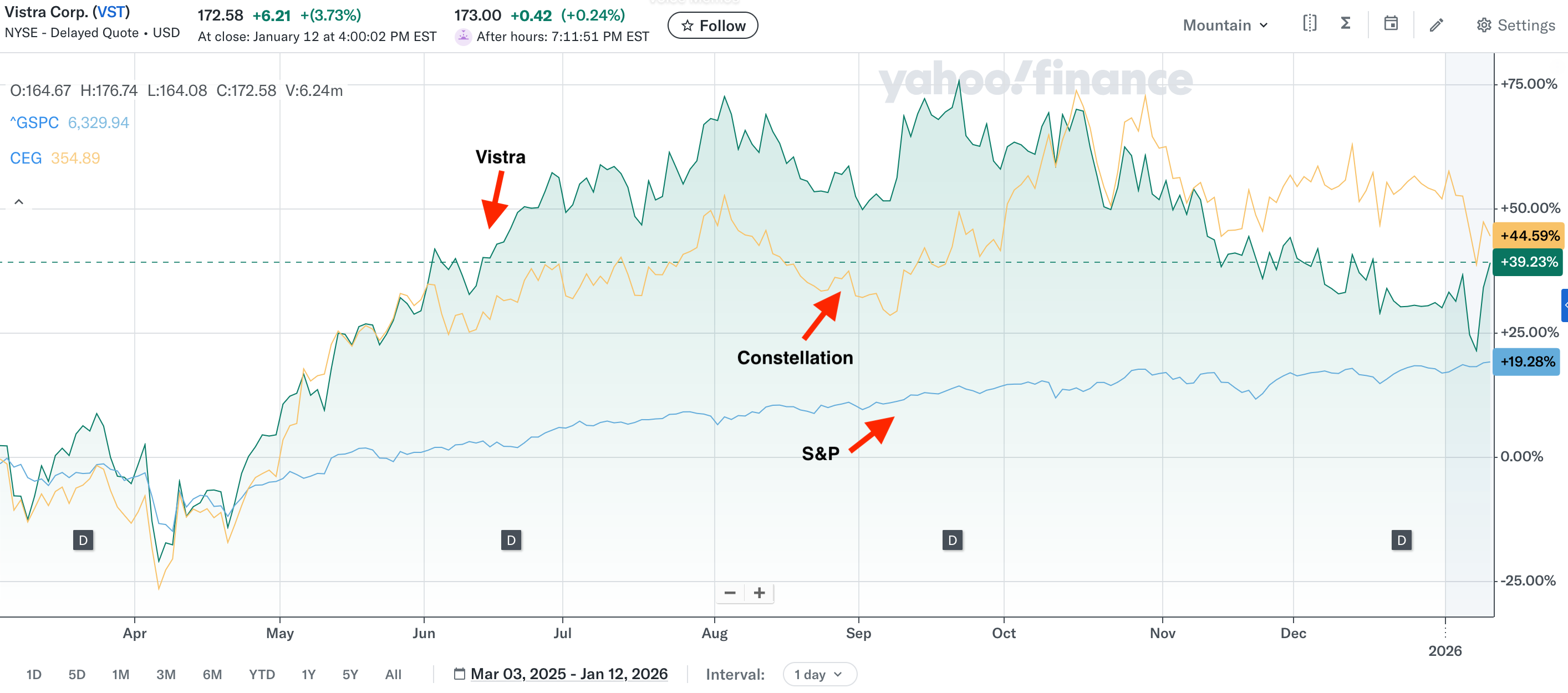
Figure 1. Evolution of VST and CEG share prices (source: Yahoo Finance)
Even utilities with spare transmission capacity have seen multiples expand as investors price in scarcity.
Stop-gap solutions prove the constraint is real. Companies deploy gas turbines and diesel generators as backup and primary power. In Texas and Oklahoma, xAI and OpenAI installed on-site generation to circumvent transmission bottlenecks. GE Vernova’s turbines can be shipped and installed quickly. Orders have grown triple digits, and generator revenue could add $1.5 billion to Cummins’ earnings as data centers stock up.
Providers of turbines, transformers, and generators are enjoying a windfall. The bottleneck is real and immediate.
Nuclear as a response to scarcity
Faced with these constraints, Meta has gone nuclear. Last week, the company announced deals that lock in a patchwork of baseload power:
TerraPower: Meta will finance two Natrium small modular reactors (SMRs) delivering 690 MW by 2032, with options for up to 2.1 GW by 2035. TerraPower’s design uses a sodium-cooled fast reactor paired with molten-salt thermal storage.
Vistra: Over 2.1 GW of power will come from Vistra’s existing Perry and Davis-Besse plants in Ohio and expansions at Beaver Valley. These units supply immediate baseload capacity for Prometheus.
Oklo: The start-up backed by Sam Altman will build a 1.2-GW nuclear campus in Pike County, Ohio, using micro-reactor designs that promise modularity.
Constellation: A 20-year power-purchase agreement with Constellation secures output from the Clinton Clean Energy Center in Illinois.
Collectively, these contracts exceed the total electricity consumption of several states. Meta is in a race to secure firm, low-carbon power in a highly competitive market. Other hyperscalers are pursuing their own versions of this strategy. Microsoft has sought to restart the Three Mile Island plant, and Amazon has expressed interest in SMRs.
This is occurring in the context of a favorable political environment. Nuclear energy has become a priority for the Trump administration, which sees it as essential to maintaining U.S. competitiveness in AI.
Beyond securing baseload power, these agreements enable Meta to acquire clean energy attributes - such as those from Constellation’s Clinton plant - allowing the company to credit the nuclear output toward its sustainability targets, including 100% clean energy matching and net-zero emissions by 2030.
The global nuclear pivot underscores that the bottleneck is real and immediate. It does not mean, however, that the problem is solved. Or that these solutions are prudent.
Extrapolation is fragile: Efficiency is accelerating
The common narrative assumes that because AI demand grows exponentially, power consumption must also rise exponentially. That view extrapolates today’s inefficiencies into the future.
However, innovations in both training and inference efficiency are rewriting the energy calculus and come in addition to broader questions around the transformer paradigm itself.
Training efficiency: mHC and the DeepSeek revolution
Last week, in my IPO analysis of MiniMax, I revealed how the company had divided by six its training compute costs as a percentage of sales with its Lightning Attention mechanism. I also characterized this as a “patching mechanism,” given the company had not fully solved the underlying instability issues. But the analysis highlighted something more profound: algorithmic innovation is beginning to substitute for brute hardware.
DeepSeek, which rocked our world in January 2025, is about to rock it again.
The company recently introduced manifold-constrained hyper-connections (mHC), a structural modification to transformer networks that will be at the heart of its upcoming February release. Unlike earlier hyper-connection schemes, mHC projects gradients onto a mathematical manifold, stabilizing training without exploding memory. Tests on 3-, 9-, and 27-billion-parameter models showed improved performance with only 6.27% hardware overhead. This means wider models can be trained on the same hardware footprint, slashing energy per parameter.
My analysis comparing mHC to MiniMax’s Lightning Attention concluded that mHC offers a more elegant fix to instability and delivers a 6-8x cost advantage versus models like Anthropic’s Claude when adjusting for output token inflation. DeepSeek’s V3 training run consumed 2.79 million GPU-hours and cost approximately $5.58 million. That’s far below the hundreds of millions spent on earlier frontier models. The cluster used just 2,048 H800 GPUs, demonstrating that algorithmic breakthroughs can dramatically reduce power requirements.
These innovations are part of a broader trend. Mixture-of-experts (MoE) architectures activate only a small fraction of parameters for each token. This approach is at the core of Thinking Machine Labs (“TML”), a U.S. startup that has received abundant funding prior to any product release. By focusing on understandable, collaborative AI systems that activate sparse parameters, TML aims to reduce energy demands during both training and inference, potentially cutting costs by factors of 4-6x compared to dense models.
The AI scaling law is being bent as innovation enables more capability per unit of energy.
Inference efficiency and the Intelligence Economy
When it comes to stories about building gargantuan new data centers, the need for training models grabs headlines. However, inference, the use of compute in the day-to-day production environments, rather than for training large models, has become the dominant workload. While statistics vary on the exact quantum, inference is likely 70%-80% of AI workloads. For a deeper dive into the technical and economic distinctions between training and inference, see Parts I and II of my “Two Tales of Compute” series that I released recently.
At CES in Las Vegas last week, inference was front and center of the conversation. Lenovo’s chief technology officer predicted that 80% of AI compute will be inference and only 20% training.
These tokens (the units of data processed by AI models) reflect how AI systems have integrated into the economy across multiple use cases. Coding, of course, has emerged as the major use case, but also customer service, content generation, and countless other applications. This is what I have dubbed the “inference economy” that eventually autonomous agentic AI systems will capture value directly from the $60 trillion global labor market. In that scenario, the token costs cover the workload formerly performed by humans at a fraction of the cost. Even now, the inference economy is also changing the scaling laws in its own way.
That’s because the energy cost of inference is collapsing. The Intelligence Per Watt (IPW) metric, introduced by researchers from Stanford and Meta in a November 2025 paper, measures task accuracy per unit of power. They showed that from 2023 to 2025, IPW improved 5.3×: local models running on consumer-grade hardware answered 88.7% of single-turn chat and reasoning queries correctly. Remarkably, local accelerators were only 1.4× less energy-efficient than cloud GPUs, and local query coverage. The percentage of queries that can be handled by edge devices increased from 23.2% to 71.3%.
This suggests that most user interactions do not require power-hungry cloud clusters. The process of AI inference is starting to migrate from data centers to edge devices such as PCs, smartphones, and other hardware closer to users. One force propelling this shift has been the development of small language models (SLMs). As Alexia Jolicoeur-Martineau, a senior researcher at the Samsung - SAIT AI Lab, has documented, SLMs can handle many tasks with a fraction of the energy. NVIDIA’s recent deal with Groq, focused on edge inference, exemplifies this trend.
Interestingly, one of the current limitations of this development is the reconfiguration of the hardware supply chain, given bottlenecks in memory production. AI data centers are securing memory chips rather than the PC market, but this is a transitional phenomenon. As supply chains adjust and local devices become more capable, the shift to edge inference will accelerate.
Efficiency gains are also possible through prompt caching, sparse activation, and model compression. This means each watt delivers more intelligence. Inference demand may still explode in absolute terms, but energy per query drops sharply.
Extrapolating today’s power use into the 2030s misses this fundamental decoupling.
The transformer question
There is also a deeper uncertainty: the actual viability of the transformer architecture going forward.
If a new compute paradigm emerges, it could completely change the scaling laws. That could be through improved state-space models, neuromorphic computing, or something yet unforeseen. Training runs that today require gigawatts might tomorrow require megawatts. The history of computing is littered with architectures that seemed indispensable until they were not.
So, we are left with a clear bottleneck now. Efficiency is ramping up over the next five years. Beyond that horizon, there is fundamental uncertainty about architectures.
This is where, in my mind, Meta’s thesis begins to collapse.
Towards a stranded asset scenario?
How long does nuclear take? The reality of nuclear AI startups
Nuclear power can be broken down into two categories:
Category 1: Reopening or continued operation of large legacy plants. Here, remember Vogtle, the Georgia plant I mentioned in my Fermi report. Vogtle took far longer than expected, and costs were vastly above budget. The Bessemer Trust notes that traditional reactors require 10–15 years for permitting and construction.
Category 2: SMRs. These are still fundamentally unproven. Oklo, for instance, remains a startup without commercial operations. The company has impressive backing. Sam Altman is chairman, and it raised capital via a SPAC merger. But it has yet to deliver a single operational reactor. Among the reasons are technical challenges, regulatory hurdles, and financing constraints. All of this cannot be compensated for by political will to move faster.
Even under optimistic scenarios, Oklo’s reactors will not be online until the early 2030s, and TerraPower’s Natrium units for Meta are scheduled for 2032, with full expansion to 2.1 GW by 2035. The Three Mile Island plant that Microsoft plans to restart will not be operational until 2028. These timelines stand in stark contrast to the pace of AI innovation. Transformer architectures are replaced in months, not decades. Hardware generations turn over every two to three years.
This will likely lead to significant delays. Hopefully, the SMR technology will be viable by 2035. But that is a long time in AI terms.
By then, training and inference efficiency may have fundamentally altered the energy demand landscape.
Meta’s balance sheet strength and the breaking point
Meanwhile, investors are already wary of the amount of CapEx linked to the AI build-out. A Bank of America survey in late 2025 showed that concerns about AI capital expenditures were at an all-time high among institutional investors.
Figure 2 – BofA Survey on capex (source: BofA)
IBM CEO Arvind Krishna warned that pursuing large-scale AI infrastructure could push capital expenditures into the $1.5 trillion range for a single company, noting that a 1-GW data center costs around $80 billion and that AI chips must be replaced every five years.
Compounding the stress is how this expansion is being financed: through increasing amounts of debt. Meta, like its peers, has been adding leverage to fund its AI ambitions.
And this is why I think the nuclear pre-commitments may be la goutte d’eau qui fait déborder le vase - the drop that makes the vase overflow.
If there are delays in reactor construction, or if demand for centralized, energy-intensive inference slows due to efficiency gains, Meta is the entity facing the greatest risk.
Not Constellation. Not Vistra. Not even Oklo.
Those companies have their own commercial and regulatory risks, but they are energy providers. If Meta’s demand evaporates or shifts, they can sell power elsewhere. The U.S. economy will continue to need electricity for electric vehicles, manufacturing, and electrification broadly.
Meta, however, faces a stranded asset risk on a scale that the energy providers do not. The company has locked in multi-decade contracts for gigawatts of power tied to specific use cases.
The case of Fermi illustrates the speculative dynamics at play.
The Texas-based real-estate investment trust with deep political connections to the Trump administration debuted on NASDAQ in October 2025. and raised $683 million to build nuclear capacity for data centers. Fermi saw its shares jump 19% on the first day, valuing it near $16 billion despite having no revenue, no customers, and no regulatory approvals.
In my S-1 teardown, I gave Fermi a 1.8/5 Durable Growth Moat™ score and warned that investors were conflating a real constraint with a sustainable business model. As I noted at the time: “ Rather than offering some technical breakthrough, Fermi offers a strategy for regulatory arbitrage that it believes will allow it to radically accelerate development and construction of nuclear power the broader AI industry needs to scale. The entire AI ecosystem badly needs this to be true.”
Reality began to bite almost immediately. First came word from the company that there was a delay in signing a formal agreement with the first tenant, who had signed a letter of intent pre-IPO, of its massive Project Matador Campus in Texas. Then in December, the company disclosed that the first tenant had ended its period of exclusivity and that Fermi was not seeking other candidates to be the first tenants.
Less than 4 months post-IPO, Fermi’s stock is down about 75%, and it’s facing a wave of investor class-action lawsuits.
Meta is not Fermi, of course. But the logic of pre-financing unproven nuclear startups on decade-long timelines, when the underlying demand curve may bend sharply due to efficiency improvements, raises similar questions.
I question the cost of this optionality more so than the cost of pursuing AGI, which is what we would expect from a company like Meta.
AI circularity extends to energy
The AI trade has been characterized by the emergence of circular financing architectures in AI that have become so concentrated and self-referential that they’ve transformed the AI boom from a technology story into a financial stability question. I explored this extensively in my recent analysis of OpenAI’s circular deals with Nvidia, AMD, and Oracle, where customers are suppliers, suppliers are investors, and investors are customers, with capital flowing in circles that make it nearly impossible to distinguish genuine demand from financial engineering.
Meta’s nuclear pre-commitments represent an extension of this circularity into the energy domain. The company is effectively pre-financing nuclear startups.
Oklo has no operational reactors. \TerraPower’s designs are unproven at commercial scale in order to power the AI models that will, theoretically, generate the revenues to justify the investment. If the models succeed and centralized, power-intensive demand remains robust through the 2030s, the circularity holds. If efficiency improvements reduce power needs, if inference migrates to edge devices, or if Meta’s AI ambitions stumble, the circle breaks, and Meta is left holding expensive contracts for baseload power it does not require.
This is vendor financing with decade-long equity kickers, creating cross-dependencies that obscure true economic value. The same logic that makes OpenAI’s circular architecture fragile—concentrated bets on unproven business models with long-duration commitments—applies here.
Just as Nvidia isn’t making a pure investment in OpenAI but securing a customer, Meta isn’t simply buying power but betting that its specific AI roadmap will justify gigawatts of nuclear capacity a decade hence.
The question is whether Meta is setting itself up as a winner in this circularity or positioning itself to hold stranded assets when the architecture evolves.
Conclusion
The power bottleneck is real. The alignment of the compute curve and the power curve is not.
I prefer companies pursuing vertically integrated strategies that provide immediate power and maintain flexibility. Bolt Data & Energy, backed by Eric Schmidt, controls 882,000 acres in West Texas with hybrid power generation. Iris Energy (IREN) and TeraWulf (WULF) own their land, energy sources, and data centers, achieving costs around $0.033 per kWh while building capacity in months. Critically, these companies can repurpose excess power if AI demand shifts. They are not locked into long-dated contracts with a single use case - though they already bear massive risks due to their business models.
Meta’s approach is the opposite: multi-gigawatt nuclear projects stretching to 2035, betting that centralized, power-intensive workloads will persist despite three compounding risks: training efficiency improvements, inference migration to the edge, and architectural shifts.
The AI trade was just regaining confidence after months of bubble concerns. Meta’s nuclear pre-commitments represent a reversion to brute force thinking that calls for throwing enough energy at the problem and assuming scaling laws will hold. Even worse, it comes just at precisely the moment when Chinese labs are demonstrating that algorithmic innovation can substitute for hardware.
The industry needs to develop a coherent view of how AI architecture will actually evolve. Distinguishing between solving today’s bottleneck and underwriting tomorrow’s stranded assets becomes a critical investment question.
The power bottleneck is real. The investment risk that comes with it does not have to be existential.


This is a very impressive report. I love the comment about financing being “self referential”. It captures the whole zeitgeist
Excellent mapping of the current discontinuity. However, the 'stranded asset' risk assumes that energy is merely an operational input for AI. From a GTS perspective, Meta’s 6.6 GW move isn't a gamble on current transformer architectures, but a strategic liquidation of the biological labor stack to underwrite the Energy Fortress.
Efficiency gains (DeepSeek, mHC) won't kill demand; they will only accelerate the decoupling of Capital Velocity (V) from human performance. Meta is not just buying power for tokens; they are securing the only collateral that survives the 2026 Realignment.