
The Hyperscaler Dispersion: Why the J-Curve Lands Differently for Google, Amazon, Microsoft and Meta
Q2 revealed the hyperscalers becoming the agentic economy's landlords and financiers - and value migrating to the ends of their stack.

TL;DR: Consensus expects aggregate hyperscaler free cash flow to decline through 2027, then roughly triple its 2024 peak by 2030. Q2 strengthened the case for the decline, but the rebound’s composition matters more than its size: cash flow generated from utility-like compute deserves a utility multiple, not a software one. Yet forecasts still assume all four companies recover proportionally. The earnings instead offered the first clear evidence of a structural separation. Hyperscalers are becoming the agentic economy’s landlords, financiers, and counterparties. As part of this metamorphosis, the value migrates toward the stack’s two ends: the silicon and power below, and the irreplaceable customer-facing context above. The models and the harness in the middle risk being commoditized or subsidized in the contest for those positions. The question is not how large the 2030 cash-flow bars become, but which are achievable, at what margins and from which defensible layers.
The four largest hyperscalers reported earnings within nine days of one another. All four beat revenue expectations and raised or extended capital-spending guidance. Together, their guidance now points to $720-745 billion of Capex in 2026, while Goldman Sachs argues that 2027 consensus remains too conservative against a base case approaching $1.1 trillion.
Yet the market delivered four different verdicts. Microsoft recorded the largest single-day addition of market value in stock-market history, nearly $450 billion, after a quarter whose optics were flattered by an accounting change extending the estimated useful life of its data centers from 15 to 25 years. The market punished Alphabet, which delivered the strongest operating earnings, by 7%. Amazon rose 15% despite reporting the first negative trailing free cash flow of its AI investment cycle. Meta fell 8% even as its advertising machine converted AI spending into auction yield more directly than any of its peers.
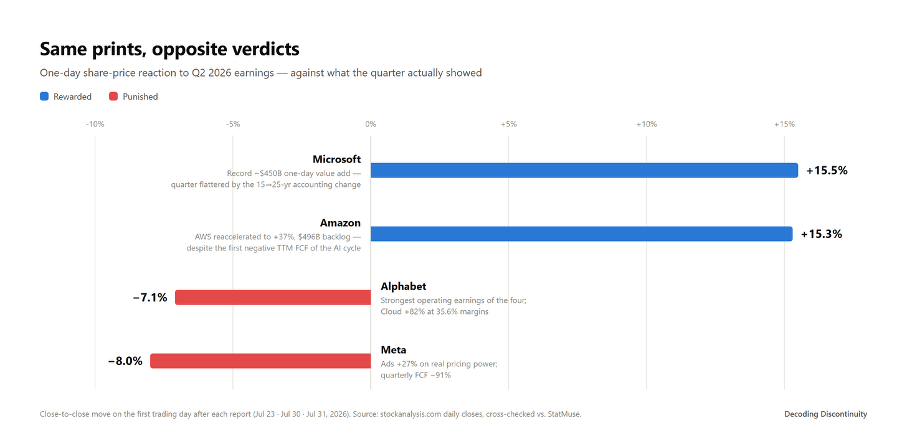
When it comes to the hyperscalers, the ROI question is usually framed too narrowly: how much AI revenue is appearing against the Capex, and how quickly will free cash flow recover? But a dollar invested in commodity compute, proprietary silicon, a frontier model, or an irreplaceable customer substrate does not produce the same margin, durability, or multiple.
The consensus free-cash-flow curve obscures that distinction. It shows combined free cash flow declining through 2027 and then roughly tripling its 2024 peak by 2030, with all four companies recovering broadly in proportion. But cash flow earned from infrastructure volume is not equivalent to cash flow generated by proprietary silicon, enterprise identity, or an irreplaceable commerce, search, or attention graph.
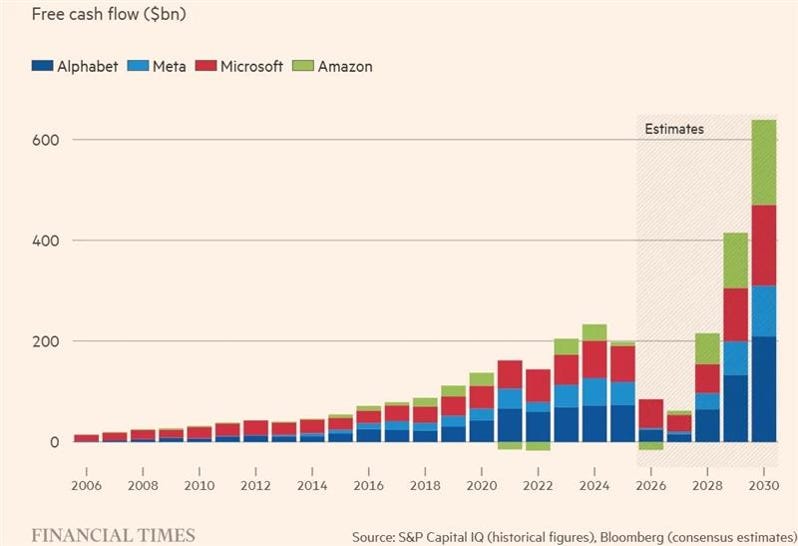
That the market has stopped pricing the Big Four as one trade is progress. In May, I argued in The Hyperscaler Reckoning that the commoditization of compute and the erosion of application interfaces would not affect the four companies equally because their Capex was not buying the same strategic positions. But look at how the symmetry broke: investors sorted primarily on near-term monetization - who could show the clearest revenue against the spending - rather than on who owns the layers that make those returns durable. By that logic, they punished the company with arguably one of the strongest structural positions and most rewarded a print whose reported economics were flattered by an accounting change. The sorting has begun, but on the wrong axis.
The right axis is structural: which layers the Capex strengthens, where scarcity persists and where competition drives margins down. Answering those questions requires looking through the consolidated companies and separating the different businesses contained inside them.
I apply here the Orchestration Economics framework that divides each hyperscaler into four layers:
Layer 0 is silicon: the chips and physical inputs, including Google’s TPU and Amazon’s Trainium.
Layer 1 is intelligence: the frontier models and the temporary capability premiums they command.
Layer 2 is the compute substrate and the harness: the infrastructure that serves the models and the orchestration runtime that turns them into working agents. These two functions currently sit together but may develop very different economics.
Layer 3 is the proprietary context in which intent originates and outcomes are executed: Search, Office, and enterprise identity; Amazon’s store and fulfillment network; and Meta’s attention graph.
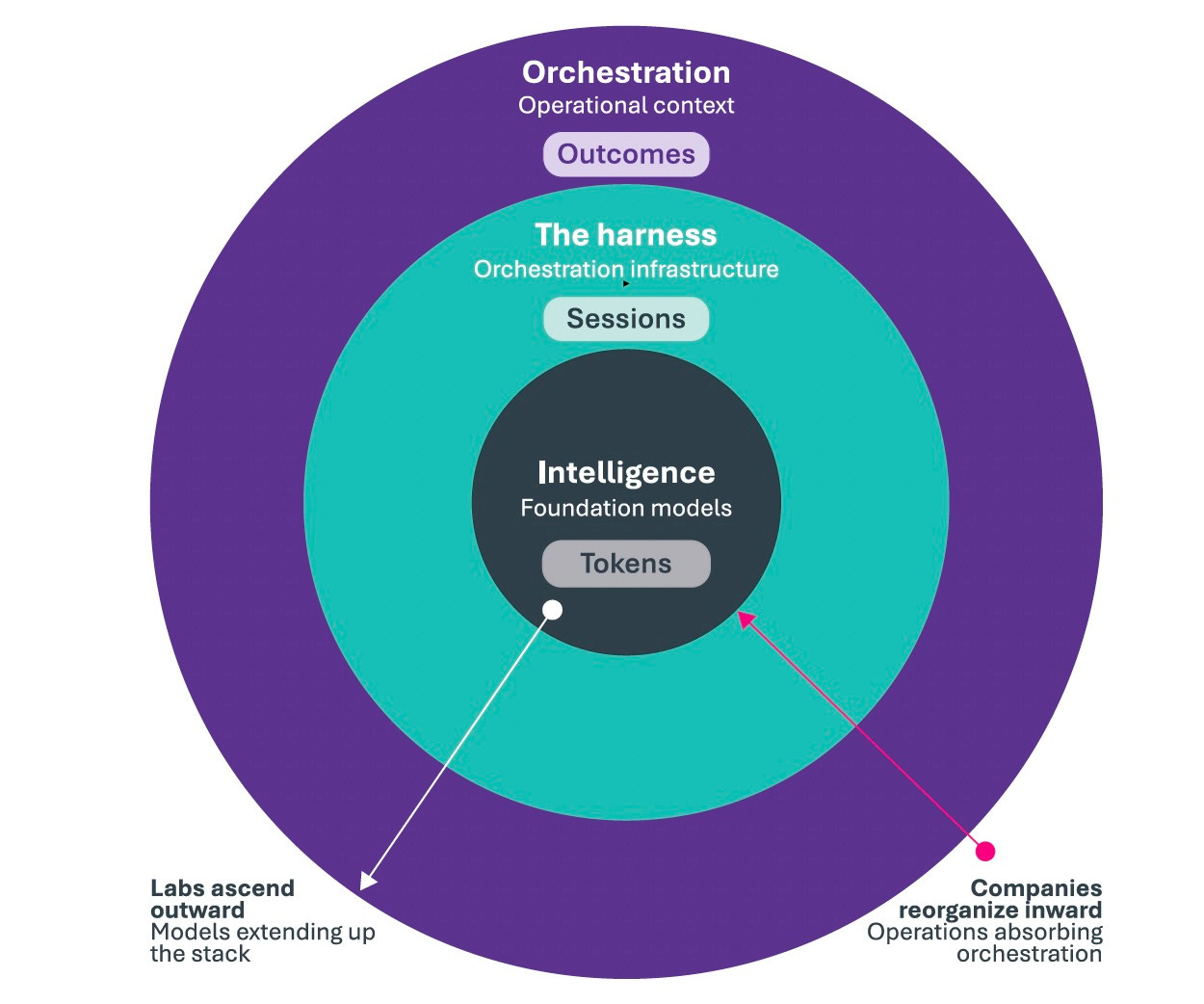
The question is therefore not whether the combined 2030 free-cash-flow bar is achievable. It is which company’s portion of that bar is real, at what margin and with what durability. Answering that requires taking the companies apart, layer by layer. I’ll begin with where the spending is landing and how it is being financed.
The buildout becomes infrastructure
The quarter confirmed a projection from the AGNT Manifesto: the buildout would consume most of the hyperscalers’ operating cash flow and push free cash flow toward zero and, for some, below it.
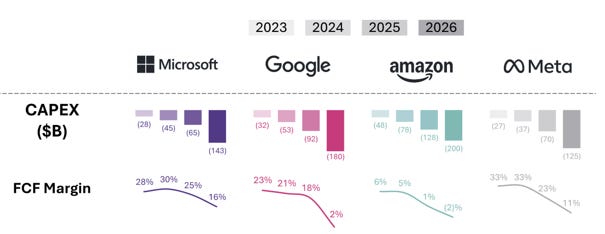
Amazon’s trailing 12-month free cash flow turned negative at minus $7.6 billion. Alphabet’s record $44.9 billion of Q2 Capex exceeded operating cash flow. Meta’s quarterly free cash flow fell 91%, with some sell-side models projecting negative cash flow through 2027. Microsoft remains the exception, generating $19.6 billion, although 23% less than a year earlier.
The more revealing change is not that free cash flow has fallen. It is that the buildout has begun to outgrow the cash generated by the businesses financing it.
Alphabet raised $84.75 billion of equity while suspending buybacks. Meta halted repurchases, issued $25 billion of bonds and discloses roughly $52 billion of maximum exposure and guarantees across its off-balance-sheet data-center vehicles, before its newest venture with BlackRock has even been quantified. Amazon’s long-term debt nearly doubled in six months. According to FactSet, debt now finances 32% of trailing Capex across the hyperscaler complex (a tally that includes Oracle), up from 9% in fiscal 2024. The companies are not running out of capital, but a buildout expected to finance itself through operating cash increasingly depends on equity, debt, private credit, leases and guarantees.
Spending continues to rise for two reasons: demand exceeds supply, and the inputs themselves are getting more expensive.
All four companies described themselves as supply constrained. Jassy said that even at $220 billion in Capex, Amazon would lack enough capacity to meet demand through 2027. AWS, Microsoft and Google Cloud together report nearly $1.7 trillion of commitments. Meanwhile, Amazon attributed its latest $20 billion increase in Capex guidance to memory costs. Memory scarcity raises both the prices hyperscalers collect and the capital required to create new supply.
Then there is accounting, which exposes the different clocks inside the buildout. Microsoft is extending the estimated useful life of certain data-center assets from 15 to 25 years, affecting depreciation and moving approximately $15 billion out of reported calendar-2026 Capex without changing the underlying capacity contracted. In the same week, Jassy cited a sub-three-year payback on servers Amazon depreciates over five years, installed inside shells that may operate for decades.
Those figures measure different things, but that is the point. The AI buildout contains chips that may become obsolete within years, servers expected to repay their cost before retirement, and buildings, power systems and leases that remain on the balance sheet for decades. It no longer resembles the financial architecture of an asset-light software business. It increasingly resembles telecommunications, power, and other capital-intensive infrastructure.
The strongest objection to this thesis is AWS itself. Cloud was called a commodity in 2012 and never became one. AWS sustained operating margins above 30% because applications accumulated data, dependencies and operating history that made moving expensive, risky and slow. Perhaps AI infrastructure is simply cloud again, one order of magnitude larger.
Jassy gave that defense its clearest form yet on Amazon’s Q2 earnings call. The physical shell is built once and hosts successive generations of improving equipment. Servers are ordered months rather than years ahead of demand, repay their cost in less than three years and serve capacity largely contracted on five-year terms. Demand visibility reduces the danger of empty data centers, while rapid payback limits the capital exposed to obsolescence. AI margins, he said, are tracking core cloud margins at the equivalent stage of development.
It is a serious argument. But it answers the risk of stranded capacity more convincingly than the risk of falling prices.
Model-serving workloads are more standardized and portable than the applications of the SaaS era. Models can be served across multiple clouds, and open-weight models can increasingly be deployed wherever the economics are most attractive.
The buyers are different, too. Traditional cloud sold to millions of enterprises, most with limited bargaining power. A disproportionate share of frontier AI demand comes from a small number of laboratories that negotiate at enormous scale and increasingly participate in the design of the silicon they consume. Anthropic buys capacity from all three major clouds. OpenAI ended Azure’s exclusivity. The suppliers financing the infrastructure are also financing its largest customers.
Most importantly, today’s scarcity rents are attracting the capital that can eventually eliminate them. Hyperscaler balance sheets, special-purpose vehicles and private-credit funds are financing new capacity beyond the incumbents’ historical rationing discipline. Jassy’s contracts can protect utilization. They cannot guarantee the price at which each new generation of equipment will be sold.
That is the distinction between the ROI question and the layer question. The first asks whether current contracts allow today’s servers to repay their cost. Amazon has made a persuasive case that they do. The second asks whether the pricing power behind those contracts survives once capacity expands, and workloads become more portable. The terminal multiple turns on the second.
The reported backlogs illustrate why the distinction matters. Microsoft has disclosed $678 billion of contracted commitments, AWS $496 billion, and Google Cloud $514 billion. These figures provide powerful evidence of demand and significantly reduce near-term utilization risk. But the agreements are economically layer-agnostic. The same committed dollar might ultimately purchase a commodity GPU hour, proprietary silicon, a managed model service or a higher-margin orchestration product. None of the three companies discloses enough of the mix to determine where the backlog’s eventual margins will reside.
Counterparty quality also matters. Amazon has committed a $20 billion facility to Anthropic tied to compute delivery, while roughly $4 of its $5.75 in headline quarterly EPS came from the appreciation of its Anthropic stake. The demand is real, but economically interdependent: Amazon finances a customer whose commitments support the backlog justifying its Capex, while the customer’s appreciation flows back through Amazon’s income statement. More to come on that next week.
Backlog proves the infrastructure will be used, but not which layer captures its value. For that, the analysis must move above compute to the models and harnesses sold through it.
The middle gets cheaper
Kimi K3 forces an honest scoring of Layer 1, the “intelligence” itself.
Released with full open weights, Moonshot AI’s model ranked fourth on the Artificial Analysis index and led several agent-relevant automation benchmarks. Its exact position will change; that is the finding. The frontier moved twice in one quarter: frontier margin is a moving window, not a seat any company permanently owns.
Anthropic and OpenAI currently hold that window. Google is the only hyperscaler consistently contesting it, aided by the integration economics of TPU and Gemini. But K3 compresses the economic space below the frontier: buyers can increasingly pay for genuinely scarce capability or begin from an improving open-weight baseline. For three of the four hyperscalers, Layer 1 is becoming less a race to win than a procurement problem.
That moves the contest to the harness.
Nadella stated the doctrine explicitly on Microsoft’s earnings call: “You got to keep your harness separate from the model…any model at any given time is swappable.” Within days of K3’s release, Microsoft was reportedly evaluating it for use inside Copilot - a switch that reports suggest could save it as much as $600 million a year in inference costs currently paid to OpenAI and Anthropic. If it substitutes a cheaper model without changing Copilot’s price, the spread initially accrues to Microsoft.
Here is where I revise my May position, based on the evidence that has emerged since.
The conclusion at the time was that the spread would widen mechanically as models became cheaper, causing margin to pool in the harness. That is plausible in the near term. But it is not a sufficient three-year thesis. A spread persists only if the layer capturing it possesses a barrier that competitors cannot reproduce, bypass, or subsidize away.
Generic harness functionality does not meet that test. Laboratories are training planning and tool use into models; open runtimes reproduce previously proprietary features; and Nvidia, MCP and free agent SDKs subsidize orchestration to strengthen adjacent businesses. Hyperscalers, labs and chip companies can all treat the harness as customer acquisition rather than a standalone profit pool.
The deeper problem is that the frontier itself absorbs the harness. Each model generation internalizes more of what orchestration used to do: planning, tool selection, memory management, multi-step execution. What required an elaborate scaffold around last year’s model ships inside next year’s. A layer the models are steadily absorbing cannot hold a moat - whatever the harness does well becomes a training target for the next release.
What the models cannot absorb is authority. Who authorized an agent, with what permissions, spending whose money, accountable to whom - these are property-rights questions, not intelligence questions, and they grow more acute as agents grow more capable, not less. Identity, permissioning, governance and verified outcomes sit within the enterprise’s control structure, outside the weights.
An orchestration layer that holds that authority - and the state that accumulates around it: persistent memory, evaluation history, learned operating policies, verified outcome data - stops behaving like a harness and begins behaving like a platform. In the language of this framework, it migrates economically from Layer 2 toward Layer 3. The product category has not changed. The source of its defensibility has.
Margin moves out of undifferentiated models as open-weight performance improves. It eventually moves out of generic compute as scarcity normalizes. Value can pass through the harness, but it stays only where orchestration holds authority, and the proprietary state and context that accumulate around it. That is precisely Microsoft’s play, aided by the rise of open-source models in the enterprise.
The ends start printing
If the middle faces margin compression, durable value should pool at the two ends of the stack - a barbell. Q2 supplied the first evidence that it is.
Let’s start below, at the silicon layer.
Google delivered TPU systems directly into customer data centers for the first time - recognizing its first, still-modest revenue from external TPU sales, with the bulk of contracted revenue expected from 2027 - while a merchant ecosystem formed around them: a Blackstone joint venture selling TPU compute, Anthropic expanding its commitment by a further 3.5 gigawatts and a reported $36 billion debt package financing its purchases. Layer 0 is developing its own customers and capital market.
Amazon’s custom silicon is appearing through contracts rather than direct sales. The associated chips business reached a $25 billion annualized run rate, while agreements with OpenAI and Anthropic tied performance obligations to the Trainium roadmap. Google and Amazon therefore possess an option Microsoft and Meta lack: their Capex can create an externally monetized silicon architecture rather than remaining solely an internal cost.
That option does not guarantee excess returns, but it means the same Capex dollar is buying different positions at the four companies.
The other end of the barbell is appearing at Layer 3.
In May, I argued that moats located beneath the interface could survive a change in operator, while moats whose value resided principally in the interface were more exposed. Amazon supplied the clearest evidence. Shoppers engaging with sponsored prompts inside its agentic shopping flow converted 48% more often and spent 21% more than shoppers who did not click one.
The result is early, but its direction matters: when an agent replaces the shopping interface, Amazon’s selection, fulfillment, payments and trust become inputs the agent needs. The interface changes while the substrate - and its monetization - survives.
Meta’s attention substrate produced a related result. Ad revenue rose 27%, while one million businesses a week reportedly transact through its agents. Zuckerberg described a model in which businesses “only pay us when we achieve results for them”, allowing Meta to auction compute as it auctions advertising. This is not a cloud proposition: it applies Meta’s audience, demand signals and optimization history to agentic outcomes rather than impressions.
Google is more ambiguous. Search revenue grew 17%, but management’s insistence that AI features still send “billions of clicks” to websites reveals the pressure point: the click remains central as the product moves toward answers and actions. Google’s defense is the index, commercial intent, advertiser demand and transaction rails beneath the interface - not the preservation of the interface itself.
Google is therefore building transaction rails alongside the interface that may eventually reduce the importance of the click. Its advantage is not necessarily that the traditional search experience survives unchanged. It is that the index, commercial intent, advertiser demand and payment relationships beneath Search can be reorganized around an agent-mediated transaction. Look at what is happening inside the search box itself: AI Mode now generates working mini-apps on the fly - dashboards, trackers, custom tools built from a natural-language prompt - and connects directly to third-party apps to complete tasks in place. The box that once returned links is learning to produce software and execute transactions, keeping intent origination, and its monetization, inside Google’s substrate even as the click fades.
Microsoft illustrates the more difficult side of the dividing line.
Microsoft 365 seat growth has slowed to 6%, with an increasing share of revenue growth coming from price. GitHub Copilot and Copilot Cowork, the products most directly exposed to autonomous software work, have both moved beyond pure per-seat pricing. GitHub Copilot revenue accelerated more than 60% quarter over quarter as usage-based elements expanded.
Nadella described the shift like this: “…we are also evolving our business model beyond per seat to per seat plus consumption.”
That sentence reflects the argument I made in May about the per-seat model’s inverse correlation with agentic success. Agents can produce additional work without adding human employees. As agentic systems become more capable, the amount of activity flowing through a product can rise while the number of seats remains flat - or even declines. A pricing model tied only to human headcount cannot fully capture the value generated by synthetic labor.
It is too early to call this a retreat from seat pricing. Rather, it seems more like a managed fallback, executed while seat optics still look strong. It is what a rational incumbent does when it believes the old model’s clock is running. Microsoft may be layering a new revenue model on top of an enduring subscription franchise rather than replacing it. But the direction is clear. The company is beginning to search for a unit of value better suited to a workforce whose productive capacity can expand without occupying another seat.
Four metamorphoses, four multiples
The hyperscalers entered this investment cycle grouped together as one AI trade. They are emerging with increasingly different anatomies.
Google holds the broadest collection of defensible positions. Cloud grew 82% at a 35.6% operating margin; Gemini keeps Google in the frontier race; direct TPU sales create a merchant-silicon option; and Search continues to compound even as its traditional interface comes under pressure. Google owns both ends of the barbell plus the frontier option. The market sold it down 7%.
Amazon combines proprietary silicon below, an agent-amplified commerce and fulfillment substrate above, and the current compute harvest between them. Its principal caveat is concentration: a substantial part of its backlog is anchored by laboratories that Amazon finances, supplies and marks through its own income statement. The demand is real, but more economically interdependent than the headline backlog suggests.
Microsoft is attempting the most unusual transformation. Agent 365 extends Entra’s identity system from human employees to synthetic ones: registration, permissions, metering and audit. Those functions govern authority and accountability - who permitted an agent to do what - and become more important as agents grow more autonomous.
Microsoft is trying to rebuild its application franchise one layer down. Agent 365 is an attempt to make Microsoft the system through which enterprises manage synthetic workers, as Office managed human ones. The test is whether agents built on other companies’ runtimes register into Entra. If they do, Microsoft controls a durable Layer 3 position. If not, it risks being left with an exposed work interface above and a contracted compute utility below.
Meta should not be judged as an aspiring external compute provider. Its infrastructure program is an internal investment in the attention and advertising substrate it already owns. AI is already improving targeting and pricing; the prospective step is extending the advertising model from selling access to attention toward charging for completed outcomes. The attention substrate is proven. Whether the resulting outcome market can justify the capital required remains an assertion.
The market’s ordering - Microsoft and Amazon rewarded, Google and Meta punished - therefore mixed structural judgment with quarterly optics. Amazon’s reward was directionally supported, and Meta’s punishment reflected a legitimate gap between current spending and future returns. But Google’s selloff discounted the company with the broadest layer positions, while Microsoft’s record gain priced in a control-plane outcome that has not yet been established.
The consensus free-cash-flow chart repeats the same analytical error at the other end of the forecast. The trough keeps moving as Capex estimates rise. The terminal bars assume something close to today’s scarcity margins survives the capacity arriving by 2029. And all four companies recover roughly in proportion.
The J-curve is not wrong so much as undifferentiated. If it lands, it will land at four different heights, at four different margins and deserving four different multiples. It is the dispersion within the curve that matters, not just the curve itself.
A hyperscaler is no longer one company with one cash flow. It is a portfolio of layer positions operating on different clocks: a compute harvest whose scarcity premium may expire, merchant-silicon options whose markets are forming, a frontier position that resets quarter by quarter, and Layer 3 substrates already producing returns.
The stack is coming apart in the financing, accounting, contracts and disclosures. The multiples are the last thing still consolidated. They will not stay that way.
DISCLAIMER: The views and opinions expressed here are those of the author alone and are based on publicly available information. They do not constitute investment advice, a solicitation, or a recommendation to buy or sell any security or financial instrument. The author may hold positions in the securities of companies mentioned. Past performance is not indicative of future results. Readers should conduct their own independent due diligence and consult a qualified financial advisor before making any investment decision.


