


(NASDAQ: FRMI)
The AI revolution’s new constraint isn’t just compute. It’s power.
Fermi America plans to solve that with an 11 GW nuclear-gas HyperGrid™ built for AI datacenters.
In early October, Fermi raised $683M in an IPO that valued the company at almost $16B. The three co-founders are now paper billionaires: Toby Neugebauer, Rick Perry, and Griffin Perry.
The company is nine months old. Has zero revenue. No customers. Just a plan to build America’s first startup nuclear power startup to deliver energy for giant datacenters. Strong political connections. And a strategy to leverage a favorable regulatory environment.
Is this a blueprint for building the AI infrastructure the U.S. needs? Or another sign that the AI bubble is inflating?
At moments of Discontinuity, such as the one we are experiencing with generative and agentic AI, that distinction may not be as clear as it appears on the surface.
To cut through the hype, leading AI strategist and investor Raphaelle d’Ornano has released a 31-page report: “Fermi - Speculative Infrastructure Bet or Strategic Option on AI’s Power Crisis?”
The analysis applies her proprietary Durable Growth Moat™ framework to Fermi’s S-11 filing.
The result: 1.8/5
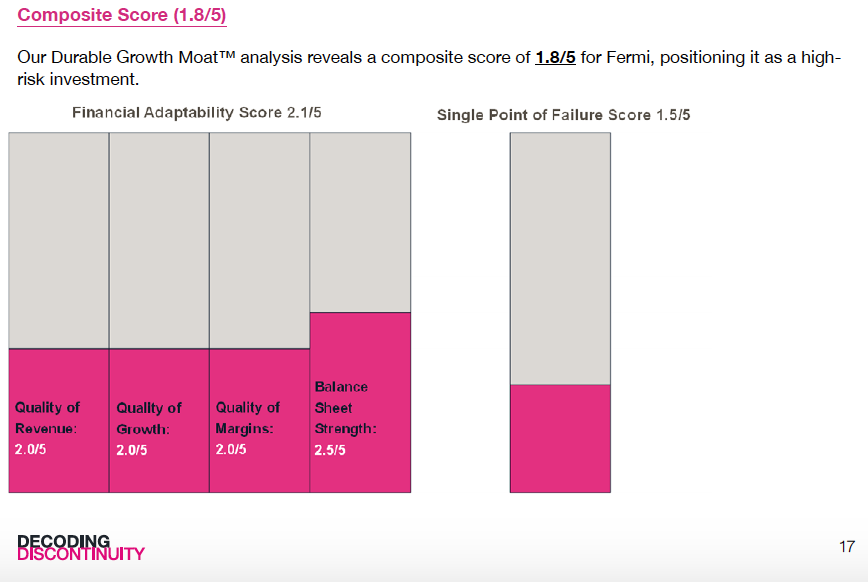
That score implies that Fermi’s $17B valuation and nuclear ambitions are a case study in speculative discontinuity.
At a time when power has become one of the most critical components of the AI industry’s ambitions, this report provides the most detailed analysis of AI’s nuclear frontier. It reveals how to separate durable value from hype. The analysis covers Fermi’s financial fundamentals, single point of failures and, need to believes for moat realization, and proposes a valuation framework for this one-of-a kind asset.
Distinguishing between hype and fear requires rigorous fundamental analysis that markets under euphoria systematically abandon.
Raphaëlle is CEO and founder of Decoding Discontinuity, a strategic advisory and investment platform focused on the structural impact of generative and agentic AI. Decoding Discontinuity develops proprietary frameworks for analyzing how companies are positioned to adapt to generative and agentic AI. Her Durable Growth Moat methodology assesses whether competitive advantages endure through generative and agentic AI discontinuities by examining structural fragility, control layer integrity, and economic resilience. With over a decade of experience in complex financial analysis and strategic advisory across VC, growth, and PE, Raphaëlle bridges technological understanding with capital markets expertise. Her insights have informed more than $50B in transactions while helping leadership teams navigate unprecedented architectural change.
For investors and corporate leaders seeking to understand the transformative nature of the discontinuity being caused by generative and agentic AI, this report and d’Ornano’s methodologies offer a playbook for evaluating high-risk AI investments, separating speculation from strategy, and defining defensible value and enduring competitive advantages.
What’s Covered
Full business model analysis of Fermi’s 11 GW nuclear-powered AI campus plan
Six critical “Need to Believe” assumptions evaluated
Stage-by-stage valuation framework ($1.5B to $55B across 6 development stages)
Comparative analysis vs. Crusoe Energy
Assessment of major execution risks, including REIT qualification, nuclear development, and project financing
Report Title: Fermi – Speculative Infrastructure Bet or Strategic Option on AI’s Power Crisis?
Author: Raphaëlle d’Ornano, Decoding Discontinuity
Date: October 7, 2025
Pages: 31