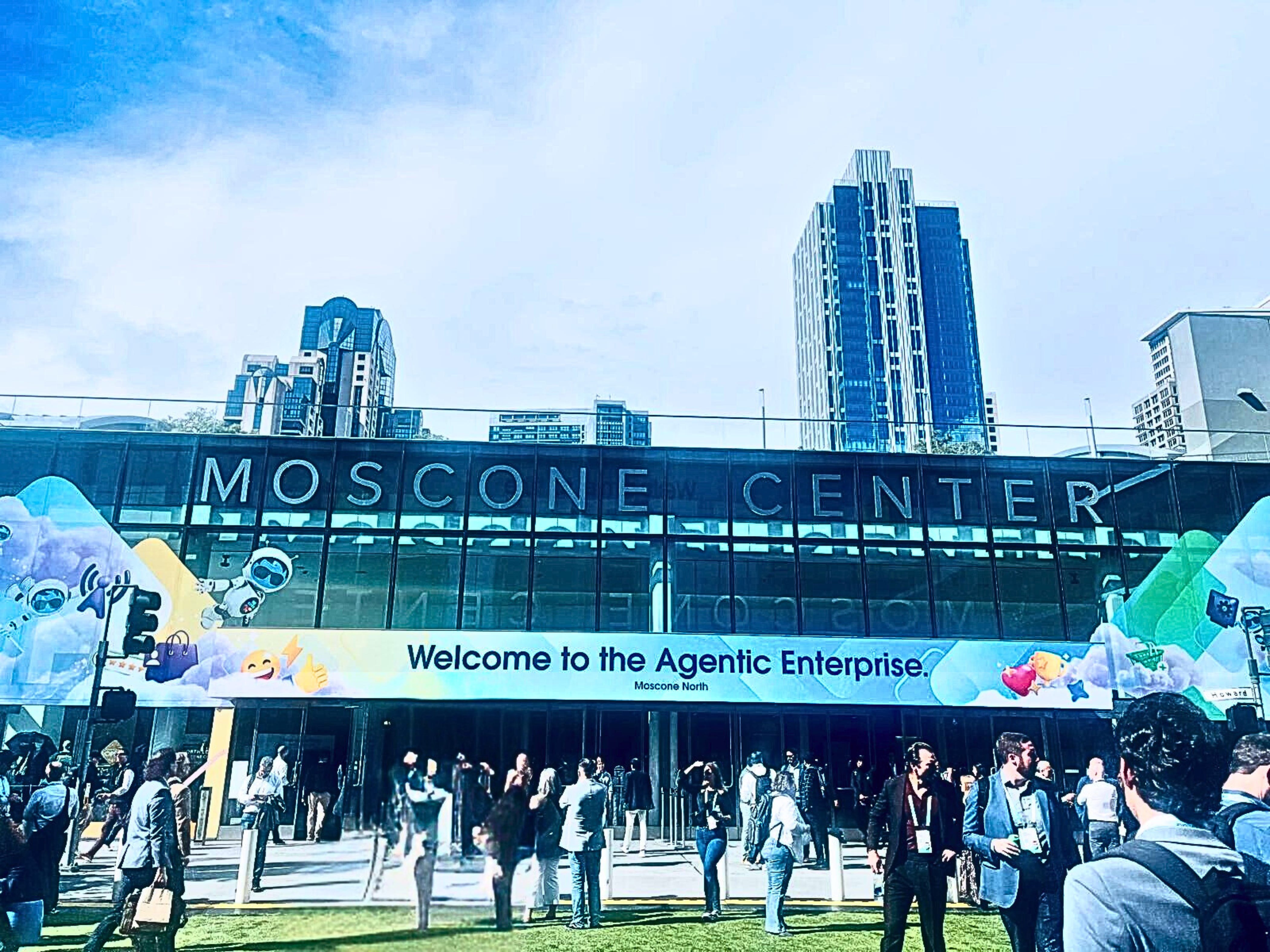
First Law of Value in the Agentic Era: Proximity to User Intent
Part 1 explores how competitive advantage shifts from owning systems of record to capturing where intent begins and orchestrating work from there. At Dreamforce, Salesforce moved the moat upstream.
This is Part 1 of my new series: “Laws of Value in the Agentic Era.” In the Agentic Era, competitive advantage migrates from owning systems of record to controlling where user intent originates. The closer you are to capturing user goals in natural language, the more valuable you become. Salesforce’s Dreamforce 2025 strategy - securing Slack as an intent gateway and launching Agentforce 360 - illustrates this shift perfectly. But this isn’t just about Salesforce. It’s about an inversion in software architecture: moats now form upstream at intent origin, not downstream at data storage. Whoever orchestrates the work wins; everyone else becomes an API call.
Part 2 will explore the Second Law: Context compounds faster than data and creates defensible memory moats.
Part 3 will explore the Third Law: Workflow integration power.
When Salesforce announced earlier this year that it would restrict AI companies’ access to Slack data, the tech world erupted. Anti-competitive! Defensive! Fear-driven! The narrative was familiar: legacy incumbent panics, throws up walls, inevitably loses to nimble, open competitors. That seemed to be how the AI world was going.
At that time, I saw the move as smart positioning, a calculated play to protect data moats. After analyzing Dreamforce 2025 and the Agentforce 360 launch, I believe it’s strategic genius. Not because Salesforce blocked competitors from data, but because they understood something critical: In the agentic era, competitive advantage doesn’t come from better models or more data. It comes from controlling where user intent gets expressed.
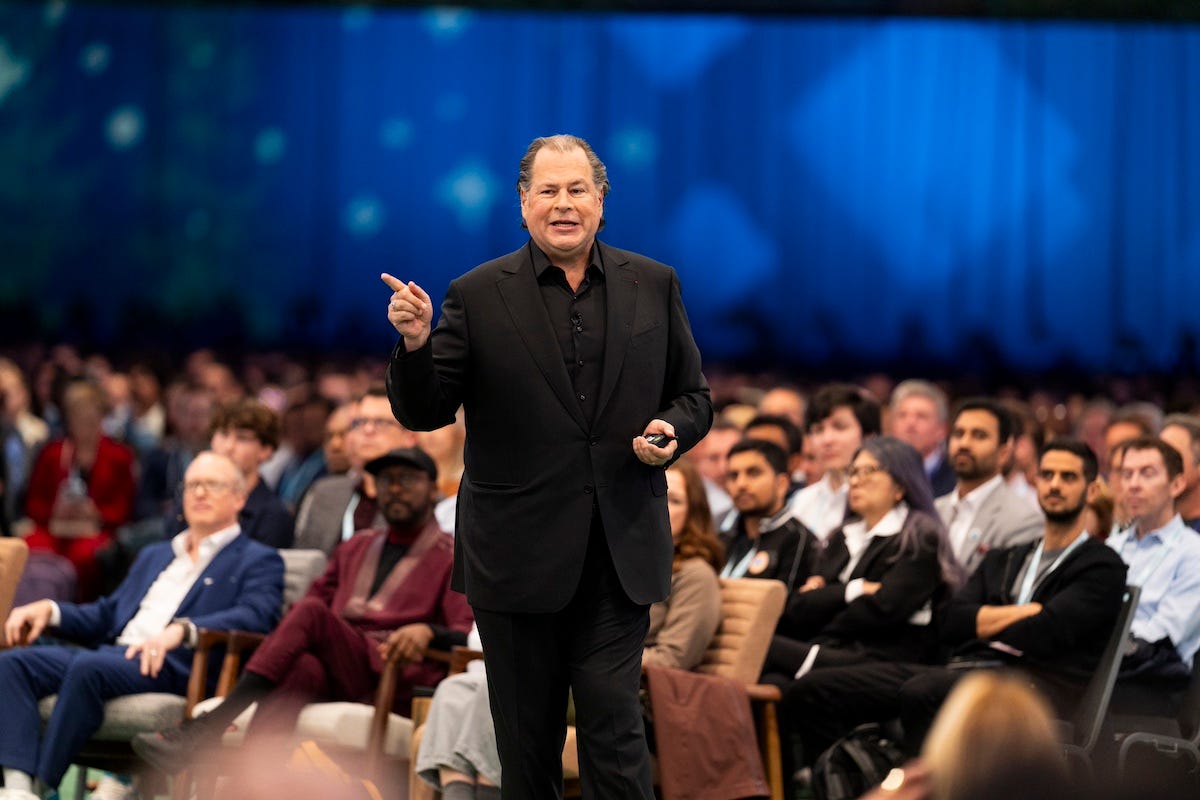
There’s a moment in every technology transition when the old rules stop working and new ones haven’t yet been written. We’re in that moment now. Dreamforce just screamed it out loud. The agentic revolution isn’t just changing how software works. It’s fundamentally rewriting where value accumulates and how moats get built.
For the past two decades, enterprise software moats were constructed downstream. You won by owning the system of record — the database where critical business data lived, surrounded by workflows that made switching painful. Hence the power of Gross Retention Rate (GRR) when assessing a tech company to ensure that your revenue is “sticky” and that you are able to retain your customers.
Salesforce built an empire on this principle. So did Workday, ServiceNow, and SAP.
That world is ending. Not software, but that world.
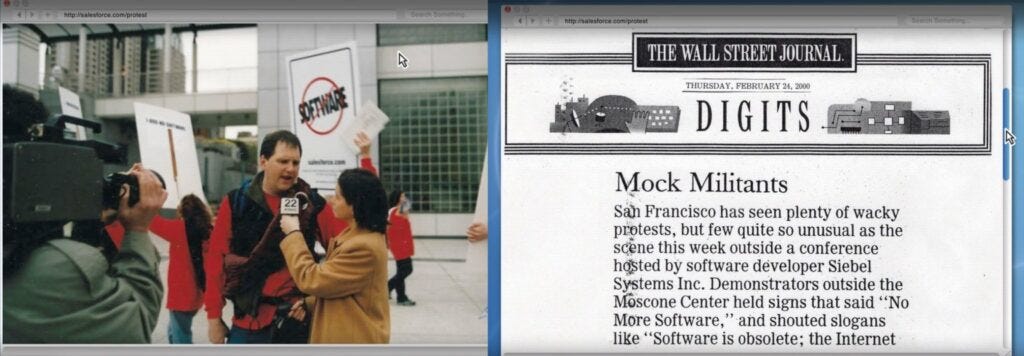
Just as Salesforce proclaimed “No More Software” in 2000, it’s time for a new rallying cry 25 years later: “Long Live Orchestration Platforms!”

In an agentic world, moats don’t form where data sits. They form where intent originates. This is the moment a user expresses a goal and an agent takes the first action. This isn’t a minor repositioning. It’s a complete inversion of software architecture and a wholesale migration of economic value. Companies that understand this shift will build the platforms of the next decade. Those that don’t will find themselves relegated to API endpoints in someone else’s orchestration layer.
This is the First Law of Value in the Agentic Era: Power accrues to whoever captures user intent and orchestrates the work from there.
Why Intent Became the New Moat
Traditional software made you come to it. You opened Salesforce to update a deal. You opened Jira to file a ticket. You opened Tableau to build a dashboard. Each application was a destination, a discrete stop in your workflow where you manually translated intention into action.
Agents invert this model. Rather than going to the software, software comes to you. You express a goal in natural language: “close the Q4 pipeline,” “resolve the production incident,” “analyze last quarter’s retention”and agents decompose that intent into a plan, route it to the right systems (perhaps the most important part), execute the work, and synthesize results. The user never leaves the interface where the intent was expressed.
This architectural shift has profound economic implications. In the old model, value accrued to systems of record because they owned the data and the workflows that operated on that data. Switching costs were structural. Ripping out Salesforce meant migrating years of customer data, reconfiguring integrations, and retraining teams.
But when an agent mediates the interaction, the underlying system of record becomes just another API call. The agent doesn’t care whether your CRM is Salesforce or HubSpot. It doesn’t care whether your data warehouse is Snowflake or Databricks. What matters is whether the agent can access the right context to ground its plan and whether it can orchestrate the sequence of actions needed to fulfill the user’s goal.
In this world, the system where intent is expressed becomes the control plane. It decides which agents run, in what order, with what context, under what constraints. That’s the new moat.
Recent research backs this up. Work on agentic systems — from Amazon’s MARCO framework to the Task Memory Engine architecture — converges on a single insight: the key to reliable agents is explicit intent modeling and orchestration. Systems that can capture the user’s goal, maintain context across multi-step workflows, and coordinate specialized sub-agents dramatically outperform monolithic approaches. The surface that hears the user first becomes the dispatcher of value.
This orchestration insight is vividly illustrated by OpenAI’s GPT-5, where the built-in router plays a pivotal role. The router analyzes user intent in real-time, assessing query complexity to dynamically route processing to the appropriate internal model variant - whether a lightweight one for simple tasks or a more advanced reasoning engine for intricate problems. This mirrors the broader agentic era dynamic: just as GPT-5’s router captures and directs intent within the model, platforms like Slack or Teams must route intents across ecosystems to accrue value.
The Intent Hierarchy: Where Are You in the Stack?
Not all proximity to intent is created equal. There’s a hierarchy:
Highest Moat Potential: Intent Origin. This is where goals are first expressed, often in natural language, unstructured, with high ambiguity. Examples: Google Search when you type “best CRM for startups,” ChatGPT when you say “help me plan Q1 hiring,” Slack when you message “get me up to speed on the enterprise deal.”
Strong Moat: Intent Capture. This is where goals become structured, translated into specific actions, mapped to known workflows, scoped with constraints. Examples: Salesforce when you open it to update deal stages, Jira when you file a bug, Linear when you create a sprint.
Moderate Moat: Intent Processing. This is where goals are executed, data is read and written, APIs are called, workflows run. Examples: Zapier orchestrating multi-system automations, Workday processing payroll, Mulesoft connecting enterprise systems.
Lowest Moat: Intent Output. This is where results are viewed - dashboards refresh, reports generate, notifications fire. Examples: Tableau rendering charts, PowerBI showing KPIs, Looker displaying metrics.
The further upstream you sit in this hierarchy, the more durable your moat. If you’re at Intent Origin, you control routing and decide which downstream systems get invoked. If you’re at Intent Output, you’re vulnerable to being bypassed by agents that deliver results directly in the origination surface.
The further upstream you sit in this hierarchy, the more durable your moat. If you’re at Intent Origin, you control routing. You decide which downstream systems get invoked. If you’re at Intent Output, you’re one click away from being replaced by an agent that synthesizes results directly into the origination surface.
This explains why Salesforce’s move to lock down Slack data and reposition it as the “agentic cockpit” was so strategically sophisticated. Slack sits at Intent Origin. It’s where work conversations happen, where problems first get articulated, where users express goals in natural language before they’ve been formalized. By securing that substrate and building Agentforce as the orchestration runtime underneath, Salesforce shifted from owning systems of record downstream to owning the intent gateway upstream.
That’s not defensive positioning. That’s offense.
Why Context Is the Substrate of the Moat
Capturing intent isn’t enough. You need context to operationalize it.
Consider a user in Slack who types: “Update the Chicago deal to closed-won and schedule a kickoff with their team next week.”
An agent with no context sees a sentence. An agent grounded in Slack’s conversational memory sees a three-month thread about this deal, the buyer’s org structure, calendar patterns, company kickoff templates, and past deals of similar size. That context is what turns a generic LLM into a precision instrument. And critically, it’s not portable. You can’t export Slack’s conversational memory into a competitor’s system.
This is why Slack’s Real-Time Search (RTS) and Model Context Protocol (MCP) matter strategically. They expose Slack’s conversational context to Salesforce agents in a governed, scoped way - no bulk export, no uncontrolled replication, but real-time access to exactly the context an agent needs to ground its next action. That’s how you stay open to model innovation (bring your GPT, Claude, or Gemini) while keeping the context moat defensible.
Slack as the Agentic Cockpit: Dreamforce’s Architectural Vision
At Dreamforce 2025, Salesforce didn’t announce incremental AI features. They unveiled an architectural vision re-framing the entire enterprise software stack, with Slack positioned as the “agentic OS.” In other words, as the conversational hub where human employees and AI agents coordinate work side-by-side, where intent gets expressed in natural language, and where orchestration happens in real-time.
As Slack’s CEO Denise Dresser, stated: “Every company is asking where their agents will live… Slack is the answer.”
It’s a product architecture bet backed by concrete capabilities:
Enhanced Slackbot evolved into a personal AI companion handling complex requests conversationally — summarizing threads, drafting content, preparing meeting briefs. It draws on Slack conversations and files to deliver contextually relevant information, learning user preferences over time to act as a smart assistant embedded directly in the workflow.
Specialized Agentforce apps embedded in Slack: Agentforce Sales brings CRM pipeline data and AI insights into Slack sidebars. Sales teams collaborate on live customer data in a channel instead of context-switching to Salesforce. Agentforce IT Service lets employees request help (password resets, system access) via chat with immediate AI resolution or automatic escalation. Etc.
Slack Enterprise Search turns Slack into a universal query interface: Employees query across all company knowledge with natural language—files, messages, integrated systems—powered by AI understanding of intent. Instead of navigating wikis or databases, users ask Slack questions and retrieve answers from everywhere.
External agent integration via RTS and MCP: OpenAI, Anthropic, Google, and others can build custom Slack-native agents with secure access to conversation context (with proper permissions) that act within Slack’s UI. External AI agents can “live” in Slack, respond to mentions or DMs, and take actions—all while grounded in live chat context.
As a result, Slack remains the primary interface where all agents interact with users, and customers are encouraged to keep work in Slack because that’s where the AI magic happens.
Early metrics from Salesforce claim companies using AI agents in Slack have seen up to 3× more revenue per employee by accelerating decisions and operations.
Whether those numbers hold at scale remains to be seen. But the architectural thesis is clear: Slack becomes the system of intent and shared context. Customer 360 remains the system of record. Agentforce is the system of orchestration that binds them. That triad explains both the product choices and the policy choices, including the API restrictions that initially looked defensive.
Orchestration Rights Equal Revenue Rights
I think that perhaps the most underappreciated implication of intent capture is economic: Whoever controls orchestration controls monetization.
When a user expresses a goal at the intent surface, someone has to decide which agents handle it. That routing decision determines:
Which first-party services get engaged (Salesforce’s Sales Cloud, Service Cloud, Tableau)
Which third-party integrations get invoked (HubSpot, Stripe, Notion)
How much work gets done inside your ecosystem vs. outside
Who gets credit—and payment—for value delivered
If you own the intent gateway, you own this routing logic. That makes the intent surface an attach-rate factory.
Every goal expressed is an opportunity to engage one of your premium capabilities. Miss a sale? The agent suggests Salesforce Einstein to score leads. Support ticket aging out? Route it to Agentforce Service. Dashboard unclear? Pull in Tableau Pulse for deeper insights.
This is the economic engine that made AWS successful: control the compute layer, and you can upsell storage, databases, ML services, and a thousand other capabilities. Intent capture is the agentic equivalent. Control the orchestration surface, and every user goal becomes a distribution channel for your entire portfolio.
The corollary is grim for incumbents downstream. If you’re a point solution, say, a specialized sales engagement tool, and the user’s goal (”help me close this deal”) is expressed in Slack and orchestrated by Agentforce, you’re now competing to be the sub-agent that gets invoked. Your switching costs collapsed. Your direct relationship with the user eroded. You’re a vendor to the orchestrator, not the primary interface.
At Dreamforce 2025, I was invited to join John Furrier of SiliconANGLE & theCUBE to share thoughts on Day 1, Salesforce, and the Agentic Era. It was a great conversation with Holger Mueller, Principal Analyst & VP, Constellation Research, Inc., and Gemma Allen, Principal Analyst, the Cube Research. The full episode is here:
The Protocol Trap: Standardization as Value Erosion
One counterargument: if orchestration matters so much, won’t protocols like MCP, A2A (Agent-to-Agent), or LMOS standardize this layer and make it commoditized?
Yes. And that’s exactly the risk for anyone who doesn’t also own the intent surface.
Protocols standardize interfaces. That’s powerful for interoperability. But standardization also equalizes capabilities and erodes differentiation. If every CRM exposes identical agent endpoints via MCP, the orchestrator no longer has a reason to prefer one over another. At that point, differentiation moves to price, brand, or factors unrelated to the agent experience.
This is why Salesforce’s strategy of being “maximally open at the model layer” while “maximally opinionated about where and how context flows” is so astute I think. Let models compete — Claude vs. GPT-5 vs. Gemini. Let tools proliferate — thousands of MCP-compatible services. But keep orchestration anchored in Slack. Keep context locked to Slack’s memory fabric. Keep the routing logic — what gets invoked when — under Salesforce control. This is what Dreamforce 2025 was about, no doubt about it.
Protocol standardization is inevitable. It will make individual agents more interoperable. But the platform that orchestrates those agents will capture the value. That platform needs to sit where intent originates and where context accumulates. Everything else is downstream.
So, what does that mean?
If you’re building software today, you must ask three questions:
1. Where do I meet intent?
If users don’t express goals in your product first, you’re not at the intent gateway. That doesn’t mean you’re doomed. But it means your moat is elsewhere (unique data, workflow lock-in, regulatory compliance). You need a strategy to either (a) move upstream to capture intent, or (b) become an indispensable sub-agent that orchestrators can’t route around.
2. What context do I control?
If your differentiation used to be features or workflows, ask whether those workflows can be replicated by a well-prompted agent with access to standard APIs. If yes, your moat is context—the situated memory of how work actually happens in your domain. Can you accumulate that context faster than competitors? Can you defend it through network effects or proprietary data access? Agentic-AI native startups are getting very good at the former, and represent a threat to incumbents that is starting to clearly resonate.
3. Can I orchestrate or get orchestrated?
Do you provide an orchestration surface (a meta-agent that decomposes tasks and delegates to sub-agents), or are you designing your product to be a great sub-agent (clear capabilities, reliable schemas, fast APIs)? Both can work, but the economics are different. Orchestrators capture more value. Sub-agents scale through volume but face commoditization pressure.
If you neither own intent nor provide differentiated capabilities to the orchestrator, the harsh truth is that you risk becoming a replaceable API call in someone else’s plan.
The Agent Exchange Is Coming
The logical endpoint of this shift is an Agent Exchange, a marketplace where intent (expressed by users) meets capability (provided by specialized agents), mediated by an auction-style platform that routes work based on performance, cost, and context alignment.
This already exists in embryonic form. Last March, Salesforce announced AgentExchange, a marketplace for discovering and deploying specialized agents. At Dreamforce, Salesforce said this would now be a cornerstone of the larger Agentforce 360 Platform.
Anthropic’s MCP ecosystem is proliferating agent providers. Google’s A2A protocol envisions cross-agent collaboration markets. The pattern is clear: standardized interfaces for agent discovery and invocation, plus reputation systems to track reliability and quality.
In this world, capturing intent becomes even more critical. The User-Side Platform (USP) translates human goals into structured task specifications. The Agent-Side Platform (ASP) represents agent capabilities and tracks performance. The exchange itself handles routing, including matching tasks to agents via auctions or optimization algorithms. Whoever controls the USP controls demand. Whoever controls demand controls the economics.
This is why incumbents are racing to embed agents into their existing workflow surfaces. Microsoft with Copilot in Teams and Office. Notion with Notion AI in collaborative docs. Slack with Agentforce in channels. They’re all trying to become the surface where intent originates, before a horizontal orchestrator (like a standalone agent OS or a new category-defining product) captures that layer.
The Competitive Endgame
Let’s game this out. Five years from now, where does value concentrate?
Scenario 1: Fragmented orchestration. Every application embeds its own agent layer. Slack has Agentforce. Microsoft has Copilot. Notion has Notion AI. Users live in multiple tools, and each tool routes to its own ecosystem. In this world, intent capture is distributed, and moats are traditional - workflow lock-in, data gravity, integration depth.
Scenario 2: Consolidated orchestrators. A handful of platforms emerge as the dominant intent gateways - likely Slack, Teams, or a new AI-native workspace. Users do all their work through that surface. It orchestrates to best-of-breed sub-agents behind the scenes. In this world, the orchestrator captures the largest share of value. Downstream tools become commoditized utilities.
Scenario 3: Decentralized agent mesh. Open protocols (MCP, A2A, LMOS) enable a truly interoperable agent ecosystem where any agent can invoke any other agent with appropriate permissions. Value flows dynamically based on performance and reputation, not ownership. In this world, no one owns orchestration. - It’s a shared protocol layer. Value accrues to the best agents (highest quality, lowest cost, fastest response) rather than the best platforms.
Scenario 1 is the incumbent’s bet. Scenario 2 is Salesforce’s bet (and likely OpenAI’s with Agent SDKs). Scenario 3 is the open-source community’s bet. History suggests we’ll get a hybrid: some consolidation around dominant orchestrators, plus a long tail of specialized agents accessible via protocols.
But in all three scenarios, proximity to user intent is the strategic high ground. The players who control where goals are expressed—whether that’s Slack channels, Teams chats, or a new AI-native interface—will have structural advantages in routing, context access, and monetization.
Lessons from Salesforce’s Playbook
Let’s revisit the Salesforce-Slack sequence with fresh eyes, from the API restrictions through Dreamforce 2025:
Recognize that agentic moats form where intent is captured (not where records are stored).
Secure the conversational data from uncontrolled replication and LLM ingestion (API terms update, May/June 2025).
Expose governed, real-time access patterns (RTS, MCP) so partners can participate within your rules.
Launch the agent runtime at Dreamforce 2025 (Agentforce 360), so building, deploying, and managing agents is natively tied to your fabric.
Elevate first-party agents (Slackbot 2.0, Sales Agent, Service Agent, Tableau Agent) to demonstrate the end-state UX and capture early adoption.
Step 2 looked defensive in May. Steps 3–5 at Dreamforce revealed why it was offensive. Salesforce preserved the substrate (conversational context) that makes steps 3–5 valuable. They didn’t just protect the moat. They moved the moat upstream.
This is the playbook:
Own intent.
Govern context.
Orchestrate work.
Everything else is downstream.
The Path Forward
If the First Law holds—power accrues to whoever captures user intent—then the strategic imperatives are clear:
For incumbents downstream: Either move upstream to capture intent (build the agent cockpit, not just the system of record), or differentiate so aggressively at the capability layer that you’re irreplaceable to orchestrators. Workflow lock-in won’t save you. Data gravity won’t save you. You need to become the agent that other agents depend on.
For horizontal orchestrators: Race to become the default intent surface—the place where users start their day and express goals. This probably means conversational interfaces (chat, voice) rather than traditional app UIs. Invest heavily in context accumulation and memory architectures. The depth of your conversational memory is your long-term moat.
For specialized agents: Embrace protocols. Make yourself maximally interoperable. Compete on quality, speed, and cost, not lock-in. You’re playing a volume game. Be the best sub-agent in your category, and you’ll get routed to millions of times. Fail to be best-in-class, and you’ll get disintermediated by a better alternative overnight.
The discontinuity is here. Salesforce’s Dreamforce 2025 vision demonstrates strategic brilliance in identifying where the moat is migrating. But strategic brilliance doesn’t guarantee victory. It guarantees positioning for the fight.
Whether Salesforce wins depends on execution quality they haven’t yet proven, competitive dynamics more complex than surface analyses suggest, and whether their core assumption (that intent centralizes in a few platforms rather than fragmenting across many) proves correct.
The question isn’t whether the First Law is true. The question is whether you’re positioned at the origin of intent or downstream from it. History will remember this decade as the moment when software inverted, when value migrated from systems of record to systems of intent, from data warehouses to conversational memory, from application destinations to orchestration gateways.
Own the intent. Orchestrate the work. Everything else is an API call.