


NVIDIA’s Agent Toolkit, unveiled at GTC 2026, is the company’s bid to become to the agentic era what AWS became to the cloud. The stack is open-source, and its ambition is infrastructural: rather than compete with Anthropic or OpenAI for ownership of the agent, NVIDIA is building the substrate beneath it. When Salesforce ships Agentforce, when SAP deploys Joule, when ServiceNow fields an agentic workflow, each can run on NVIDIA’s runtime, security, and data layer regardless of which model powers the intelligence above. The move arms SaaS incumbents against the model providers, threatening to absorb them, while creating two competing architectures that NVIDIA profits from equally. If model providers win, NVIDIA sells the chips. If incumbents orchestrate on NVIDIA’s stack, NVIDIA owns the hardware beneath and the plumbing between. The Agent Toolkit extends NVIDIA’s lock-in to the agent runtime layer, a new software layer for the agentic era. It is not a departure from the chip business. It is the chip business expanding its surface area upward.
When NVIDIA CEO Jensen Huang stepped onto the stage at the SAP Center in San Jose last Monday, he was wearing the iconic leather jacket as he launched into a marathon keynote that stretched almost 2.5 hours.
He dutifully name-checked LLM rivals Anthropic and OpenAI, made a string of product and partnerships and announcements, mentioned “agent” or “agentic” at least 44 times, and ended the spectacle by conversing with a robotic version of Frozen’s Olaf.
While the world knows NVIDIA as the company whose chips are powering the AI boom, Huang spent his time on stage doing his best to reframe the company as...something else, something more.
“We’re going to talk about platforms,” he said. “Nvidia has three platforms. You think that we mostly talk about one of them. We’re going to talk about all of them, and most importantly, we’re going to talk about ecosystems. This conference is going to cover every single layer of the five-layer cake of artificial intelligence, from the infrastructure to chips to the platforms, the models, and, of course...the applications.”
Tucked in between those layers, about two hours into the presentation, was a 4-minute wedge that sounded like a routine announcement. Something about a coalition of companies to advance open, frontier-level foundation models. And then, by the way, the company briefly unveiled an open-source software toolkit for building AI agents that had already been embraced by enterprise software companies, including Adobe, Salesforce, SAP, ServiceNow, Atlassian, Siemens, CrowdStrike, and Palantir. There were new models, a new security runtime, and a new data architecture.
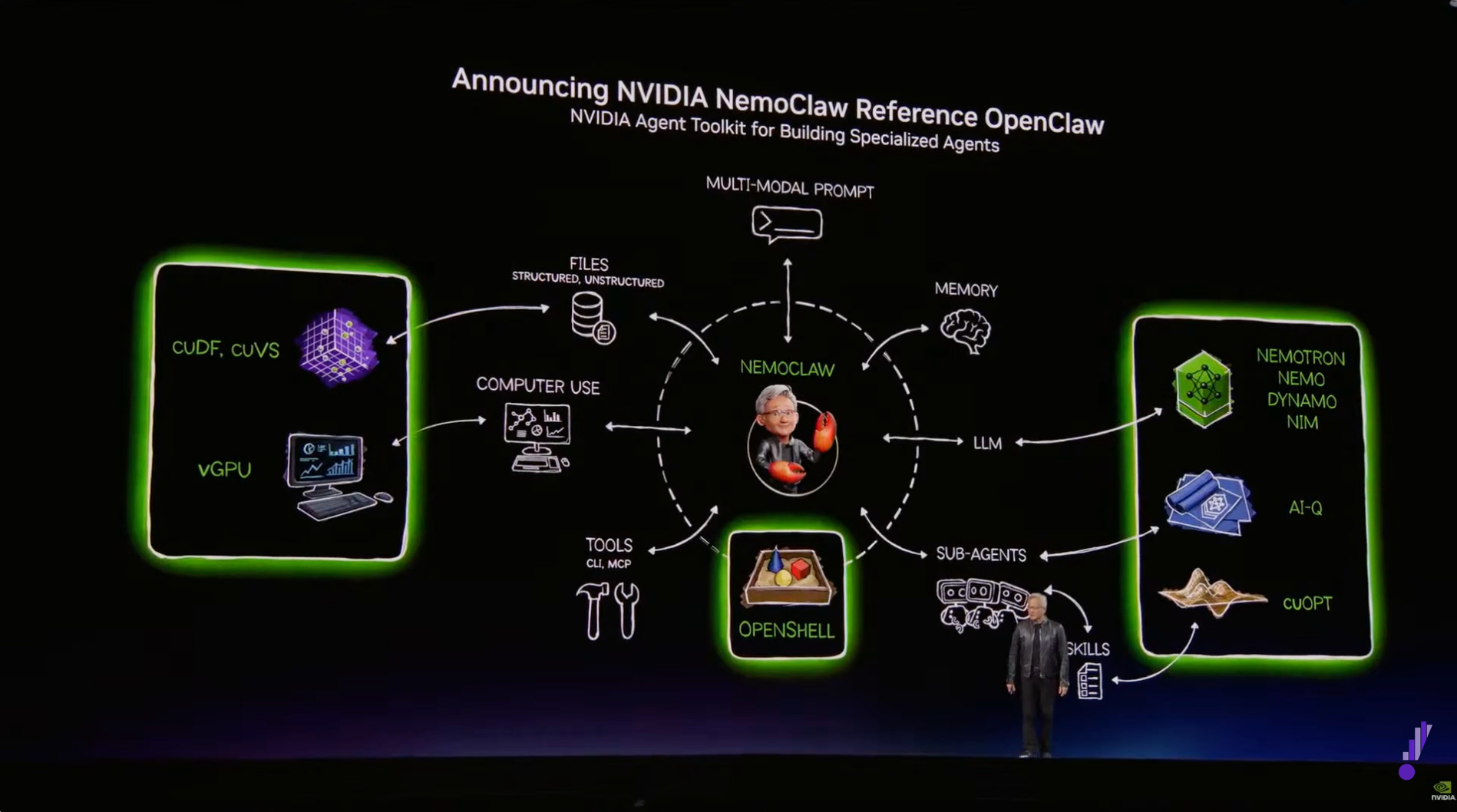
Because the NVIDIA Agent Toolkit was barely a blip, it was easy to miss the bigger significance: A direct challenge to Anthropic and OpenAI, the two companies widely expected to dominate the Agentic Era.
NVIDIA has become the indispensable substrate for AI computation. The Agent Toolkit is a bid to make NVIDIA just as indispensable at the runtime layer where enterprise agents are deployed, governed, and connected to data. It is a move to become the AWS of AI agents, the company that provides the infrastructure on which all AI agents run, regardless of which model powers them and which platform deploys them.
NVIDIA stock rose 1.7% on the day of the keynote, then drifted lower for the rest of the week amid broader macro pressures and the Iran-driven oil shock. Sell-side analysts focused on the $1 trillion order backlog for Blackwell and Vera Rubin chips. Naturally, the open-source Agent Toolkit, which would generate zero direct revenue, did not feature in their models.
The toolkit announcement deserved considerably more attention. But when it comes to NVIDIA, such oversight is not without precedent.
In 2006, NVIDIA released its Compute Unified Device Architecture (CUDA), which enables developers to write software that performs computationally intensive tasks on its GPUs. At the time, NVIDIA was a specialized hardware company whose primary business was its processors for gaming PCs. While CUDA, when it was announced, appeared to be just a niche product from a second-tier chip company, it turned NVIDIA’s chips from graphics processors into the computational backbone of modern AI.
It took nearly a decade before CUDA’s role as the substrate of the deep learning revolution became clear. No analyst in 2006 had a line item on their NVIDIA forecast for “future AI training demand enabled by a free parallel computing toolkit.”
And yet, as Huang opened his keynote, CUDA was topic number one.
“It all began here,” he said. “This is the 20th anniversary of CUDA. There are a couple of hundred thousand public projects. CUDA literally is integrated into every single ecosystem.”
In that sense, the timing of the Agent Toolkit introduction may have been perfect.
NVIDIA has moved from a specialized hardware company to a dominant platform company thanks to CUDA. Now, with Agent Toolkit, the company has signaled it intends to further migrate to an infrastructure-as-a-platform player in the Agentic Era. The GPU business remains. The software infrastructure business allows to sell even more GPUs. A new moat emerges, or so NVIDIA hopes.
The difference is that this time, the outcome will not unfold over a decade. It will be decided in the next few years (or months, given the pace of Agentic AI progress?). And it will determine whether the agentic economy is controlled by the companies that build intelligence, or by the one that builds the system it runs on.
To understand what NVIDIA is really attempting, and whether it can work, we need to start with how the ground shifted beneath it.