


Chapter 7 · All chapters
This is the latest excerpt from AGNT: The Orchestration Economics Manifesto - An Investment Framework for the Agentic Era. Each Thursday, I explore a major theme of the Manifesto and unpack the frameworks, adding extra context with more recent developments. Note: The figures and sequential references are taken directly from the larger Manifesto.
Parts I and II established that the paradigm has shifted. Machines became actors. The intelligence required for autonomous professional work exists as commercially available infrastructure. Agents are deployed in production. The infrastructure, while strained, is scaling.
The question now: Who captures the value it creates?
When a factor of production commoditizes, when intelligence becomes abundant, then value migrates to whoever controls the coordination of the newly abundant input. This migration is a pattern that has repeated across every major economic transition, from electricity to computing to cloud infrastructure. The entity that coordinates the abundant resource captures the surplus. In the agentic economy, the entity that coordinates machine actors captures the surplus of the entire transition.
The framework that describes who captures value, under what conditions, and why is Orchestration Economics. This manifesto defines the Three Laws of Agentic Value that determine whose orchestration position is durable. They are structural in nature, already visible, measurable, and investable.
However, we must first clarify how the new layer of value is formed.

Orchestration Economics
Orchestration Economics rests on a fundamental structural claim: The entity that controls the orchestration of machine actors captures the surplus of the transition. This is not a marginal improvement over SaaS economics, nor is it limited to software. It is a categorical shift in three dimensions:
Pricing is outcome-based, not seat-based or time-based. The unit of commerce is a claim processed, an analysis completed, a route optimized – not a license sold or a billable hour. Pricing per agent task (i.e., per consumption) is an intermediary step in that journey.
Budget is labor, not IT. The vendor does not compete with software for a slice of the 3-5% IT line. It competes with salaried professionals for a slice of the 25-40% knowledge-work line. The addressable market expands by a factor of 5-10x. What is more, the market is not limited to labor substitution; agents complete value-accretive tasks that did not exist before.
Defensibility is topological, not feature-based. What protects an orchestrator is the structure of the workflow it controls, not the capabilities of any single agent inside it.
The rest of this chapter establishes where this layer sits in the firm's new architecture, how value migrates into it, why most companies will fail to capture it even when they think they are, and under what conditions an orchestration position is durable rather than temporary. The Three Laws formalize those conditions.
The New Layer
Before agents, the architecture of knowledge work was straightforward. A human expressed intent: process this claim, close this deal, optimize this route. The human also had the tools to execute that intent. The human opened a CRM to update a record, a spreadsheet to run an analysis, and an email client to send a message. Each tool was a destination. The human was the orchestrator. The tools were the instruments. The business outcome was the product of human judgment applied through software.
Agents invert this architecture fundamentally. They insert a new layer between humans and tools. Humans used to go to the tools. Now the tools come to the human, mediated by the agent.
In the simplest case, this involves just a single AI agent. The human expresses intent: update the Chicago deal to closed-won and schedule a kickoff with their team next week.” The agent receives that intent, determines which systems to invoke (the CRM, the calendar, the email system), executes the necessary actions across those systems, and delivers the outcome. The human never opens the CRM. Never touches the calendar. Never drafts the email. The agent coordinates it.
Even in this single-agent case, orchestration is happening. The agent is orchestrating tools on the human’s behalf. The agent is, in the precise sense of the word, a synthetic colleague. This is the foundation of Orchestration Economics: agents are not better tools. They are a new layer between humans and their tools, designed to produce business outcomes.
The entity that controls the “Orchestration Layer” owns the relationship between the human and the work for a specific workflow, or set of workflows, aimed at producing a business outcome. It decides which tools are invoked, which data is accessed, which sequence yields the best outcome, which systems are essential, and which are bypassed entirely.
The Orchestration Layer described in this Manifesto is categorically different from the technical Orchestration Layer known as the “Harness”. This is a critical distinction. The Harness enables an LLM to produce results and makes intelligence operational. The Orchestration Layer turns operational intelligence into a business outcome.
The Architecture of the Agentic Firm
The agentic firm is organized in concentric rings, not layers, because what matters is not just function, but proximity to value capture. The farther out the ring, the greater the control over outcomes, and the stronger the economic position:
Ring 1 – Intelligence. The foundation models. The substrate. Its economic unit is the token.
Ring 2 – Harness. The technical orchestration infrastructure that makes intelligence operational: the systems that decompose goals, delegate to agents, manage state, coordinate execution, and accumulate learning across sessions. Claude Code, OpenAI Codex, enterprise agent platforms, managed agent systems, and emerging agent operating environments are Harness products.
Ring 3 – Orchestration. The outermost sub-layer. The position occupied by the entity that places Rings 1 and 2 at the center of its operations and adds what neither can produce: the operational context accumulated through running the world. Its economic unit is the outcome.
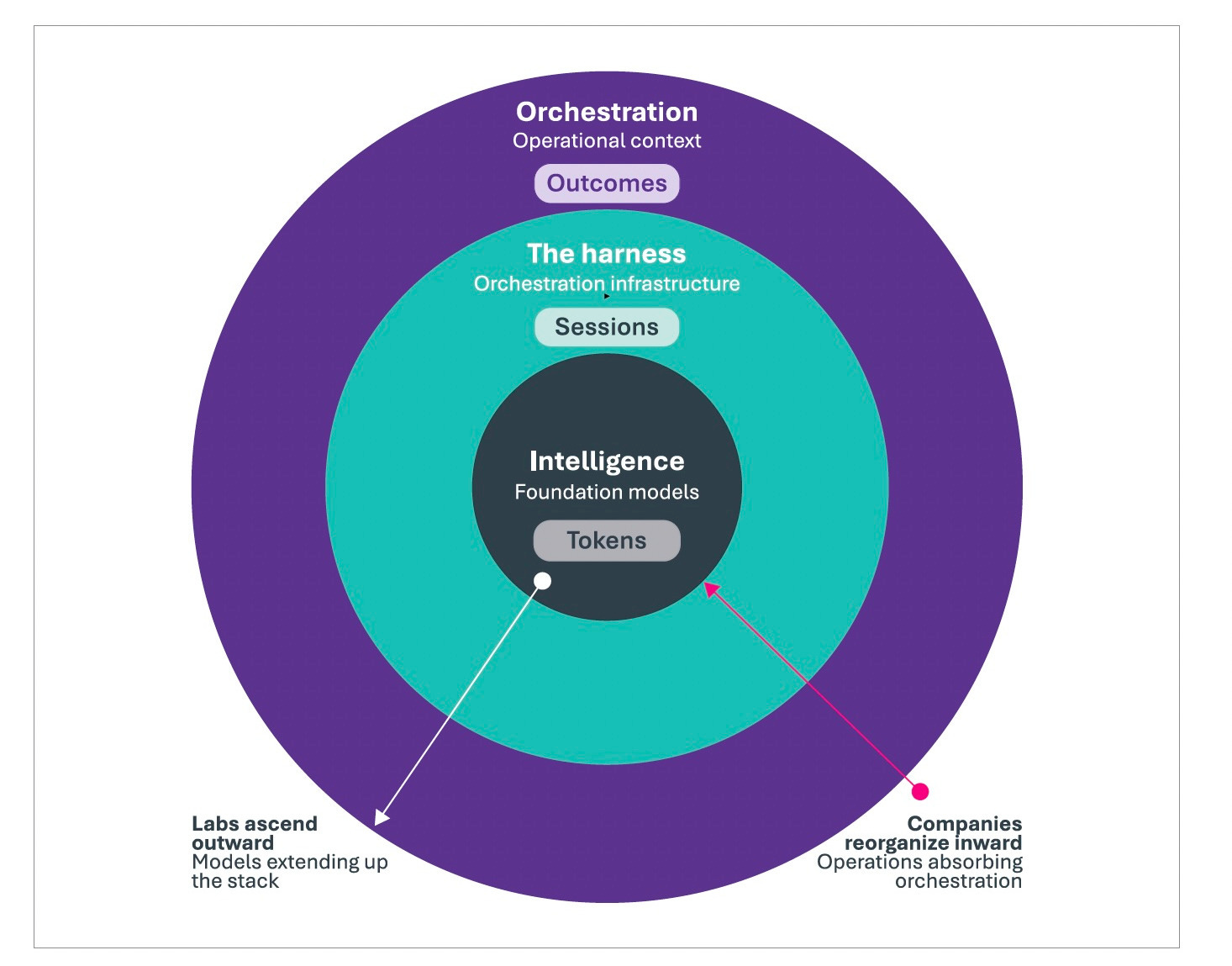
When I first argued in 2025 that the durable moat for LLM labs lay in orchestration rather than model intelligence, I was describing Ring 2. The labs confirmed the thesis. They recognized that model capability alone was commoditizing and moved into the infrastructure that makes it operational. The Coding Wedge was the entry point. Each product since has deepened the position.
But the labs did not stop at the Harness. Cowork extended into knowledge work. Vertical plugins reached into business functions. Frontier positioned itself as a control plane for the enterprise. With each step, the labs move outward, from intelligence through Harness toward the outermost sub-layer, contesting it against companies that have occupied it for decades. This expansion from Ring 2 to Ring 3 is at the root of the SaaSpocalypse and the broader value destruction in the public markets since the start of the year. We explore this in Chapter 13 infra.
An entity that provides intelligence is not an orchestrator. An entity that builds a Harness is not an orchestrator. The orchestrator wraps around both and produces business outcomes.
A single entity can occupy more than one ring. Two patterns are already visible.
The debate is no longer whether labs will move into Ring 3, but where they can do so successfully.
Anthropic today credibly sits in Ring 1 (Claude), Ring 2 (Claude Code, MCP, Skills, Agent SDK), and extends into Ring 3 (Claude Code for enterprise, Cowork, managed agents). In narrow domains, coding is the clearest because it already crosses all three. OpenAI is pursuing the same stack. The labs built inward-out: from intelligence, through Harness, toward outcome.
Occupying the inner rings does not confer the outer ring. Ring 3 is not a further technical layer. It is the operational context co-produced with the workflow being orchestrated. The labs can ship Ring 2 unilaterally. They cannot ship Ring 3 unilaterally because the intent, context, and workflow reside within the firm whose work is being orchestrated.
In domains where the lab also owns the workflow, such as coding, where the developer’s intent, context, and workflow are all captured natively inside the Harness, the lab credibly holds Ring 3. In domains where it does not, such as insurance underwriting at a carrier, credit analysis at a bank, claim evaluation, or at a reinsurer, then the lab supplies Rings 1 and 2, and someone else holds Ring 3.
Ring 3 is, therefore, domain-specific, not firm-wide. The same entity can hold it in one workflow and lose it in another. Whether any entity durably holds Ring 3 is not settled by its stack position. It is determined by the Three Laws.
The architecture is new. The contest for who occupies the outermost ring is already underway.
Captain and Crew: The Topology of Coordination
For a simple task such as updating a CRM record or scheduling a meeting, a single agent coordinating a few tools is sufficient. But evaluating an insurance claim, analyzing a company’s creditworthiness, or optimizing this supply chain becomes too complex for a single agent to handle all dimensions.
This is where multi-agent systems emerge. The system has a crew of agents with specialized capabilities whose job is to execute well-scoped work, such as document extraction, risk modeling, fraud detection, pricing, or compliance validation. They can be brilliant within their domains. But they do not see the whole map. They do not decide which workflow to run. They do not own the relationship with the human who asked for the outcome.
A multi-agent system could, in principle, be organized in many ways. A federation of peer agents could negotiate amongst themselves. A swarm could converge by consensus. Independent specialists could run in parallel and average their outputs. All of these have been tried. None produces coherent work at enterprise reliability.
A Google-DeepMind-MIT study, first published in December 2025, formalized this structure. A multi-agent system is an agent system with more than one reasoning entity, where agents interact through a communication topology and an orchestration policy that defines how the system makes decisions: how sub-agent outputs are aggregated, whether the orchestrator can override sub-agent decisions, whether memory persists across rounds, and when the task is complete.
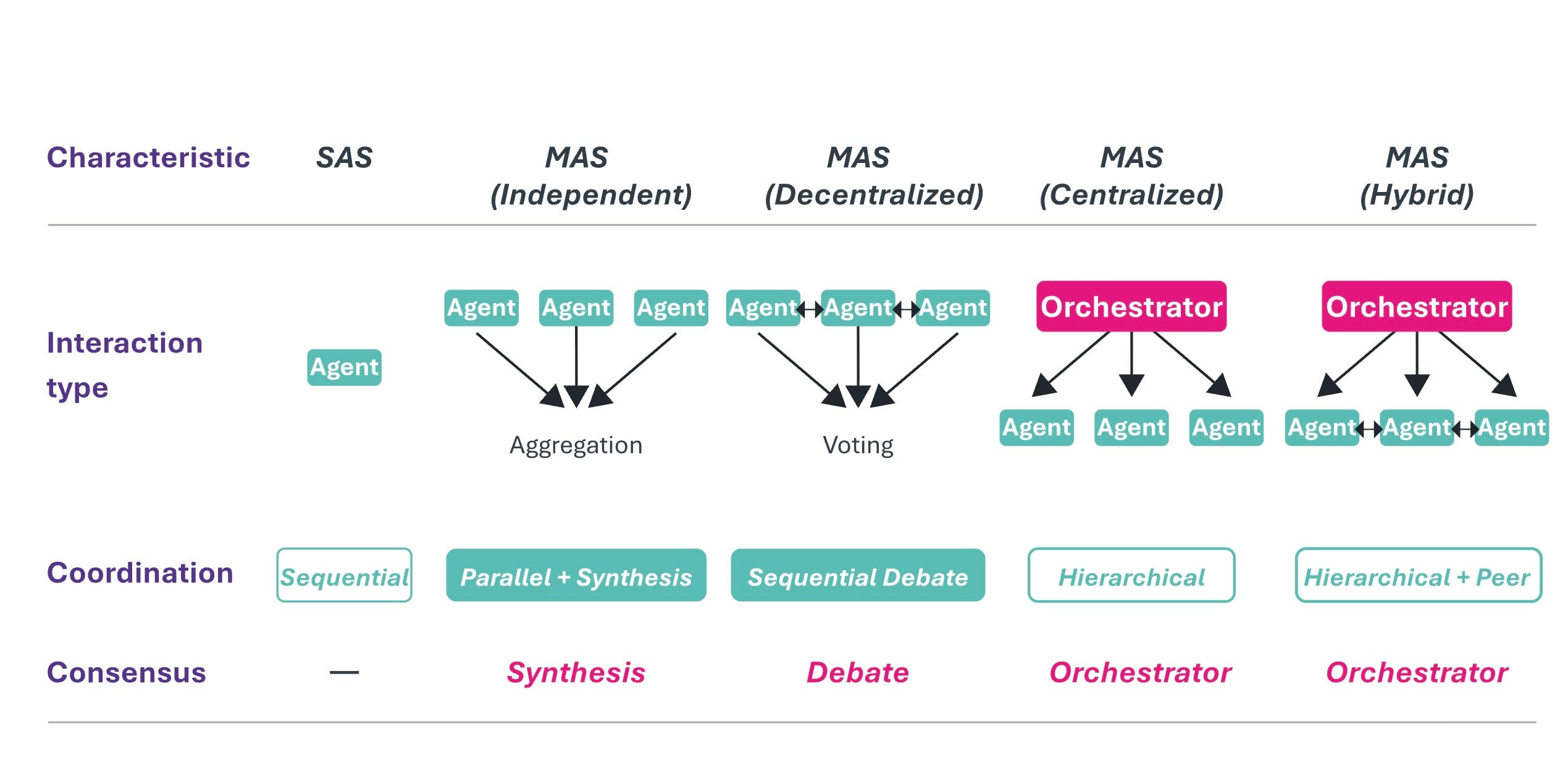
According to the most recent April 2026 revision of the paper, centralized coordination architectures exhibited approximately 75% lower trace-level error amplification than independent topologies (4.4× versus 17.2×). The broader result was not simply fewer propagated errors, but the emergence of verification mechanisms that improved reliability when tasks were naturally decomposable.
Only the architecture where one agent receives the task, decomposes it, selects and validates specialists, and decides what happens next produces the coherent outcomes enterprises will pay for.
The orchestrating agent becomes the captain. It does not perform the specialized work itself. It decomposes the goal into subtasks. It assigns those subtasks to the appropriate specialists on the agentic crew. It collects their outputs. It validates them. It synthesizes the results. The human talks to the captain. The captain commands the crew. The crew does the work. The captain reports back to the human. That is the agentic AI loop.
As we move into the core exploration of Orchestration Economics, it is worth noting that the discussion of the transition to the Agentic Era has remained at a simplistic, binary level. Winners and losers. Eat or be eaten. Victim or beneficiary of the SaaSpocalypse. The more nuanced and challenging question most companies will be facing: Do you want to be the captain or the crew?
The economic consequence follows directly from the topology, not from the metaphor.
Specialist agents are substitutable. A better extraction model can be swapped in. A better pricing model can replace the incumbent. The crew is upgradeable. Its members have limited pricing power because the captain can always source a better one.
The captain is not substitutable. Replacing the orchestrator means rewiring the workflow, including remapping the topology, retraining the policy, reestablishing every integration, and re-accumulating the operational memory. The switching cost is categorical.
Value is multiplicative, not additive. A single agent coordinating three tools yields linear value: the sum of the tasks it automates. An orchestrator coordinating five specialist agents, each coordinating their own tools, produces nonlinear value. The orchestrator can redesign the workflow, parallelizing steps, eliminating redundancies, and catching errors across domains that no individual specialist would detect. The orchestrator is not a participant in the workflow. It is the workflow.
In human organizations, we call this management. In multi-agent systems, we call it orchestration. Value accrues to the Orchestration Layer rather than being evenly distributed among the agents beneath it. Not because someone has to be in charge, but because the topology in which centralized coordination wins is the only topology in which the workflow works at all. The entity at the center of that topology captures the surplus that coherence creates.
Let’s follow the money through an actual enterprise workflow
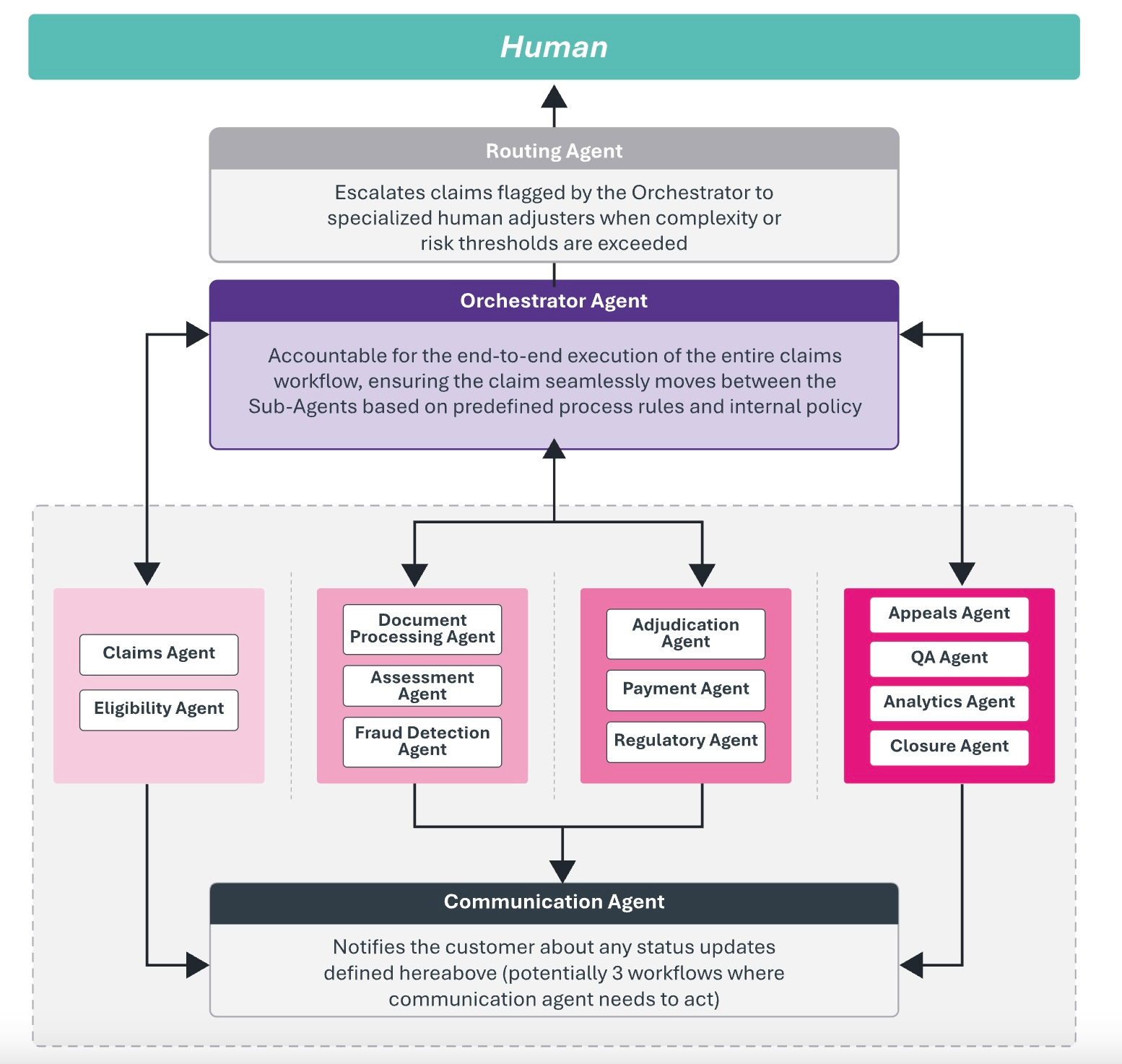
A commercial insurance submission arrives. Under the old architecture, it enters a human chain: intake, review, coding, investigation, pricing, approval, and documentation. Each human is an expert. Each has trained for years. Together, they process the claim in days, sometimes weeks, at costs measured in hundreds of dollars per claim. The Orchestration Layer lived in a manager’s brain and a project management tool. The bottleneck was human capacity for coordination.
Under agentic orchestration, the same workflow transforms. The submission arrives at a master agent. The master agent does not “process a document” as legacy software does. The master agent interprets the goal: evaluate this risk and produce a quote that aligns with our growth and risk constraints. It inspects the case. It decides which specialized agents to invoke: extraction, enrichment, risk modeling, pricing, or compliance validation. It sets their inputs. It sequences their work. It validates their outputs. It determines when the goal is achieved.
The specialist agents are valuable. They have real reasoning capacity. But they are no longer where the workflow is decided. Their job is to respond to the plan. Not to define it. The control plane has moved. So has the economics.
The question every company in the agentic economy must answer is not rhetorical. It is operational.
Are you the captain? Or are you the crew?
The Programmable Firm
Carnegie Mellon and Stanford University research teams released a landmark study in October 2025 called “How Do AI Agents Do Human Work?” that provided an empirical foundation for the Agentic Era. The teams compared how humans and AI agents complete identical work across data analysis, engineering, computation, writing, and design. They concluded that for tasks defined as “readily programmable,” AI agents will complete the work 88.3% faster at 90.4-96.2% lower cost. These figures represent benchmark environments rather than fully operational enterprise deployments.
The key finding is not that work is programmable end to end. It is more consequential: programming is embedded in 82.5% of knowledge-work occupations. In practice, this means a large share of enterprise workflows contain programmable components, even if they are not fully automatable.
Programmability is the unlock. A programmable workflow can be agentized. A workflow that can be agentized can be orchestrated. A workflow that can be orchestrated can be sold as an outcome rather than licensed as a tool. The economic category changes not because the AI is better, but because the work itself has always been more structured than the software market has reflected.
The gate is reliability. Every enterprise workflow has a reliability requirement: a level of accuracy and completeness below which human oversight remains necessary. When an AI system handles 40% or 50% of cases correctly, it accelerates human workers but cannot replace them. Every output still needs review. The human chain stays intact. The company has purchased a productivity tool.
When an AI system handles 85% or 90% of cases correctly, the economics change categorically. The workflow runs autonomously. Humans handle only the exceptions, the fraction of cases the system flags for review. The company has not purchased a productivity tool. It has purchased an autonomous function. The difference between these two states is not a percentage improvement. It is a reclassification.
In the first state, where AI is a productivity tool, the vendor sells software licenses. The buyer pays $50-$200 per seat per month from the IT budget. The vendor competes on features against other software vendors. The human labor cost remains on the books. This is SaaS economics.
In the second state, where AI becomes an autonomous function, the vendor sells an outcome. The buyer pays per claim processed, per credit analysis completed, or per supply chain route optimized. The budget is no longer IT spend. It is labor spend: the fully loaded cost of the knowledge workers the autonomous function replaces.
A single insurance underwriter costs $8,000-$15,000 per month in salary, benefits, training, and management overhead. A credit analyst costs similar. The vendor prices based on that labor cost, not on competing software licenses.
Apply this lens to a large institution like JPMorgan. With approximately $50 billion in annual labor costs and assuming ~30% of tasks fall into the “readily programmable” category, agents begin to meaningfully reshape the cost structure. However, because these tasks still require verification, exception handling, and integration into broader workflows, the immediate impact is not full replacement but partial automation and labor reallocation. Even under conservative assumptions, this translates into multi-billion-dollar efficiency gains, not through elimination of labor, but through compression of the programmable portions of work. That pool does not sit in the IT line. It sits in headcount.
The addressable market shifts accordingly. Enterprises typically spend 3-5% of revenue on IT, but 25-40% on knowledge work. The critical transition is not from software to AI, but from tools to workflow execution. Once an orchestrator reliably automates the programmable segments of work while coordinating human oversight where needed, it begins to tap into the much larger pool of labor spend. The prize is therefore not to replace SaaS but to expand beyond it by capturing portions of the operating budget that have historically been reserved for human execution. In that sense, the orchestrator that crosses the reliability threshold does not compete within the software market but instead redefines the market boundary, expanding it by a factor of 5 to 10.
The orchestrator creates this transition. The specialist agents, no matter how capable individually, do not. A pricing agent that achieves extraordinary accuracy still operates within the first state. It makes the human underwriter faster. It is a tool.
An orchestrator that coordinates pricing, risk, compliance, and documentation agents into a coherent autonomous workflow delivers the second state. It replaces the underwriting function. It delivers an outcome. The outcome emerges only from the coordinated whole. Only the orchestrator delivers it.
Bypass Risk
Orchestration Economics does not guarantee permanent advantage. The same structural logic that creates the orchestrator’s position also defines the conditions under which that position can be undermined.
Bypass risk is the possibility that a new entrant positions itself between the user’s intent and the existing orchestrator. In doing so, it captures the Orchestration Layer from above. Protocols such as MCP standardized how agents connect to external systems and to each other. A2A standardizes agent-to-agent communication. ANP sits atop both as a discovery layer.
Historically, APIs standardized software connectivity. In the agentic economy, protocols standardize agent connectivity. The strategic implication is profound: once interfaces become standardized, defensibility migrates away from integration and toward intent, context, and workflow ownership.
Standardization is powerful for interoperability. It also dissolves the integration friction that protected many orchestration positions. The company that controlled its workflow through the sheer difficulty of connecting systems wakes up one morning to find that the friction is gone. Protocols dissolved it. Orchestration Economics is therefore not a simple claim that the orchestrator always wins. It is a framework that says the orchestrator wins unless it gets bypassed.
The orchestrator’s advantage is structural, but its defensibility is conditional. It depends on building moats that protocols cannot standardize away and that competitors cannot replicate. Which moats? Under what conditions does an orchestration position become durable rather than temporary? What separates the orchestrators who compound their advantage from those who lose it to the next layer above?
The Three Laws
Knowing that orchestrators capture value does not tell us which positions are defensible. The orchestrator’s advantage is structural. Its defensibility is conditional. It depends on building moats that protocols cannot standardize away and that competitors cannot replicate.
Three conditions determine whether an orchestration position is durable. Each is necessary. None is sufficient alone. The entity that satisfies all three simultaneously holds a position that compounds with use, resists bypass, and captures the surplus of the agentic transition. The entity that satisfies one or two, even brilliantly, occupies a layer that the orchestration economy will eventually treat as crew rather than captain.
Previously: The Infrastructure Question · Next: The First Law: Proximity to Intent Determines Value Capture.
Chapter 9 develops the Second Law: Context Builds Moats.
Chapter 10 develops the Third Law: Workflow Intelligence Secures Control.
Once we define the Three Laws, we will apply them to Palantir.
The views and opinions expressed in this publication are those of the author alone and are based on publicly available information. The expressed views and opinions do not constitute investment advice, a solicitation, or a recommendation to buy or sell any security or financial instrument. The author may hold positions in the securities of companies mentioned. Certain companies referenced may be current or former clients of, or counterparties to, the author or affiliated entities; such relationships will be disclosed where applicable. Past performance is not indicative of future results. To the fullest extent permitted by applicable law, the author does not accept any liability for any loss or damage arising from reliance on this content. Readers should conduct their own independent due diligence and consult a qualified financial advisor before making any investment decision.