


Chapter 8 · All chapters
This is the latest excerpt from AGNT: The Orchestration Economics Manifesto - An Investment Framework for the Agentic Era. Each Thursday, I explore a major theme of the Manifesto and unpack the frameworks, adding extra context with more recent developments. Note: The figures and sequential references are taken directly from the larger Manifesto.
Let’s return to the insurance workflow. The master agent receives a goal: evaluate this risk and produce a quote that fits our growth and risk constraints. The extraction agent receives a task: pull the relevant data from this document. The fraud detection agent receives a task: check this submission for anomalies. The pricing agent receives a task: calculate the payout given these parameters.
All four are agents. All four orchestrate tools. All four sit in the Orchestration Layer. But the master agent controls routing. It decides which specialists to invoke, in what order, and under what constraints. It defines the workflow. It validates the outputs. It determines when the goal is achieved. The specialist agents execute tasks defined by someone else. They may be brilliant within their domains. But they do not see the whole map. They do not decide whether the claim gets processed. They do not own the relationship with the human who submitted it.
Chapter 7 established that this hierarchy creates disproportionate value capture. The First Law explains why: it is not coordination alone that creates the advantage. It is in proximity to the human’s original intent. The master agent sits closest to the moment a human expresses a goal. The pricing agent sits furthest from it, several translations downstream. That distance determines everything: defensibility, pricing power, switching costs, and bypass risk.
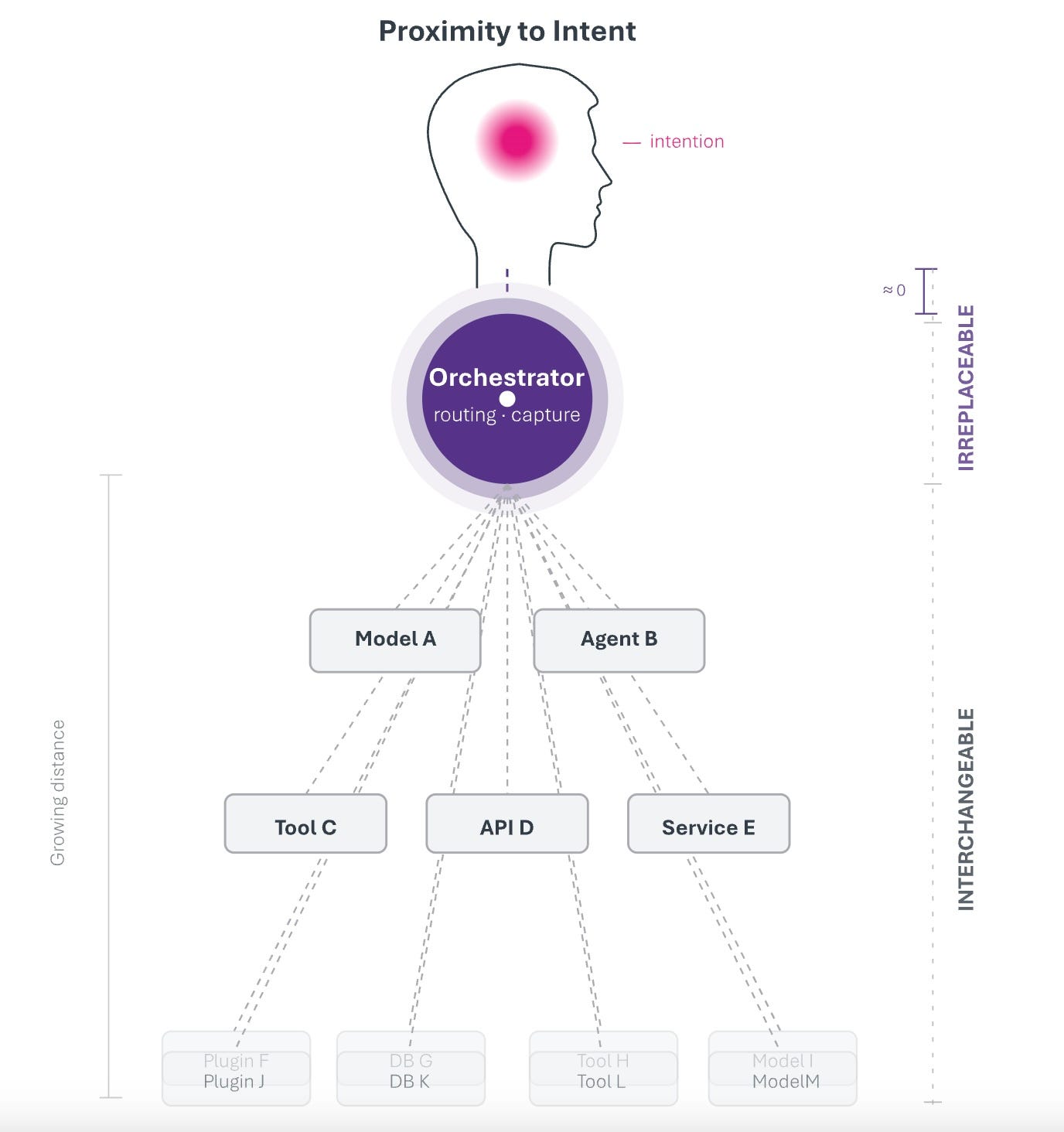
The principle generalizes across the entire agentic economy. There is a hierarchy of positions relative to intent, and your location determines the durability of your orchestration position:
Intent Origin carries the highest value. This is where goals are first expressed in natural language, unstructured, with high ambiguity. The human who submits “evaluate this risk” is expressing intent at the origin. In enterprise software more broadly, search interfaces occupy this layer: conversational interfaces, ambient assistants, operating systems, enterprise collaboration tools, and autonomous workflows. Whoever controls the intent origin potentially controls routing.
Intent Capture carries strong value. This is where goals become structured as they are translated into specific actions, mapped to known workflows, and scoped with constraints. When the master agent decomposes “evaluate this risk” into discrete tasks for each specialist, it is performing intent capture. If agents intercept intent at the origin layer and route it directly to execution, the capture layer is skipped entirely.
Intent Processing carries moderate value. This is where goals are executed. Data is read and written, APIs are called, and workflows run. The extraction agent and the fraud detection agent occupy this layer. Essential work. Nothing happens without it. But it does not control where intent originates or how it gets structured.
Intent Output carries the lowest value. This is where results are viewed as dashboards refresh, reports are generated, and notifications are displayed. This layer is one abstraction from replacement. When the master agent synthesizes results and delivers the outcome directly to the human who expressed the goal, separate output displays become redundant.
The further upstream you sit, the more durable your moat. The further downstream, the more replaceable you become. Because the Orchestration Layer above you can substitute you without the user noticing. The insurance company does not care which extraction agent runs. It cares that the master agent delivered the right quote.

Why Upstream Wins
The hierarchy is not merely a ranking. It reflects a structural asymmetry in how value flows through agentic systems. The entity at the intent origin has three advantages that entities downstream do not:
Routing authority. The intent origin decides which downstream systems get invoked. Every goal expressed is an opportunity to engage your capabilities, route to your ecosystem, and monetize through your platform. This is the economic engine that made AWS successful: control the compute layer, and you can upsell storage, databases, machine learning services, and a thousand other capabilities. Intent capture is the agentic equivalent. Control the orchestration surface, and every user goal becomes a distribution channel.
Relationship ownership. The human interacts with the intent surface. The human trusts the intent surface. The human returns to the intent surface. Everything downstream is invisible to the user. It is mediated, abstracted, and replaceable. The intent surface owns the relationship. Everyone else is a vendor.
Phase transition capture. Connect this to the economics of Chapter 7. The phase transition to Orchestration Economics only accrues to the entity that delivers the complete outcome. That entity must sit at or near the intent origin, because only the intent origin can promise the customer that if they receive the goal, it will deliver the result. An orchestrator at the processing layer can coordinate agents effectively, but it cannot deliver the autonomous function the customer is paying for. It depends on someone upstream to provide the goal. Someone upstream can bypass it. An orchestrator at intent origin owns the goal itself, and everything downstream flows from that ownership.
Not all data enables these advantages equally. Customer behavioral data, such as how users interact, what they choose, and what patterns they follow, creates the strongest orchestration advantage because it feeds directly into routing decisions. Operational transaction data creates the strongest execution advantage but does not grant routing authority. The implication for investors is direct: companies that accumulate behavioral data at the intent surface compound their routing advantage with every interaction. Companies that accumulate transactional data downstream build strong specialist positions but remain vulnerable to bypass. The corollary is severe for companies positioned downstream. If you are a point solution, such as a specialized sales engagement tool, and the user’s goal is expressed in Slack and orchestrated by Agentforce, you are competing to be the sub-agent that gets invoked. Your switching costs collapsed. Your direct relationship with the user eroded. You moved from captain to crew. The crew is replaceable.
The Software Inversion
For two decades, enterprise software moats were constructed downstream. You won by owning the system of record. This is the database where critical business data lives, surrounded by workflows that made switching painful. Salesforce built an empire on this principle. So did Workday, ServiceNow, and SAP.
The Orchestration Layer inverts this. When an agent mediates the interaction, the system of record becomes just another API call. The agent does not care whether your CRM is Salesforce or HubSpot. What matters is whether the agent can access the right context and orchestrate the sequence of actions needed to fulfill the user’s goal. Moats no longer form where data sits. They form where intent originates.
Salesforce recognized this before most of the market. Its repositioning of Slack at Dreamforce 2025 is the First Law made concrete. Restricting AI companies’ access to Slack data looked defensive. The sequence that followed instead demonstrated an offensive strategy by governing access through MCP, the Agentforce runtime, and first-party agents embedded directly in Slack.
Salesforce moved the moat upstream, from owning the database where records sit to owning the surface where goals are expressed. Slack became the system of intent. Customer 360 remained the system of record. Agentforce became the Orchestration Layer, binding them. The company understood that controlling the origin of intent is more valuable than controlling any system downstream.
This continued in April at Salesforce’s TDX developer conference in San Francisco. Salesforce's strategy unveiled at TDX 2026 provides a concrete illustration of the First Law in practice.
Rather than defending Customer 360 as the primary destination for work, Salesforce deliberately moved its competitive position upstream, toward the point where work begins. Headless 360 exposes the underlying platform as APIs, MCP tools, and agentic services, making the traditional application interface increasingly optional. At the same time, Slack is repositioned as the system of intent, Agentforce as the orchestration layer, and Data 360 as the context substrate that informs routing decisions.
This architecture reflects an important strategic realization: the long-term moat no longer resides in owning the system of record where data is stored, but in owning the surface where users express goals and where agents accumulate the behavioral context needed to orchestrate future work. The CRM becomes execution infrastructure; the intent surface becomes the source of durable economic power.
The same principle operates at every scale. Within OpenAI’s GPT-5, a built-in router analyzes user intent and directs processing to the appropriate internal model variant. The router sits at the intent origin inside the model. Platforms like Slack or Teams must do the same thing across entire ecosystems. The architecture is fractal: whoever captures intent first controls what happens next, whether “next” means selecting a model variant or orchestrating a fleet of enterprise agents.
The Protocol Test
Protocols provide the sharpest test of the First Law.
Chapter 7 established bypass risk as the counterforce to orchestration advantage. MCP and A2A, along with their rapid adoption by every major platform, standardize how agents connect to systems and to each other. That standardization dissolves integration friction, the difficulty of connecting systems that once protected many orchestration positions. The First Law predicts exactly which positions survive this dissolution and which do not.
Protocols can standardize every layer below the intent origin. They can make tools interchangeable, specialist agents substitutable, and integrations frictionless. If every CRM exposes the same agent endpoints via MCP, an orchestrator has little structural reason to prefer one over another. Switching costs collapse. Differentiation shifts toward price. Margin compresses. This is the crew’s fate in a world of universal protocols. But protocols cannot standardize the moment a human expresses a goal. They cannot standardize the trust relationship between a user and the surface where they articulate what they want. Intent origin is protocol-resistant because it depends on human habit, institutional workflow, and accumulated context. None of these can be specified in an API schema.
Protocols commoditize execution. Intent surfaces capture value.
The orchestrator that relied on integration friction has no moat left. The orchestrator at intent origin has a moat that protocols reinforce because every new protocol-compliant tool that connects to its ecosystem makes the intent surface more valuable, not less. More tools mean more capabilities the captain can route to. The crew gets more substitutable. The captain gets more powerful.
Strategic Positioning
The First Law creates a simple diagnostic for any company in our investment universe: where do you sit in the intent hierarchy, and can you move upstream?
For the systems of record, the processing engines, the output layers, the imperative is to move from downstream to upstream. Build the agent cockpit, not just the system of record. If moving upstream is not feasible, differentiate so aggressively that you become irreplaceable to orchestrators. Be the specialist so good that the captain cannot sail without you. Workflow lock-in will not protect you. Data gravity will not protect you. The question is whether you can become the agent that other agents depend on.
For horizontal orchestrators competing to be the default intent surface, the imperative is speed. Race to become the place where users start their day and express goals. This probably means conversational interfaces rather than traditional application UIs. Invest in context accumulation and memory architectures because the depth of your conversational memory prevents a bypass when the next intent surfaces.
For specialized agents at the execution layer, embrace protocols and compete on quality, speed, and cost. Be the best sub-agent in your category, and you will be routed millions of times. Fail to be best in class, and you will be replaced overnight. You are the crew. Make yourself indispensable crew.
Where does value concentrate five years from now? Three scenarios frame the range:
Fragmented orchestration: every application embeds its own agent layer. Slack has Agentforce. Microsoft has Copilot. Intent capture is distributed, and moats remain traditional.
Consolidated orchestrators: a handful of platforms emerge as dominant intent gateways, orchestrating best-of-breed sub-agents behind the scenes. Downstream tools become commoditized utilities.
Decentralized agent mesh: open protocols enable any agent to invoke any other agent, and value flows dynamically based on performance rather than ownership.
History suggests a hybrid: consolidation around dominant orchestrators, plus a long tail of specialized agents accessible via protocols. But in all three scenarios, proximity to user intent is the strategic high ground. The players who control where goals are expressed will have structural advantages in routing, context access, and monetization. The players who do not will compete on price.
If you neither own intent nor provide differentiated capabilities to the orchestrator, you risk becoming a replaceable API call in someone else’s plan.
The First Law
The First Law establishes the first condition for defensible orchestration: proximity to intent determines where value concentrates, who controls routing, and whose position survives protocol standardization. Moats form where intent originates, not where data sits. The captain who hears the human’s goal first captures the economics of the phase transition. Everyone downstream competes on execution.
Owning intent is necessary, not sufficient. Return to the insurance example one more time. The master agent sits at the intent origin. It controls routing. It captures the phase transition economics. But what happens when a competitor builds a rival master agent for the same workflow? Both sit at the origin. Both offer orchestration. What determines which one the customer stays with?
The answer is not who arrived first. It is who built the deeper context. Who accumulated the operational intelligence that makes orchestration effective in ways a new entrant cannot replicate on day one?
That is the Second Law.
The views and opinions expressed in this publication are those of the author alone and are based on publicly available information. The expressed views and opinions do not constitute investment advice, a solicitation, or a recommendation to buy or sell any security or financial instrument. The author may hold positions in the securities of companies mentioned. Certain companies referenced may be current or former clients of, or counterparties to, the author or affiliated entities; such relationships will be disclosed where applicable. Past performance is not indicative of future results. To the fullest extent permitted by applicable law, the author does not accept any liability for any loss or damage arising from reliance on this content. Readers should conduct their own independent due diligence and consult a qualified financial advisor before making any investment decision.