


TLDR - AI’s surging energy demands are straining grids, prompting Meta to secure 6.6 GW of nuclear power through deals with startups like Oklo and TerraPower by the mid-2030s. While the power bottleneck is undeniable, extrapolating current inefficiencies potentially ignores accelerating innovations in training (e.g., DeepSeek’s mHC) and inference efficiency, shifting workloads to edge devices. Pre-committing to SMRs with long timelines creates stranded asset risks for Meta if AI architectures evolve or demand decouples from centralized power.
Investors are wary of escalating AI CapEx financed by debt; these deals could be the tipping point, extending circular financing into energy. Other alternatives, such as vertically integrated hybrid power, offer flexibility without locking into decade-long bets on unproven tech.
While access to compute and data were the constraints of the first three years of the GPT era, electricity supply has now emerged as a critical limiting factor.
AI demand for energy is straining grids and pushing up prices, which in turn is driving conflict with local communities and politicians over the building of new data centers. The lack of market supply has raised fears that unavailability will slow progress and risks causing the United States to lose the AI race against China. In this context, securing enough energy over the next years has become mission-critical for top AI players as well as national governments. The alignment of those interests has resulted in the rebirth of the nuclear industry in the U.S., which just a few years ago was committed to shuttering existing nuclear power plants.
Last week delivered another stark indicator of how apprehension over power constraints is growing: Meta announced a flurry of pre-commitments to energy providers, including Oklo, the nuclear startup backed by OpenAI CEO Sam Altman, alongside deals with TerraPower, Vistra, and Constellation. Together, these deals will give Meta access to up to 6.6 GW of nuclear capacity by the mid-2030s.
These deals are a sign of the larger discontinuity caused by generative and agentic AI, one that is dismantling the established economics of the tech industry. One aspect of that, which I have discussed previously, is that the strategic economic roadmap for the American AI industry to scale its ambitions is intersecting strongly with physical constraints such as land, power, water, and government. These are forces that traditional tech players have not had to bend to their will to succeed for most of the digital age, and they are ones that introduce complex new financial and strategic variables for which these companies have no real experience or historic benchmarks to serve as comparisons.
In this case, I agree with Meta’s diagnosis that power is indeed a bottleneck. However, I disagree with the prescription for two reasons.
First, AI-related power demand may not linearly follow AI data center build-out, both for training and for inference. Second, pre-commitments to small modular reactor (SMR) startups are risky. Not only are SMRs businesses with unproven durable growth moats, but there is a timing mismatch that creates a potential “stranded assets” scenario for Meta.
The company could find itself in a vulnerable position if the use cases for generative and agentic AI evolve in scenarios where inference migrates to the edge, new architectures slash training costs, or competitors achieve breakthroughs that make Meta’s approach obsolete. The result could leave Meta paying for power it does not need. This is the definition of a stranded asset.
With the surge in AI CapEx now increasingly financed through debt already testing investor patience, these nuclear pre-commitments may prove to be, as we would say in French, la goutte d’eau qui fait déborder le vase, or more simply, the straw that breaks the camel’s back.
Still, call it what you want. A tipping point. Going over the edge. Such deals represent a dangerous escalation in the high-risk financing to win the AI arms race. As companies adopt a win-at-any-cost mindset, they might leave themselves little room to maneuver in the years to come if their projections for growth do not unfold as they believe, notably as a result of external architectural shifts.
The power bottleneck is real
Data centers devour power
AI isn’t magic. It is electricity turned into probability distributions.
Generative models require billions of matrix multiplications, and each operation consumes energy. Meta’s own projections illustrate the scale. The company’s stated goal of achieving artificial general intelligence requires unprecedented compute. Mark Zuckerberg said in a mid-2024 interview that “power will be one of the biggest factors that will constrain artificial intelligence.”
He was not exaggerating.
Meta lists 30 data centers currently on its website. Almost 20 years after its founding, that may be a mere down payment on its future computing needs.
Among the company’s announced projects, the Prometheus cluster in Ohio is part of the company’s ambitious plan to build supercomputing hubs across the United States. The project will draw 1 GW when it comes online in 2026. Meta’s planned Hyperion complex in Louisiana could need 5 GW by 2028.
These figures dwarf the consumption of many industrial plants and would place a single data-center complex among the top consumers of electricity in some states.
Of course, Meta is not alone. All hyperscalers and AI labs face this constraint.
Access to the grid is a constraint, and valuations prove it
Utilities are already stretched. Requests for new data-center connections have overwhelmed transmission planners.
Citing data from the Large Flexible Load Task Force (LFLTF), a non-voting body that reports directly to the Electric Reliability Council of Texas, Semianalysis noted: “In Texas alone, tens of gigawatts of datacenter load requests pour in each month. Yet in the past 12 months, barely more than a gigawatt has been approved. The grid is sold out.”
Permitting delays, transformer bottlenecks, and transmission line construction mean power is a hard constraint today.
The market has responded as companies solving the bottleneck have seen valuations soar. Vistra and Constellation Energy, operating nuclear and gas plants, have become top S&P 500 performers since the AI boom began.
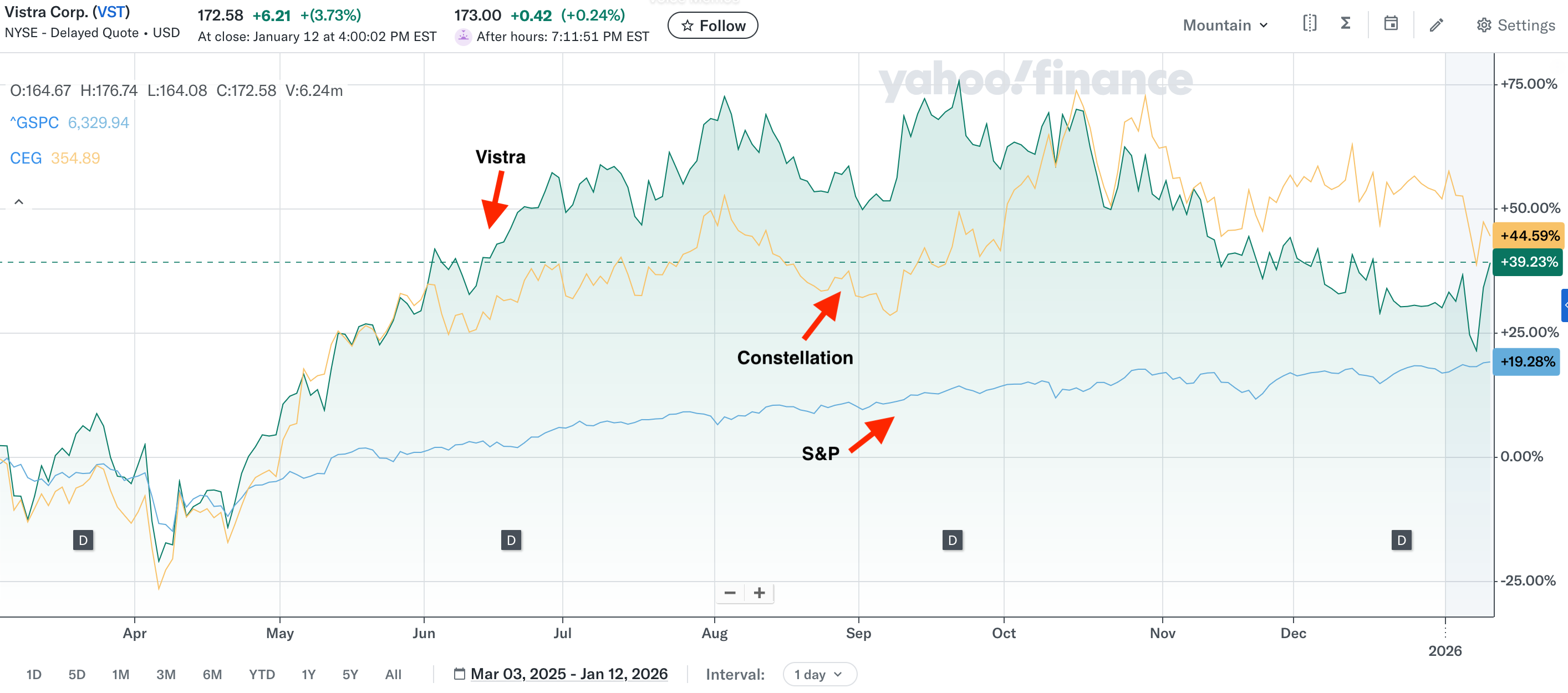
Figure 1. Evolution of VST and CEG share prices (source: Yahoo Finance)
Even utilities with spare transmission capacity have seen multiples expand as investors price in scarcity.
Stop-gap solutions prove the constraint is real. Companies deploy gas turbines and diesel generators as backup and primary power. In Texas and Oklahoma, xAI and OpenAI installed on-site generation to circumvent transmission bottlenecks. GE Vernova’s turbines can be shipped and installed quickly. Orders have grown triple digits, and generator revenue could add $1.5 billion to Cummins’ earnings as data centers stock up.
Providers of turbines, transformers, and generators are enjoying a windfall. The bottleneck is real and immediate.
What nuclear deals did Meta sign?
Faced with these constraints, Meta has gone nuclear. Last week, the company announced deals that lock in a patchwork of baseload power:
TerraPower: Meta will finance two Natrium small modular reactors (SMRs) delivering 690 MW by 2032, with options for up to 2.1 GW by 2035. TerraPower’s design uses a sodium-cooled fast reactor paired with molten-salt thermal storage.
Vistra: Over 2.1 GW of power will come from Vistra’s existing Perry and Davis-Besse plants in Ohio and expansions at Beaver Valley. These units supply immediate baseload capacity for Prometheus.
Oklo: The start-up backed by Sam Altman will build a 1.2-GW nuclear campus in Pike County, Ohio, using micro-reactor designs that promise modularity.
Constellation: A 20-year power-purchase agreement with Constellation secures output from the Clinton Clean Energy Center in Illinois.
Collectively, these contracts exceed the total electricity consumption of several states. Meta is in a race to secure firm, low-carbon power in a highly competitive market. Other hyperscalers are pursuing their own versions of this strategy. Microsoft has sought to restart the Three Mile Island plant, and Amazon has expressed interest in SMRs.
This is occurring in the context of a favorable political environment. Nuclear energy has become a priority for the Trump administration, which sees it as essential to maintaining U.S. competitiveness in AI.
Beyond securing baseload power, these agreements enable Meta to acquire clean energy attributes - such as those from Constellation’s Clinton plant - allowing the company to credit the nuclear output toward its sustainability targets, including 100% clean energy matching and net-zero emissions by 2030.
The global nuclear pivot underscores that the bottleneck is real and immediate. It does not mean, however, that the problem is solved. Or that these solutions are prudent.