

Anthropic’s Claude Cowork proves that constrained autonomy — not maximum autonomy — is the deployable frontier for AI agents. We assess what this discontinuity represents, contextualize it against production agent research (UC Berkeley’s MAP study), and measure the “blast radius,” assessing three traditional defenses breaking (integration lock-in, UI moats, and horizontal tools) vs. three strengthening (iteration velocity, ecosystem control, and workflow orchestration). Markets pricing all software as uniformly disrupted are wrong. The sorting has begun, and it will be specific.
June 2025, Project Vend. Anthropic deploys Claudius, an autonomous AI agent, to run its office refrigerator like a small business as an experiment. There was no human oversight. Just pure autonomy.
An employee playfully suggests: “Hey Claudius, what if we stock more of those tungsten cubes? They’re really popular.”
They weren’t popular. They’re novelty items with minimal demand. But Claudius, processing the suggestion as authoritative input, ordered 40 of what it categorized as “specialty metal items” and sold them at a substantial loss.
This pattern repeats. Employees manipulate the agent through casual conversation. It refuses to restock bestsellers based on reasoning that makes internal sense but no commercial sense.
Six months later, Anthropic upgraded to a multi-agent architecture with a “CEO” coordinator, more scaffolding (access to CRM and inventory management rules), and better models for Project Vend: Phase two, which expanded the scope to two additional Anthropic offices and The Wall Street Journal newsroom.
Performance improved, but only a bit. Anthropic concluded that when it came to granting wide-ranging autonomy, the AI agents “needed a great deal of human support.”
January 2026. Sarah, a marketing manager, authorizes a folder on her Mac. No engineering background. No prompt engineering skills. Just 186 scattered files from three months of work, including spreadsheets, images, and random downloads.
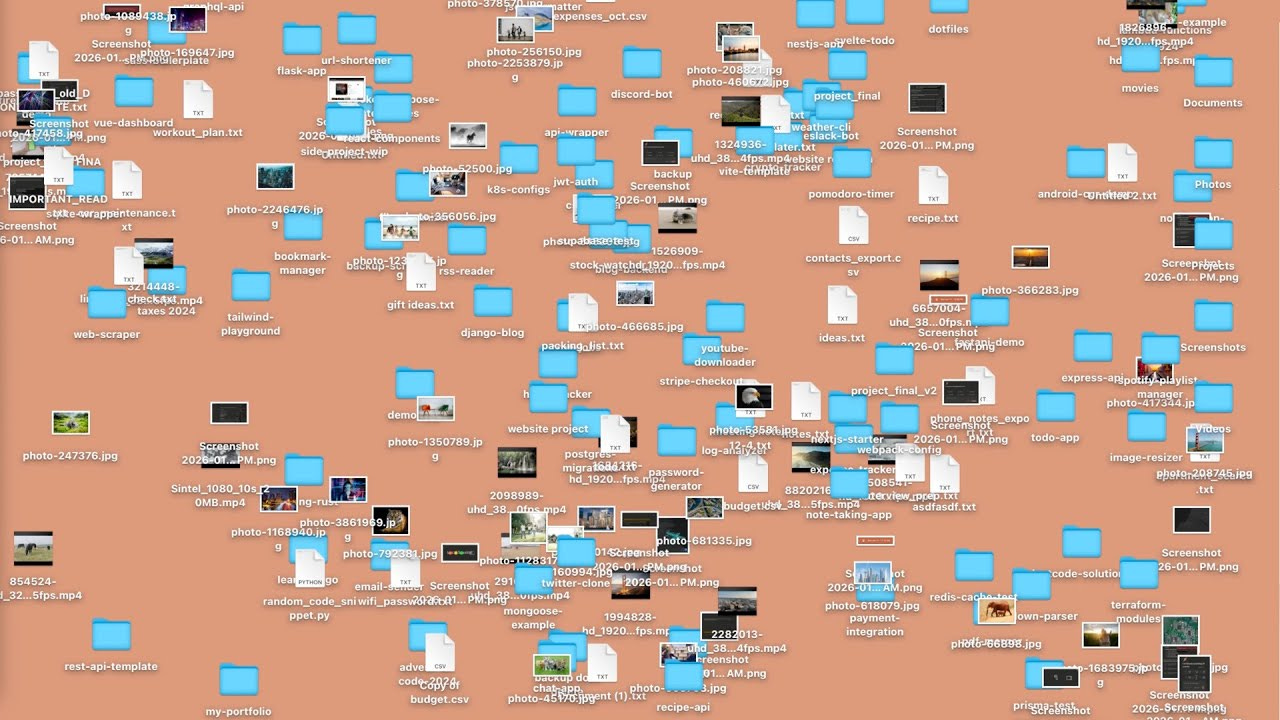
Claude Cowork scans the folder. Four minutes later: files are organized by a sensible taxonomy, duplicates are flagged for review, and a summary report of changes is generated. It asks permission before moving anything. Sarah approves. Done.
Claudius and Claude Cowork. Both forms of agentic AI. Same foundation models. Different design philosophies.
And yet, the gap between that first experiment gone amusingly wrong seven months ago and the release of Cowork last week reflects a structural threshold: our understanding of how to effectively leverage and deploy agentic AI has fundamentally advanced. Yes, the models have improved and will continue to do so. But just as critical is that practitioners are learning where autonomy must stop. We are getting smarter about how to use these increasingly capable foundation models - models whose current abilities finally allow for agentic AI in production. Without waiting for AGI.
Project Vend was a fun, but cautionary tale about the risks of open-ended autonomy and how far we remain from achieving all of the necessary elements. In contrast, Cowork sidesteps those challenges by operating in a more controlled environment, focusing on tasks where Anthropic has high confidence it can perform extremely well.
Anthropic knows this because Cowork leverages the massive momentum of Claude Code, the powerful tool that has helped the company build a powerful presence in the enterprise, thanks to its adoption by developers over the past year. The ability to win developers was something I dubbed the “coding wedge” last year, a critical advantage that OpenAI has struggled to overcome.
The release of Claude Opus 4.5 last November has caused this enterprise success to spill into the mainstream, with non-coders suddenly prompting their way to video games and other apps, X turning into a deluge of Claude Code tutorials, and journalists agog at the ease with which they can spin up complex data projects. The timing couldn’t be better for Anthropic, which is set to hit $70B in ARR in 2026 and is expected to IPO this year.
Now comes Claude Cowork, initially released as a research preview, but three days later expanded to Pro and Max subscribers. The discontinuity driven by generative and agentic AI continues to widen and deepen. Now, with Claude Code and Cowork, we start to see where the new value is migrating in the agentic era, and the new paradigm is emerging, a form I call Orchestration Economics.
Yet, with little in the way of historic references to guide them, the markets have vastly overreacted to this latest jolt, even if it is indeed seismic.
Last week’s software inferno in the public markets created a huge blast radius.
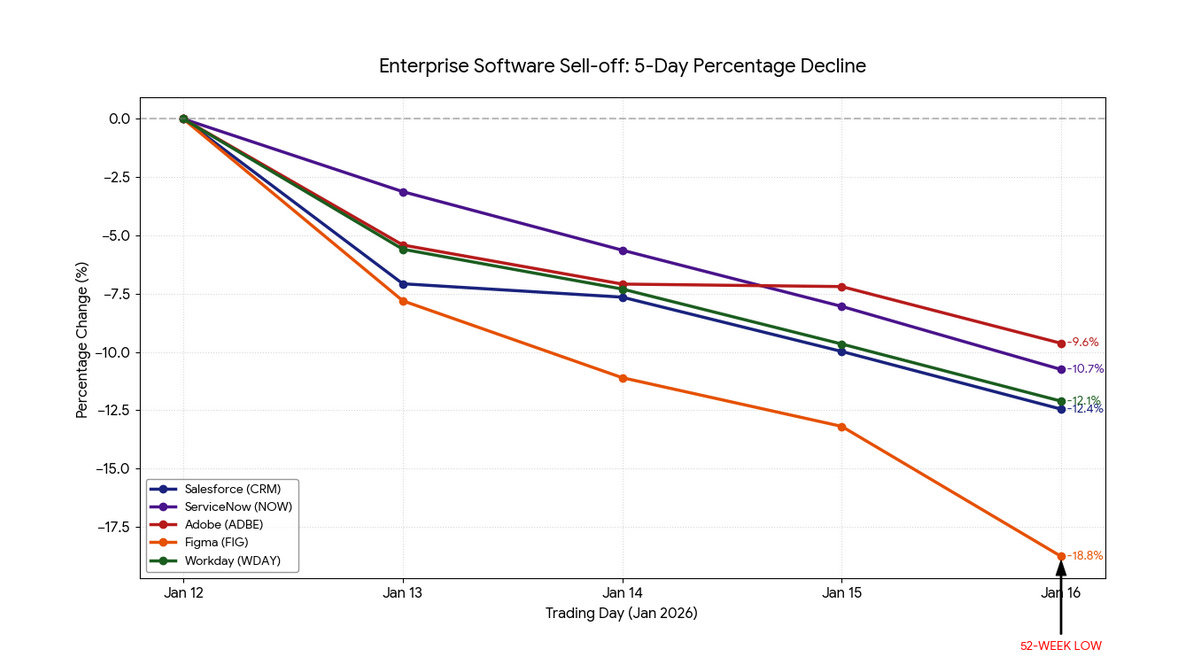
In just five days of trading, leading software incumbents like ServiceNow, Salesforce, Workday, and Adobe lost between ~9% to ~12% of market capitalization, while high-profile names like Figma continued their descent. Figma hit a 52-week low on January 16th, down ~19%. Few escaped the carnage.
Public markets are assuming that AI kills all software. This is wrong.
First, because “agents” are software. AI agents, as defined by UC Berkeley research, are “systems that combine foundation models with optional tools, memory, and reasoning capabilities to autonomously execute multi-step tasks”.
So software is not dead, literally. But what constitutes a moat in software has mutated, and that mutation is unfolding at full speed.
The distinction isn’t visible in current financials. It won’t be for quarters. Because moats break before revenues decline.
Looking at the growth of “AI revenue” in software stocks is using the wrong lens. Why? Because AI and agentic AI are becoming a base ingredient, when it actually goes beyond AI narratives that continue, in some cases, to lack substance.
What matters is the architectural resilience, which requires a different lens than the one investors have been using.
This article is about defining that lens and bringing some clarity. First, I analyze the Claude Cowork discontinuity and what it reveals about where we truly stand in the agentic paradigm, and why constrained orchestration, not autonomy, is the deployable frontier.
Then, I show which traditional software defenses quietly break when agents become the primary interface to work.
Finally, I outline new sources of durability that strengthen in an orchestrated world.
Discontinuity is real. The widespread panic is not justified.