


TL;DR: Monarch exposes the credit chain behind Anthropic’s $44.6 billion compute commitment: the financing, energy, construction, and equipment needed to make capacity usable. Nscale’s IPO tests whether the infrastructure company can coordinate those steps and whether a signed customer contract can support the capital required to deliver it.
Nscale’s IPO puts Monarch, its planned vertically integrated AI campus in West Virginia, at the center of a question behind Anthropic’s expansion: when a frontier lab commits to future compute, who finances the power, equipment, and construction required to deliver it? The answer will help determine whether contracted demand becomes operating capacity, and where economic risk and value settle along the way.
A year ago, I called compute Anthropic’s single point of failure: the Harness was only as durable as the silicon beneath it, supplied by companies that also had a stake in Anthropic. By May, the access problem had become acute. In “King Claude: The Orchestration Moat in Operation”, I examined Anthropic’s efforts to secure compute at scale. By August 2026, access was no longer the only question; the commitments that addressed it had created a financing challenge of their own. In “The Compute Trap 2.0: How Anthropic Refinanced Its Single Point of Failure”, I followed that shift.
Nscale brings that question to the supplier side. The British company is building an integrated AI infrastructure business spanning sites, power generation, data centers, and GPU capacity. Anthropic has agreed to take compute capacity at Monarch, according to Nscale’s S-1. Nscale’s Monarch materials and acquisition announcement describe the ambition to bring those layers together; the prospectus lets investors assess what it will take to turn that plan into an operating service.
Nscale filed its S-1 for a New York listing on September 18. The filing does not set a share count or offering price, but the Financial Times reported a valuation target of up to $35 billion. That’s more than twice Nscale's $14.6 billion valuation in its March Series C.
Our full institutional report, released today, applies the Durable Growth Moat™ framework to Nscale’s S-1. This companion article examines the supply-side credit chain: how customer commitments support, or fail to support, the financing of power, equipment, and construction. Nscale’s filing shows two different stages. Microsoft’s prepayments and the financing raised against them have supported capacity; Anthropic’s $44.6 billion Monarch commitment still depends on Nscale securing capital and delivering the campus.
The question for investors is how much of that unfinished chain the reported valuation already prices in.
What is Nscale building?
Nscale is building an integrated AI infrastructure business spanning powered sites, generation, data centers and GPU capacity.
The investment case rests on that integration. The British company says it owns every layer of an AI factory, from powered land and behind-the-meter generation to GPUs and the software that runs them. The premise is that one operator can coordinate site development, power, data-center construction, and GPU deployment with fewer handoffs.
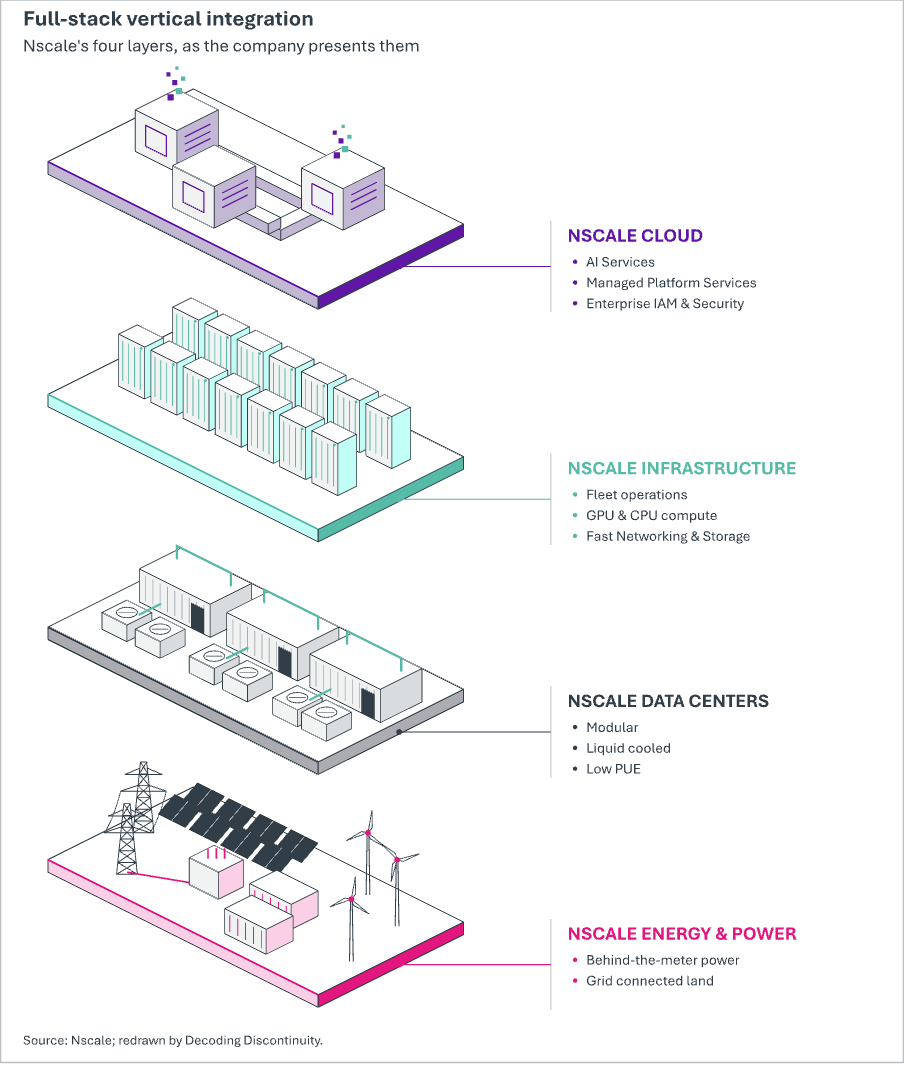
That ambition is far ahead of the current operating business. In the first half of 2026, Nscale generated $140.6 million in revenue and recorded a net loss of $1.02 billion. Two customers, Microsoft and Anthropic, account for about 85 percent of its contract book; the largest, unnamed in the filing, was 52 percent of first-half revenue.
The founder’s letter says Nscale has grown from $100 million in total contracted value to more than $103 billion. Microsoft’s statements of work, signed between September 2025 and April 2026, total $43.8 billion through 2033; Anthropic’s four agreements total $44.6 billion.
But only a small share of that book was tied to active capacity as of August 31: $2.6 billion, or about 2.5 percent. Nscale had 55 MW running against 1,370 MW signed, roughly 4 percent; only 7 MW of the running capacity was at sites Nscale owned. It also reported 25,000 active GPUs against 461,000 contracted, about 5.4 percent. The prospectus therefore asks investors to value a much larger pipeline alongside the business Nscale operates today.
Integration could create value by reducing delays across those layers. But it also concentrates capital and execution risk: Nscale still must secure permits, power, financing, and equipment, then deliver capacity customers accept.
Integration helps only if it makes those steps faster, cheaper, or more reliable.
What is the credit chain?
The credit chain is the sequence through which a customer’s commitment supports obligations upstream. The supplier must persuade builders and equipment providers to commit, financiers to fund the work, and the customer to accept the finished capacity. A large contract signals expected demand. It does not prove each step is financeable.
If one link weakens, risk shifts to counterparties, project timing, or the capital needed to keep building.
Nscale’s book shows two different stages.
The Microsoft chain is further along. As of June 30, Nscale reported $6.49 billion in deferred revenue, almost all from Microsoft prepayments. Lenders have also financed GPU facilities in Ward County and North Carolina — $1.85 billion and $1.2 billion, respectively—against Microsoft’s acceptance of delivered capacity. Elsewhere, Nscale’s sites in Norway and Iceland carry project debt, while its Dell framework agreements include $2.54 billion in equipment rent.
These arrangements show how customer commitments, lenders, and equipment providers can each support different parts of an infrastructure build.
The Anthropic chain is less complete. Nscale’s S-1 discloses no comparable prepayment or financing for the Monarch tranches. The contract is signed, but the steps between that commitment and operating capacity remain to be financed and delivered.
Monarch is where the difference between the two chains becomes visible.
Where is Anthropic’s credit chain incomplete at Monarch?
The missing link is committed financing: Anthropic has contracted for capacity, but Nscale still has to fund and deliver it.
The S-1 tells two stories about Monarch. In its growth narrative, it is a 2,250-acre site with the potential for up to 8 GW of gross behind-the-meter power. Nscale expects the first 2 GW of generation online by the first half of 2028 and describes a longer-term runway to more than 6.5 GW of IT load. The acquisition note is starker: it calls Monarch a “prospective data center site” with “no outputs.”
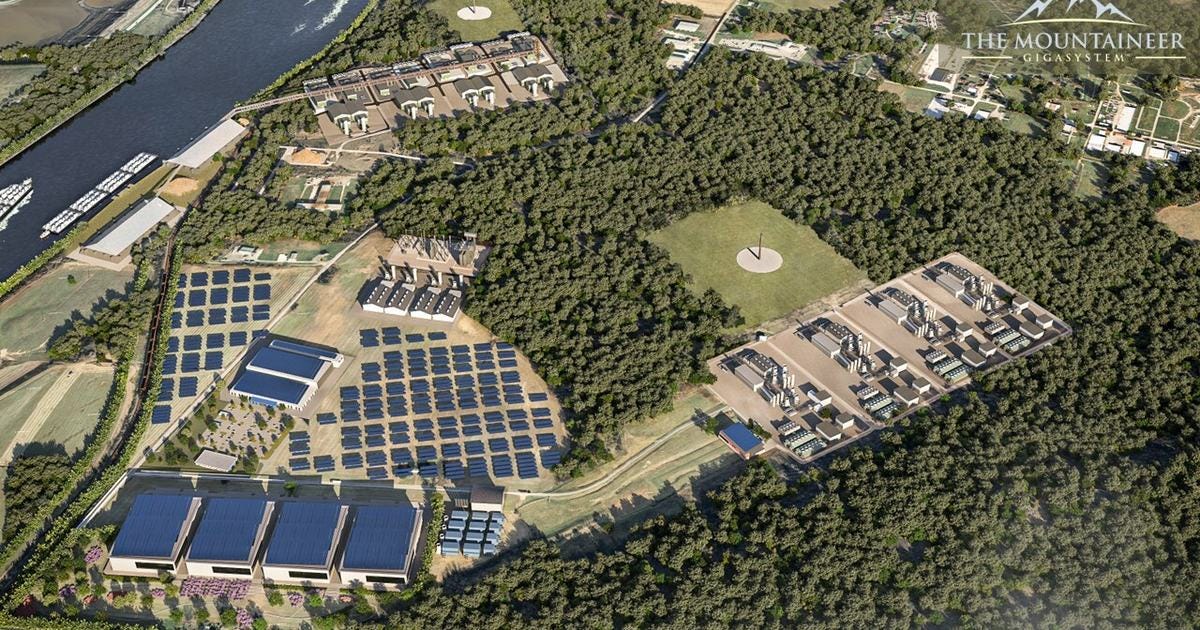
Nscale acquired AIPCorp, which included Monarch, on March 31, 2026, for stated consideration of $792.6 million, mostly in Nscale Series C shares. The accounts treat the acquisition as an asset purchase, not the purchase of an operating business. They record $743.4 million for Monarch’s power rights, valued using “megawatt-based market benchmarks.” Against the planned 2 GW first phase, that comes to about $0.37 million per gross megawatt: a value for development rights, not delivered power.
The risk factors list what remains between those rights and electricity: permits to obtain, generation to design and commission, natural gas to secure at commercially viable prices, and continued work with Caterpillar as generator supplier.
The filing offers no public calendar for those steps. State records do. West Virginia published a draft air-permit notice for 864 gas engines on September 29. The public meeting is scheduled for October 26, written comments close October 30, and the notice anticipates startup in April 2027. The pipeline that would supply the site is under construction, with completion targeted for year-end. Nscale has disclosed no gas supply contract.
Anthropic has contracted for 460 MW of the first phase’s 1.37 GW of IT load. That leaves 910 MW without a disclosed tenant, as well as the planned expansion beyond the first phase.
Monarch is not the only project where power delivery can affect the financing chain. Project Jupiter, Oracle’s planned campus in southern New Mexico for OpenAI workloads, now calls for 2.45 GW of Bloom fuel cells, replacing an earlier turbine-and-diesel plan. Its gas pipeline has been delayed until February 2027. In September, Oracle sent the developer a force-majeure notice seeking to defer payments if the campus misses its 2028 target. The notice shows how a delay in power delivery can shift costs back from a customer to the developer. oracle.com
Monarch also had a previous prospective customer. Nscale announced a non-binding Microsoft letter of intent for 1.35 GW at the campus in March; it lapsed over the summer, and the S-1 gives no reason. Anthropic signed later, for 460 MW. The distinction matters: Microsoft’s LOI was not a tenancy, and its withdrawal left no signed lease behind.
Transactions in 2025 and 2026 suggest that power rights gain value as a project advances. Rights before a permit can be worth a few hundred thousand dollars per megawatt. More value attaches when permits, financing and a creditworthy tenant are in place; even energized power can be worth less than its build cost without a tenant.
Nscale’s Anthropic agreements require it to use best efforts to obtain qualifying financing for the GPUs and data-center infrastructure. As of the filing, it had no binding commitments for that financing. It must place GPU orders within a specified period, deliver four tranches by dates redacted in the S-1, pass customer acceptance, and meet uptime requirements stricter than those in its other contracts. Anthropic pays nothing before a tranche is accepted; the unredacted terms disclose no prepayment or credit support.
That makes the $44.6 billion a contractual commitment, not operating backlog. Anthropic’s footnotes describe a non-cancelable spend obligation, but Nscale’s filing says the financing required to perform is not yet committed and gives Anthropic termination rights if it misses certain delivery deadlines. The going-concern note makes the gap explicit: the funding plan initially raised substantial doubt, and management said it could defer, reduce, or cancel capital spending if financing did not come through.
Fermi America is a cautionary comparison, though not a case of tenants simply failing to appear. It priced its 2025 IPO at roughly $14.8 billion in equity value; by October 2, 2026, its market capitalization was about $2.58 billion and its enterprise value about $3.11 billion. Fermi has since signed a TensorWave lease, but its SEC filing says it does not expect revenue until it begins delivering capacity.
Monarch is earlier in that conversion: its power rights carry an accounting value of about $0.37 million per gross megawatt, while permits, gas supply and financing remain unresolved.
The next question is what investors pay for a megawatt at each stage.
What is Nscale worth at IPO?
The report values Nscale at $12–22 billion of enterprise value and $11–20 billion of equity, with a center near $15 billion. The center sits above our $6–13 billion owned-power cash-flow case because the market pays a premium for financed megawatts based on margins seen at CoreWeave but not yet at Nscale. We accept that premium only on the financed Microsoft book, where a lender has underwritten the capacity.
The scenarios show how much value depends on execution. At assumed margins of 50–60% for rented sites—margins Nscale has not yet reported—the equity is worth $2–8 billion, supported largely by land. If Monarch earns the margins associated with owned off-grid power and clears its financing, permit, and gas hurdles, its value rises to $6–13 billion. If every contract earns margins comparable to the strongest peers, the upside case reaches $16–22 billion.
Our conclusion is a ceiling, not a target. We would cap our equity value at about $15 billion, and pay even that only once three conditions are met: Anthropic financing is committed with the counterparties named; more than 120 megawatts of capacity is energized and delivered, rather than guided; and Monarch has a final air permit and a signed gas-supply agreement.
At a reported IPO valuation of up to $35 billion, investors would be paying a GPU-cloud multiple for unfinanced megawatts and a tenanted-land price for Monarch’s unlet expansion runway.
What must Nscale disclose in an amended S-1?
Five disclosures would show investors how much of the Anthropic chain is financed and what remains contingent.
In August, I listed what Anthropic’s S-1 must disclose. Nscale’s amended filing is expected in mid-October and must include the following disclosures:
The length of the Anthropic longstop, the date after which late delivery becomes termination.
The financing status of each of the four tranches, and the sources in the “plan involving multiple financing sources.”
Any credit support from Anthropic: prepayment, deposit, letter of credit or guarantee. The unredacted text shows none.
The financing-cost assumption behind the fixed price. A fixed-price GPU-services contract with no financing is a bet on the rate at which the financing eventually arrives.
Anthropic’s share of total contract value and of planned capital expenditure, so that a buyer can see how much of the capital still to be raised sits behind the unfinanced chain.
What does Nscale’s IPO reveal about AI infrastructure financing?
Nscale’s IPO shows how frontier AI demand reaches operating capacity: customer commitments must support project financing, power, equipment, and delivery. Microsoft’s prepayments and lender-backed projects show the credit chain advancing. Anthropic’s Monarch commitment still depends on Nscale securing capital and bringing capacity online. Investors are being asked to price that execution risk today.
The Compute Trap has always had two sides: spend too little and lose the frontier; spend too much and overwhelm the economics. Anthropic addressed the first by committing to more capacity than any lab in history. So far, it has managed the second by moving much of the financing burden onto other balance sheets.
In August, I asked whose balance sheets and on what terms.
Nscale’s IPO brings that question to public investors. They must value an operating business alongside a plan to build much more capacity. The bull case is clear: demand grows, customers need dedicated deployments, and a provider that can assemble power and compute at scale becomes strategically important. If Nscale delivers its projects well, each completed campus could make it easier to attract customers, capital and suppliers for the next one. Coordination could become a competitive capability.
The risk is that real demand can still take a long, capital-intensive path to revenue. Nscale has to finance, build, power, and commission capacity before it can earn from workloads. Delays can raise costs, change financing needs, or reduce capacity value. The investment case turns on whether Nscale can deliver and repeat projects without letting the capital burden outrun the returns.
That distinction matters beyond Nscale: contracts show expected demand; the economics emerge when a supplier finances and delivers usable capacity at returns that justify the build. Investors should follow the milestones in sequence: project financing, permits and power, construction and equipment commissioning, customer acceptance, then evidence of margins and repeatability. Each step should make the next easier to finance and more likely to produce usable capacity.
Monarch puts that process on the ground. It is where Anthropic’s demand meets Nscale’s responsibility to finance and build. The question is whether coordinating those dependencies gives Nscale a durable advantage, or leaves it shouldering the project's cost and risk.
The contrast between Nscale’s customer books shows why the financing matters. Microsoft’s prepayments and lender-backed projects illustrate a chain supported by customer credit. Anthropic’s commitment still awaits that support. As of June 30, Nscale reported $27.5 billion of equipment and construction commitments against $1.5 billion of cash, before Monarch GPU orders. Our model assumes the IPO would fund the first of two required equity raises.
Nscale may still earn its valuation. The next tests arrive soon: the Monarch air-permit meeting is October 26, with comments due October 30; Nscale is reportedly targeting a November listing; and year-end disclosures should show whether energized capacity is growing. Together, these milestones will show whether the chain is advancing.
At the IPO, investors must pay today for an outcome those tests have yet to prove.
The full report lays out what must be true for a $35 billion valuation to hold. It tests the assumptions and execution risks, traces Monarch’s path from rights to operating capacity, and values Nscale under three cash-flow cases.
To inquire about receiving a copy of the full Nscale analysis, contact:
Mathieu Huet: mathieu@decodingdiscontinuity.com
or
Chris O’Brien: chris@decodingdiscontinuity.com
DISCLAIMER: The views and opinions expressed here are those of the author alone and are based on publicly available information. They do not constitute investment advice, a solicitation, or a recommendation to buy or sell any security or financial instrument. The author may hold positions in the securities of companies mentioned. Past performance is not indicative of future results. Readers should conduct their own independent due diligence and consult a qualified financial advisor before making any investment decision.