


TL; DR
The king. Anthropic was worth $61.5 billion at Series E in March 2025. It is closing approximately $50 billion of primary capital at a post-money valuation of roughly $900 billion in May 2026. The Wall Street Journal reports that Anthropic is on track for its first profitable quarter in Q2 2026, with $559 million in operating profit on $10.9 billion in revenue, implying a 5.1% operating margin. The SpaceX S-1, filed May 20, 2026, disclosed that Anthropic could pay xAI up to $40 billion through May 2029 for the full 300 megawatts of capacity at the Colossus I data center and has an agreement for capacity at Colossus II. Musk later clarified the termination terms, leaving far less firmly committed than the headline suggested. By every operational and financial measure, Anthropic is king of the first agentic cycle.
The thesis. The trillion-dollar question now: can Anthropic defend the throne? Its success rests on its ability to successfully do three things simultaneously: leverage its current position at the Harness layer to win the orchestrator role, the position at the center of the agentic enterprise IT stack; maintain the overall rapid pace of adoption; and avoid three potential Single Points of Failure. I will explore each of these factors in depth using the frameworks and methodologies outlined in AGNT: The Orchestration Economics Manifesto. The System of Execution, published in August 2026, revisits the interface risk against Anthropic’s $2 trillion IPO case.
How it got there. Context matters, so we must first understand the conditions that fueled Anthropic’s stunning rise to dominance. Last year (2025), when I argued that the AI race would not be won at the model layer but at the orchestration layer, that position seemed like an outlier, and Anthropic was valued at $61.5 billion. Now, this is almost a consensus, and yet it is still often poorly understood how Anthropic built its agentic orchestration moat.
What $900 billion requires. The mark is 30x against $30 billion of annualized revenue. Against the May 22, 2026 hyperscaler comparables (Alphabet 11.1x, Microsoft 8.7x, Meta 7.2x), Anthropic looks expensive; against the only other private frontier lab at scale (OpenAI ~35x at $852 billion / ~$24 billion), Anthropic is the cheaper of the two. The bull case prices Anthropic on a trajectory to enter the mature hyperscaler cohort, which requires revenue to roughly triple to a ~$90 billion annualized run rate and for the multiple to compress to ~10x, into Alphabet-adjacent territory. The 80x YoY revenue growth disclosed for Q1 2026 leaves substantial deceleration headroom inside that envelope. Plausible. Not yet earned.
A narrative ahead of reality? For the first time in this cycle, Anthropic’s narrative may be running ahead of its valuation rather than behind it. The architecture has been validated. The execution evidence is partial. The three conditions hold today. The next eighteen months will produce the evidence on whether the moat is genuinely durable or whether the king’s throne is more contestable than the priced reality currently suggests.
During the early, intoxicating dot-com years, it was common to hear someone say that one year in internet time felt like seven years in the real world. The accelerated Agentic Era has further compressed that sense of time. Now, one month feels like seven years.
Which is why turning the clock back to just May 2025 somehow feels like reaching back to another, distant era. But as we stand on the cusp of what may be the three most consequential IPOs in the history of the technology industry, it’s essential that we understand the pivotal events of the past twelve months that shattered conventional wisdom
Put aside benchmarks and valuations for a moment. In late May 2025, the consensus was that OpenAI had become a juggernaut, dominating consumer markets, mindshare, press, and awareness. It has raised billions more. It had the splashy infrastructure announcements made from the White House. Everyone else was gasping for air and relevance.
A May 2025 report by multi-model platform Poe suggested Anthropic had lost ground to OpenAI since January 2025 in terms of model quality and market share.
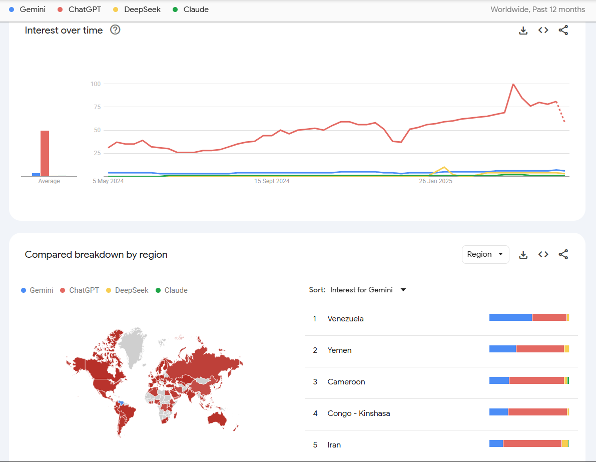
“Owning that segment not only locks out rivals, but also gives a long-term advantage in terms of revenue and the ability to invest in future models,” Ben Thompson of Stratechery wrote in June 2025 of OpenAI, while noting that Anthropic’s bet on “coding is a riskier position in some respects.”
Flash forward to the present day. The Agentic World has been turned upside down.
Now, Anthropic is such a force that it can drop niche plugins and wipe out billions in market cap on stock markets. It rolls out new products that extend its functionality both horizontally and vertically at a relentless pace. The company’s latest model, Mythos, is reported to be so powerful that it has spooked businesses and governments around the world. Anthropic is growing at an unprecedented pace and outstripping its own projections, so much so that it struck a deal to lease compute from former rival xAI, essentially making it one of the biggest pieces of SpaceX’s business.
This reversal of fortunes has left even the most astute observers struggling to fully explain Anthropic’s momentum. This is natural because they are turning to old frameworks in search of answers. What they are not recognizing is that generative and agentic AI have created a Discontinuity, not just a disruption, that requires making a clean break with past ideas, playbooks, models, and frameworks.
That’s why understanding how Anthropic got here is more than just a history lesson or a walk down Agentic Memory Lane. The why is essential to decoding the nature of the Agentic Era, both what matters now and what will continue to matter in the coming months and years as the new paradigm of Orchestration Economics continues to take shape.
Almost a year ago, while the world was still obsessed with model benchmarks, I began arguing that the real race was not for the most intelligent model. It was for the layer above intelligence: the layer that decomposes goals, delegates to specialist agents, manages state, and accumulates cross-system understanding across sessions. I called it the “Orchestration Layer” or “Harness “in the first essay of the Agentic Era series and argued that the moat would accrue to whoever built it.
Anthropic established a structural position in the enterprise via coding, which I dubbed the “Coding Wedge.” From there, it used that structural position to learn how to deploy and orchestrate agents at an accelerated rate. That advantage began to compound exponentially to the point where it became visible earlier this year, and suddenly, Anthropic had been transformed into an unstoppable force.
Nonetheless, we are still early in the deployment of agentic fleets, and Anthropic has yet to establish itself in the enterprise beyond an API provider, albeit a dominant one, and to demonstrate that it can occupy the seat of the “Orchestrator,” the strategic position by which an actor receives a human intent, orchestrates a series of agentic workflows to execute it so as to produce a business outcome. Orchestration is a complex architectural construct in the enterprise and, in my view, is the foundation for building a moat and durable growth in the Agentic Era.
I want to break from my usual newsletter format this week to do two things. First, at this critical juncture, I wanted to review what I had written over the past year and assess what I had gotten right and where I had missed the mark. The new rules of Orchestration Economics are still emerging, and it’s essential that we be willing to test all assumptions and theories against the reality that develops. And second, I want to use this essay to view these ideas and frameworks from Anthropic's perspective and examine the nature of its architectural moat in depth to illuminate how these dynamics are shaping the Agentic Era.
The Context
Anthropic was valued at $61.5 billion when it raised its Series E in March 2025. The investment debate among institutional allocators at the time was whether Claude 3.7 had a measurable benchmark advantage over GPT-4o and Gemini 2.5, an argument whose answer rotated week to week within a five-point band. The investment thesis on frontier labs was straightforward: pay for the model that wins on the benchmarks.
Twelve months later, Anthropic is closing a round of approximately $50 billion at a post-money valuation of roughly $900 billion. Its success in coding became a springboard for winning the enterprise. Any notion that consumer mindshare would translate to back-office adoption has faded from memory.
Independent enterprise trackers confirm the leadership shift. Menlo Ventures’ 2025 State of Generative AI in the Enterprise report, released in December 2025, found that Anthropic captured 40% of enterprise LLM API spend, compared with 27% for OpenAI and 21% for Google. Anthropic’s share was up from 24% the prior year, and OpenAI's was down from 50% in 2023.
The Ramp AI Index, released in May 2026, drawing on transaction data from more than 50,000 US businesses, recorded Anthropic surpassing OpenAI in business adoption for the first time: 34.4% of businesses paying for Anthropic versus 32.3% for OpenAI, with Anthropic having quadrupled its business adoption year over year while OpenAI grew 0.3%.
Facing a potential compute crunch, Anthropic made a shocking deal with xAI. According to the SpaceX prospectus filed on May 20, 2026, Anthropic will pay xAI $1.25 billion per month through May 2029 for the full 300 megawatts of Colossus 1. The architectural inversion is now in the public record: the company that built the largest speculative GPU cluster of the cycle has become the supplier to the company that solved enterprise demand.
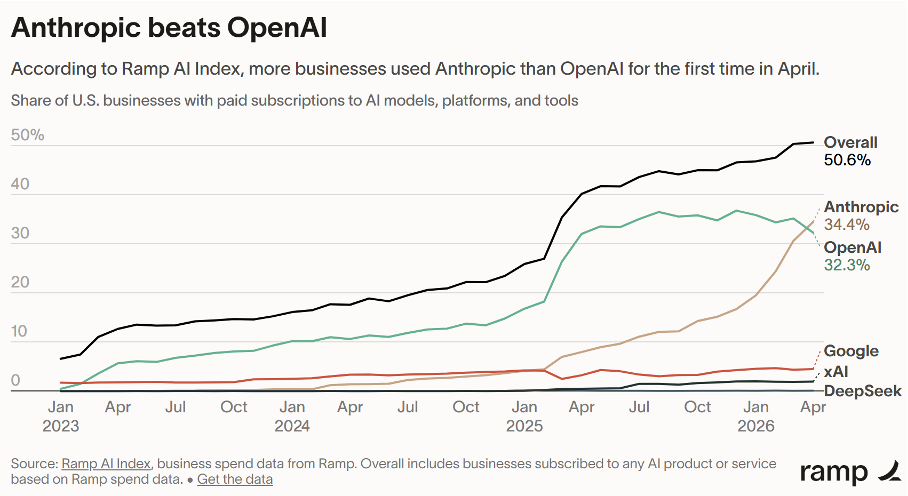
Even now, the classic benchmarks can muddy this picture.
Consider one apparent counter-signal: Microsoft and OpenAI leading the narrower agent-orchestration-platform metric in recent enterprise surveys (Copilot Studio/Azure at 38.6%, OpenAI Assistants at 25.7%, Anthropic at 5.7% in VentureBeat’s Feb 2026 tracker). However, this sits at a different layer than the model-spend race. Microsoft’s lead is largely a distribution artifact of the M365/Azure estate; OpenAI’s standalone share is real but materially below its model-API position.
The model-and-spend layer (Menlo 40%, Ramp 34.4%) is Anthropic versus a catching-up field; the orchestration control plane is a separate, still-contested layer where Microsoft’s tenant-level distribution is the structural incumbency to beat.
That also explains Anthropic’s recent product direction: Claude Managed Agents, Agent Skills, shared Excel and PowerPoint context, and the Copilot Cowork partnership with Microsoft all point toward the same strategic objective: ownership of the orchestration layer itself. Anthropic is clearly treating orchestration as a contested frontier, one that is far from settled.
What gives us a clearer picture of Anthropic’s ascendancy is the financial information that has been publicly disclosed so far:
Revenue trajectory. Anthropic’s annualized run-rate grew from approximately $1 billion in late 2024 to $9 billion at the end of 2025, to $14 billion at the Series G announcement on February 12, 2026, $19 billion in March, and to approximately $30 billion in April 2026.
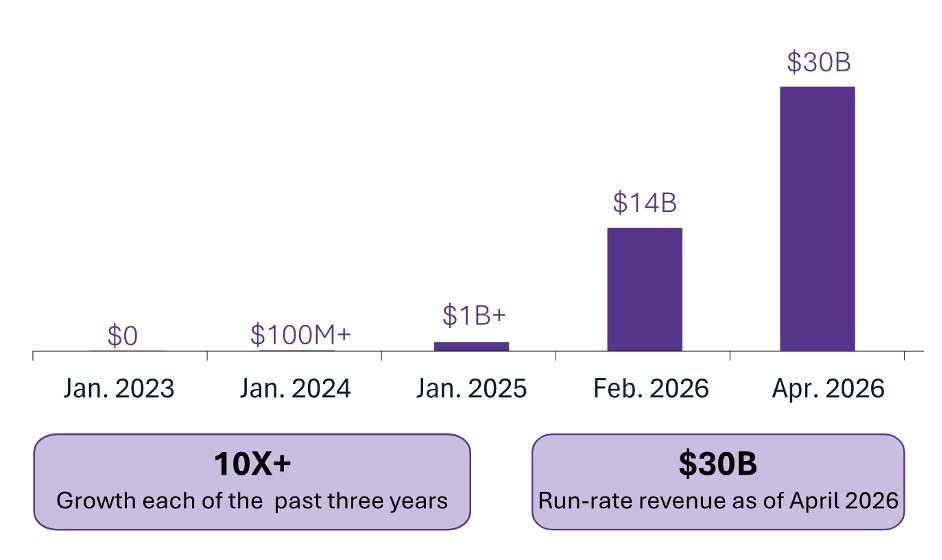
Anthropic’s Series G announcement framed this as approximately 10x annual revenue growth in each of the prior three years. CEO Dario Amodei told VentureBeat that Q1 2026 growth represented 80x year-over-year, exceeding the company’s own internal projection by a factor of eight. The Q1 2026 revenue, per The Wall Street Journal, was $4.8 billion, and the outlet also reported that Q2 2026 is on track for $10.9 billion in quarterly revenue and a projected $559 million in operating profit for Anthropic.
Margin direction. The Q2 2026 5.1% operating margin contrasts with OpenAI’s Q1 2026 operating margin of approximately negative 122%. Anthropic’s margin trajectory is visible in three public dimensions:
Each Sonnet release has improved inference economics measurably over its predecessor, with pricing-versus-capability gains disclosed at launch.
The hyperscaler compute deployments, most notably Google TPU for first-party workloads, produce favorable unit economics that Anthropic has attributed to architectural fit.
The progressive mix shift toward higher-margin first-party enterprise revenue relative to API-reseller volume is evident in the disclosed enterprise customer counts. API and product growth. At the Series G announcement, Anthropic disclosed that Claude Code had reached an ARR of $2.5 billion, more than double since the start of 2026, with weekly active users also doubling in the same period. Approximately 4% of all public GitHub commits worldwide are being authored by Claude Code, twice the figure of one month prior.
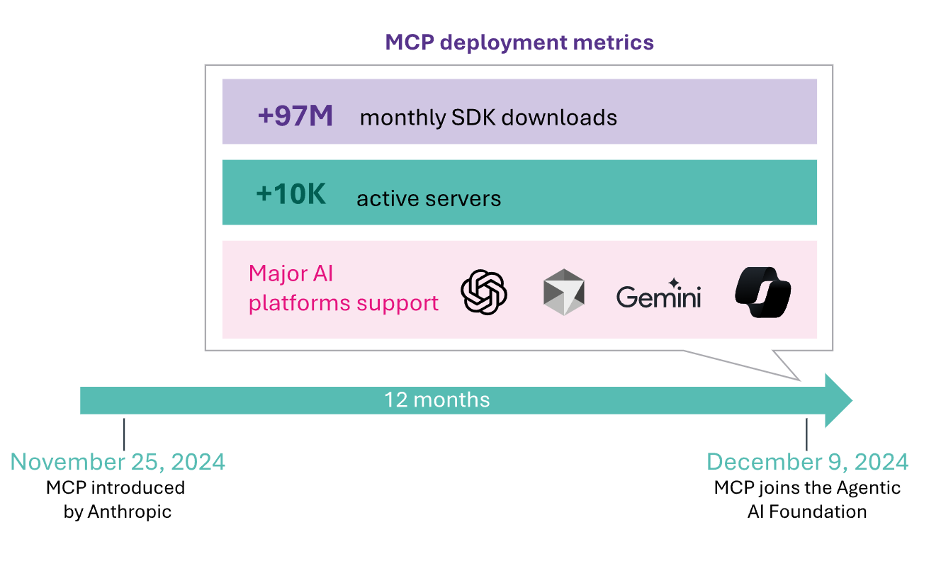
Business subscriptions to Claude Code quadrupled in two months. Enterprise use represents more than half of Claude Code's revenue. The Bedrock customer count crossed 100,000 in April 2026. Customers spending more than $1 million annually crossed 1,000, doubling in two months. Eight of the Fortune 10 and 70% of the Fortune 100 are now Claude customers. MCP downloads exceeded 97 million per month, per Anthropic’s March 2026 disclosure.
Compute commitments. The public disclosures resolve into two distinct stacks. Equity into Anthropic from compute partners of approximately $80 billion, including:
AWS up to $25 billion
Google up to $40 billion ($10 billion cash plus $30 billion milestone-contingent)
Microsoft $5 billion
NVIDIA up to $10 billion
Anthropic’s disclosed compute commitments total approximately $400 billion across the cited term lengths, plus 1 GW of reserved NVIDIA Grace Blackwell / Vera Rubin capacity not separately priced:
AWS, more than $100 billion over ten years alongside 5 gigawatts of Trainium2/Trainium3 capacity;
Google, approximately $200 billion over five years alongside 5 gigawatts of TPU capacity arriving in 2027;
Microsoft Azure, $30 billion;
Fluidstack, $50 billion for custom Texas and New York data centers;
Add to this Anthropic's participation as one of the AI lab signatories to the Department of Energy MOUs under the Genesis Mission executive order of November 24, 2025, which lists nuclear fission and fusion among its priority scientific domains. Then the SpaceX S-1 disclosure ($40 billion through May 2029).
This last item is approximately $15 billion in annualized compute payments recorded on the income statement, against $30 billion in current annualized revenue.
That’s about half of the revenue committed to a single supplier, which is also Anthropic’s most direct competitor in frontier models.
These numbers describe the king’s throne and the moat he has attempted to build around it. The architectural question remains: what will be required to defend it? One answer arrived in September 2026: permission to operate the frontier.
Act I - May 2025: The bet on orchestration
The dominant investment thesis among institutional allocators in May 2025 was that the AI race would be won at the model layer. Several labs clustered within 5 percentage points across every standardized evaluation: MMLU-Pro, GPQA-Diamond, Humanity’s Last Exam, and the latest iteration of SWE-Bench. The leaderboard rotated every six to eight weeks. No frontier lab held a sustained, measurable performance edge.
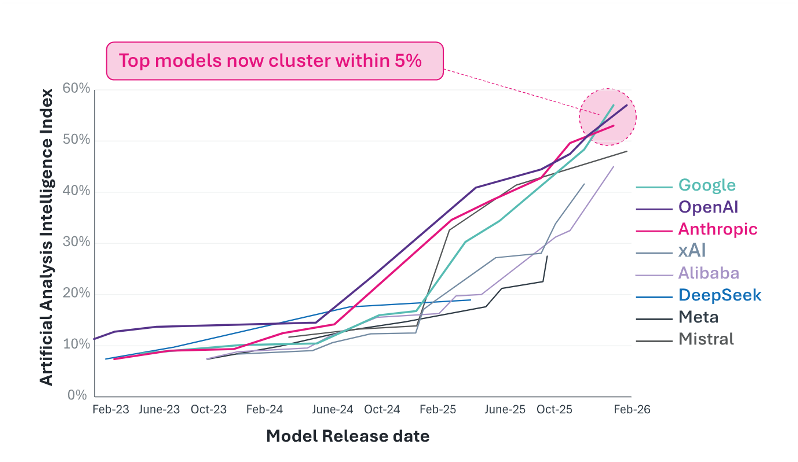
My reading of those benchmarks deviated from the consensus. The cluster was the signal. When three or four labs converge within measurement-error bands on every standardized evaluation, and when the leaderboard order rotates faster than the publication cycle of those evaluations, the most likely interpretation is not that someone is winning. It is that intelligence had commoditized.
I argued in the May 2 essay that durable value would accrue not to the lab with the highest benchmark scores but to the lab that controlled the coordination layer between commoditized intelligence and enterprise context. I listed four mechanical advantages required to build it:
connection protocols that standardize how models reach external systems;
agent frameworks that guide multi-stage reasoning;
tool-integration systems that extend model capability through specialized services;
interface design patterns that translate raw intelligence into intuitive user experiences.
The first of the four was the most important. Anthropic launched the Model Context Protocol (MCP) in November 2024. By Q2 2025, OpenAI and Google had both adopted it as a standard for connecting their models to external systems. By May 2025, the protocol war was effectively decided. But the consensus continued to frame the competition as Claude versus GPT-4o versus Gemini.
I argued that Anthropic had set the connection standard for the entire cycle and would capture value from every integration built on top. In retrospect, I was partially right and partially exposed.
Setting an open standard is not the same as monopolizing the value of that standard. Open protocols are, by definition, public utilities. TCP/IP did not enrich its authors. MCP’s universal adoption solves the connection problem at the layer above the model and below the application. But in doing so, it commoditizes the protocol layer itself. Value can leak in two directions from a commoditized protocol: downward, to whichever model performs best inside the coordination envelope; or upward, to whoever owns the distribution surface that aggregates user intent.
The protocol owner’s claim to value depends on holding either the model layer beneath or the distribution layer above. Holding the protocol alone is insufficient. In May 2025, the thesis was that Anthropic would control both. So far, that thesis has held.
At the time of publication, Anthropic was valued at $61.5 billion, while OpenAI stood at nearly $300 billion. My argument was that this gap would narrow as the market came to understand what Anthropic was actually building. This ran against both prevailing valuation assumptions and the analytical consensus underpinning them.