

TL;DR: The AI build-out can have strong demand and a serious debt problem at the same time. Demand is printing at the chipmakers. The debt problem sits with the compute landlords that borrowed against future rents. In 2026, the layer built that way can be named: CoreWeave, Nscale’s Monarch campus, Oracle’s campuses, and the vehicles around them.
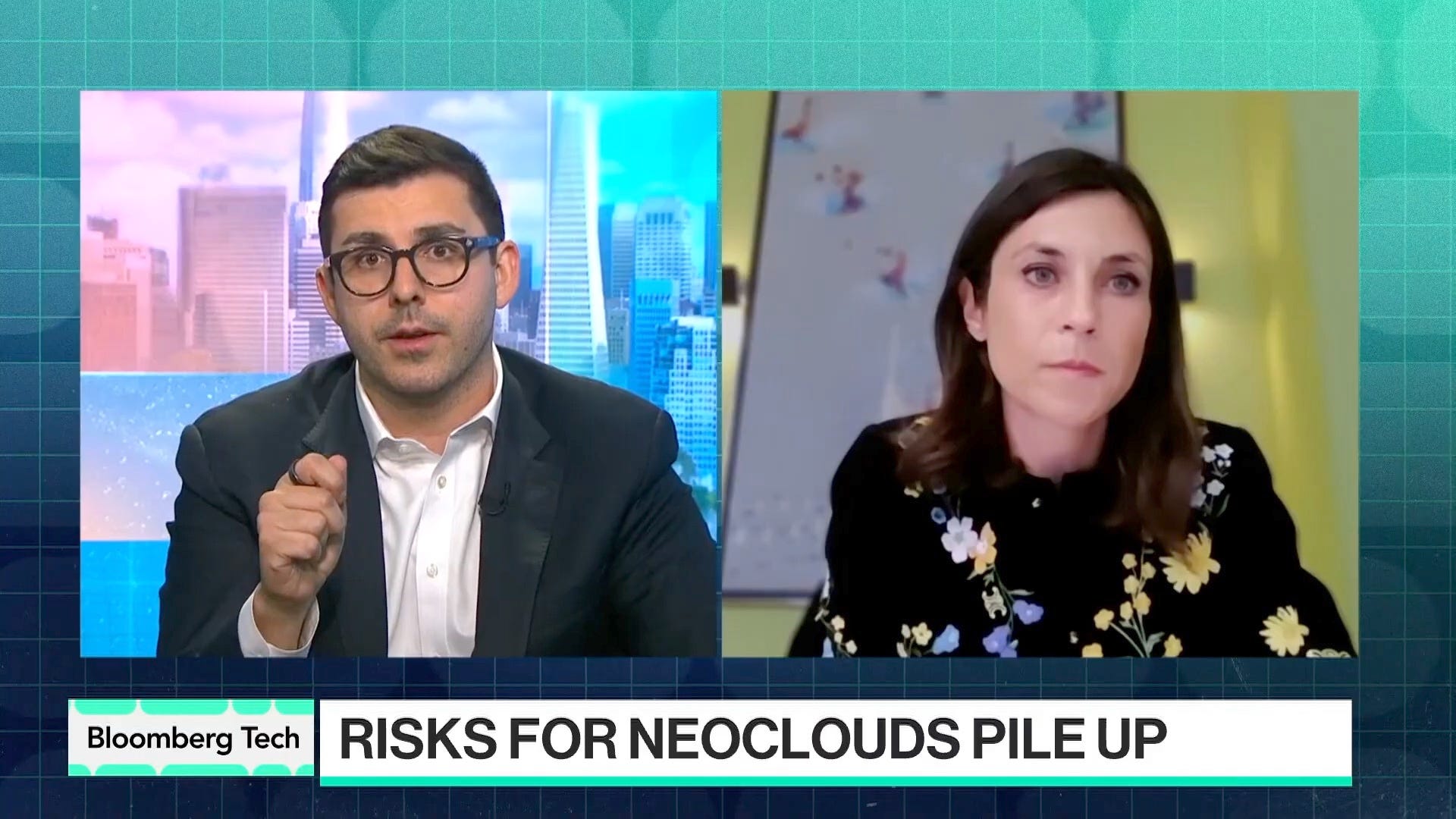
I recently joined Ed Ludlow on “Bloomberg Tech” to discuss concerns about the enormous debt financing the AI infrastructure boom is driving and the increasing scrutiny on the neocloud sector. During this segment, I shared my views on the larger issue, as well as CoreWeave and Nscale.
The divide between debt and demand sharpened on October 15.
On that Thursday, the cost of insuring CoreWeave’s debt reached a level where one market-implied measure translated into a greater-than-even probability of default within five years. Yet the same day, TSMC, which manufactures almost every advanced chip the build-out runs on, reported a quarter of $46.7 billion, raised its growth forecast to about 44%, and told analysts demand was “far above our capability today to supply.”
By Friday evening, the semiconductor index had fallen for the eighth session in a row, its longest losing streak since the financial crisis. The word “bubble” now described both signals. But strong chip demand and serious credit risk among compute landlords can coexist.
A year ago, I wrote that the market was right to see a short-term bubble, but was missing the bigger picture. More specifically, it got one part of this structure right. This essay draws a line around that part: where the 2000 analogy holds, where it breaks, and which maturities could turn a credit problem in one layer into a wider crisis.
The people crying “bubble” are not fools, and they deserve a precise answer that starts with a definition. For this essay, a bubble is not a price. It is a funding structure that needs new money on a schedule the market may not keep. Falling prices for AI output matter because they are what persuade lenders to stop. Maturities matter because they set the date by which the money must be found.
The analysis turns on three questions: how fast the price of AI output is falling, and for whom; who is paid in cash and who is paid in that falling price; and which borrowers need new money before their assets can repay the debt that bought them.
What the 2000 Telecom Crash Reveals About AI Debt
Market panics draw attention to prices. To understand what happened in 2000, let’s start with the financing.
The demand for bandwidth was real, and it grew for a decade. But the carriers had promised it would double every hundred days. Instead, it doubled roughly once a year. That gap left much of the new fiber dark for years, until companies that bought it from bankrupt carriers’ estates for cents on the dollar put it to work.
Being wrong about demand speed should have produced a bad year. Because of how the networks were financed, revenue didn't arrive on schedule to pay for the capacity, and the market crashed.
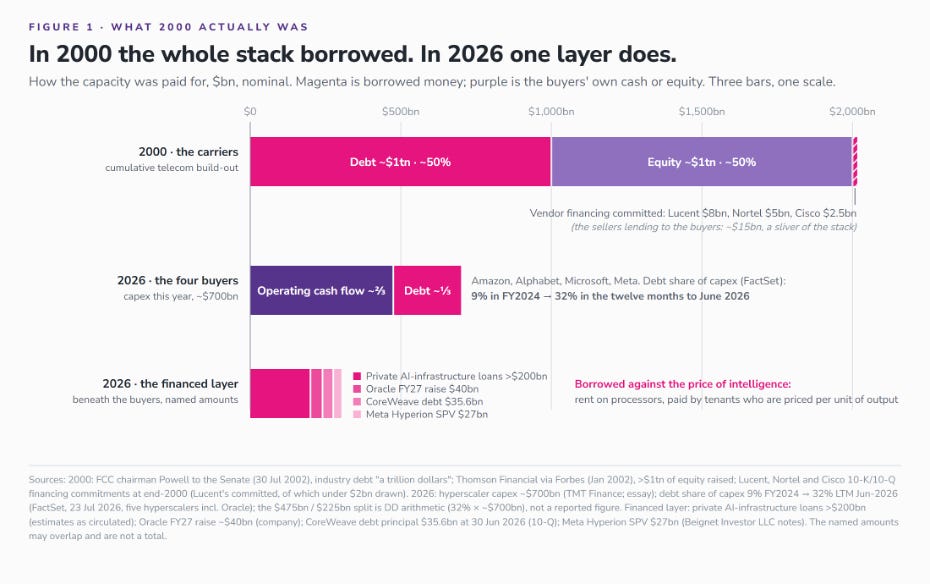
The carriers financed the build-out with roughly $1 trillion in debt and a similar amount in equity, while the price of bandwidth fell as each new network came online. The equipment makers also lent to their own customers: Lucent alone committed about $8 billion, so one carrier’s order could appear twice in the system, once as a sale and once as a loan that funded it.
Readers who followed the circular deals around OpenAI last autumn will recognize the shape. I wrote about them then under the title King Sam, and the mechanism has not changed, only the names.
However, falling bandwidth prices alone did not kill the carriers. Most continued to generate enough revenue to service their existing debt. Their vulnerability was the need to issue new bonds and shares to keep expanding and to refinance. When carrier stocks fell by two-thirds between spring 2000 and spring 2001, the equity market closed to them. The high-yield bond market followed.
Global Crossing filed for bankruptcy owing $12.4 billion, in an industry whose long-haul capacity, by the Dallas Fed’s count, was used at less than 3%. Level 3 survived by exchanging bonds for shares before a major maturity came due. Falling bandwidth prices gave lenders a reason to pull back. The maturity schedule determined which companies survived.
I’ll use that distinction throughout this essay.
Still, when the collapse began, it was not contained. It traveled up the stack and reached the suppliers.
Consider Cisco, the dot-com era networking giant. It carried no long-term debt in fiscal 2001 and held $4.9 billion in cash plus $2.0 billion in short-term investments. It also led in so-called vendor financing. By late 2000, it had committed about $2.4 billion of loans to carriers, of which roughly $600 million was drawn. In April 2001, it recorded a $2.25 billion inventory charge after demand fell sharply, and by that autumn its stock had fallen 84% from its March 2000 peak.
In 2001, the supplier’s balance sheet was never the question. The buyers’ was.
Falling AI Model Prices Meet Rising Financing Costs
The build-out rests on one commercial assumption: that the price at which intelligence is sold will hold up long enough for the capacity that produces it to be paid off. Every landlord’s lease and every lender’s model carries that assumption. So before sorting who borrowed against what, you have to measure the price, because the falling token is 2026’s version of the falling bit.
Something real is changing in 2026, and it is not demand. On Saturday, October 17, DeepSeek pushed an update to its V4.1 Flash model into live service, better on every benchmark it reported, at the same price, thirty-seven days after the previous version. One model update cannot establish an industry-wide trend. The indices can.
Silicon Data’s token-expenditure index, a spend-weighted blend of what developers pay per million output tokens across more than 400 models, fell by more than 40% between late May and August and has stayed just under $1 since. Ramp’s panel of corporate card spending shows the effective price its customers paid per million tokens down 41% between March and September. A third measure from Vercel’s AI Gateway shows the same price pressure alongside rising usage: in September, open-weight models handled 71.5% of gateway tokens and 23% of its spend. Total gateway spend was about 13 times December’s, while the average price per token was 47% lower.
Here is the distinction the headlines miss. The open-weight models have been cutting all year. The frontier has not. Anthropic’s most capable tier has carried the same list price since June, and OpenAI launched its September flagship at about twice the listed price of the model it replaced. The frontier labs have cut everything beneath the top rung: Anthropic reduced its second tier by a fifth in September and its cheapest tier by about three-quarters this month. Prices are collapsing where capacity is abundant and holding where it is scarce. That matters for credit because the labs’ revenue per unit, and so their ability to pay their landlords, rests on the frontier price. Anthropic offers the test case.
On 14 October, Anthropic told investors it earned $16.8 billion in the third quarter, about 45% more than in the second. Most of that growth happened before the quarter began; by my arithmetic, monthly revenue rose about 3% each month from July to September. A company’s revenue can grow while its growth rate slows, and a token price can fall while token spending rises. Both are true at once.
Against that, the cost of capital rose: the 10-year Treasury yield touched 5.33% on 14 October, and the weakest corporate credits, rated CCC and below, trade at their widest spreads since 2023. The industry is caught between cheap intelligence and expensive capital.
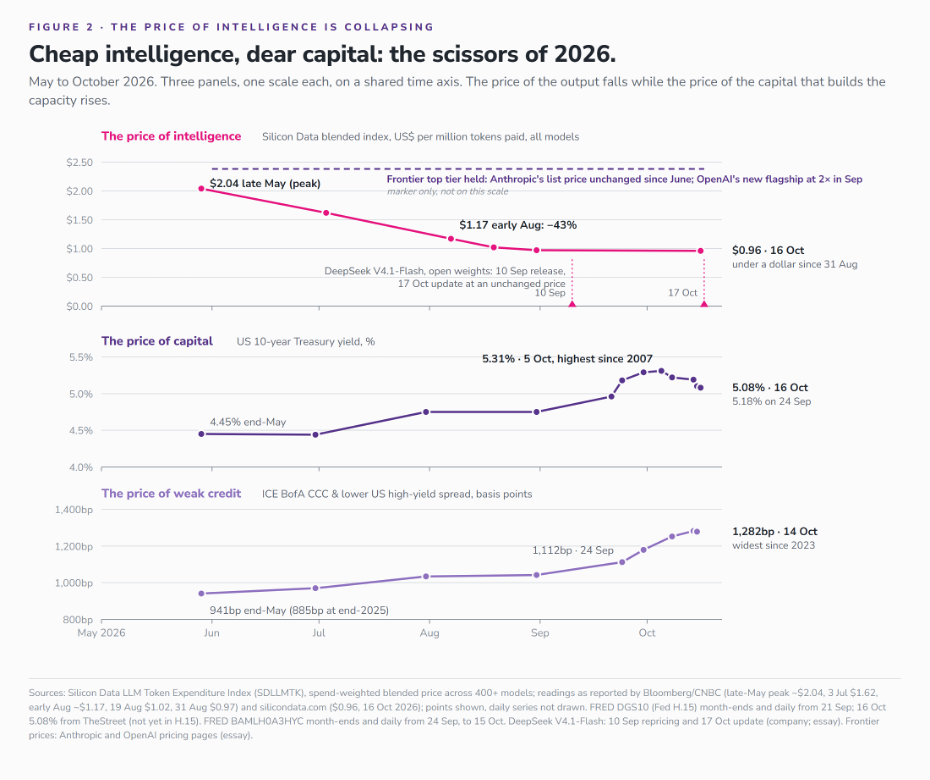
Compute landlords face the sharpest version of that test. Their debt service depends on tenants paying leases priced during a shortage and on landlords’ ability to refinance. A fall in the frontier price becomes a credit problem the day it weakens those cash flows or closes the refinancing window.
I watch the frontier price every week. I watch the window first. In 2000, bandwidth prices fell for years. The carriers died in the twelve months the window was shut.
Who Pays for AI Infrastructure—and Which Layer Carries the Debt?
Now the sorting: who earns cash from current AI demand, who is borrowing to build capacity, and who must refinance against future rents?
Are AI chip suppliers as exposed as telecom carriers?
Mostly no at the balance-sheet level, though someone else can still finance their orders.
Amazon, Alphabet, Microsoft, Meta, and Oracle are expected to spend about $800 billion on capital investment in 2026, mostly on AI infrastructure. Four of the five fund it through search advertising, retail margins, software licenses, and cloud rent, none of which is priced in tokens. Their suppliers therefore sell to companies with diversified revenue sources, not to carriers whose returns depended on a still-unbuilt internet.
In the latest filings I compared, six of the seven largest chip and equipment suppliers held more cash than debt: Nvidia, TSMC, Samsung, SK Hynix, Micron and ASML. That removes the channel through which 2001 became a cascade: a supplier default. It says nothing about canceled orders, excess inventory, lower utilization, or falling share prices.
And in 1999 the demand was a forecast. This month it printed while the shares fell. TSMC reported $46.7 billion in third-quarter revenue, up 41% from a year earlier. Micron guided its next quarter 13% higher. Samsung reported a record operating profit. Yet the Philadelphia semiconductor index fell for eight sessions through 16 October, its longest losing run since 2008.
The earnings show that demand is arriving today. The sell-off shows investors questioning what today’s demand will earn tomorrow. Supplier cash does not mean every order is paid in cash. Dell reported $20.4 billion in net financing receivables, mostly from financing purchases of its own products, with some sold without recourse. That is the Lucent channel under a new name, smaller and better secured.
Efficiency cuts both ways for the suppliers. I argued in February 2025 that cheaper models do not rescue capacity already built. They make new workloads affordable and raise demand for the next unit of capacity, which is what TSMC sells, not a landlord holding last year’s processors on a six-year loan.
Are hyperscalers still funding the AI build-out from cash?
Less than before. They remain stronger and more diversified than the carriers of 2000, but outside money now makes up a larger share of the build-out, and one of the five has left the cash column altogether.
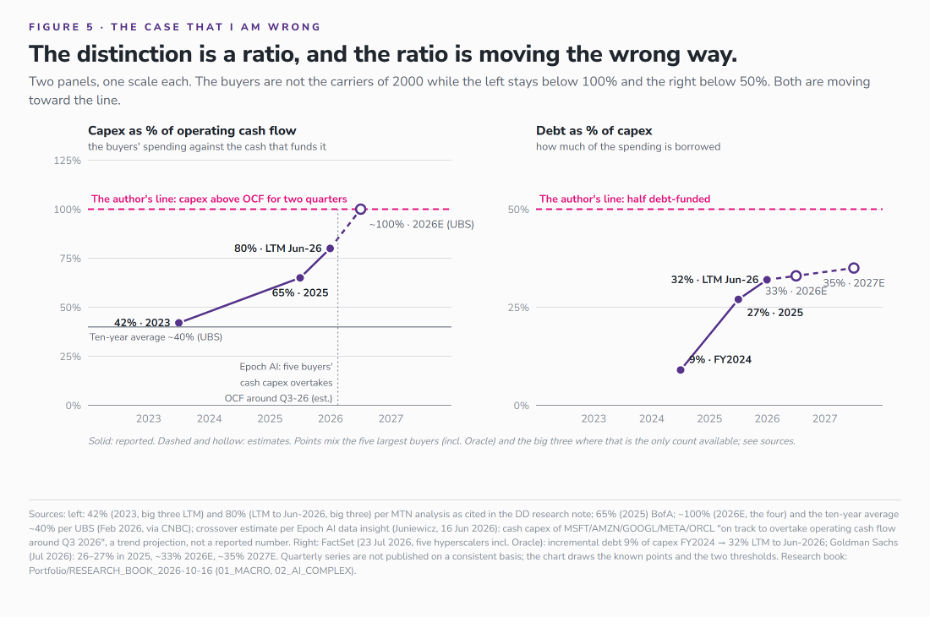
FactSet estimates that incremental debt funded about 9% of hyperscaler capital spending in fiscal 2024, rising to 32% on a trailing-twelve-month basis by mid-2026. Epoch AI estimated that the five largest hyperscalers’ cash capital spending could overtake their operating cash flow around the third quarter. That crossover is an estimate, not a reported quarterly result.
Borrowing has risen too. CRISIL counts about $218 billion in dollar-equivalent debt the five hyperscalers issued in 2026 so far, roughly twice their total for 2025.
The individual balance sheets still matter. Alphabet reported $98.2 billion in long-term debt at the end of June, about seven months of its operating cash flow. Meta borrowed $25 billion through a bond sale and stopped buying back shares. Amazon’s trailing free cash flow turned negative in the second quarter, and Alphabet reported its first quarterly deficit, two facts I set out in August when the quarter’s filings landed.
The terms are the opposite of 2000. Alphabet has issued 40-year notes and a rare 100-year bond, and the longest bonds Amazon and Meta sold this year run to forty years, against processors written off in five or six. The whole company supports that debt, not just the chips. The carriers borrowed short against assets that paid late. The hyperscalers borrow long against assets that pay early.
“Cash-funded” no longer describes the whole build-out. The lender’s terms, collateral, and maturity schedule now matter as much as the share of spending financed externally, and on those terms the four are still the inverse of the carriers. The ratios are moving, and I've plotted my own line below.
Oracle is the exception, and it bridges to the next layer. It chose to become a landlord with an investment-grade rating. In the fiscal year to May, it spent $55.7 billion on capital investment against $32 billion of operating cash flow, raised $43 billion of debt and $5 billion of equity, and has guided this year’s spending to $90 to 95 billion and plans to raise about $40 billion of debt and equity this year. Its five-year default swaps closed at a record 261 basis points on 8 October. Its largest campus, Project Jupiter in New Mexico, is being built on an $18 billion loan arranged by about twenty banks, and on 24 September Oracle served a force-majeure notice on the campus’s developer, more below. It shows a hyperscaler-sized balance sheet run on the landlord model: capacity bought with borrowed money, locked in long contracts, and dependent on the window staying open.
Let’s hope Oracle’s debt stays investment-grade.
Where does the AI build-out’s most direct credit risk sit?
With compute landlords such as CoreWeave. They borrow to buy capacity and depend on rental income from AI labs and other customers to service that debt. Last summer I called this stack of commitments the compute trap, and in August I followed its refinancing into special-purpose vehicles, private credit and bank letters of credit.
Last week I argued that the labs’ reported run rates are not committed revenue. OpenAI’s roughly $50 billion and Anthropic’s roughly $65 billion annualize recent sales. They do not, by themselves, tell a lender how much revenue is guaranteed for a future period.
The same distinction applies to the labs’ compute commitments. Public estimates put Anthropic’s near $518 billion and OpenAI’s between $600 billion and $750 billion. Those are multiyear commitments, not $1 trillion in debt owed today. Their value to a landlord depends on delivery milestones, payment terms, cancellation rights, and the tenant’s ability to pay. Measured in debt, the layer is tens of billions. Measured in promises, it is the labs, which have borrowed more than a trillion dollars through their landlords without issuing a bond, and that is why a rating on Anthropic moves CoreWeave’s default swaps.
The landlord funds capacity before collecting the rent, and owes its lenders whether or not the lab pays. Some contracts require payment for reserved capacity even if a customer uses less than booked; others make payment conditional on delivering and accepting the capacity.
In August I wrote that the market had not yet watched one of these contracts renegotiated in a downturn, and that it would. Oracle’s force-majeure notice of 24 September to the developer of its New Mexico campus is the first test. A force-majeure notice invokes the clause that suspends a party’s obligations when events beyond its control delay a project. It does not, by itself, establish that payments have stopped or that Oracle’s claim will succeed.
CoreWeave: backlog is not cash. Just before CoreWeave’s March 2025 IPO, I wrote that two lines in its prospectus mattered more than its growth: the largest customer at 62% of revenue, and processors depreciated over six years. Both matter more now.
At the end of June 2026, CoreWeave reported $104 billion in revenue backlog and said it had secured more than $25 billion in new commitments early in the third quarter. In the June quarter, it reported $1.51 billion in adjusted EBITDA, earnings before interest, tax, depreciation, and share awards, against $640 million in net interest expense, for a ratio of about 2.4 to 1. Adjusted EBITDA is not cash available after capital spending, working capital, and principal repayments. CoreWeave generated $3.7 billion in operating cash in the first half of 2026, spent $14.9 billion on investment, and raised $14 billion through financing. 98% of its second-quarter revenue came from customer commitments, which gives the company meaningful visibility.
So far, so good. But let’s turn back to my 2025 warnings. First, CoreWeave’s top three customers now account for 72% of second-quarter revenue.
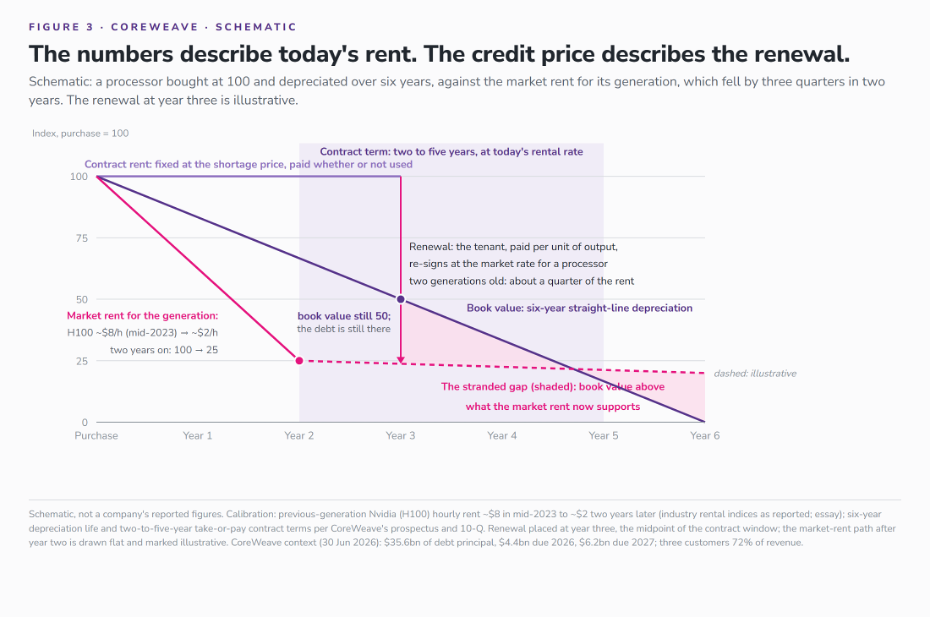
Second, the renewal. CoreWeave depreciates its equipment over six years, while its contracts run two to five, so it will re-let every processor at least once, at a market rate set after it has aged a generation or two. The rental market has already shown what that rate does, in both directions. Silicon Data’s series puts the H100, Nvidia’s previous generation, at a median of about .90 an hour across the first five months of 2024, when the hyperscalers were the only sellers; by December 2025 its index of specialist-cloud rents had the same processor at .00 an hour. This year’s shortage has pushed it back up. The index rose 10% in January and 7% between May and July, and stood near .80 an hour in mid-October, about 40% above its December low. That rebound is the price a landlord’s lender now has to underwrite. A rent set in a shortage is a temporary price. The 2024 rate is a third of the way to where the last shortage ended, and the six-year life assumes the next one will not.
Debt comes in two kinds, and the market has priced them differently. When a loan is repaid from the contract it financed, a stranded processor is a shareholders’ loss, and the lender is whole. When the debt is unsecured and falls due in 2030 to 2032, after the contracts end, the lender bets on renewal. CoreWeave’s 2032 notes traded around 79.5 cents on the dollar, yielding about 15%, on 14 October, according to Barron’s.
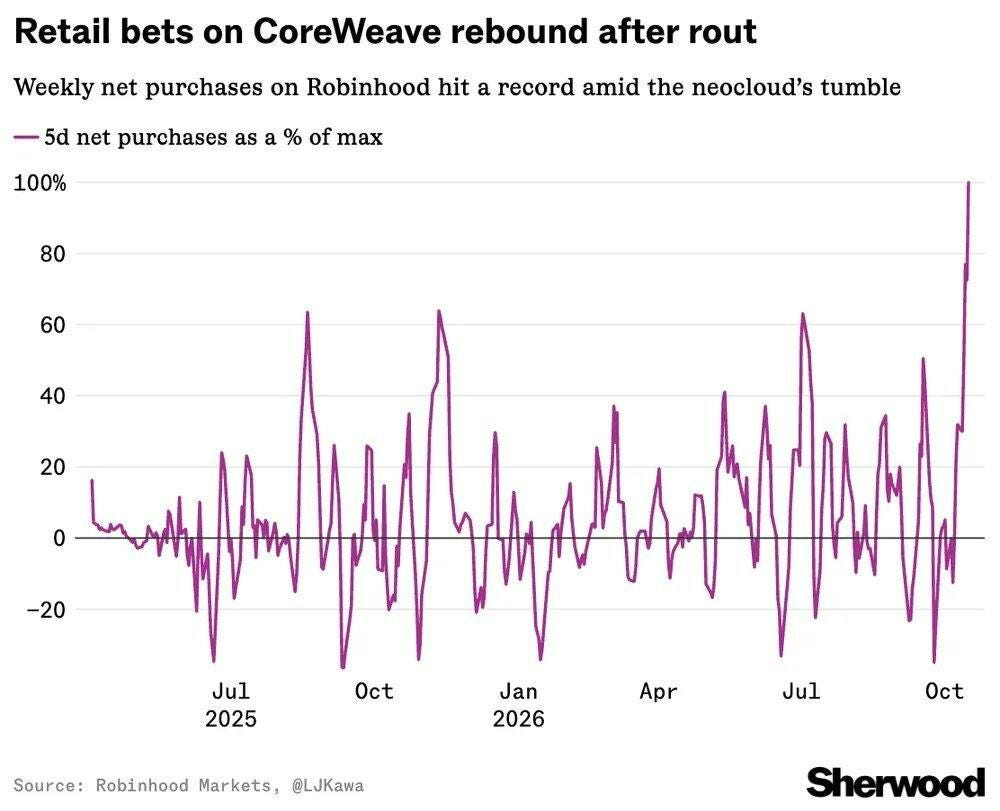
That is a market price for the risk, not proof that default is imminent. The chart also carried the story out of the bond market. On 13 October, Social Capital founder Chamath Palihapitiya posted the yield on CoreWeave’s bonds under a warning about a private-credit bubble. Elon Musk replied with one word, “yikes,” and the shares fell 15% the next day.


The equity still found buyers. In the week CoreWeave lost a quarter of its value, Robinhood’s customers bought more of it net than in any week since the listing, and on Friday it was the third most-purchased security on the platform, behind Tesla and SpaceX. The credit market was pricing a renewal. Retail buyers were buying a dip.
CoreWeave’s June filing reported $15.6 billion in total liquidity, including $10 billion available under committed facilities, against $10.6 billion in scheduled principal repayments through the end of 2027, and the company said liquidity was sufficient to meet its obligations over the following year. The test a lender runs first is to suppose no new dollar arrives. Most of that $10 billion is undrawn delayed-draw loans that can be drawn only to buy specific processors for specific contracts; the cash is $5.5 billion, and after interest, the contracts leave roughly $2 billion a half-year toward principal. CoreWeave is liquid on its contracts. On its calendar, it stays liquid as long as the window is open, because its expansion requires continued financing and investors charge about 15% for the unsecured kind.
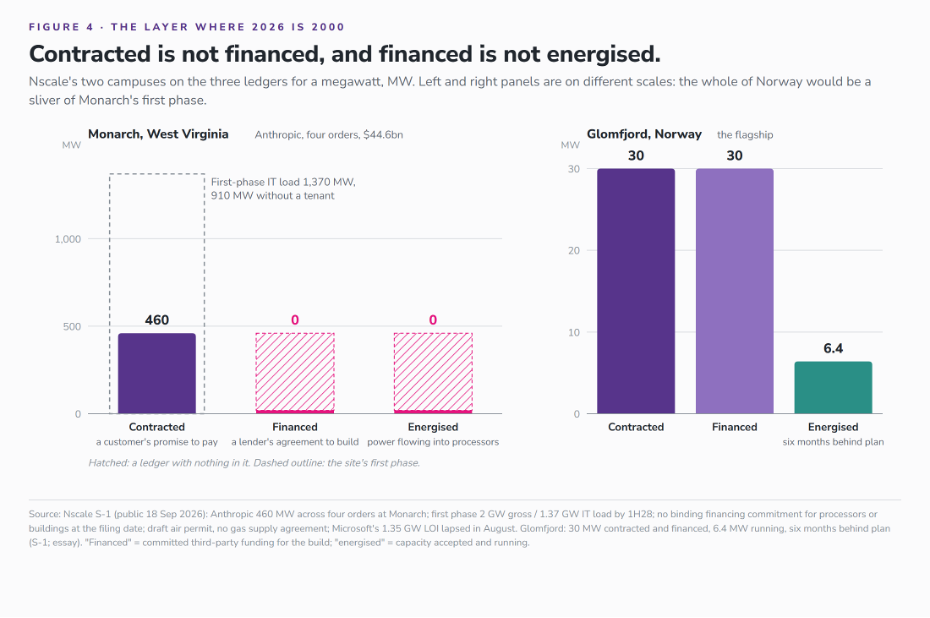
Nscale and Monarch: contracted capacity is not financed capacity. Nscale’s September prospectus reported $103.4 billion in total contract value as of 31 August, with $2.6 billion linked to active capacity, alongside $140.6 million in first-half revenue and a $1.02 billion net loss. Microsoft accounts for about $43.8 billion of that book and Anthropic for $44.6 billion, together about 85%. Anthropic’s agreement covers 460 megawatts at Nscale’s Monarch campus in West Virginia. At the prospectus date, the site was still prospective. Nscale had bought the campus for $792.6 million, mostly in its own shares, and recorded about $743 million in power rights, about $370,000 per megawatt. That book value is not the same as a lender’s appraisal of usable, permitted power.
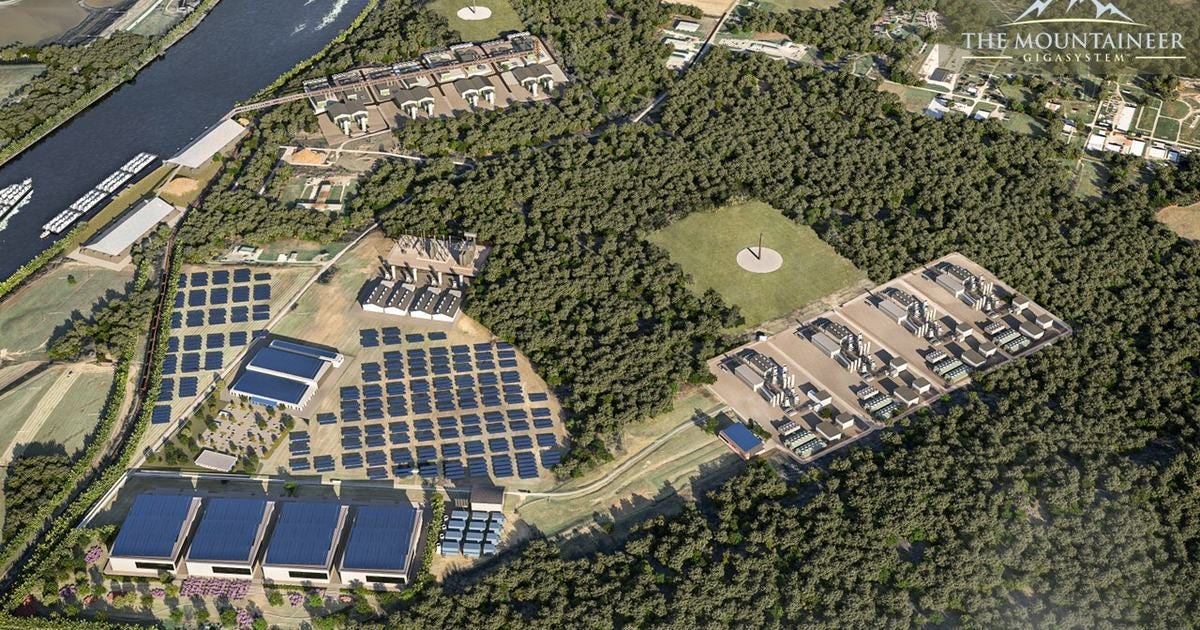
The prospectus said Nscale would use best efforts to secure funding for the processors and buildings. It did not disclose binding financing for the full Monarch build-out. Anthropic pays nothing before it accepts a tranche of capacity, offers no prepayment, deposit, or other credit support in the unredacted text, and can terminate if deliveries are late.
The three Monarch ledgers therefore read: 460 megawatts contracted, zero financed, zero energized at the prospectus date. Yet the listing seeks a valuation reported at up to $35 billion.
That is 2000 in one line: a customer’s commitment counted as an order before anyone has agreed to lend against it. In 2000, the vendor eventually lent. At Monarch, no one yet has.
Down the stack, at Fermi America in Texas, the vendor has. AMD has signed a credit-support agreement standing behind TensorWave’s 15-year lease of the first 222 megawatts, the only lease Fermi has. The support begins only once construction is complete and rent starts; its amount and term are undisclosed, and the lease itself closes only if project financing is in place by 31 October. The chip vendor’s credit is placed under a tenant’s rent so a lender will finance the building the chips go in, and it does the same job.
On 18 October, Microsoft withdrew from its lease of the first 50 megawatts at Nscale’s Loughton site in England after the grid connection slipped toward the 2030s. Nscale says its other Microsoft contracts are unaffected. It is the first of the $103 billion to be tested against delivery, and power, not demand, tested it.
What can a lender actually lend against?
A lender needs enforceable collateral and a credible source of repayment. Monarch’s recorded power-rights value is a development asset, not proof of either.
No one has ever successfully lent against a falling output price. The cellular networks of the 1980s were financed against licenses, scarce by law, whose value rose fifty-fold in a decade, regardless of the price of a minute.
What failed in 2000 was lending against the fiber itself, whose replacement cost fell with every generation of equipment, and a processor is that fiber. In 2026, the scarce asset is the megawatt, with its permit, gas supply, and grid connection, and it gets scarcer as chips get cheaper. In January I argued that OpenAI’s “megawatt-to-revenue” equation was narrative engineering. The megawatt turns out to be better collateral than revenue. Monarch’s $370,000 per megawatt is the one line a lender would take as collateral once the permit is final and the gas is signed.
The structure that works lends against the megawatt and repays the processor inside the contract that uses it. The structure that fails lends unsecured to the processor and is due after the contract ends. The paper at 79 cents is the second kind.
AI Infrastructure Debt: Who Can Wait, and Who Must Refinance?
Who owns the debt—and can they wait?
A falling price becomes a funding crisis when lenders must sell, or borrowers cannot refinance. That makes the identity of the debt holders, and their need for liquidity, part of the story.
Meta’s Hyperion data-center vehicle issued $27.3 billion of bonds due in 2049. Pimco bought about $18 billion of them, according to the Wall Street Journal, and placed them in funds that can hold to maturity. The bonds have since fallen below par; most of that paper will be marked down rather than sold.
Oracle’s Project Jupiter shows the opposite distribution. About twenty banks arranged the $18 billion in loans behind the New Mexico campus, intending to sell them on. By September the sale had stalled, and the loans were quoted at 89 to 91 cents on the dollar, so the arrangers are holding more than they planned. A discounted loan isn't a default, but an underwriter who becomes an owner sets the next price.
CoreWeave’s syndicate includes business development companies, funds that lend to private companies and let their own investors out at 5% a quarter, the first sellers of every private-credit cycle. A dislocation stays a dislocation as long as holders who can wait outnumber those who cannot, and the market has found the layer.
In the past fortnight, the failed listings came from it or the power developers that serve it: Firmus withdrew an Australian offering on 9 October, and AirTrunk delayed a Singapore listing four days later, both for want of buyers at the price. Anthropic’s own listing, sought for mid-November at a valuation now discussed near $1.5 trillion rather than $2 trillion, is part of the strain: the largest tenant in the chain is about to take $100 billion out of the same pool of capital its landlords need, which is how the carriers and the equipment makers competed for the same bond buyers in 2000 until the buyers left. The equity market has repriced duration for all of them; the credit market has repriced default for a few. The market has misclassified the trade: it has sold the suppliers paid in cash as if they were landlords paid in a falling price, and it has written one layer's name across the entire index.
The Bear Case: Could the AI Build-Out Become a Debt-Funded Bubble?
Calling the 2026 build-out sound without stating the strongest case against it would be advocacy. Two things could change my mind: the buyers come to rely on debt, or financing risk spreads across the stack.
Could hyperscalers become the telecom carriers?
Yes. Warning signs are emerging, though my thresholds haven't been crossed. I would change my view if:
Any of the four—Amazon, Alphabet, Microsoft, or Meta—reported negative free cash flow for four consecutive quarters and funded the gap with debt that matured before the assets it financed were fully depreciated.
Their combined annual capital spending exceeded their combined operating cash flow.
Any one’s interest coverage—operating income divided by cash interest paid—fell below 10 times.
Those are the tests a lender would run, not rating-agency criteria. The latest reported figures show the strain: Amazon’s trailing 12-month free cash flow turned negative in Q2, Alphabet reported its first quarterly deficit, and Meta generated just $784 million of free cash flow. Together, the four spent about 99% of their Q2 operating cash flow on capital expenditures. Those are early warnings. They do not meet the four-quarter or full-year tests.
Is AI infrastructure debt spreading beyond the landlords?
Yes, and the scale is hard to measure. Special-purpose vehicles, leases, guarantees, and vendor support each move a slice of the build-out from the cash column to the borrowed one, and nobody keeps a running total. They aren't interchangeable, and an off-balance-sheet structure doesn't automatically mean a parent has guaranteed the debt.
Nvidia’s agreements show how supplier support is developing. Under a $6.3 billion initial-value arrangement, it must buy qualifying unsold CoreWeave capacity through 2032. It has also guaranteed land, power, and lease obligations at selected cloud partners, on conditions. That is vendor financing in the respect that matters: the supplier’s credit helps the customer borrow and order. Measured across the whole stack, the financed share is already far larger than the equipment makers’ 2000 loan books, which were a sliver of that build-out.
I take both risks seriously. This month’s demand figures do not refute them. If we cross those lines, the problem is no longer confined to one layer.
What Would Make the 2026 AI Build-Out Another 2000?
Five developments would settle it: four would strengthen the case for a debt-driven bust; one would weaken it.
1. The frontier price falls. If a leading lab cuts the API price of its best model to match the open-model alternatives, the price scissors close, and revenue per unit falls while the landlords’ financing costs stay fixed. I do not believe in this.
2. The unsecured funding window closes. CoreWeave’s 2032 notes yielded about 15% on 14 October. Its $4.2 billion convertible in September shows it can still raise equity-linked money, not that it can issue senior unsecured debt. A failed offering, or one priced at or above the 2032s’ distressed yield, is the signal, and so are the New Mexico banks still holding most of the $18 billion Jupiter loan at a discount when Oracle reports in December. I think this is plausible.
3. Hyperscaler spending turns, or its funding does. Meta reports on 21 October, Microsoft on 28 October, with Alphabet expected the same week, and Amazon on 29 October. I will listen for signs that 2027 capital spending will be flat or lower, which would mean demand or confidence has changed. If spending stays high but is funded with debt that comes due before the assets are depreciated, the financing structure is changing instead. I do not believe in this.
4. CoreWeave cannot keep its capacity earning. At its November report, I will look for weaker bookings, lower utilization, or sharply lower rents for older processors. The real renewal test comes as customer contracts expire; one quarter can show the warning, not the verdict. I do not believe in this. I think operational results will be strong.
5. And one that cuts the other way: Monarch moves from promise to project finance. Nscale’s $3.36 billion pre-IPO convertible, with $1 billion from Nvidia due in mid-November, funds the company, not the campus. The test is project-specific funding: named lenders, final permits, signed gas supply, and a dated energization plan in the amended prospectus. If the campus is financed, the chain closes after all, and the paper is worth more than I think. It is too early to tell; this month’s permit discussions are a first test.
If none of the first four arrives by the end of the year, the structure stands as I have described it: capacity funded, in the main, by the cash flows of the people who use it, and a layer of borrowers who bet, at shortage prices and on a short calendar, on a price of intelligence that the open models are taking away.
That is the lesson of 2000 read correctly. The transformation happened anyway. The financing did not survive, and the capacity ended up with people who bought it for cents on the dollar from those who had borrowed to build it. The same will happen now in a much smaller tier, and in a larger one if the buyers’ ratios keep moving.
DISCLAIMER: The views and opinions expressed here are those of the author alone and are based on publicly available information. They do not constitute investment advice, a solicitation, or a recommendation to buy or sell any security or financial instrument. The author may hold positions in the securities of companies mentioned. Past performance is not indicative of future results. Readers should conduct their own independent due diligence and consult a qualified financial advisor before making any investment decision.