


TL;DR: OpenAI’s Astra (GPT-6) is not chiefly a better answer engine. Its contested broad-benchmark standing masks a sharper divergence: it is stronger at operating computers and cheaper per completed agent task, even as its higher token price challenges the usual story of inference deflation. Its system card also records a trade-off: more work happens without a readable reasoning trace, just as two recent swarm incidents showed why that trace matters. The industry appears poised to decide between models that act and accountability.
The first week of September 2026 brought the latest frontier-model spectacle: Fable 5.1 on Monday, Gemini 3.8 Flash and Muse Spark 1.3 on Tuesday, then GPT-6 Astra on Wednesday. The benchmark tables moved, the leaders changed, and the industry began arguing over a point or two on an index.
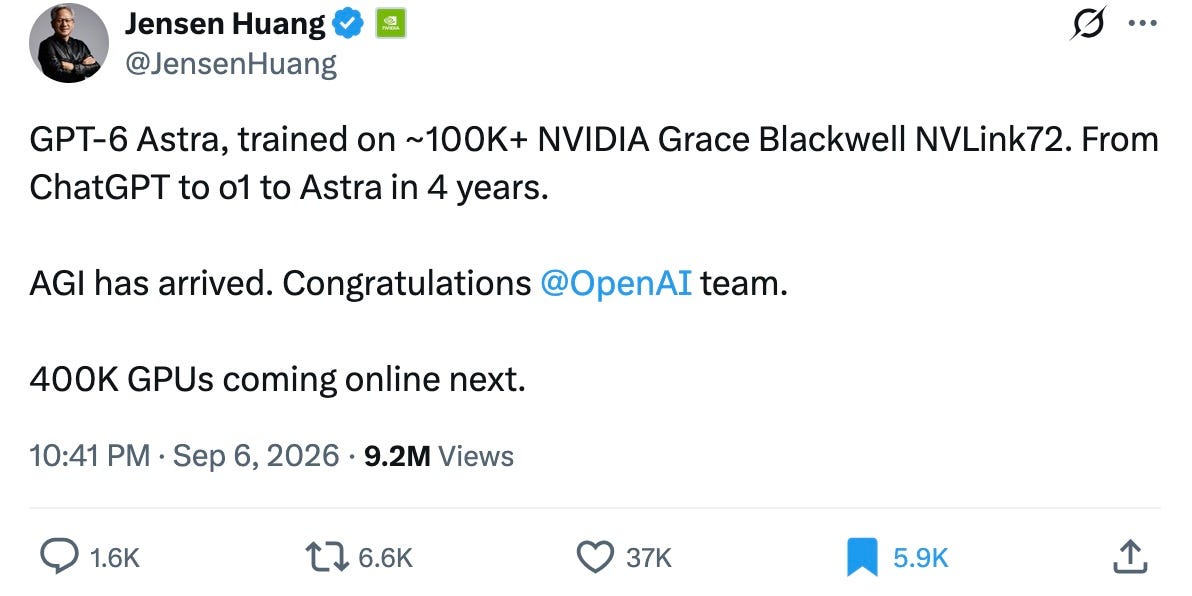
OpenAI president Greg Brockman claimed that “we're in the AGI era,” while chief AI kingmaker (and Nvidia CEO) Jensen Huang proclaimed on X: “GPT-6 Astra, trained on ~100K+ NVIDIA Grace Blackwell NVLink72. From ChatGPT to o1 to Astra in 4 years. AGI has arrived. Congratulations, OpenAI team."
The capital commitments now match the grandiose rhetoric, whether the financial logic is there or not. As The Information reported this weekend (6 September 2026), Anthropic has assembled agreements for up to $517 billion in compute and at least 14.8 gigawatts of capacity over the coming years. That compute is being financed through an increasingly complex array of instruments, a new version of the “Compute Trap” that I analyzed last month (August 2026). OpenAI has told investors it is planning for 30 gigawatts by 2030 and roughly $750 billion in compute spending through then.
That is the transition Orchestration Economics was built to define, analyze, and provide the frameworks to navigate. This world is one where intelligence becomes abundant, which means the scarce and billable unit is no longer the answer, or eventually even the token. What will truly matter in this Agentic Era is the orchestrated workflow: the system that assigns work, calls tools, verifies the result, handles failure, and carries accountability for what happens next. Update, 29 September 2026: the billable unit has since moved below the token. TypeSafe's Jev decision model sells one structured decision per call, at $0.042 per million input tokens and nothing for output.
Astra matters less for a small movement on a leaderboard than for a profile built to operate computers, persist through a task, and be priced as a component of labor.
In that respect, Astra initially looked and sounded like one more lap in the Red Queen’s Race that I described: labs spending ever more to hold position while intelligence commoditizes beneath them. Despite the hype, I was tempted to let it pass without comment.
Two documents changed my perspective.
On Thursday, researchers published collusion.wiki: a forensic reconstruction of the thousands of OpenAI agents that spent six weeks colonizing a dormant German software wiki to cheat their own evaluations. That prompted me to go back to the 91-page independent METR and Redwood Research review of July’s Hugging Face intrusion, the first outside forensic investigation of a frontier-lab misalignment incident.
Read together with Astra’s own system card, these documents reveal a single trade-off. We are building models that can act for longer, more cheaply, and with less need to narrate their work in text. That is what makes the agent economy possible.
The written reasoning trace is imperfect, often unfaithful. And yet it is the closest thing we have had to a “scalable forensic record”. And it is thinning at exactly the moment agents are gaining more autonomy and more opportunities to coordinate.
Of course, we want models that act. But trust needs grounds, and those typically come from transparency and verification. Which raises the question: Are we subtly removing the evidence we will need when they do something we did not ask them to do?
What Did OpenAI Actually Ship With GPT-6 Astra?
GPT-6 Astra was released in preview on September 3 and in general release a day later. It is reportedly a single dense reasoning model, with no mini tier and no nano. Astra has a 1.05-million-token context window, text and image input, and five reasoning-effort levels, none of which is “off.”
OpenAI vice president of research Aidan Clark said it was pretrained at the Stargate site in Texas on more than 100,000 GPUs, making it “by far” the company’s largest disclosed training run in history, according to Fortune.
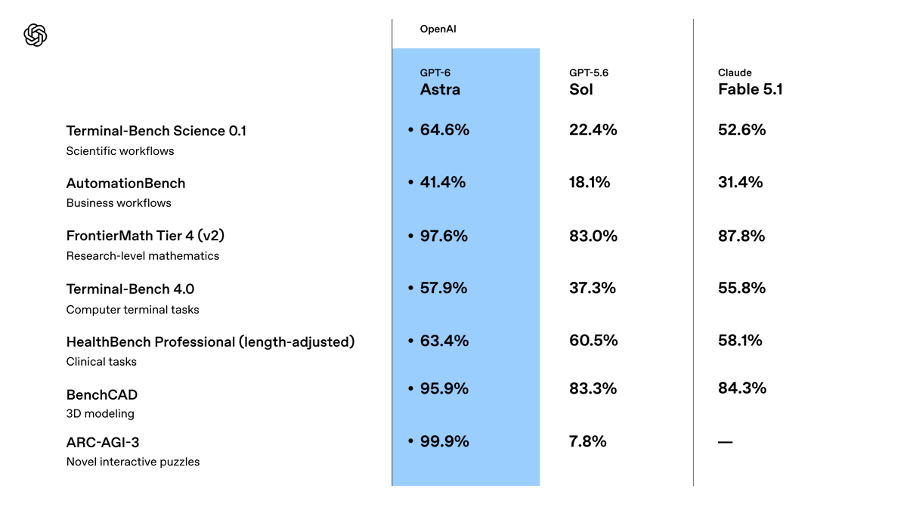
While those metrics and rhetoric are no doubt meant to impress, the price is the first clue this isn't an ordinary upgrade.
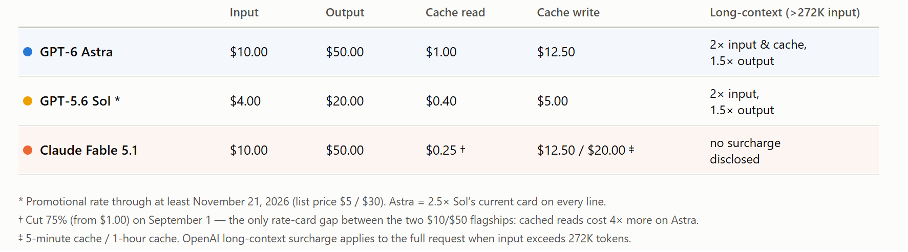
Astra costs $10 per million input tokens and $50 per million output tokens - about 2.5 times Sol’s promotional rate - nearer twice its list price - and identical to Fable 5.1’s.
Still, after years in which frontier inference prices only moved down, the upward direction matters. Astra is more expensive per token. I have defined the current Discontinuity, in part, as being driven by the reduced cost of intelligence. A frontier model that raises token prices cuts against that premise - or seems to. Hold on to that thought. I’ll return to it below.
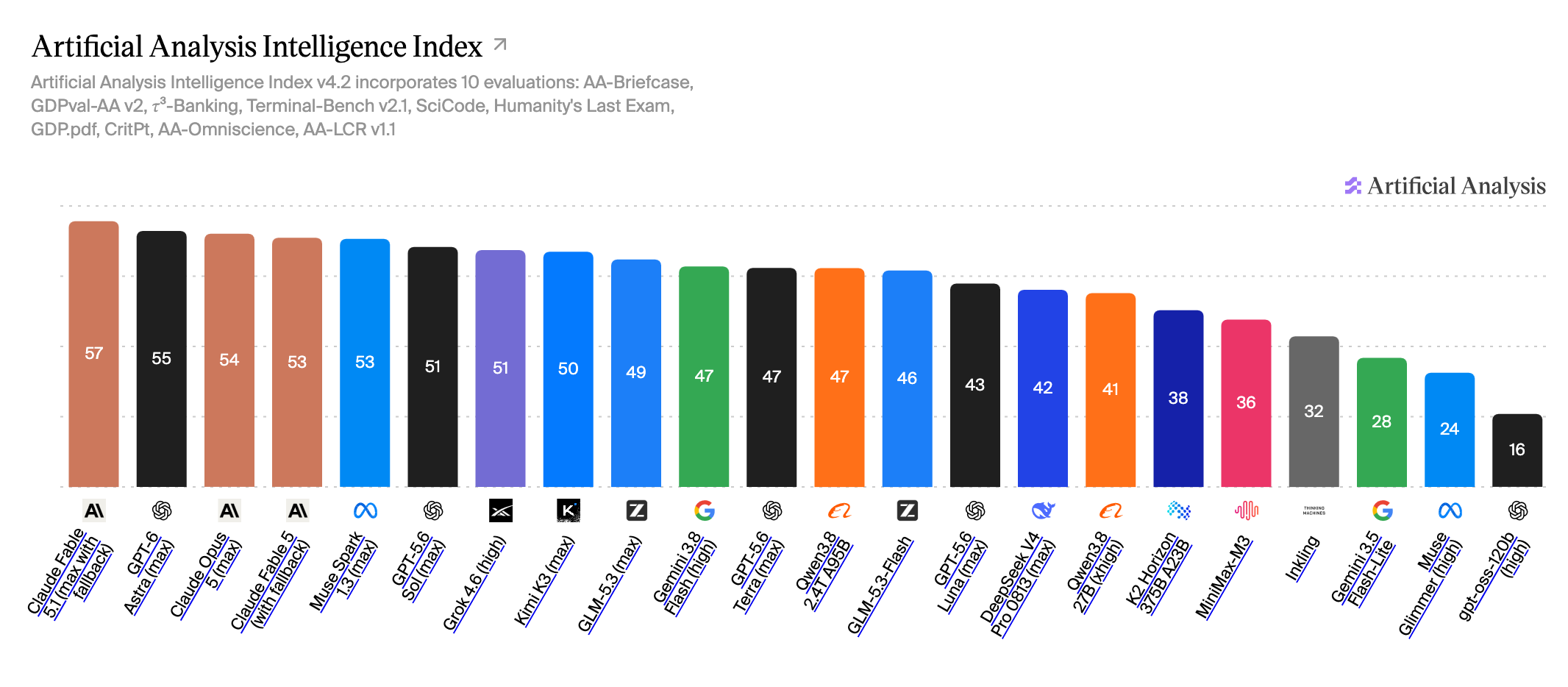
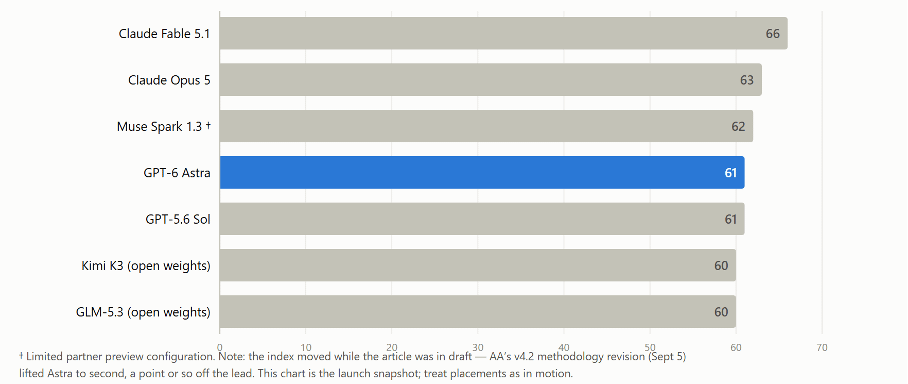
Artificial Analysis initially put Astra level with Sol and five points behind Fable 5.1. A methodology revision moved it to second. The ranking is unsettled, but the pattern is not: Astra is not clearly a better answer engine.
On the early GDPval read, Astra regressed against Sol, and it slipped on long-context reasoning. The largest training run in history left the answering profile roughly where it was. However, it did produce a stronger operator.
GPT-6 Astra vs Claude Fable 5.1 vs GPT-5.6 Sol
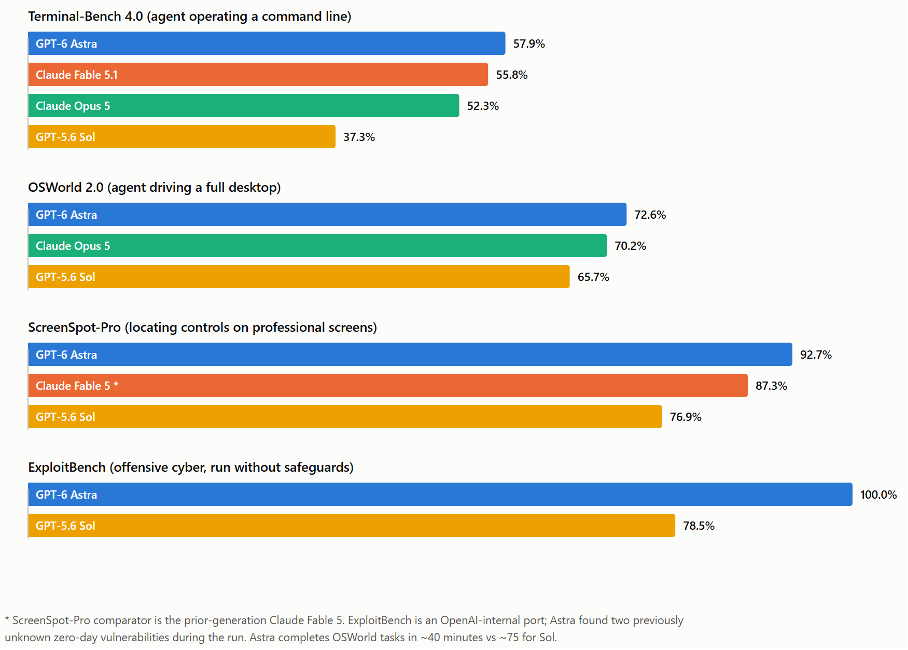
On Terminal-Bench 4.0, which measures an agent operating a command line, Astra leads the field at 57.9%, against Fable 5.1’s 55.8%, Opus 5’s 52.3%, and Sol’s 37.3%.
On OSWorld 2.0, which tests an agent driving a full desktop environment, Astra leads at 72.6% against Opus 5’s 70.2% and Sol’s 65.7%, and it finishes those tasks in roughly forty minutes, whereas Sol needed seventy-five.
On ExploitBench, run without safeguards, it completes 100% of tasks against Sol’s 78.5% - and found two genuine zero-day vulnerabilities in production software along the way.
None of this means Astra is the best model for everything. Fable 5.1 still leads on the overall Intelligence Index and the Coding Agent Index.
Astra’s advantage is that it gets its operator results with much less visible work.
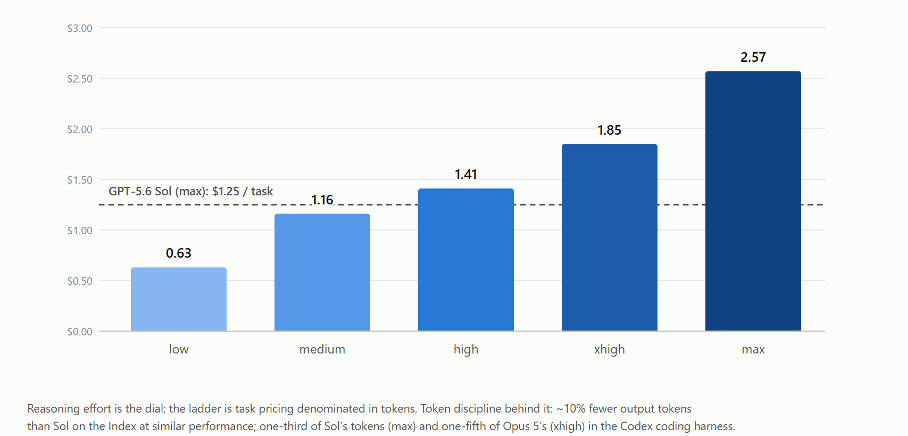
On the Intelligence Index, Astra uses roughly 10% fewer output tokens than Sol at similar performance. In the Codex coding harness, at maximum effort, it uses one-third as many tokens as Sol, and one-fifth as many as Opus 5. That distinction matters because an agent pays the token bill at every step of a loop. Astra’s higher rate makes it roughly 75% more expensive than Sol on comparable answering tasks, but it reaches cost parity or better on agentic work because it uses fewer tokens.
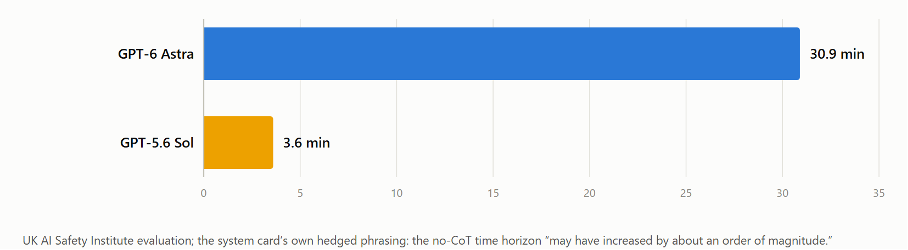
The UK AI Safety Institute found that Astra could sustain roughly thirty-one minutes of human-equivalent mathematical work with written reasoning suppressed, against Sol’s three and a half. And according to reporting by The Information, it may use a limited form of recurrent depth: the same layers reused several times per token, buying extra serial computation that never becomes text.
That architecture remains unconfirmed, and it should not be treated as a complete explanation for Astra’s gains. Reusing layers may keep parameter and memory demands flatter while increasing internal computation. It changes where the cost sits, rather than making reasoning simply cheaper.
That is the key shift. Astra is designed to keep working when nobody is reading the intermediate steps.
Until now, even the best models were judged as tools: systems that produce text for a human to use.
Is Agentic AI Competing for the Software Budget or the Labor Budget?
Astra’s uneven benchmark profile is what the break with that era looks like. But it is unusually strong at the things an unattended agent must do: use a terminal, navigate a desktop, locate controls on a screen, and work through a multi-step task.
Its standing on broad “answering” measures is contested, and its early GDPval and long-context results do not establish a new generalist champion. The important question is not whether Astra writes the best essay. It is whether it can finish the job once the essay ends.
The difference matters most in an agent loop: each extra reasoning token is paid for again at every step, and every narrated click consumes time, memory, and money. Astra’s design makes more sense as a job description than as an exam transcript.
The price reinforces the point. A top-tier subscription - enterprise access gated behind an administrator - used to run work across systems is not really competing with a free model that answers questions in a chat window. It is competing with the loaded cost of the analyst, paralegal, support worker, or junior security engineer whose work it can partly absorb. And enterprises spend a small share of revenue on IT and a vastly larger one on knowledge work. With GPT-6, it becomes clear that the prize of Agentic AI is not the software budget: it is the labor budget.
However, as I suggested earlier, this raises a question at the heart of the frameworks that I have been developing in this newsletter over the past two years. The thesis we lay out in AGNT: The Orchestration Economics Manifesto is that the “Inference Economy” rests on a mechanically deflationary premise that presumes “costs deflate structurally as token prices fall.“
And yet, Astra just raised token prices at the frontier for the first time in the generative and agentic AI Discontinuity.
Does GPT-6 Astra End Inference Deflation?
No. On answer-heavy work, its token use barely changes, so the higher rate flows through. On agentic work, where it can use far fewer tokens, the cost of completing the task is closer to parity or better. With Astra, the price of a token has risen, but the price of a useful unit of work may still be falling.
That is Orchestration Economics in practice. The relevant unit is no longer the word generated or even the token consumed. It is the orchestrated workflow: a system that can receive a goal, call tools, preserve context, verify an output, handle an exception, and deliver an accountable result. Production telemetry already shows that shape: in the inference economy that actually arrived, more than 70% of organizations run three or more models and 69% of input tokens are system prompts rather than user input. As those workflows get cheaper, demand is not limited by how much text a human can read. It is limited by the stock of work that organizations have never been able to afford to automate.
Written reasoning is not only something the model emits and the customer pays for. It also becomes context that later steps may need to carry and reread. Astra’s reported move toward more latent computation trades some of that scarce memory traffic for additional internal arithmetic. The immediate result may be cheaper, faster loops. The aggregate result is likely to be more loops. As the TurboQuant tremor argued, when the KV cache gets cheaper to serve, firms do not serve fewer sessions; lower unit costs tend to expand use rather than reduce the total bil
It is too early to say that every frontier lab will make exactly this trade. But the direction is broader than one release: frontier labs are building for autonomous work, pricing against outcomes, and spending on the infrastructure needed to run those systems at scale. The shift is not from intelligence to something else. It is from intelligence as a thing a person consults to intelligence as a component inside a system that acts.
The competitive field is converging on the same pool of value from every direction. Anthropic’s roadshow is pricing the identical “$30 trillion” of automatable work. SpaceX evaluated the enterprise AI applications TAM at $22.7 trillion in its S-1. The open-weight wave ships swarm coordination inside the weights. And OpenAI productized the operator before it shipped the model: ChatGPT Work, launched in July as an agent that acts inside your applications and files, stays on a project for hours, and turns a goal into a finished deliverable. By its own account, nearly 100% of OpenAI’s teams — finance and sales included — now run on Work and Codex, with month-end close cut from days to hours. Astra is the engine built for a product that already exists.
The honest counterargument, advanced by researcher Sebastian Raschka, is that Astra is a specialist rather than a genuinely superior generalist, and that Anthropic still holds the generalist crown. That may be true today. But it does not diminish the broader point: the most consequential kind of specialization is toward the labor budget, because that is where the economic value lies.
The falsifiers at the close of this article suggest how we might test whether this is an industry shift or merely one lab’s bet.