
The Compute Trap 2.0: How Anthropic Refinanced Its Single Point of Failure
Anthropic solved compute access with ~$450B of announced commitments. The $10B Volta deal shows a new blueprint for their financing. What the S-1 must disclose.


TL;DR: Anthropic has largely solved the compute access problem that once threatened its growth. But the solution has created a new version of the “Compute Trap”: hundreds of billions of dollars of long-duration capacity commitments increasingly financed through SPVs, private credit and bank guarantees. Its coming S-1 will reveal how much of that risk is truly fixed.
Anthropic solved its compute access problem by building a far larger financing machine. Its IPO will test whether growth can absorb the commitments before those commitments begin to constrain it.
One of the greatest risks facing Anthropic a year ago was that it could not secure sufficient compute without becoming overly dependent on two shareholders who were also critical suppliers. I called compute a Single Point of Failure or the “SPOF”: The Harness was only as durable as the silicon underneath it.
Lurking just below that SPOF was the broader problem of the Compute Trap: spend too little and you risk losing the frontier. Spend too much and you risk overwhelming the economics of the business.
By May, when I revisited Anthropic in King Claude, the first half of that trap was no longer theoretical. Anthropic’s growth had outrun its available capacity badly enough that it turned to former rival xAI, leasing the full 300 megawatts of SpaceX’s Colossus 1 for $1.25 billion a month. The contract bought Anthropic time, but not permanence: either side could terminate on 90 days’ notice.
The question had already begun to shift from compute access to what I called growth endurance: could Anthropic grow revenue fast enough, for long enough, to absorb a compute base contracted in advance against future demand?
Three months later, we have the next part of the answer.
Anthropic has largely solved the access problem by diversifying across more suppliers that have vastly increased its capacity. But in solving the access version of the Compute Trap, Anthropic has exposed its financial version.
The company now sits atop hundreds of billions of dollars of announced compute commitments backed by a dizzying array of complex financial instruments that range from hyperscaler balance sheets to SPVs, private credit, and bank guarantees.
The original SPOF has been diversified. The underlying risk has been refinanced. As a result, the question is no longer simply: can Anthropic get enough compute to stay at the frontier? It is whether Anthropic can grow fast enough, for long enough, to support the financial architecture required to secure it.
Anthropic is preparing to go public carrying roughly $450 billion of announced compute commitments. The exact number matters less than what sits underneath it: how much is genuinely take-or-pay, how much is cancellable capacity, how much is lease liability, and how much remains contingent on future deployment. The S-1 should finally tell us whether Anthropic has built one of the most sophisticated financing machines in technology or simply converted an availability problem into a fixed-cost problem.
If SpaceX bought Anthropic time to address the access issues, then Volta may show what a more permanent financing model might look like.
Volta, a newly launched AI infrastructure company founded by former Brookfield executives, emerged from stealth in August with a six-year, $10 billion compute contract reported by Bloomberg to be with Anthropic. Behind it sits a sixteen-year infrastructure lease supported by roughly $1.3 billion of anticipated bank letters of credit.
Volta summarized its founding thesis in five words: compute is infrastructure and should be financed as such. That sentence captures what has changed over the past twelve months; the AI buildout has transformed beyond being a technology or capacity story into a credit story.
And the largest private balance sheet at the center of that story is racing toward the public markets to test the viability of that strategy.
Anthropic’s Compute Commitments: $254B Confirmed, $450B Announced
To see how radically the risk changed, let’s return to the baseline.
Back in August 2025, AWS was Anthropic’s self-described “primary cloud provider and training partner” backed by $8 billion of Amazon’s money. Google supplied TPUs and held equity.
This represented an SPOF in the plainest sense. Twelve months later, that configuration looks radically different.
The confirmed floor is roughly $254 billion of compute commitments. Include the ~$200 billion five-year Google commitment reported by The Information in May and since detailed by the Financial Times as a Google-orchestrated web of chip and data-center financings, though never confirmed by the companies themselves, and the total reaches approximately $454 billion. I will treat that number as unconfirmed throughout this analysis. One caution on its shape: per the FT, roughly four-fifths of the ~$200 billion is the chips themselves - the ~$35 billion Compute SPV closed in June plus Broadcom’s filed $128 billion of TPU purchase commitments - with the balance in Google-backstopped data-center leases. It is a financing web tied to Anthropic’s lease payments, not an incremental cloud bill stacked on top of the structures described below; and because its data-center leg may overlap with other announced sites, the $454 billion aggregate is best read as an upper bound.
Three facts about that ledger matter for our analysis.
First, the velocity. Roughly 82% of all disclosed compute dollars - 69% counting confirmed deals only - were committed in the first seven months of 2026, just as the company’s revenue exploded.
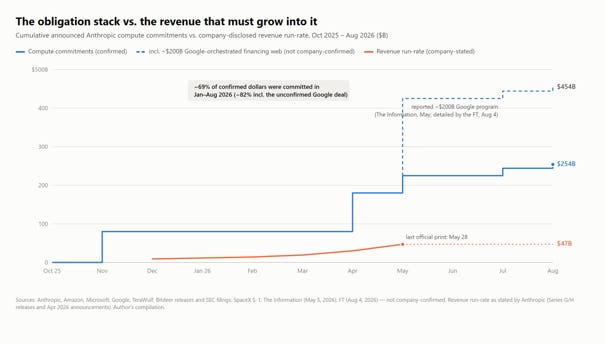
Amodei told Dwarkesh Patel in February that the industry would build “10 to 15 gigawatts” this year. Anthropic has already announced roughly 14 gigawatts. Not all of that capacity comes online in 2026, but the scale is still extraordinary. One company has contracted for approximately one entire year the global industry buildout.
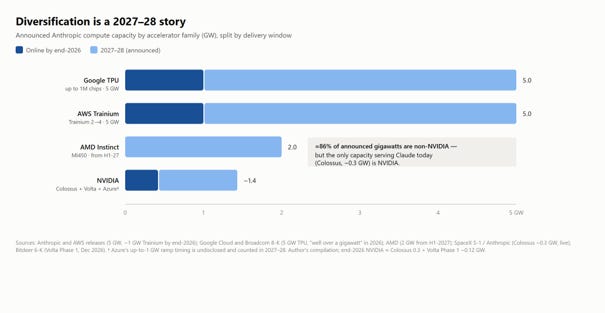
Second, the silicon. The full diversification is still over the horizon, though the live fleet is already mixed: more than a million Trainium2 chips and Google TPUs already serve Claude in production. The largest live increment of 2026 is Colossus, with 300 megawatts. Colossus is switched on now and it’s pure NVIDIA. So are Volta’s Vera Rubin racks. Of those ~14 gigawatts, about 86% are non-NVIDIA: five gigawatts of Google TPUs, five gigawatts of Amazon Trainiums, and two gigawatts of AMD. (The four accelerator families sum to 13.4 GW - nearly 90% non-NVIDIA - with the balance of the ~14 GW book at sites whose silicon is undisclosed). Anthropic now has four accelerator families in production or under contract, plus its own inference silicon in development.
Third, the financing. This is perhaps the most important aspect for this thesis. Through April, most of the money behind the megawatts sat on hyperscaler balance sheets: Google’s, Amazon’s, and Microsoft’s. Roughly three-quarters of the committed dollars were ultimately supported by companies with trillion-dollar balance sheets.
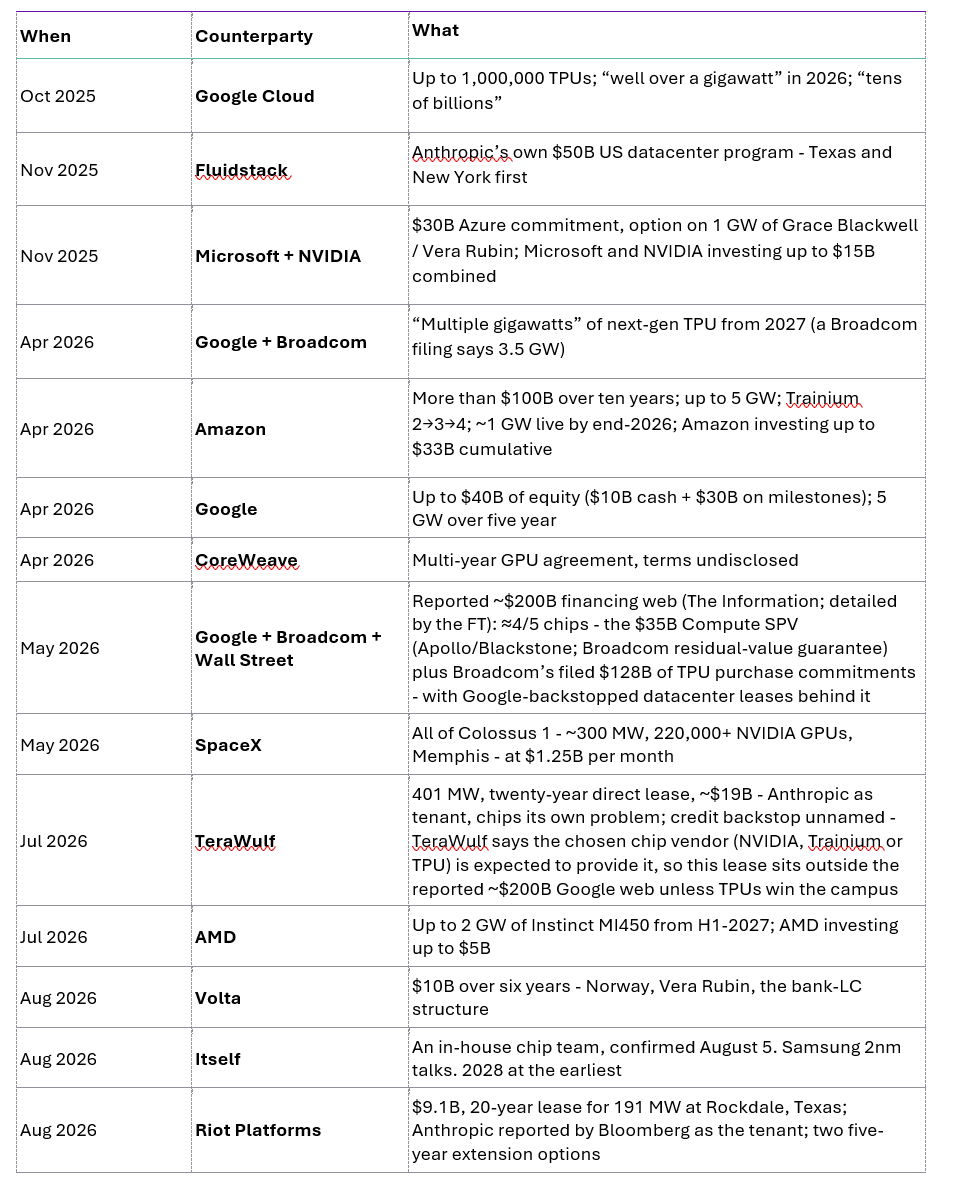
Since July, the financing architecture has shifted. Riot officially disclosed a 20-year, $9.1 billion lease for 191 MW at Rockdale with an unnamed “leading frontier AI lab,” running through June 2048; Bloomberg is reporting that tenant is Anthropic. Riot also says the first 96 MW is due by December 2027 and the full 191 MW by June 2028.
TeraWulf and now Riot bring former crypto-mining infrastructure into long-duration AI leases; Volta adds an SPV supported by equity, debt and anticipated bank letters of credit. Duration risk is migrating away from hyperscaler balance sheets and into a newer, thinner and more leveraged financing layer.
That completes the transition: Anthropic bought faster, diversified more aggressively, and changed who ultimately finances the capacity. The first two helped eliminate the old single point of failure. The third explains why the Compute Trap survived.
How the Compute Trap Was Refinanced
What replaced the original SPOF is larger, more leveraged and more financially entangled. The shift happened through three transformations:
1. From supplier concentration to obligation scale. The 2025 question was whether Anthropic could get enough compute. It can. The 2026 question is whether it can grow into what it has committed to buy. The headline stack is roughly $454 billion, or 9.7x a $47 billion revenue run-rate; the confirmed-only floor is 5.4x. Annualized, that falls to about 1.7x revenue, or roughly 0.8x excluding the unconfirmed Google deal. That single contract materially changes the picture, which is why the S-1 matters.
2. From supplier concentration to financial entanglement. If the reported $200 billion Google commitment is real, Google alone accounts for roughly half of Anthropic’s compute book. It also owns about 14% of the company, has committed up to $40 billion more in equity, and competes through Gemini, which might at some-point become an open-source model. At least, that is not excluded. Amazon sits in a similar position, combining a large equity exposure with a decade-long compute commitment exceeding $100 billion. Diversifying between your two largest shareholders, both also competitors, is less independent than the counterparty count suggests.
3. From availability risk to fixed-cost risk. A take-or-pay or lease obligation converts a variable cost into a fixed one. That is wonderful operating leverage while demand compounds. It runs precisely backward in an air pocket. We have already seen the mechanism flex. The Information reported in January that gross margin compressed to roughly 40% after inference costs ran 23% over plan. The public-market preview is CoreWeave, whose S-1 disclosed that Microsoft was 62% of its 2024 revenue and whose anchor contracts come up for renewal in 2027. The market has not yet watched an AI take-or-pay stack get renegotiated in a downturn. It will.
One caveat to the diversification story: four accelerator families still converge on the same underlying supply chain. TPUs, Trainium, NVIDIA and AMD all depend on TSMC advanced packaging and the same three major HBM suppliers. The Series H cap table offers an important clues: Micron, Samsung and SK hynix all invested.
The bottleneck may no longer sit at the chip vendor level, but it has not disappeared. It has moved further down the stack.
Can Anthropic Outrun the Compute Trap?
The bear case doesn’t necessarily tell the whole story. Anthropic has built several genuine hedges against it.
First, the diversification is real.
The 2025 problem of supplier hostage risk is gone. Anthropic now has ten-plus counterparties across four silicon families, with every other frontier lab running one or two. Its CFO says compute is allocated “fungibly” across training, inference, and internal workloads. This may be one of Anthropic’s most important competitive assets: the ability to arbitrage not just suppliers, but silicon architectures.
Second, Anthropic appears unusually compute-efficient.
Anthropic reached its current revenue scale on a fraction of OpenAI’s reported training spend, projects positive cash flow years earlier, and has crossed into reported (though still unaudited) operating profitability while its rival’s losses continue to widen toward an estimated $14 billion this year.
That matters because the strongest answer to a fixed-cost problem is not necessarily fewer fixed costs. It is enough revenue and enough efficiency to grow into them.
In King Claude, I called this growth endurance: the compute base is contracted in advance, so the only way to compress its burden is for revenue to grow faster than the commitments compound. That remains the strongest bull case for Anthropic.
At Anthropic’s current pace, the denominator is moving almost as quickly as the obligation stack. A company whose revenue run-rate moved from roughly $9 billion at the end of 2025 to $47 billion by late May can make commitments that look extraordinary today appear much less so surprisingly quickly.
But, lately, the rise of Chinese open-source and the broader move-away from the frontier has increased pressure on this aspect.
Third, the financing architecture may prove more scalable than it looks.
OpenAI and Anthropic face the same problem: frontier labs are not investment grade, yet someone must finance hundreds of billions of dollars of infrastructure. Their answers are diverging. NVIDIA has reportedly discussed guaranteeing up to $250 billion of OpenAI’s datacenter leases; Anthropic’s newer structures lean on commercial-bank credit. One is circular. The other is merely leveraged.
If Anthropic can turn compute financing from supplier subsidy into conventional bank credit, “compute financed as infrastructure” becomes a real market. But the aggregate risk remains: individually rational decisions can still produce a painful obligation stack if revenue arrives a year late.
That is the Compute Trap now: not whether Anthropic can secure capacity, but whether growth stays on schedule long enough to absorb it.
Inside the Volta Deal: $10B, a 16-Year Lease and $1.3B of Letters of Credit
Volta has raised $300 million in equity at a $2.4 billion valuation from Andreessen Horowitz, Altimeter, the Azora, NVIDIA, and Michael Dell. The company will deliver NVIDIA Vera Rubin capacity from a hydro-powered campus in Tydal, Norway that it does not own from systems that have not been installed inside data halls that are still being built.
Behind Volta’s sixteen-year, $4.7 billion lease obligation sits neither a hyperscaler guarantee nor a chip-vendor backstop, but approximately $1.3 billion of anticipated letters of credit arranged by affiliates of J.P. Morgan.
The structure rewards close reading, so here is the stack:
Anthropic (reported) → six-year, $10B compute contract → Volta Infra (a16z / Altimeter / Azora / NVIDIA / Dell equity; ~$5B Azora-led program of project equity and senior bank debt) → Volta Tydal AS (Norwegian SPV) → sixteen-year, $4.7B lease → Bitdeer’s Tydal campus (121 IT MW, hydro, PUE ~1.1) → NVIDIA Vera Rubin systems, supplied and integrated by Dell → wrapped by ~$1.3B of J.P. Morgan-arranged letters of credit (anticipated).
Two details explain why this deal is an arithmetic derivation matters. To be clear, this is my calculation, not any party’s.
First, the lease’s headline rate of roughly $202 per kilowatt-month is a 16-year average with a 3% annual escalator. That implies about $233 million in first-year rent. Volta with a year-one rate of about $160, can terminate without penalty after year ten, putting the firmly committed portion of the lease at roughly $2.7 billion.
Now isolate years seven through ten: the period after Anthropic’s six-year contract expires but before Volta can walk away. The rent over those four years comes to approximately $1.17 billion. The letters of credit are $1.3 billion.
That suggests that the bank wrap is not simply a generic security deposit. It appears sized, almost to the dollar, to the portion of the lease without contracted customer revenue once Anthropic’s offtake expires. This is project finance’s mind arriving in AI compute. The LC is its signature. And it comes just as Nvidia answers in kind: on August 10 it announced memorandums with Apollo, BlackRock, Blackstone, Brookfield, Goldman Sachs and KKR to mobilize $500 billion of third-party capital for AI infrastructure - Huang pitching the chips themselves as “productive, investable infrastructure”.
That brings us to what is new.
Letters of credit in AI datacenter leases are not. CoreWeave posted a $50 million LC to Applied Digital in March. Nor is SPV-financed compute for Anthropic: in June, a little-reported ~$35 billion vehicle anchored by Apollo and Blackstone bought roughly one million Google TPUs to lease to Anthropic, with Broadcom guaranteeing the residual value of some $30 billion of the exposure. As per above, The FT has since identified that vehicle as the first tranche of the ~$200 billion Google-orchestrated program - the template for the further 3.5 GW of TPUs that Broadcom’s filings show it has agreed to buy for Anthropic’s use.
What appears new in Volta is the combination: a multi-billion-dollar deployment in which a non-investment-grade intermediary’s lease is supported by commercial-bank letters of credit covering roughly four and a half years of rent, while the landlord retains all of its equity and neither the chip vendor, hyperscaler nor AI lab guarantees the obligation.
That distinction matters because previous structures paid heavily for credit support. TeraWulf gave Google warrants for roughly 14% of the company in exchange for a $3.2 billion leaseback. Cipher gave Google about 5.4% for $1.4 billion. NVIDIA’s neocloud program charges a revenue share for its minimum-revenue guarantee. Broadcom takes residual-value exposure.
In each case, credit support comes with a permanent economic claim somewhere in the structure.
Volta pays a bank a fee. A fee can be priced, refinanced, and terminated. It dilutes no one. If the structure closes and performs, bank credit becomes a materially cleaner alternative to paying suppliers or hyperscalers with equity. At that point, “compute financed as infrastructure” stops being a slogan and starts becoming a financing market (Bitdeer itself expects exactly that. On its August 10 earnings call, its chief strategy officer described bank-issued credit backing - rather than a chip vendor’s or a hyperscaler’s - as a structure he expects to catch on across the industry.) The funding-cost gap between the two worlds is already measurable: the FT finds data-center projects carrying Google’s backstop borrowing at a median 7.1% against 9.3% for neoclouds building around NVIDIA - what Jefferies calls a structural cost-of-capital disadvantage for the NVIDIA orbit.
The second revealing detail is the fine print around independence.
Andreessen Horowitz’s launch post emphasizes that Volta was assembled “without a hyperscaler or Nvidia backstop”. As a statement about credit, that appears correct: there is no NVIDIA guarantee and no Google-style wrap.
But place the credit structure beside the cap table. NVIDIA is an equity investor in Volta, which buys NVIDIA systems, to serve a lab in which NVIDIA has separately committed up to $10 billion.
No backstop. A shareholder instead. The credit may be independent. The economics are less so.
The Bank for International Settlements described the broader pattern in this year’s annual report: chipmakers and hyperscalers take equity stakes in AI labs or neocloud providers, which in turn enter multi-year commitments for chips and compute. It also warned that the third-party leaseback structures emerging beneath those equity loops are often poorly disclosed and can create risks around multiple claims on the same underlying assets.
Volta does not eliminate that circularity. It changes its form. The supplier guarantee disappears; bank credit takes its place. The circularity moves down a layer, becomes smaller relative to the transaction, and acquires a more conventional capital structure.
What Anthropic’s S-1 Must Disclose
Anthropic confirmed on June 1 that it had confidentially filed its S-1. If the reported October timetable holds, the public filing will do something private-market reporting cannot: put the economics of the compute buildout into audited financial statements and securities-law disclosure.
When the public S-1 lands, it will be critical to watch both of these aspects:
1. The purchase-obligation footnote. This will be the first audited presentation of what the ~$454 billion consists of: leases, unconditional purchase commitments, and contingent capacity options. SpaceX already showed why this distinction is everything. In King Claude, I described Colossus as tactical rather than structural precisely because its 90-day termination right put an escape hatch underneath the headline commitment. What was initially reported as a $45 billion, three-year commitment turned out, per Musk’s clarification, to have a 180-day initial term followed by mutual 90-day cancellation rights - potentially leaving only about $7.5 billion firmly committed. The S-1 will tell us how much of Anthropic’s broader compute stack is SpaceX-shaped: enormous in headline value, but flexible in duration - and how much is genuinely fixed and take-or-pay. If most of it is the former, the bear case shrinks dramatically. If it is the latter, it doesn’t.
2. The related-party map. Amazon’s actual ownership percentage remains undisclosed. Google’s post-IPO ownership limits matter. So do the contractual relationships connecting the two. The filing should finally map the circular flow cleanly. The individual relationships are already known. What is missing is the consolidated picture.
The Compute Trap Now: From Compute Access to Growth Endurance
Anthropic has solved compute access far more aggressively than I expected one year ago. It has diversified across suppliers, silicon architectures and financing sources. The original supplier SPOF is largely gone.
But the Compute Trap is not.
The constraint has moved from access to economics. Anthropic must secure capacity years before the revenue that will consume it is certain. The commitments are increasingly fixed; the revenue is not. What I called growth endurance in King Claude remains the central financial bet: revenue must grow faster than the obligation base long enough for the infrastructure to amortize.
What has changed is who carries that bet.
A year ago, compute risk sat largely on Anthropic and two hyperscaler balance sheets. Today it is distributed across hyperscalers, chipmakers, memory suppliers, landlords, SPVs, private credit and now commercial banks. Anthropic has not eliminated the risk so much as built a financing system capable of absorbing it.
The system may work. Bank credit is cheaper than equity, multi-silicon gives Anthropic flexibility, and fast revenue growth could make today’s commitments look manageable surprisingly quickly.
But everything depends on time. If adoption compounds, the fixed-cost base amortizes. If growth slips, operating leverage reverses.
That is why the S-1 matters. It will show how much of Anthropic’s compute stack is SpaceX-shaped - large but flexible - and how much is truly fixed and take-or-pay.
Anthropic solved the first problem: securing enough compute to stay at the frontier. The next is harder: can adoption amortize the infrastructure before the infrastructure constrains adoption?
As Amodei put it: “If you’re off by only a year, you destroy yourselves”.
The S-1 will tell us how much room Anthropic has bought itself.
DISCLAIMER: The views and opinions expressed here are those of the author alone and are based on publicly available information. They do not constitute investment advice, a solicitation, or a recommendation to buy or sell any security or financial instrument. The author may hold positions in the securities of companies mentioned. Past performance is not indicative of future results. Readers should conduct their own independent due diligence and consult a qualified financial advisor before making any investment decision.