
By Raphaëlle d'Ornano, founder and Chief Investment Officer of Decoding Discontinuity
What is the ARAF™ framework?
ARAF™, the Architectural Resilience Assessment Framework, is the instrument behind every company assessment on this site, and behind the investing this research informs. The framework reads the structure, converts the reading into a score, and the score into a sign: whether the transition is adding to the company’s position or taking from it.
Every discontinuity sorts. The agentic transition is sorting companies now, by whether the position they built in the old economy still holds once an agent captures the user’s intent, reads the company’s context by machine, and directs the work itself. The Three Laws of orchestration economics describe that field: value moves to proximity to intent, to depth of context, to control of the workflow. A law explains the field. It does not tell you which company is standing in it.
ARAF™ was built to answer that question for one company at a time. When intelligence becomes machine input, does this company’s architecture become a source of value or a liability?
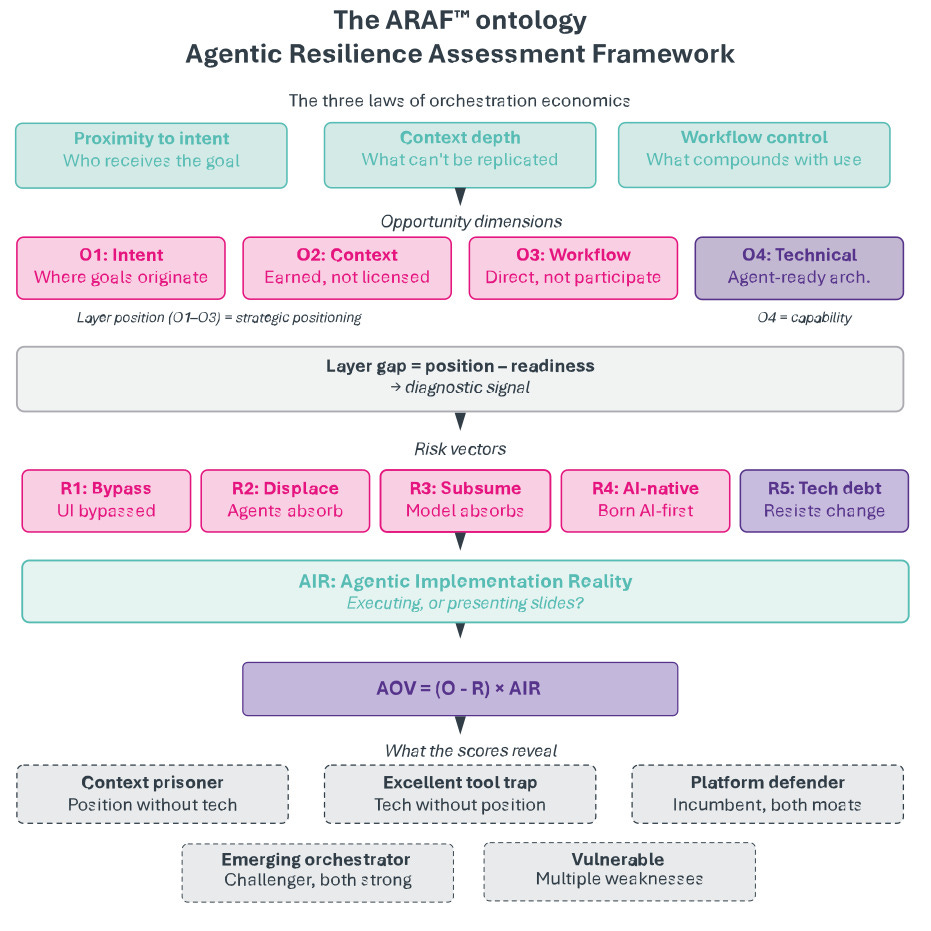
Two forces in opposition
ARAF measures two forces and assesses their balance.
The first is Opportunity. Four dimensions decide where a company sits in the agentic economy.
O1, Intent Proximity. Where does the user’s goal originate? The company that sits at the point of intent formation controls routing; everything downstream is interchangeable. O1 measures not whether a company touches the user, but whether it is where the goal is formed.
O2, Context Depth. What does the company know that cannot be rebuilt from public data? Ten million processed claims. A billion routed shipments. A trillion dollars of underwritten credit. O2 separates context that is proprietary from context that merely looks proprietary.
O3, Workflow Control. Does the company direct the work, or merely take part in it? A system of action tells agents what to do; a system of record stores what was done. O3 is that distinction.
O4, Technical Readiness. Can agents actually interact with the company’s systems? API coverage, protocol compatibility, authentication architecture, real-time data access. O4 is necessary. It is not sufficient.
The first three dimensions define Layer Position: where the company sits in the stack, at the orchestration layer, the context layer, the tool layer or the infrastructure layer. That is the structural diagnosis. O4 is the technical reality.
The distance between the two is the Layer Gap, the framework's single most important diagnostic signal.
A positive gap means strategic assets trapped behind technical limits. The company is a Context Prisoner.
A negative gap means technical excellence without strategic position. The company is an Excellent Tool.
The second force is Risk. Five vectors measure how directly the agentic transition threatens the company’s current position.
R1, Bypass. Can agents route around the company’s interface entirely? If the interface disappears, does the value proposition survive?
R2, Displacement. Can agents absorb the cognitive work the company’s users perform today? This is the scissors: agents commoditize from below while asset owners absorb from above.
R3, Model Consolidation. Can a foundation model replicate the company’s functionality as a built-in feature? Every company one API call from obsolescence carries R3.
R4, AI-Native Competition. Are new entrants building the same capability without the legacy constraints?
R5, Technical Debt. Does the architecture itself resist the transition? Monolithic systems, batch processing, legacy authentication. Every constraint that slows agent integration is R5.
The third element is AIR, the Agentic Implementation Reality check. It asks whether the company is executing on its opportunity or presenting slides about it. Real agent deployments, credible timelines, evidence that can be checked.
The output
ARAF produces one number: the Adjusted Option Value. It is the probability-weighted capacity of a company to achieve durable orchestration, adjusted for the risks that could prevent it and for the evidence of its execution.
The sign of that number is the finding. It indicates whether the agentic transition adds to a company’s structural position or takes from it. How large the prize is, and when it arrives, are separate questions the framework leaves to the valuation work that follows.
Five structural positions
The framework sorts companies into five positions, each with its own transformation path and its own risk profile. Layer Position places a company on the vertical axis; Technical Readiness on the horizontal; and the diagonal between them is the Layer Gap. The top right includes two kinds of companies that hold both: the incumbent defending its position and the entrant earning it.
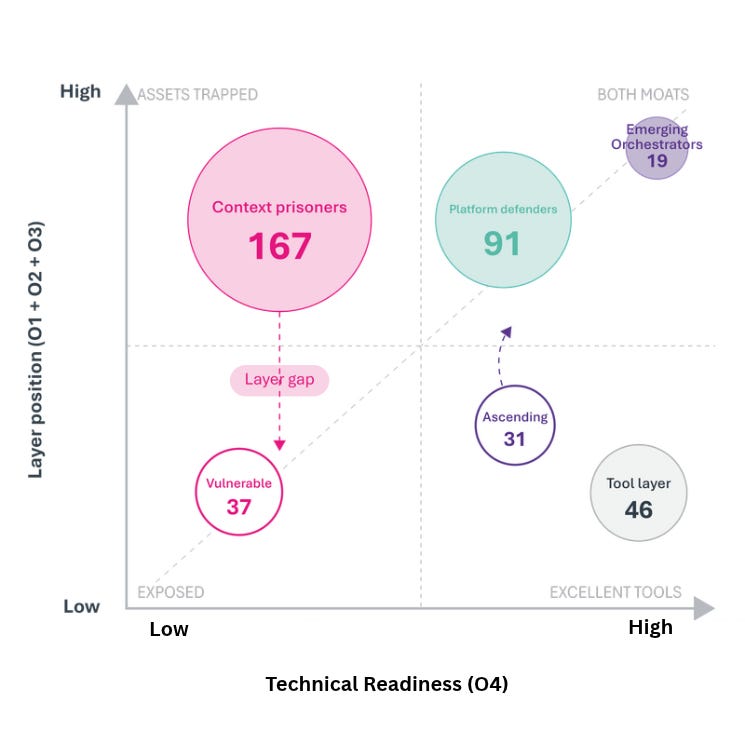
Context Prisoner. Strategic assets trapped behind technical limits. The positive Layer Gap.
Excellent Tool. Technical excellence without strategic position. The negative Layer Gap.
Platform Defender. An incumbent whose position holds, defending it against bypass and consolidation.
Emerging Orchestrator. A company earning the right to direct the work, with the execution evidence to show it.
Vulnerable. Exposed on the risk vectors without the opportunity to offset them.
How the framework is used
Every company assessed on this site is read through these dimensions. When an essay here says a company is a Context Prisoner or an Emerging Orchestrator, it is this instrument speaking. When an essay calls a price wrong, it is because the sign of the Adjusted Option Value and the price disagree.
The framework is revised on evidence. A dimension changes when the agentic economy produces a discontinuity the old definition cannot read, and not before.
ARAF™ and the Durable Growth Moat™ are frameworks of Decoding Discontinuity. The full text of the framework, as first published, is in AGNT: The Orchestration Economics Manifesto, Part V, Chapter 19.