


This is Part II in a series examining the structural repricing of enterprise software. In Part I, I argue that SaaS incumbents are more resilient than the market assumes because they hold the context and workflow authority required by AI orchestration. In Part III, I examine who benefits from orchestration and why the answer is not what the market expects.
This second part lies between those and examines the same structural shift from the attackers’ perspective. What are the AI labs building, and what justifies a $380 billion valuation?
AI labs like Anthropic and OpenAI are shifting focus from commoditizing models to orchestration platforms that coordinate agents, workflows, and enterprise context, justifying sky-high valuations like Anthropic’s $380B. OpenAI’s Frontier bets on a horizontal control plane for interchangeable agents, while Anthropic’s Cowork emphasizes vertical integration for deep embedding and switching costs. Success hinges on outpacing model commoditization, building context faster than incumbents, and navigating massive burn rates, with risks like open-source erosion and compute traps threatening the transition.
The LLM battlefield has shifted. To understand the new frontline, consider the latest volley exchanged this month between the “Great Model Powers.”
OpenAI began the month by releasing GPT‑5.3‑Codex, the most powerful update to its coding model since GPT-5 was released last August. This represented a critical moment for the company as it sought to regain ground in the critical fight for the “coding wedge.”
As I wrote at the release of GPT-5, the “coding wedge” has become the strategic beachhead, where winning developers in coding workflows provides the leverage to win enterprise AI adoption and broader orchestration control. Even back then, coding had emerged as the first domain in which autonomous agents were reliable enough for real production use, becoming a practical proving ground for capability and cost.
For much of last year, I preached that whoever controls how developers build with AI gains control of the orchestration layer, which then extends from developers to all knowledge workers and enterprise workflows.
At the time, conventional wisdom portrayed OpenAI as an unstoppable juggernaut. But if you understood the coding wedge, then you weren’t surprised as Anthropic seemed to surge last fall in terms of both enterprise and mindshare. Since the start of 2026, Anthropic has appeared to be transforming from an OpenAI also-ran into a cultural phenomenon, thanks to Claude Code, its developer tool, launched barely a year ago. Following the release of the latest Claude model in November, developers began flocking to Claude, singing its praises, generating buzzy headlines in the Wall Street Journal, gushing over the release of Claude Cowork for mainstream users, and then the viral success of OpenClaw, the open-source framework created by Austrian developer Peter Steinberger that runs on any LLM but was clearly optimized for Claude (thus the original name: Clawdbot).
Originally called Clawdbot, then Moltbot after Anthropic requested a trademark change, OpenClaw allows users to deploy autonomous AI assistants on their own hardware. And that, in turn, spawned the media sensation of Moltbook, a Reddit-like platform where agents could congregate, and humans could gawk at the machine interactions.
Anthropic’s shadow suddenly loomed so large that the announcement of plugins for verticals such as legaltech for its Cowork platform, ultimately still a niche product, triggered the $285 Billion SaaSpocalypse on Wall Street. An event that managed to almost completely drown out OpenAI’s Codex launch news that came the same day. Beyond the hype, Claude Code is generating $2.5 billion in ARR, a significant portion of Anthropic’s $14 billion ARR, which has grown more than tenfold annually over the past three years.
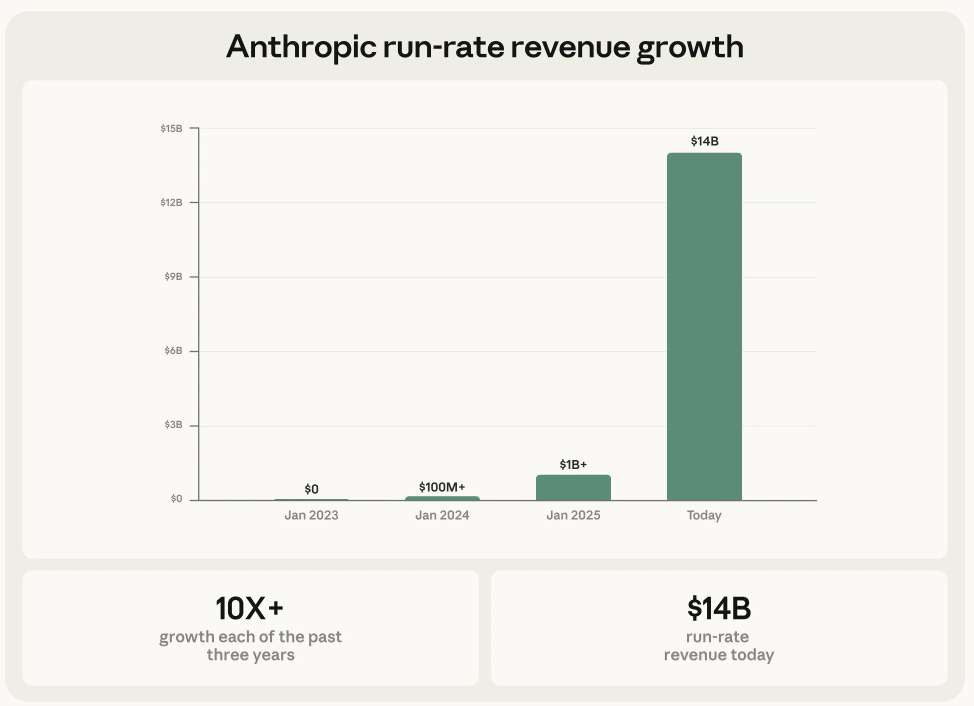
But Claude Code is not just a peripheral product. It is the very core of what has propelled Anthropic to this position. It’s why Anthropic closed a $30 billion funding round at a valuation of $380 billion, more than double its $183 billion valuation from just five months earlier, and the second-largest private funding round in technology history.
OpenAI understands this. It’s why the company spent half of its August GPT-5 launch talking about coding. And it’s why, as part of the latest Codex release on February 5, it did something that received less attention than it deserved. The company launched a product called Frontier. Not a new model, not an upgrade to GPT, but an enterprise platform for deploying and managing AI agents across business systems.
Agents on Frontier receive employee-like identities with scoped permissions. They connect to data warehouses, CRM systems, and internal applications through what OpenAI calls a “semantic layer for the enterprise.” They build institutional memory from their interactions over time.
The most critical thing to know is that they do not need to be OpenAI’s agents. Frontier manages agents from Anthropic and Google. Fidji Simo, OpenAI’s CEO of Applications, proclaimed: “We’re not going to build everything ourselves. We are going to be working with the ecosystem.”
Then, last weekend, OpenAI staged a minor coup by announcing the hiring of Steinberger, the man behind OpenClaw, “to drive the next generation of personal agents,” according to CEO Sam Altman. “We expect this will quickly become core to our product offerings. OpenClaw will live in a foundation as an open-source project that OpenAI will continue to support.”
On the surface, it would be easy to conclude that the AI labs are once again sucking up all of the oxygen, resources, and talent.
But take a closer look to find the real meaning behind these announcements.
The AI labs are leaving the model layer behind. The labs are building platform companies.
The fight is now for the orchestration layer.
They are not completely abandoning models. These remain the substrate on which everything else is built. But look at what these companies are actually building. Not what they say, but what they ship, and the picture becomes clear.
Every significant product that OpenAI and Anthropic have shipped in the past six months reveals that neither company believes the model layer alone can sustain these valuations. Claude Code, Cowork, the vertical plugins, Frontier, and Codex are not model improvements. All of them are orchestration infrastructure: systems designed to coordinate AI agents across enterprise workflows, accumulate institutional context, and create the switching costs that justify platform multiples.
Consider that $380 billion valuation. At $14 billion ARR, that represents a 27x multiple. If Anthropic is a model company selling intelligence in a market where intelligence is converging, then this is an extraordinarily aggressive bet on a commoditized asset. As I noted in May 2025, benchmark scores were already converging by 5%. Open-source alternatives have narrowed the gap between commercial leaders, as I cited in my analysis of MiniMax’s IPO, a Chinese lab with a fraction of the capital intensity of US peers. But if Anthropic is a platform company, selling orchestration, workflow coordination, and accumulated enterprise context, then 27x may be the entry price for a generational enterprise franchise.
The distinction between these two readings is the difference between fragile and durable.
Victory is hardly inevitable. In the SaaSpocalypse article, I explored the nuances required to understand which incumbents are vulnerable and which have the potential to transform themselves for the Agentic Era.
As for the AI labs making a play to become platform players, last week I wrote:
“The unpriced reality is that AI labs are moving up the stack not from strength but from necessity, because the model layer is commoditizing faster than enterprises can be rewired. These players recognize that orchestration, not intelligence, is the real control point. Yet there is plenty of evidence that any edge they have in model power will not automatically give them an advantage at the orchestration layer.”
With OpenAI and Anthropic expected to go public sometime this year, I want to dive deeper into that question, particularly. The new paradigm of Orchestration Economics is just beginning to take shape, and it will require investors to develop new tools and frameworks to price the valuations and risks in the Agentic Era.
What orchestration means
The term “orchestration” is used loosely in the industry. Its specificity matters for valuation. So, it is worth defining precisely.
Orchestration in the enterprise AI context is the set of systems that enable AI agents to perform useful work within organizations. This includes:
Connection protocols that link models to enterprise data and applications.
Agent frameworks that guide multi-step reasoning across complex workflows.
Governance systems that ensure compliance, auditability, and appropriate permissions.
Accumulated context, the institutional memory, that allows an AI system to understand not just what a task requires in the abstract, but how this organization, with its processes and exceptions and approval chains, gets work done.
Model intelligence answers the question: Can the AI do this task?
Orchestration answers the question: Can the AI do this task, here, within this organization’s systems, rules, and workflows, reliably enough that the organization will depend on it?
Orchestration is a strategic position in the Agentic AI era, one that enables you to capture user intent and turn it into a business outcome by commanding these systems.
This is the difference between a technology and a business. I believe this is the most important distinction in enterprise technology today, one that I first developed in my analytical work on the Agentic Era, and subsequently pressure-tested during a private due diligence engagement evaluating Anthropic’s competitive positioning when the company was valued at approximately $170 billion.
In that assessment, I identified three moat pathways:
enterprise orchestration
coding dominance
vertical specialization
I concluded that the orchestration thesis was “achievable but unproven.”
Nine months later, the thesis has moved from analytical to operational. It is no longer a prediction about where the labs might go. They have arrived.