

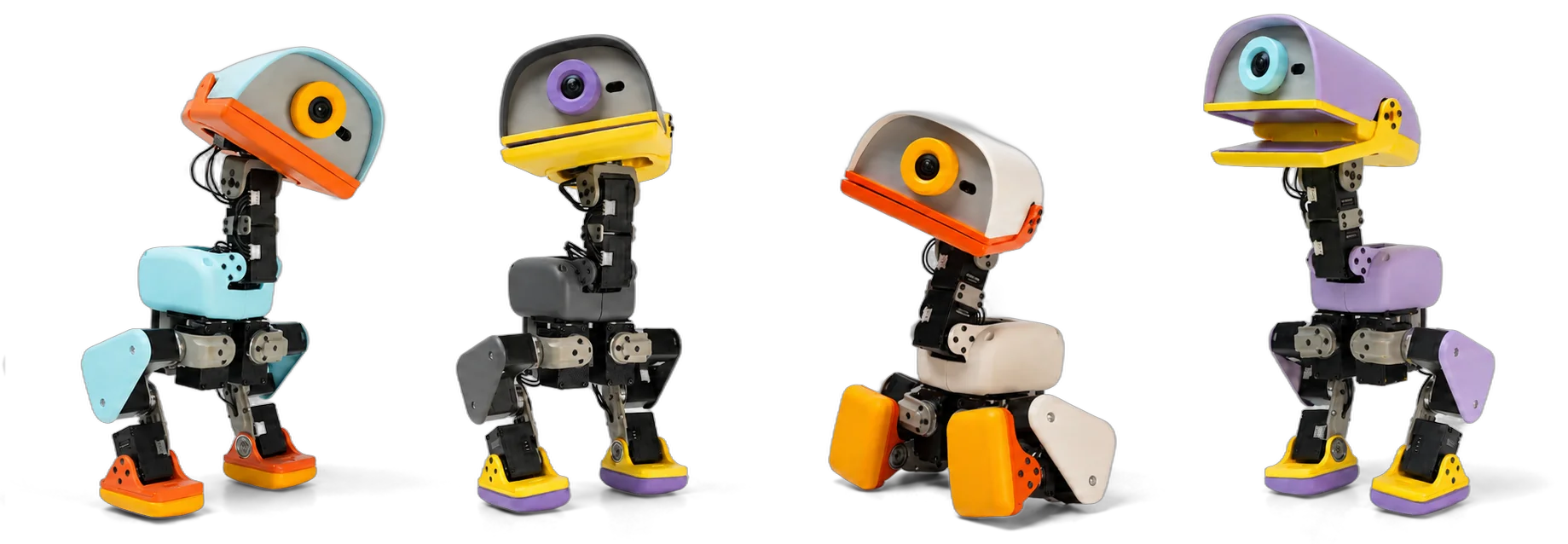
Nvidia’s reported $12.9 billion bid for AI registry Hugging Face is widely being read as a bet on model hosting. But something far more interesting may be happening beneath the surface. With Hugging Face’s release of its Microduck consumer robot, the timing of this deal suggests that Nvidia recognizes we may be at an inflection point for physical AI. More than just a cute consumer robot, Microduck is designed to create a recursive learning loop by enabling users to publish reusable behaviors back to the Hugging Face Hub. Thousands of $399 robots could become a flywheel that creates the data commons that physical AI currently lacks. If this bet succeeds, Hugging Face would be at the center of the latest tremor along the larger fault line driving value out of the model layer, as intelligence is no longer the scarce resource on which competitive advantage can rest.
The morning after The Information reported that Nvidia had agreed to acquire AI registry Hugging Face for $12.9 billion, I went looking for what Hugging Face’s leadership had to say about the biggest price ever put on open-source AI.
What I found instead was Hugging Face co-founder and CEO Clem Delangue announcing...a duck.
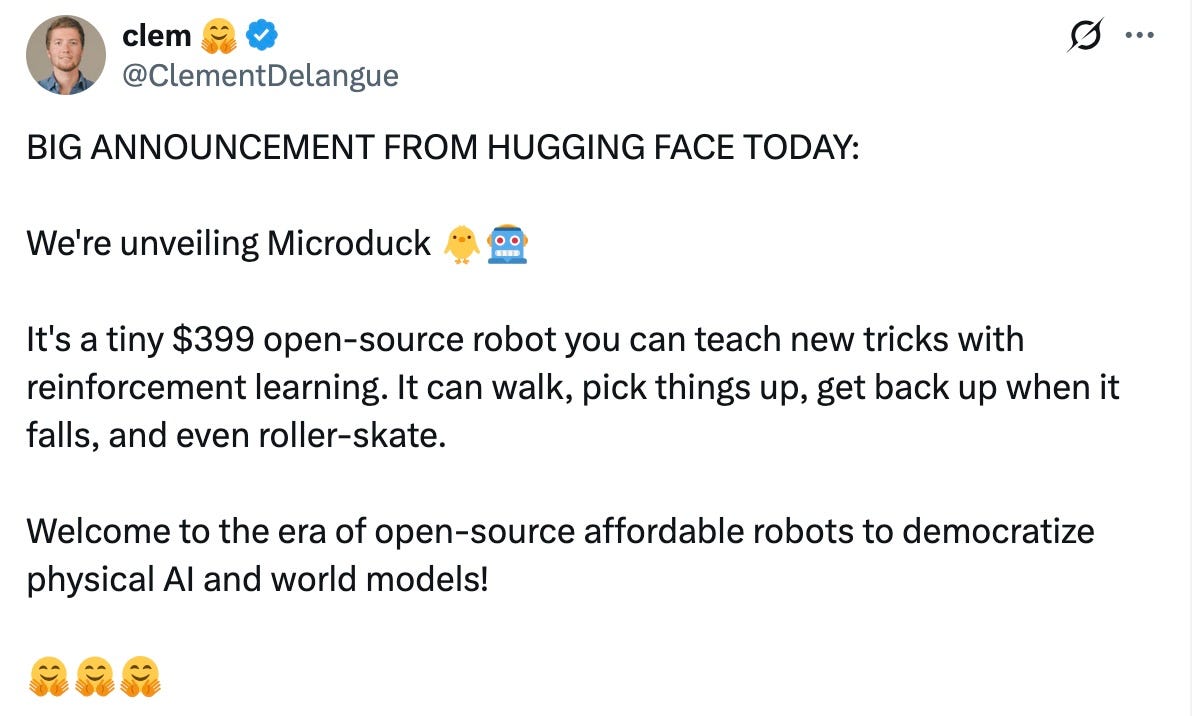
“BIG ANNOUNCEMENT FROM HUGGING FACE TODAY: We’re unveiling Microduck 🐥🤖 It’s a tiny $399 open-source robot you can teach new tricks with reinforcement learning. It can walk, pick things up, get back up when it falls, and even roller-skate.“
At first, I thought this might be a joke. Now I believe the adorable robotic ducks may point to the real story behind this deal.
Hugging Face would be the largest acquisition in Nvidia’s history, nearly twice the size of Mellanox, and its biggest move since the abandoned $40 billion Arm bid. Word of the potential deal landed hours after Nvidia reported the strongest quarter in its history: $96.2 billion in revenue, up 106%, with management guiding roughly 70% growth that it described as constrained by supply rather than demand.
While relatively tiny compared to Nvidia, Hugging Face has established itself as the primary registry where the world shares AI. An AI registry is the distribution layer where models, datasets, and increasingly behaviors are discovered, versioned, pulled, and published. Nearly three million models and more than a million datasets are published on Hugging Face. When a developer needs a model, its code pulls from Hugging Face by default. But the company only generates roughly $150 million in annualized revenue. At $12.9 billion, Nvidia would be paying about 86x sales. That is almost double the $7 billion valuation at which Hugging Face rejected a $500 million investment from Nvidia itself in late 2025. At the time, according to the Financial Times, the company did not want a dominant investor that could sway its decisions.
A repricing of that magnitude, paid to the company that turned you down, suggests Nvidia values Hugging Face as more than a model-hosting platform with a modest enterprise business attached. [Note: neither company has confirmed the transaction; no signed agreement has been reported, and the deal may collapse or close on different terms.]
Even if the deal falls through, the number raises the question this essay tries to answer: what could the chipmaker see in the registry that its current income statement cannot justify?
That brings me back to the Microduck announcement. The timing in terms of leaks about the deal and the Microduck launch was perhaps just coincidence, but it put the acquisition and one possible explanation for its price on the same screen.
The open-source inflection in language AI happened because its training corpus already existed. Physical AI has the opposite problem. The models are becoming open. Simulation makes some forms of reinforcement learning cheap. Robot hardware has collapsed in price. Shared data formats now exist. But the essential training input of data generated by bodies interacting with the physical world remains scarce, expensive to produce, and overwhelmingly locked inside closed fleets. No internet of embodied experience is waiting to be scraped.
That’s what makes Microduck more interesting than its specifications.
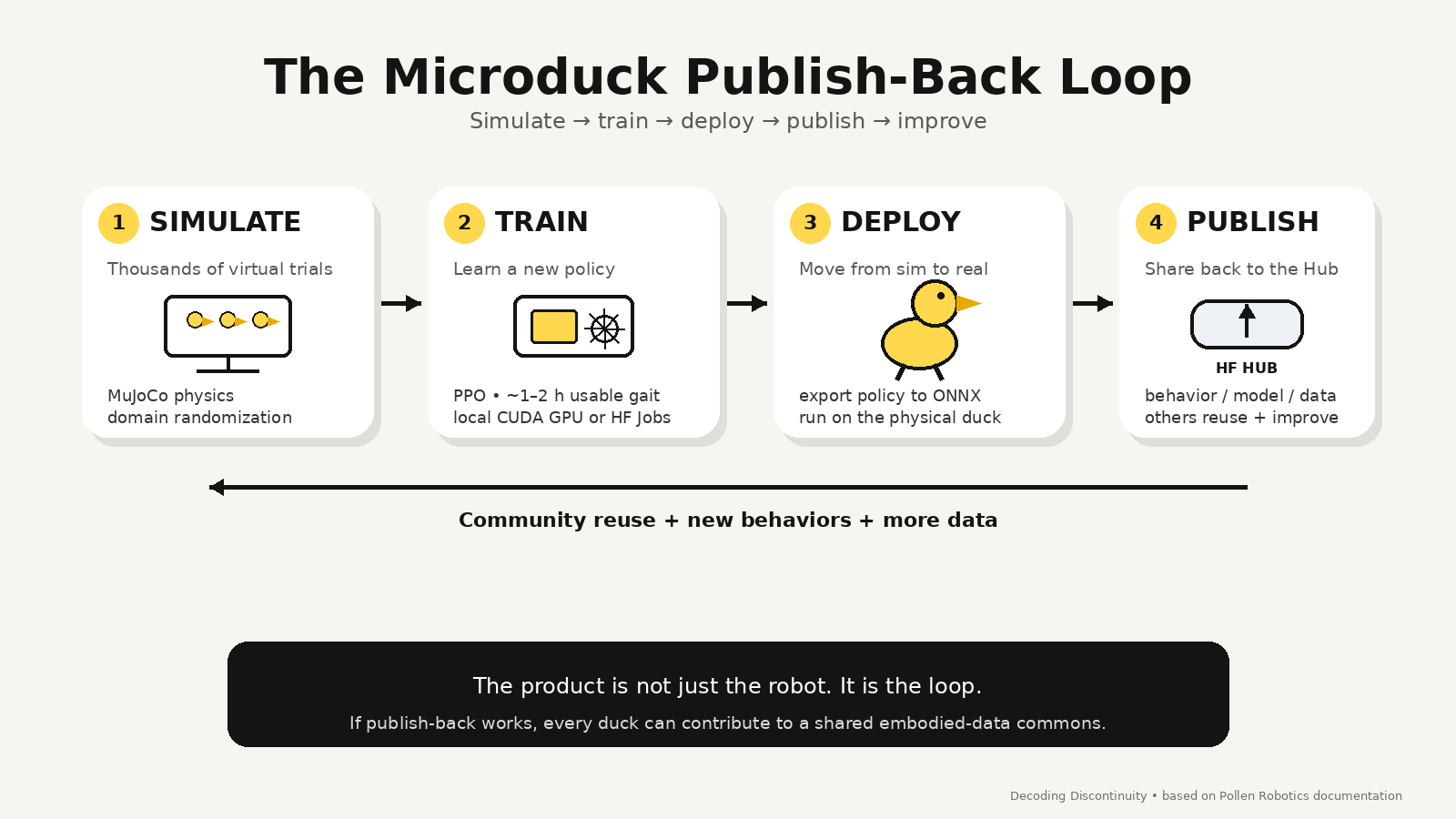
Hugging Face has designed a $399 consumer robot around a loop: train a behavior in simulation, deploy it to the machine, and publish it back to the Hub for someone else to build on. On the surface, the product looks like a robotic duck. Underneath that surface, however, the product is an attempt to turn thousands of cheap robots into a distributed engine for producing the shared corpus of embodied data that open physical AI still lacks.
If that conversion works, the Hub stops being only a registry where open intelligence is distributed and becomes one of the places where physical intelligence is produced. A community corpus begins to compound. Open robot models get the equivalent of the internet that open language models inherited for free. And a layer that looks modest when measured against today’s enterprise revenue begins to look considerably more strategic.
That, I think, is the option Nvidia may be pricing.
In that scenario, Microduck would become the latest in the sequence of tremors I have been cataloging that trace the same fault line: value migrating out of the model layer as intelligence is no longer the scarce resource on which competitive advantage can rest. With respect to Physical AI, if embodied data becomes a commons, then the value begins to migrate toward the layers that distribute intelligence, generate and verify its data, provide the bodies it inhabits, and supply the compute on which it learns.
For Hugging Face, the specific challenge it now faces is whether it can convert its consumer robot ownership into published training data at a rate its previous hardware could not. If it can, Microduck may mark the beginning of physical AI’s open-source inflection. If it cannot, the $12.9 billion thesis must rest on the registry alone.
Either way, the duck gives us a way to understand what Nvidia might actually be bidding for.
Microduck: The Product Is the Publish-Back Loop
Microduck is the descendant of Open Duck Mini, a community-built homage to Disney’s BDX droids that had a 3D-printed biped walking with simulation-trained reinforcement learning by early 2025.
Hugging Face has turned that experiment into a $399 product. Microduck is a 25-centimeter biped with fifteen motors, a camera, and a small lidar. It ships with seven pre-trained behaviors, including walking, kicking, grabbing, roller-skating, and getting back up after a fall. The behaviors are retrainable, and the software stack, model weights, and training pipeline included are published under Apache 2.0.
But more than the robot, the loop is the real product.
You simulate the duck in a physics engine and train a new behavior with reinforcement learning. A usable gait takes an hour or two on a single GPU, and one flag runs the same job on Hugging Face’s hosted compute. You deploy it to the hardware and publish the result back to the Hub for the next owner to build on. Hugging Face has taken a workflow that previously belonged to robotics labs and turned it into the intended consumer experience.
The design respects a boundary I defined in the Coding Wedge. I argued that wedges emerge where the distance between action and verification is shortest: code compiles, or it doesn’t. Simulation gives locomotion the shortest distance to a verifier in the physical world. A model can run millions of trials at near-zero marginal cost. The robot falls, or it does not. Reinforcement learning gets a cheap, automatic verifier.
That is why a $399 machine with hobby motors can learn to roller-skate at all. It also explains where Microduck’s ambitions stop. Once the task moves from locomotion into contact-rich manipulation, verification becomes harder, and the physical world starts becoming too expensive. The duck’s articulated beak can grab an object by lowering the whole body and scooping from the floor. It is a clever mechanism. It is not a hand. The tasks industrial robotics are actually paid to perform remain considerably harder.
What Microduck may already have solved is the other prerequisite for a community data engine: distribution.
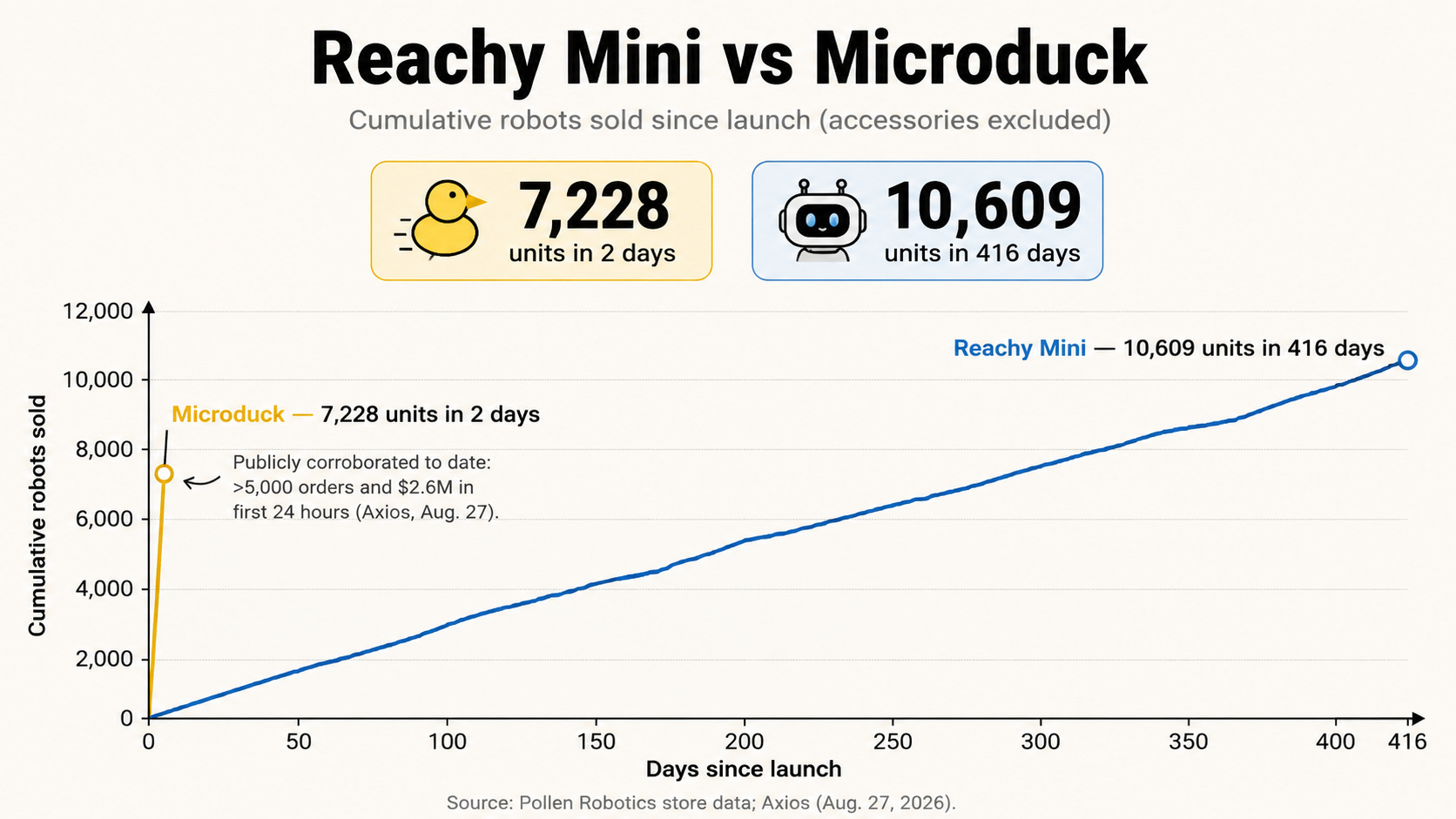
More than 7,000 units were ordered in its first two days according to the store’s running count. Delangue told Axios the first 24 hours alone brought over 5,000 units and $2.6 million in orders, two-thirds of everything its desktop predecessor, Reachy Mini, sold in fourteen months on the market. Within 48 hours, the store had stopped promising Christmas delivery for new orders. “The community ordered a lot of ducks,” as the order page now puts it, quoting a four-to-six-month lead time.
What Microduck Is Not: Closed Hardware, Nothing Shipped Yet
Important boundaries surround those numbers.
Microduck is open software, not fully open-source hardware: its mechanical and electronic design files remain closed, while the published 3D assets are simulation meshes under a non-commercial license. More importantly, nothing has shipped yet. The first deliveries are targeted before Christmas.
Physical AI’s Missing Asset: Embodied Data
What exactly is the bet that begins when the ducks arrive?
That the remaining bottleneck in open physical AI is no longer primarily the model, the hardware, or even the training machinery. It is the corpus. Language models had an advantage because their training data existed before they did. Open-weight models could eventually compound on much of the same raw material available to the closed labs. Once their capabilities caught up, the commodity tier of intelligence began going free.
In contrast, a robot has no internet of physical experience waiting to be scraped. Embodied data must be generated through demonstrations, physical interactions, successful actions, failures, and the telemetry produced while machines perform real work. Historically, generating those experiences required expensive hardware and real-world deployment. That made data a capital asset.
Tesla runs a dedicated demonstration-collection operation alongside its factory fleet. Amazon operates more than a million warehouse robots and trains fleet-scale models on years of their telemetry generated while moving actual goods.
The problem for the larger robotics world is that rich data stays where it is made. Every one of those engines is closed. Physical Intelligence open-sources its reference models, π0 and π0.5, while its frontier line has never shipped weights. Google DeepMind’s Gemini Robotics 2, released in July as the first model to run a humanoid’s legs, torso, arms and fingers from a single checkpoint, is available to trusted testers only. Figure’s Helix has never been released. In robotics, data is the dam. Whoever holds it, holds the category. That data compounds inside the organizations that own the machines.
The dam is not only a robotics-lab asset. Any company that moves physical goods at scale, including parcels through depots, pallets through plants, vehicles through networks, is potentially operating a proprietary embodied-data engine. The telemetry produced by those operations may become one of the most valuable assets sitting inside companies the AI market currently regards as boring.
Four ingredients are ready; one is missing
And yet, the conditions are ripe to level the playing field. That’s because the open-source ecosystem has assembled most of the ingredients for an inflection:
The models exist. Open baselines such as π0 and Nvidia’s GR00T give researchers and developers capable foundations to build on. Open robotics does not have to wait for its weights to begin experimenting.
The verifier is cheap. Simulation, for the locomotion class, gives reinforcement learning a free training signal, the precondition that code enjoyed and most of the knowledge economy did not. Millions of attempts can be evaluated without millions of physical falls.
The hardware collapsed in price. The SO-100, the 3D-printable teleoperation arm designed by TheRobotStudio with the LeRobot team and released in late 2024, costs roughly €225 in parts. An academic-standard that once cost around €21,000 can now be approximated for about one-hundredth of the price. The cost of producing a robot demonstration has fallen with it.
The format is increasingly shared. The LeRobotDataset schema gives robot episodes a common structure for actions, observations, and video. Training pipelines can consume data from different machines with relatively thin adapters. Nvidia’s own GR00T fine-tuning stack ships one, expecting its data in a lightly extended LeRobot format.
Those last two unglamorous items have produced something that begins to look like a corpus.
How Many Robotics Datasets Are on Hugging Face?
Community robotics datasets on the Hugging Face Hub grew from roughly 16,000 a year ago to nearly 80,000 by my count this week, the largest dataset category on the entire platform, and one of its fastest-growing shelves. A single community hackathon added ten thousand datasets, the equivalent of 260 days of continuous recording by Thomas Wolf’s own count.
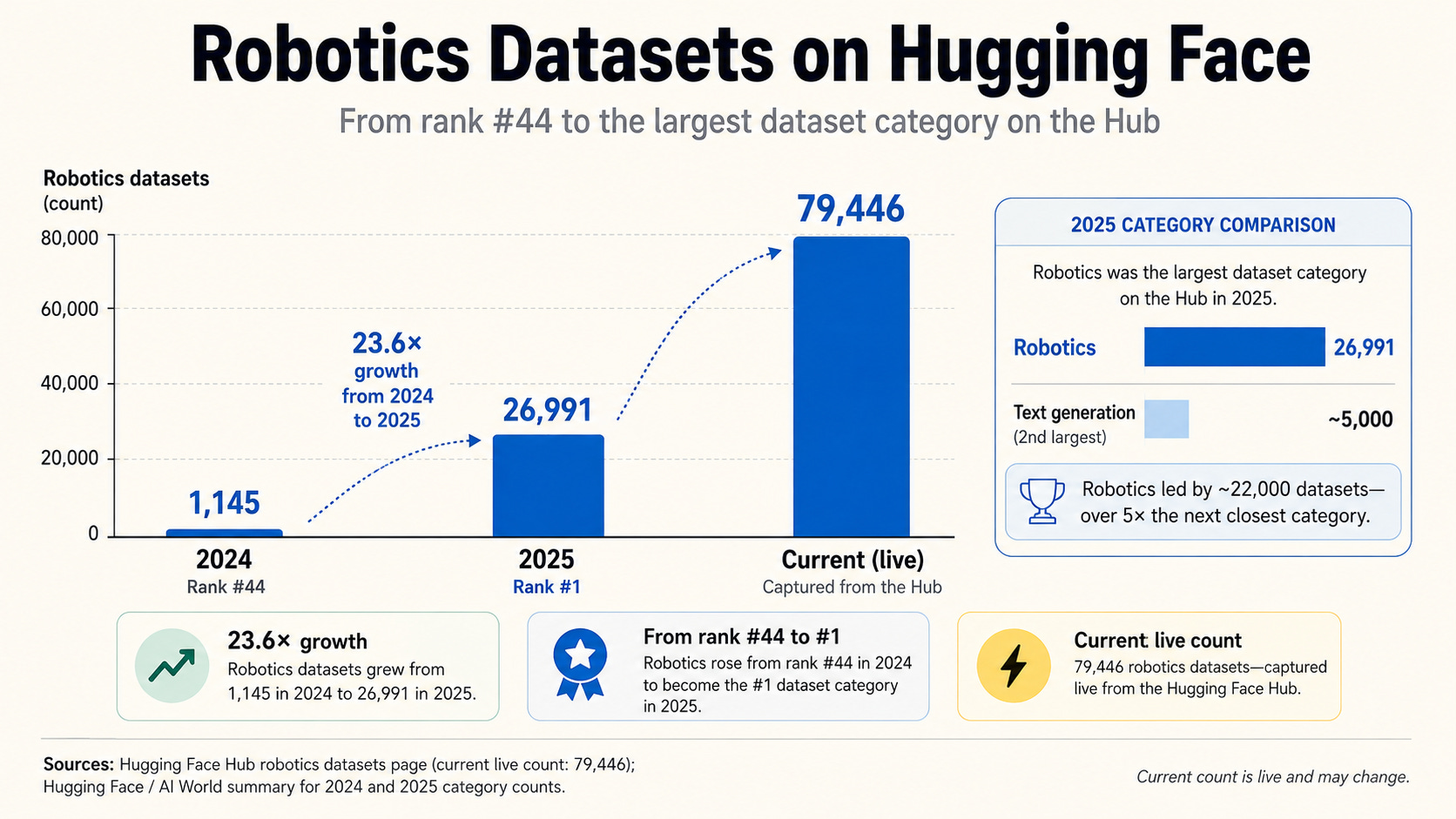
Despite this momentum, it’s important to remember that for Hugging Face, a dataset count is not the same thing as a training corpus.
Most community datasets are still teleoperated tabletop demonstrations recorded with inexpensive arms in bedrooms and labs. By episode volume, many are rehosted research collections rather than new experience generated by an expanding fleet. Quality is uneven. Labels are inconsistent. Tasks repeat.
Hugging Face diagnosed the problem in May 2025, when its researchers asked what would be required for LeRobot community data to become the “ImageNet of robotics.” Their answer cataloged the obstacle: empty task descriptions, junk episodes, inconsistent metadata, and too little useful diversity.
Reachy Mini: 10,609 Robots, One Trajectory Dataset
So the open ecosystem has demonstrated that it can create datasets. It has not yet demonstrated that it can create a self-reinforcing data engine. Hugging Face’s Reachy Mini sold 10,609 units over fourteen months and generated around two hundred community apps. The number of trajectory datasets those robots contributed back to the Hub was one.
Ten thousand robots. One dataset.
The failure was not necessarily unwillingness on the part of users. Reachy was designed primarily as an app platform: owners downloaded and consumed behaviors. Recording physical experience and publishing it back was not the product loop. Teleoperation support arrived later through a community contribution.
That distinction matters because simply distributing robots does not create a commons. The machines have to convert deployment into reusable data.
Microduck is Hugging Face’s attempt to change that conversion rate. While the order number of units makes a fun and easy number to cheer as it ticks higher, the far more important number in terms of impact will be useful trajectories published per thousand robots shipped.
That is the missing asset. And for the first time, because Hugging Face is an open platform, we can watch whether it forms.
Why Nvidia Would Pay $12.9 Billion for Hugging Face
Nvidia’s reported bid for Hugging Face is not really a bet on model hosting. It is an option on the infrastructure of open AI. Microduck makes that thesis measurable: if thousands of $399 robots publish reusable behaviors back to the Hub, Hugging Face could become the data commons that physical AI currently lacks.
But the logic of the bid does not depend on the ducks succeeding.
Let’s start with what Nvidia would be buying today. Hugging Face is already the default distribution layer for much of open AI. In Hugging Face’s libraries, a model identifier passed to from_pretrained() resolves to the Hub by default. Nvidia’s models compete there for adoption against Qwen, Llama, and the rest of the open ecosystem. The platform provides an unusually early view of what developers download, test, and deploy. These are demand signals that can precede the GPU workloads they eventually create.
That makes the registry strategically valuable even if Microduck contributes nothing. So in that framing, physical AI makes the upside larger. If the publish-back conversion works at even a fraction of consumer scale, embodied data stops being something only capital-rich fleets can produce. A commons begins to form in a shared format and on a shared platform, growing as more machines generate usable experience. Open robot models can then begin compounding on community data the way open language models compounded on the internet.
If that happens, Hugging Face is no longer simply the shelf where open models are distributed. It becomes one of the places where the scarce input to physical intelligence is accumulated.
That is one way to read the $12.9 billion valuation. Nvidia would not be buying an embodied-data engine; the Reachy numbers tell us that engine does not exist yet. It would be buying an option on whether one forms, at the platform where the pieces are already converging.
The coordinates matter deeply here. Hugging Face already hosts the fastest-growing robotics dataset category on its platform. LeRobot has supplied a common data format. Nvidia’s own GR00T stack already works with a lightly extended version. Hugging Face can provide hosted compute for the training loop. And Microduck is an attempt to distribute the missing data-generation endpoint into thousands of homes.
If the conversion happens anywhere in the open ecosystem, Hugging Face is unusually well positioned to see it first and potentially to become the place where it compounds. That will likely be true no matter what happens with the Microduck experiment. That helps explain an 86-times-revenue price in a way the current income statement does not.
Why the Hugging Face Bet Is Asymmetric for Nvidia
And there is a deeper reason the wager fits Nvidia specifically: the outcome is asymmetric.
“Free AI should be great for chips” Huang told Axios in July. That is the economic logic running underneath Nvidia’s open-source strategy. As the price of intelligence falls, usage expands. His arithmetic on the earnings call ran to 15 to 100 times more compute per agent than per human, with millions of agents running continuously as the design point. More models are trained, more agents run continuously, more simulations are executed, and more inference is consumed. Value may migrate away from the model layer without leaving the Nvidia stack.
Readers of my March essay on Nvidia’s Agent Toolkit will recognize the playbook. CUDA established it two decades ago: make an important software layer broadly available so that whatever developers build on top eventually creates demand for the underlying compute.
Nvidia has been repeating the maneuver higher in the stack through open models, agent tooling and, if the reported transaction closes, potentially the registry through which much of open AI is distributed.
Physical AI makes the loop unusually literal. Huang describes robotics as running across three computers: one to train the model, one to simulate the world, one in the body. Microduck is a miniature of that architecture. Its onboard computer is the cheap, ten-dollar Rockchip. Nvidia can concede that edge because the expensive parts of the system sit upstream: training models and simulating environments at scale.
Considering these scenarios and gaming them out, the Hugging Face (potential) deal leaves Nvidia with two favorable outcomes that begin to form the rationale behind that pricing.
If the publish-back experiment fails, then physical AI remains dominated by closed fleets such as Tesla, Amazon, and Figure, and the frontier robotics labs continue building proprietary data engines. To do that, they will need to buy enormous amounts of compute to train on them.
If it succeeds, an open, long-tail training economy begins forming around shared models, simulations, and embodied datasets with Hugging Face sitting at its distribution layer and Nvidia supplying much of the compute beneath it.
The only losing branch for Nvidia is the one where physical AI stalls entirely.