


TL;DR: Anthropic is registered as a software company and carries the cost base of a utility. My base case values the equity at $2.24 trillion, and my risk-adjusted value is $1.51 trillion, against a valuation under discussion of $1.2 trillion to $1.3 trillion. At that level, the price pays for the business Anthropic has built. It still doesn't pay for the enterprise platform my base case needs it to become.
Today I’m publishing a standalone analysis of Anthropic’s S-1, tracing the investment case, the assumptions behind my valuation, and the risks that could change my view. The accompanying 30-page teardown, with the detailed model and evidence, is available to download at the end of this article.
Investors are reportedly discussing a valuation of $1.2 trillion to $1.3 trillion for Anthropic after its offering, down from as much as $2 trillion in October.
My own numbers sit above that range. If everything an investor has to believe about the company holds, the equity is worth about $2.24 trillion before the offering. Once I price the ten events that could break the case even if those beliefs hold, it is worth about $1.51 trillion.
So I am constructive at the valuation under discussion. After weeks inside the S-1 and building a long-term model of the business, I think Anthropic has a credible path to becoming one of the defining companies of this cycle. The more useful question is what the price is paying for, because the filing describes two companies at once.
The first is a software company. Anthropic is registered under the same industry code as Microsoft and Oracle, and on one presentation of its accounts it looks like them, with a gross margin of 85%. The second is closer to a utility. On the other presentation, compute and infrastructure took 57% of revenue in the first nine months of 2026. That compute is bought 12 to 18 months ahead, is owed whether or not it is used, and sits under leases of up to twenty years.
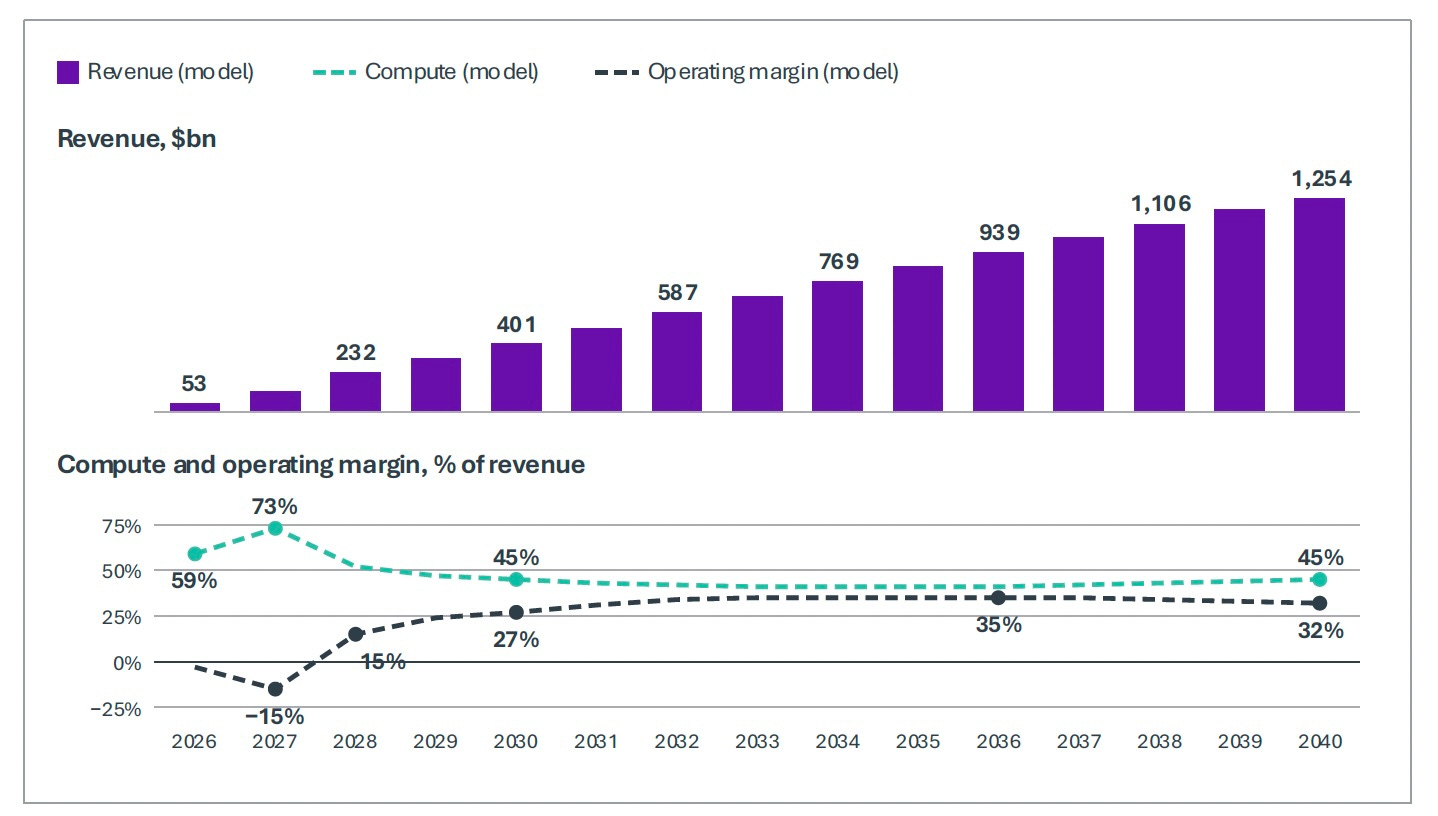
Everything that matters about this listing follows from that hybrid. The company has to secure and pay for capacity out of revenue earned each month, and the models and products have to keep that revenue growing fast enough to cover it. In my model, 2027 is a loss year, with compute at 73% of revenue, before the economics turn in 2028.
Two weeks ago, in “It’s All About Compute,” I argued that the instruments investors use had not caught up with this company, and that the filing had left its largest number, the total compute bill, blank. The amended filing has since printed it: $895.4 billion of committed spending, of which $69.8 billion falls due in the next twelve months. With the bill visible, the next question is what the company is worth and what has to be true for it to be worth that. Anthropic remains the clearest case of what I call Discontinuity, in which the benchmarks built for the previous paradigm stop describing the business in front of them.
This essay takes three of the nine beliefs my base case rests on: the compute, the price, and the enterprise platform, and one of the ten events that could break it. Each is tied to a dated disclosure, and each can fail.
Why Anthropic’s IPO Matters to the AI Market
A listing of this size gives public investors something they have not had before: the filed accounts of a frontier lab. They show the revenue such a company can sustain, the compute it must secure, what it costs to serve a customer, and which products keep the value. The market’s response will help set the cost and availability of capital across the rest of the AI stack, from compute providers and model developers to the companies building on them.
This kind of cornerstone public offering is a vital step toward establishing a new category. Salesforce’s 2004 IPO offers a useful analogy.
Salesforce went public as a subscription-based CRM company. Its prospectus also described a wider shift to “on-demand application services”: enterprise software delivered over the internet, with CRM among the first use cases. The filing called that market new and unproven.
Investors weren't blind to the broader idea, but Salesforce spelled it out, and the IPO gave software-as-a-service a definition a market could price. The company then grew far beyond CRM, and the category it had defined grew with it.
The comparison stops there. Salesforce offered investors a new category with familiar economics: recurring contracts, low marginal cost, and operating leverage. Anthropic offers a new category with unfamiliar ones. Most of its revenue is earned again each month rather than contracted. Its highest cost is committed years before the revenue it is meant to serve. And the asset that earns the revenue, the frontier model, is rebuilt about twice a year. The metrics that served software investors for two decades do not describe that business.
That is why I read this IPO as a test of the instruments investors use as much as a test of the company.
Why I Use a Long-Term DCF to Value Anthropic
Conversations about an IPO turn quickly to a multiple. Two weeks ago my objection was that every multiple quoted on this listing ignored a bill nobody outside the company could add up. The bill is now filed, and a different objection remains: next year is the least representative year the company is likely to have. The compute it has signed for arrives in 2027 whether or not the revenue does, so on my path 2027 is a loss year at almost any level of demand.
A discounted cash-flow model holds the pieces together. Revenue cannot be valued apart from the compute needed to serve it, and the compute bill cannot be judged apart from the models and products that will earn the revenue later. I therefore built a single operating path to 2040 in three lines- revenue, compute, and everything else- with each assumption stated plainly enough for a reader to challenge it.
A simple test shows what the multiple misses. Suppose 2027 revenue comes in $23 billion below my path. At the kind of forward multiple a roadshow uses, that reads as roughly $400 billion of lost value. In the model, it costs about $38 billion if the business still reaches its 2030 destination, and about $600 billion if it does not. A multiple cannot tell those two outcomes apart, and for this company the difference between them is most of the valuation.
The model therefore treats the path as conditional. It holds only if Anthropic keeps its models at the frontier, retains pricing power, grows its own products and secures compute at a competitive cost.
None of this removes the uncertainty, which would be a strange claim to make about a company in a sector still being born. The model makes the assumptions visible so each can be tracked against the evidence and changed as the evidence changes.
First the destination the model reaches, then the beliefs it rests on.
Anthropic’s Base Case: The Revenue Path to 2030
The base case is what the model shows before discounting for events that could break it.
Anthropic’s base case reaches $401 billion in annual revenue by 2030 and $939 billion by 2036. These are model outputs, not company forecasts; the question is whether Anthropic can build the business and cash generation required to reach them. They also sit above Anthropic’s own reported plan: Reuters puts the company’s 2028 revenue target at $190 billion to $200 billion, versus $232 billion on my path. On the company’s reported plan, not mine, the base case would be about $1.6 trillion.
I built the near-term starting point by taking apart Anthropic’s revenue run rate. My earlier analysis of the 2027 run rate traced the central estimate to four drivers:
how much AI work is being done
how much of that work needs a frontier model
what customers pay across the model price ladder
who captures the revenue: Anthropic through its own products, or cloud and API channels.
That analysis put the central December 2027 run-rate estimate at $169 billion.
From there, the path rests on nine beliefs, which I call need-to-believes and set out in the next section.
The model follows revenue alongside compute and other costs to estimate the cash the business could generate. On those assumptions, it produces a base-case equity value of about $2.24 trillion before accounting for the ten single points of failure.
Need-to-Believes Behind Anthropic’s Base Case
The base case rests on nine “need-to-believes”: assumptions that must hold for the model’s operating path to work. I focus on three that show what Anthropic must accomplish: secure enough compute at a competitive cost, preserve a premium for frontier models as prices fall, and become an enterprise platform beyond coding.
NTB 1: Anthropic can secure compute at a competitive cost
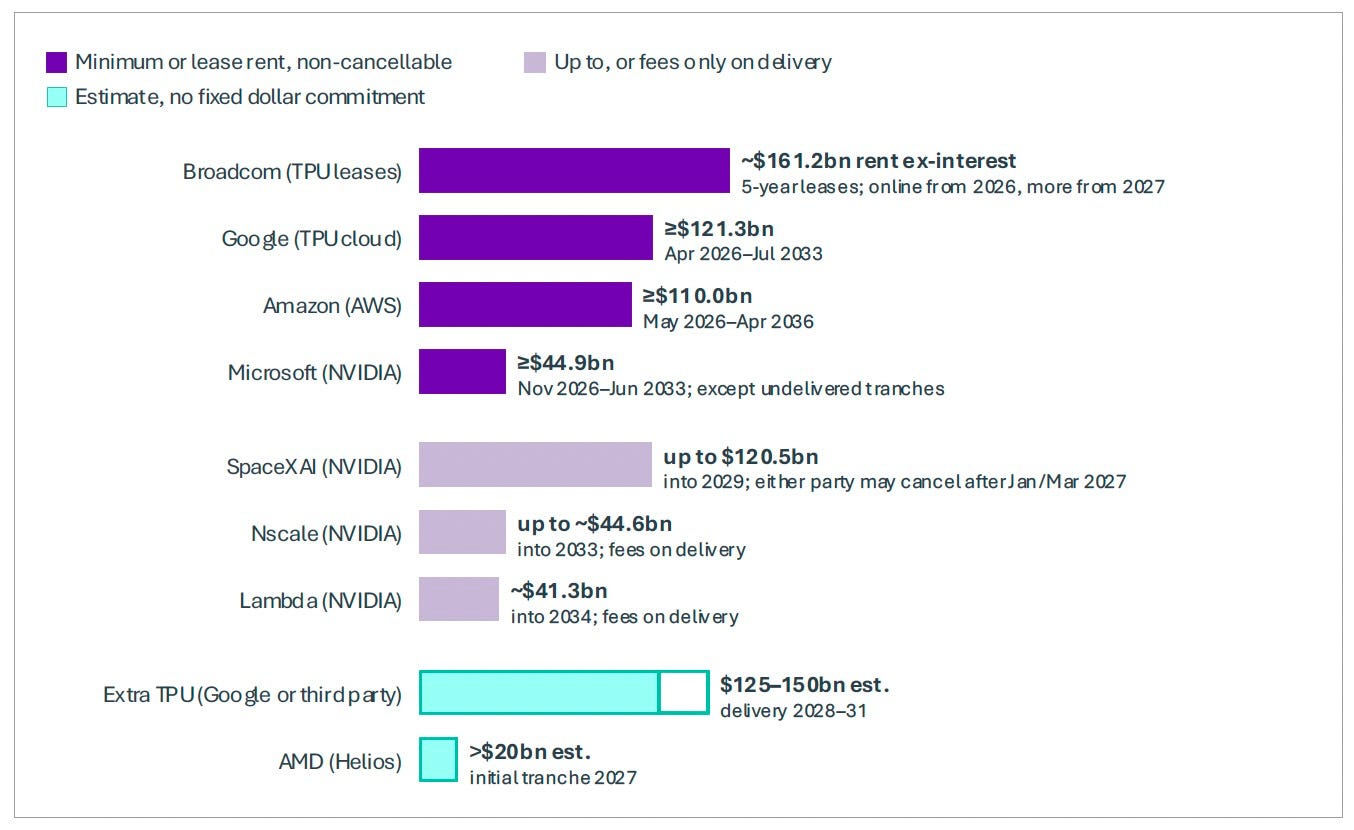
Anthropic needs enough compute, of the right kind and available on time, to train its frontier models and serve customer demand. It has signed commitments across cloud providers and accelerator types. But a signed contract does not guarantee that a powered, usable facility will be ready when the revenue path needs it.
I set out those contracts counterparty by counterparty two weeks ago, when the filing still left the total blank. The coverage ratio I proposed then can now be computed, at least on cash alone: $131.8 billion of cash and short-term investments covers the $69.8 billion due in the next twelve months 1.9 times, before the offering. The next year is funded. What remains open is whether the capacity arrives on time.
The filing gives dollars and no gigawatts, so it reports every capacity number rather than filing it. In September, Anthropic told investors to expect about 5 gigawatts by the end of 2026 and about 10 a year later. On 3 November, The New York Times reported more than 3.5 gigawatts for the end of 2026 and roughly double that for 2027. My revenue path was built on the September figures: it needs about 5 gigawatts at the end of this year and about 6.8 by December 2027. On the November figures the first of those is missed and the second is met with little room, since a year’s slippage at two or three sites would take the 2027 total below what the path needs. The offsetting evidence is the run rate, reported above $80 billion at the end of October. If that revenue was earned on less capacity than I assumed, each gigawatt is earning more than the model gives it credit for.
The cost of compute has fallen sharply as a share of revenue as Anthropic has grown: from 1,056% in 2023 to 160% in 2025, then to 57% across the first nine months of 2026. The September quarter brought a setback: compute and infrastructure reached 58% of revenue, up from 48% in June, with $5 billion of short-term compute bought at a premium.
My model assumes Anthropic’s training, research, and internal compute budget rises from $22 billion in 2026 to $100 billion in 2030, then grows 12% a year. It carries compute at 73% of revenue in 2027, 52% in 2028, and 41–45% from 2030. The path therefore depends on both capacity arriving and each generation of compute supporting more revenue.
What could weaken this belief: Anthropic says it has underestimated its compute needs and faced constraints before. Sites, power, chips, and counterparties must all deliver on schedule. About $213.8 billion of the committed spend is subject to termination rights or conditions before commencement.
Next test: Year-end capacity and obligations disclosures will show what is ready and what remains conditional. The January and March 2027 SpaceXAI windows, followed by Anthropic’s first public compute disclosures, will test the delivery schedule and cost path.
My conviction: 4/5. The signed stack and improving historical cost ratio support the belief; delivery, permitting, and financing remain open questions.
NTB 4: The frontier can keep its price
This is the belief most often misread, because there are three prices of intelligence and they are moving in different directions. The first is the price of a fixed capability: work at the level of GPT-4 costs less than a cent today for every dollar it cost in 2023, and Epoch AI measures the decline at about 13 times a year. The second is the price of the frontier itself, which has held up. The newest top-tier models from Anthropic and OpenAI both list at $10 per million input tokens and $50 per million output tokens, and Fable 5 launched at twice the price of the model it replaced. The third is the price Anthropic actually collects per token across everything it sells, which is a blend of the first two.
The belief concerns that blend. Cheaper models will take most of the routine work, and my model lets them: the frontier’s share of the work falls to about 15% by the end of 2027. What has to hold is that customers keep sending their most valuable work to the newest model and paying the premium for it, so that the frontier still earns about two-thirds of the revenue. If it does, the price Anthropic realizes per token roughly halves each year, and volume growth more than absorbs it. If it does not, the realized price converges on a floor set by free models.
The record so far supports the belief. More than 80% of Anthropic’s September-quarter revenue came from models less than six months old, which shows how quickly customers move to each new generation. In the same quarter, price cuts and discounts took about $600 million off revenue while additional usage added roughly $6 billion. Outside the filing, a Menlo Ventures survey of enterprise buyers found frontier models took 63% of spending on 42% of tokens.
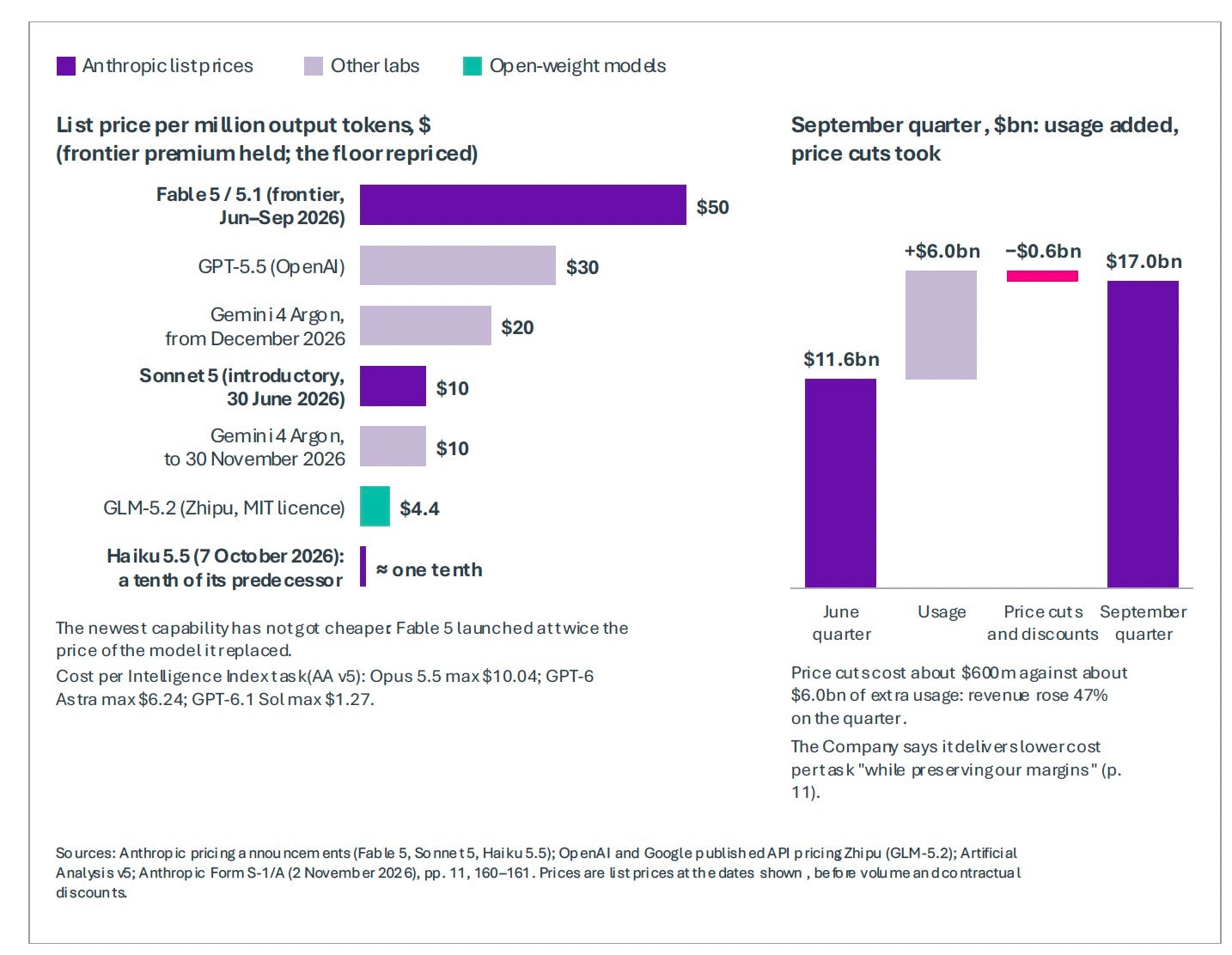
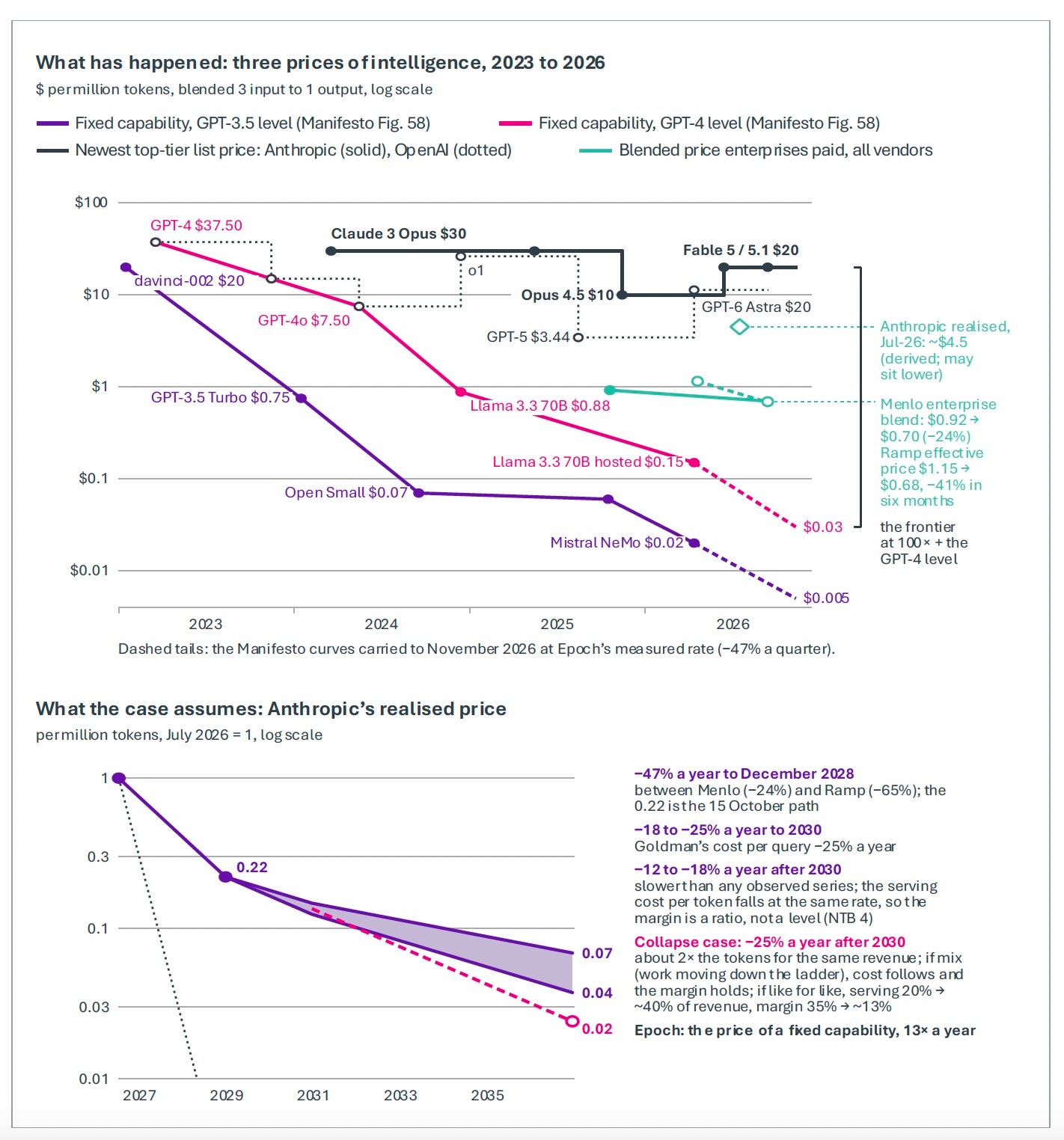
This has a consequence that is easy to miss. A falling realized price is not in itself bad news for the belief. When it falls because routine work moves to cheaper models, the cost of serving that work falls with it, and the margin holds. It becomes a problem only when the frontier must be repriced against cheaper rivals without a matching fall in Anthropic’s own cost per token. The number to watch is therefore the ratio of price to cost at the frontier, which shows up in the serving margin, more than the price on its own.
What could weaken this belief: Customers may move more of their valuable work to cheaper or open-weight models, forcing Anthropic to cut the frontier’s price like-for-like. The best open-weight model, Kimi K3.1 Pro, scores 46 on Artificial Analysis’s held-out index against 58 for Opus 5.5 and is hosted at about half the price. Anthropic does not disclose its realized price per token, so this belief is not yet visible.
Next test: The first public quarters should show the realized price and the serving margin together, which is where this belief will show. The next frontier release will show whether the top tier still launches at a premium, and the next open-weight release whether work moves off it.
My conviction: 3/5. Usage has grown faster than prices have fallen and the frontier has held its list price, but the realized price is not disclosed, and the cheaper models are improving.
NTB 7: Anthropic can become an enterprise platform beyond coding
A coding product can win developers. An enterprise platform has to work inside the systems where a company manages identity, permissions, and approvals, and it has to leave an audit record a regulated buyer will accept. Coding got Claude into the enterprise because a developer can buy without any of that: the work runs on the developer’s own machine, the developer checks the output, and the budget belongs to engineering. Each of those conditions disappears one step outside engineering. Today the approval sits with the system of record, the identity with the identity provider, and the venue with Microsoft or Google, so an Anthropic agent outside coding is working in a room that someone else controls. To change that, Anthropic has to build both the product and the sales and Applied AI teams that can carry it through an enterprise deployment.
There is a strong starting point. Anthropic reported 11,900 customers above $100,000 in annual revenue as of September 2026, up from about 950 a year earlier, with more than half of the Fortune 500 among them. The company says much of Claude’s adoption has been organic. It also points to non-technical teams using Claude Code and Cowork, cloud partnerships, systems integrators, and its Claude Frontier Academy as routes into more enterprises.
The evidence still shows use more clearly than platform revenue. The filing does not break revenue out by product or department. Enterprise spending outside Claude Code is under $75 a month per user. Managed Agents remains in beta, with no general-availability date or healthcare-grade coverage; the filing also describes customer requirements for detailed logs and tightly controlled permissions. It gives no sales-team headcount, hiring plan, quota capacity, or customer-acquisition costs.
The base case carries the platform path after 2028. It assumes a software budget of about $110–$280 per knowledge worker per month; it does not assume Anthropic captures part of the labor costs its products might replace. The model includes direct-selling costs of 5% of revenue through 2029, easing to 3% by 2032, while assigning no separate revenue to a newly built sales organization.
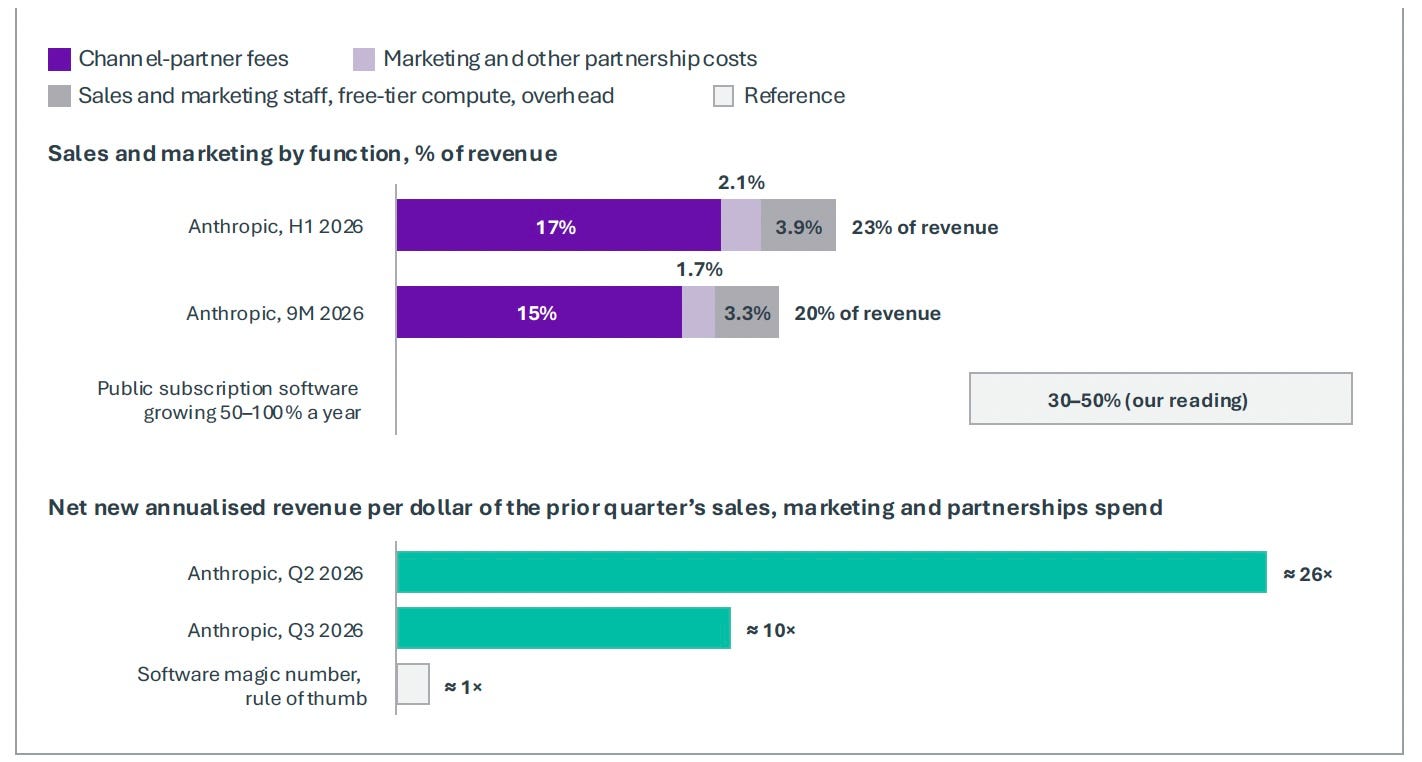
What could weaken this belief: Coding adoption may not translate into company-wide deployments. Enterprises may keep identity, approval, and audit functions in systems they already use, while limiting agents’ access to sensitive workflows. The filing says Anthropic is growing a direct sales force but gives neither its size nor its cost.
Next test: I’ll look for general availability of Managed Agents with zero data retention, audit logs, and permission scoping; approvals that can execute inside Anthropic’s runtime; and product or customer disclosures showing revenue beyond coding. Sales and Applied AI headcount, revenue per employee, and the share of large customers sourced by direct teams will test the commercial build.
My conviction: 2/5. Anthropic has reached a large customer base, but the filing shows little evidence yet that it controls the enterprise platform layer or has built the organization to sell it.
Read together, the three beliefs run from the most established to the least. The compute is signed, and the open question is delivery. The price has held so far, and the open question is whether it keeps holding as cheaper models improve. The platform is the belief the filing shows least, and the base case leans on it most: without it, revenue can still be earned inside other companies’ products, but the margin cannot.
One risk that could break the case: Anthropic’s own safety gate
A belief can erode gradually. A single point of failure is a different kind of risk: an event that would damage the case even if every belief held, and that is decided on a date rather than by a trend. A regulator switching a model off is one; a covenant tripped by a missed quarter is another. My report identifies ten. I want to dwell on one because it is the least familiar to investors: the possibility that Anthropic’s own Responsible Scaling Policy holds back its next frontier model.
Anthropic’s amended filing says the company’s estimates indicate it may imminently meet the policy’s definition of dramatically accelerated progress attributable to AI. It also says that no current model has been designated as exceeding the threshold. If a future model does cross it, Anthropic’s Trust could gate or delay the release, restrict access, or pause training after an evaluation incident. The model expected to earn a frontier premium might not be broadly available, and Anthropic’s release cadence could slow while competitors keep advancing.
There are precedents. Mythos was released as a gated research preview to Project Glasswing, with no general availability planned. Anthropic says it delayed pre-training a new frontier model for more than a month, and suspended higher-risk reinforcement-learning environments after models gained unauthorized access to real third-party systems during evaluations.
METR’s November assessment estimated that capability progress at Anthropic had accelerated to 1.9 times its earlier rate. It suggested, with substantial uncertainty, that AI use in research may explain a majority of that acceleration. METR did not determine whether Anthropic had crossed its policy threshold. The company’s published determinations for Opus 4.6 and Opus 5.5 were negative, and Anthropic has revised the policy several times this year.
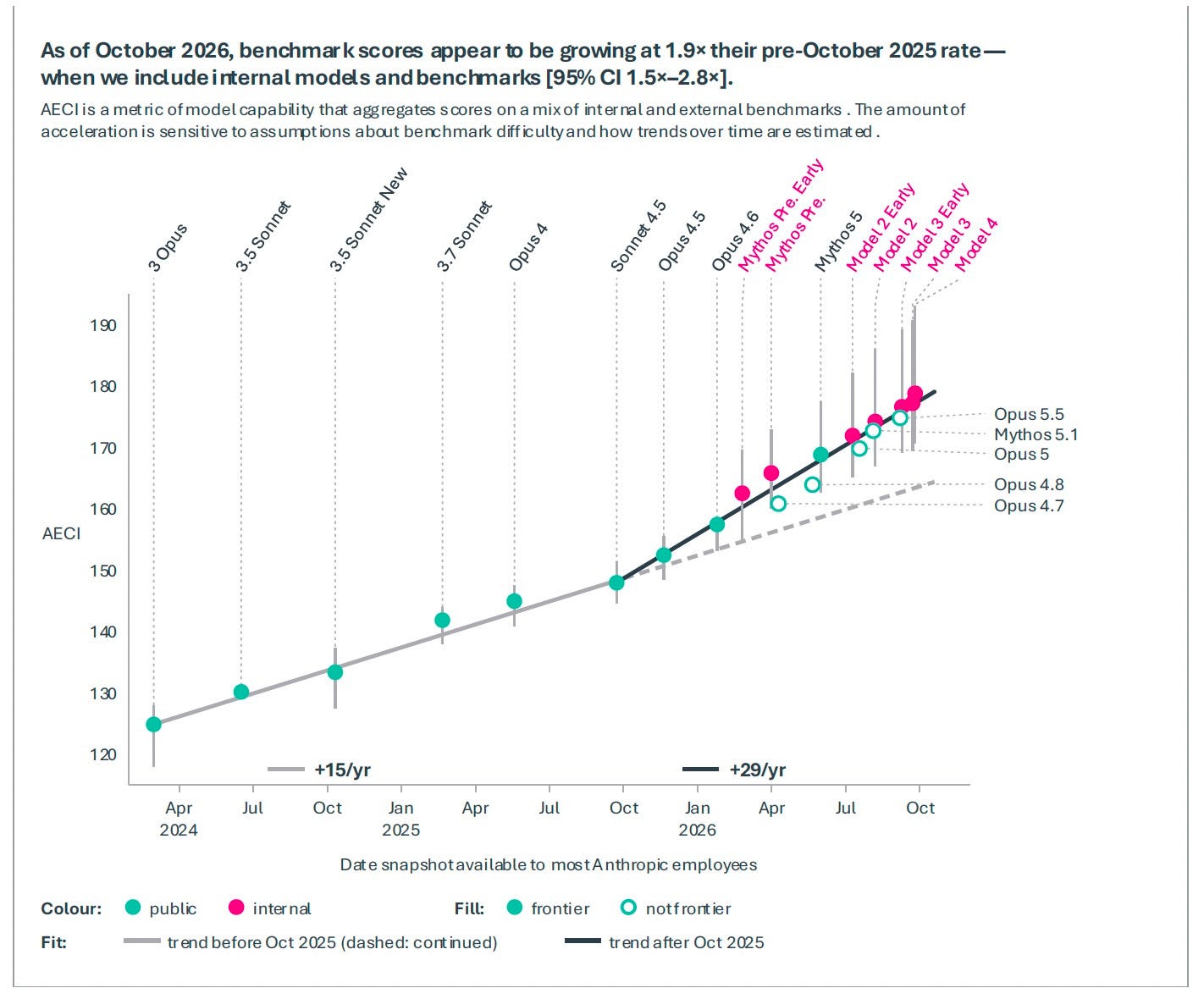
I do not read this as a flaw in the company. I argued in September, in “The AI Pause Is the Wrong Panic”, that a paced frontier may be good for safety and good for Anthropic, provided Anthropic sets the pace. The risk priced here is the case in which it is not: a gate that closes on the model the revenue path is counting on while competitors keep releasing. Watch for Anthropic’s determination on its next frontier model, whether it's broadly available at launch, and whether a training or evaluation pause slows the release cadence.
Anthropic IPO Valuation: Base Case and Risk-Adjusted Value
Based on my base-case assumptions, Anthropic’s equity is worth $2.244 trillion before the offering. I then apply a risk adjustment for the ten single points of failure identified in my filing analysis.
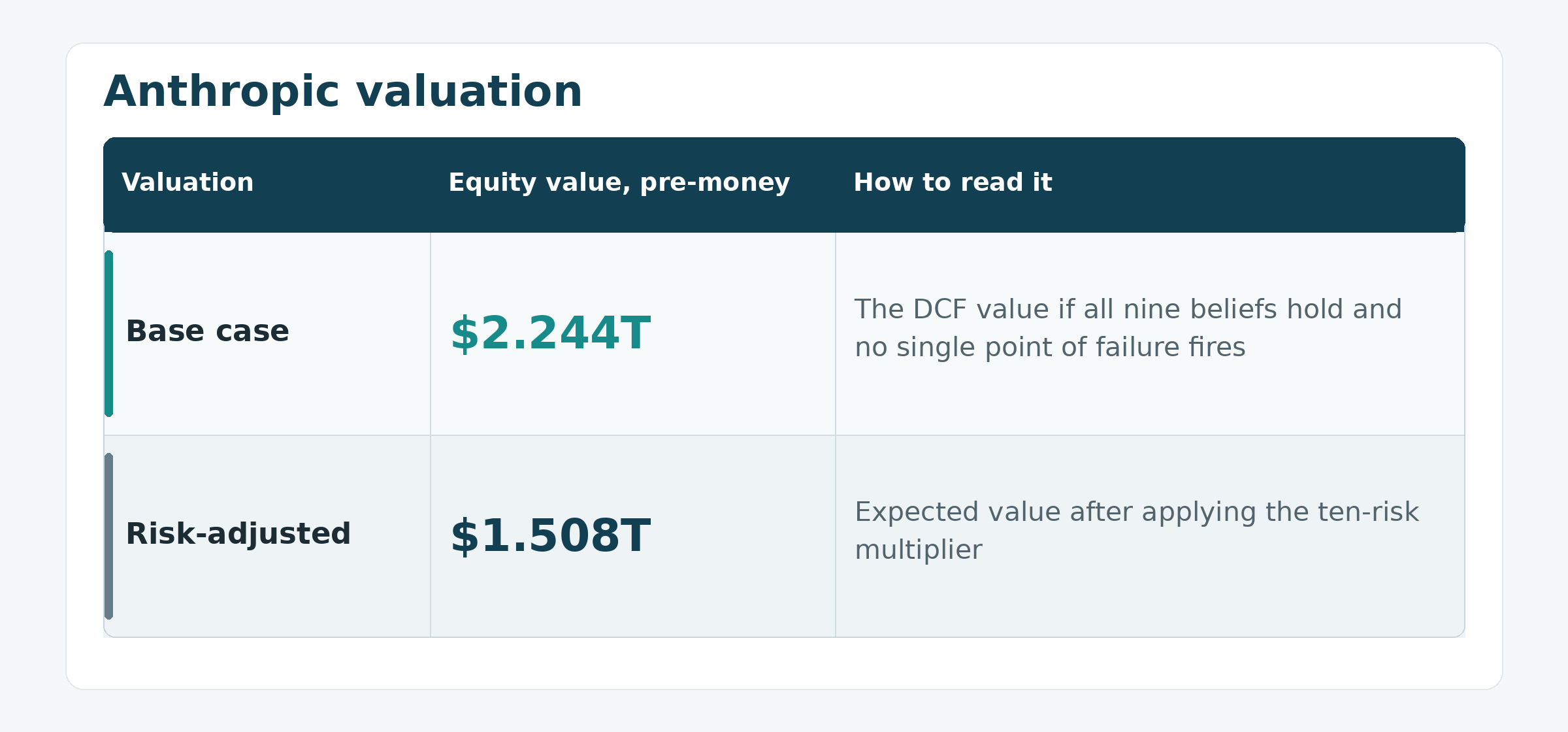
I grade each of the ten by likelihood, cost, and timing. Together they take about a third off the base case, to $1.508 trillion, or about $89 a share. That figure prices ten specific events rather than forecasting that any one of them will happen; the report sets out the grading.
When I completed the report, press coverage put the IPO valuation discussion at $1.2 trillion to $1.3 trillion post-money. To compare that with my pre-money model, I deduct an assumed $100 billion primary raise. On that basis, the reported range becomes $1.1 trillion to $1.2 trillion pre-money. That range is roughly 20% to 27% below my expected value; my base case is higher still. A buyer at the top of that range is paying as if the ten events together cost about half of the value; my grades say a third.
What interests me more than the gap is what each number pays for. My base case assumes Anthropic comes to own the room where enterprise work happens, which means the approval, the identity, and the record. Take that belief out, and the base case falls by about $0.7 trillion; after the ten events, it lands close to the valuation under discussion now. On my numbers, then, the market is pricing Anthropic roughly as the executor of agentic work it already is, where it is as good as any company in the market, and is paying very little for the platform it might become.
That is why I am constructive at the range and more cautious above it. Above my risk-adjusted value, the price starts to pay for beliefs the filing does not yet show, the enterprise platform above all. Two weeks ago I called Anthropic a new species. If it also becomes that platform, and is then paid out of its customers’ labor budgets rather than their software budgets, it will be a different animal again, and the valuation would have to be rebuilt for it rather than stretched from this one.
Two disclosures will say early whether the path holds. The December run rate, due with the fourth-quarter report in about February, has to show that October’s pace was kept: near $90 billion confirms it, and below $85 billion the quarter stalled. The first split of revenue by product, which the amended filing still doesn't provide, will show whether Anthropic’s own products are carrying the work beyond coding. I will re-run the case on each.
Going deeper on Anthropic’s IPO: 30-Page Teardown and Interviews
For the full assumptions and risk analysis, read the 30-page executive edition.

You can also watch AGNT Podcast Ep. 16 with my co-host, Gemma Allen, where we discuss my Anthropic S-1 analysis in depth.

Disclosure: This report is investment research and scenario analysis based on public information through 8 November 2026. It is not investment advice, a solicitation, or a recommendation to buy or sell any security. The views are the author’s own; where the report states a position, it is the author’s and not an instruction to the reader. The author had no access to the Company’s management and is not affiliated with the Company or its underwriters. The author may hold long or short positions in companies mentioned and may participate in the offering. To the fullest extent permitted by law, neither the author nor Decoding Discontinuity LLC accepts liability for loss arising from reliance on this content. Readers should conduct their own due diligence and consult a qualified adviser before any investment decision. Figures marked “DD estimate” are our assumptions rather than company guidance. Facts are graded by source: printed in the filing or its exhibits, reported by a named outlet, or derived by us with the inputs shown. No price range or share count had been filed at 8 November 2026; the valuation discussion is set against reported price talk. Page references are to the amended filing unless marked S-1. This edition is written to stand on its own. The full 100-page assessment is available on request to selected readers in a watermarked version.