


TL;DR: This analysis is my initial read on the Anthropic S-1. For now, I want to focus on what struck me most: the scale of compute requirements and my view that the tools and metrics being used to measure those commitments are wrong. I'll do a deeper analysis of all aspects of the company later.
Anthropic has filed to go public as a new kind of company: one that buys computing power on a scale no company has brought to a public market, and sells intelligence by the token. On a gross reading, the filing shows up to $1 trillion in commitments for chips, data centers, and power, stretching to 2045, against $132 billion in the bank, and it leaves the total blank. That is not concealment so much as a sign that the instruments have not caught up. The profit line moves with where the company points its computers, the balance sheet carries almost none of the obligations, and the software yardsticks that worked for the last twenty years return nonsense. Thomas Kuhn described this moment in science: a new paradigm arrives before the tools to measure it, and the old readings are accurate yet beside the point. The question that matters is simple, but it needs a new instrument to answer. Can Anthropic sell enough intelligence, at prices that fall every few months, to pay for the computing it has already promised to buy?
Anthropic has finally filed its registration statement with the Securities and Exchange Commission, putting the economics of a frontier AI lab before public investors.
The prospectus does not yet disclose a potential offering price, and its summary contractual compute obligations are blank for now. But its unaudited first-half statements show $8.9 billion in compute and infrastructure expenses. As of June 30, the filing discloses $265.6 billion in future purchase commitments and $321.4 billion in leases not yet commenced. That’s $587 billion across two distinct categories.
Beyond the numbers, however, the S-1 describes a compute business that sells intelligence.
Anthropic exemplifies the generative and agentic AI discontinuity I have been writing about for several years. A key claim that defines this discontinuity: As the marginal cost of cognition falls and machines become actors, the unit of value shifts toward completed workflows. The surplus goes to whoever coordinates the agents, context, and tools that get the work done.
A new economic paradigm is emerging from that discontinuity, with Anthropic emerging as possibly its most consequential company. In May, I explored at length how “King Claude” had “come to rule the first agentic cycle.” By securing the compute that it needs to deliver that intelligence, Anthropic now sits at the center of a vast web of interconnected deals, the well-documented circular financing between infrastructure companies and suppliers such as Nscale.
The result is not another high-flying tech company. Anthropic represents an entirely new species. And understanding this species requires a new set of lenses.
At the highest level, the S-1 is a narrative that shows how Anthropic is financing the intelligence behind those systems while building a platform and applications through which customers use Claude. But just as important is what this version of the S-1 omits.
As phenomenal as some of the top-line and growth numbers appear, the company doesn’t disclose enough information to form a strong conviction about whether it can keep delivering the growth needed on the right schedule to meet those obligations. The filing discloses long-term contracts that help secure future capacity. But revenue must catch up with costs committed before demand is certain.
In the prospectus, Anthropic says it wants investors not just to think in “transactional terms,” but to see the investment as part of “something bigger.” But such a landmark IPO demands more than just convincing people to believe in the mission. It must provide the metrics to determine whether it can reconcile its core business drivers.
While the S-1 doesn't tell us who will capture the value of agentic work, it gives us a sharper way to test the wager. Everything in the prospectus reports, from revenue to margin to the sales line, depends on how much capacity Anthropic has contracted, when that capacity arrives, and what price a token clears at when it does.
This analysis breaks down that financial narrative into four steps:
The weight of compute in the filing, from the risk factors through the income statement to the contracts.
Why the instruments we have, the income statement and the balance sheet, cannot measure that weight.
Kuhn, because this is what a change of paradigm looks like from the inside: the old readings are accurate and beside the point. The replacement measure proposed there is a single ratio: how much of the compute bill due in the next year is covered by cash on hand, the cash the business will generate before those payments, and the financing it can actually draw.
That leaves anyone who must forecast this company with compute as the proxy for growth rather than sales spend, and with my own 15 October revenue path tested against the filing on that basis.
Those four steps are ultimately intended to drive us toward the most critical question for the company and its investors: Can Anthropic turn compute contracted ahead of demand into enough paid usage, at prices that sustain the business, to carry those obligations—and capture durable value from the workflows Claude helps run?
Anthropic’s compute commitments are the first risk
After opening with Anthropic’s ability to keep developing the most capable models, the filing turns to compute: whether the company can secure enough capacity, and whether the components and power needed to run it will be available.
In the filing’s words, the second and third risk factors read:
“If we are unable to secure adequate compute or if we fail to direct our compute effectively across our workloads, we may be unable to train models that remain competitive with those of our competitors or adequately serve our customers“ and “Constraints on the critical inputs supporting compute could limit our ability to secure adequate compute“ The body adds: “In the past, we have significantly underestimated our compute requirements, which left us capacity constrained and impacted both product development and deployment.”
Indeed, 15 months ago I described compute as a single point of failure for Anthropic in the context of its then-$5 billion round, when OpenAI was well ahead in securing compute.
That gap has narrowed in dollars, and less in power: OpenAI put its commitments at $1.4 trillion for 30 gigawatts in November 2025 and, in February, was reported to have reset them to about $600 billion in spend through 2030. Anthropic’s filed figures are minimums on two dates: $587 billion of purchase commitments and leases not yet commenced as of June 30, 2026, plus about $266 billion of minimum payments under agreements signed or amended since. The filing gives no power figure, so the comparison stops at dollars.
The inputs are concentrated, and the S-1 comes at the right time for semiconductor companies who have seen Wall Street challenge their growth assumptions and lofty valuations in recent weeks:
One foundry in Taiwan, primarily TSMC, makes most advanced chips.
High-bandwidth memory largely comes from three makers, SK hynix, Samsung and Micron, with the warning that a larger buyer could “reserve substantially all of a manufacturer’s available production capacity.”
Transformers and switchgear face multi-year delivery times.
Some power is bought on twenty-year contracts “with annual escalators” and “uncapped fuel cost pass-throughs that apply for the duration of the term regardless of actual utilization.”
The income statement shows what that dependence costs:
Compute and infrastructure were 251% of revenue in the March quarter of 2025 and 48% in the June quarter of 2026, and it is the largest line in every period.
Revenue rose from $376 million in the March quarter of 2025 to $11.6 billion in the June quarter of 2026.
The timing of these two measures is crucial. Anthropic says it typically contracts for compute 12 to 18 months before it becomes available, and recognizes the expense as capacity becomes available, whether it is fully used. That makes much of the near-term cost base sticky: revenue can grow into it, but a slowdown in demand does not immediately remove the cost of capacity already delivered.
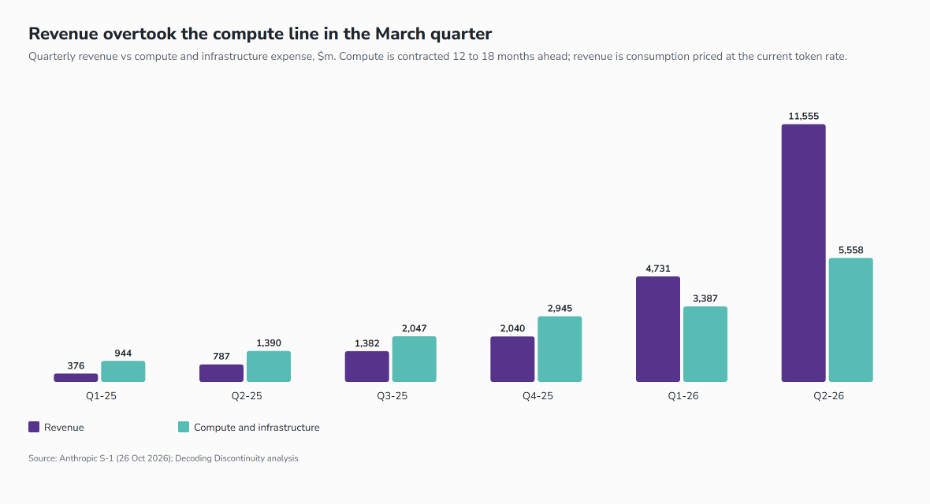
The contractual notes show how quickly that base expanded.
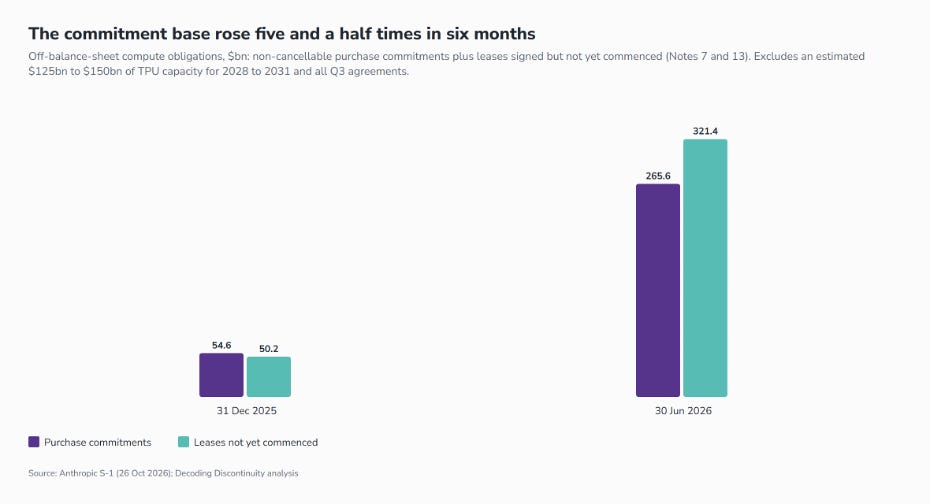
They come in two kinds. As of December 31, 2025, the company disclosed $54.6 billion in non-cancellable purchase commitments and $50.2 billion in leases signed but not yet commenced, about $105 billion in total. At 30 June 2026 the same two notes read $265.6 billion and $321.4 billion. In six months the committed base rose 5.6 times, to about $587 billion.
The quarter after added more. After June 30, the company signed or amended agreements carrying about $245 billion in minimum payments, some conditional, commencing between 2026 and 2036, plus a further $21 billion in short-term commitments that cannot be canceled. Added to June, the three figures reach about $853 billion. That is an unreconciled gross subtotal, and it can move in either direction: part of the $245 billion amends contracts already in the June totals, while an estimated $125 billion to $150 billion of TPU capacity for 2028 to 2031, whose terms “have not yet been finalized,” and the agreements with no fixed dollar amount, sit outside it. The one number that would settle it, the aggregate committed spend “as of and subsequent to September 30, 2026,” is left blank.
Read that again. The S-1’s disclosed commitment figures, combined with Anthropic’s own estimates for future capacity, approach $1 trillion on a gross basis. That’s before removing overlaps or accounting for contingent, cancellable, and unfinalized amounts. That is the scale of the build-out. The named agreements below are at the minimum or maximum amounts the filing provides; they are not additive to the June tables.
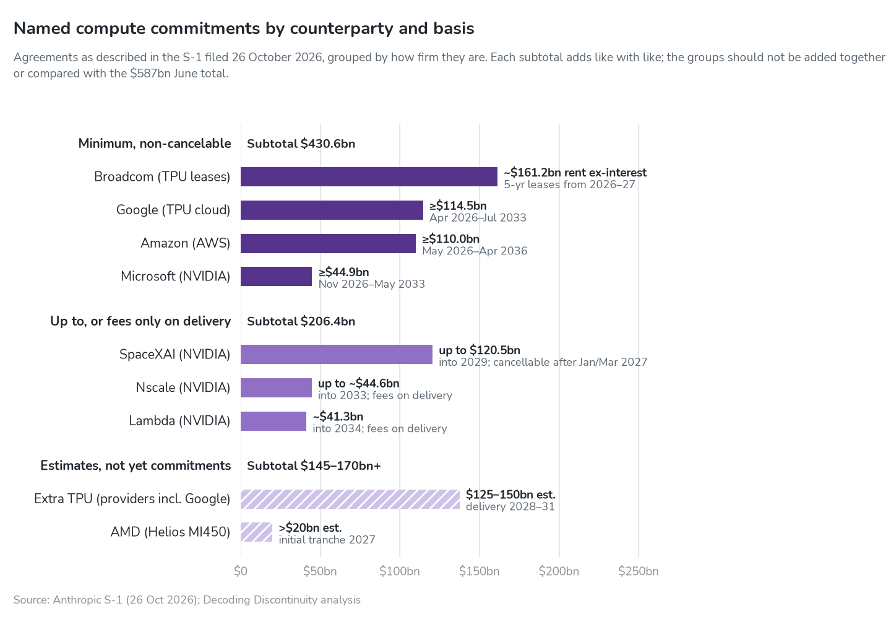
The arrangements have different payment and exit terms:
Three are cloud-service agreements, with minimum commitments and delivery protections that vary by contract.
Broadcom’s equipment leases total about $161 billion before interest; rent generally begins when equipment is ready, with provisions that can trigger payment earlier in specified delay scenarios.
SpaceXAI’s agreement runs through 2029 for up to $120.5 billion, reaching about $3.1 billion a month once all capacity is delivered, versus $1.25 billion a month for about 325,000 NVIDIA GPUs in SpaceX’s June prospectus. Either side can terminate after initial non-cancellable periods ending in early 2027.
Two other arrangements depend on counterparties securing their own financing: one with Nscale, whose prospectus I examined this month, and one with Lambda. They are paid only as capacity is delivered and accepted. Nscale’s S-1 says the financings it needs to perform “remain in process”, and $34.9 billion of Lambda’s $41.3 billion can end if Lambda misses its facility lease, so this is where the commitments are softest and the capacity least certain.
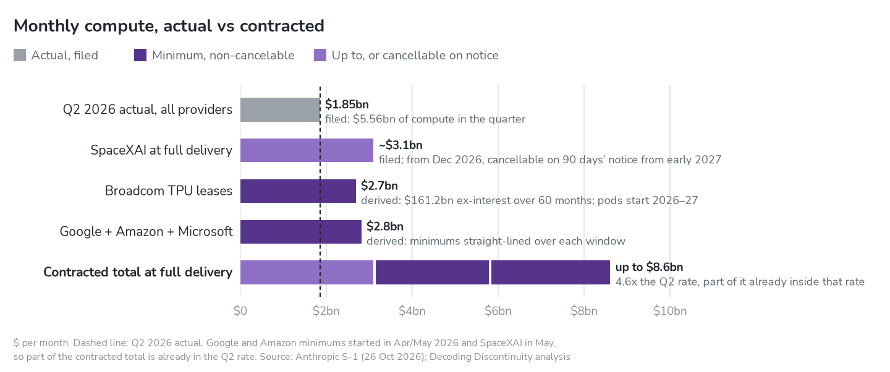
Monthly comparisons make the scale easier to see:
In the June quarter, the company’s compute and infrastructure expense across all providers was about $1.85 billion a month, or $22 billion annualized.
At full delivery, SpaceXAI rentals alone are $3.1 billion a month.
The Broadcom leases average another $2.7 billion a month over their five-year life, before interest, once all facilities are ready (n.b. that is a lease-life average, and not a 2027 payment schedule).
The three cloud contracts, straight-lined over their windows, are $2.8 billion a month.
Those are run-rate comparisons, not a forecast of the expense Anthropic will recognize in 2027. If Broadcom and SpaceXAI ramp as the filing describes, 2027 compute expense on these contracts alone falls between $70 billion and $103 billion.
The amounts are contracted, but their timing is not, and the SpaceXAI rental alone, the part either side can cancel, would run at 1.7 times the June quarter’s annualized compute expense if kept at full delivery. The 2027 range is my estimate, not a figure Anthropic reports or a fixed bill due in that year. It depends on delivery timing, ramp assumptions, and the contracts’ different payment and termination terms.
The sales line adds a third layer: the clouds are paid to sell Claude as well as to supply the compute behind it.
Sales, marketing and partnerships were $3.2 billion in the half, 19% of revenue, and of its $3.0 billion increase, $2.7 billion was “fees paid to channel partners” paid mostly to the cloud providers, whose marketplaces billed 48% of first-half revenue; the filing names channel partners without listing them.
The cloud providers sit on both sides of the business: they supply capacity and help distribute Claude. Compute shapes the supply of intelligence, a large share of its cost, and how customers buy it.
What the S-1’s cost lines reveal - and conceal
Anthropic’s accounts answer a narrower question: did it earn more than it spent in the June quarter? Yes. Operating income was $974 million on $11.6 billion of revenue.
But the bigger question is whether compute contracted years ahead can turn into customer usage month by month, even as prices fall as the red queen’s race continues. The income statement records costs as capacity becomes available. The balance sheet records only liabilities recognized under accounting rules.
Neither gives investors a complete schedule of the cash the compute build-out may require.
The income statement
In 2025, Anthropic changed how it presents operating expenses. The company moved from the software convention where cost of revenue and gross profit are followed by functional lines, to reporting expenses “based on the nature of expenses”. Compute and infrastructure now appear as a single line.
Anthropic’s explanation is that compute is “a single, shared resource across all workloads“. including research, training, serving customers, and the company’s own use of Claude. That compute is spread around to wherever “the marginal unit is expected to be most productive at any given time“ The company cannot know when it signs with Google or Amazon what fraction of the capacity will end up serving customers, so it stopped drawing the line on the face.
That decision is disappointing. It may describe how the company manages capacity. It is less helpful for assessing the business's economics. Training and inference answer different questions: training builds future models; inference serves customers today. Anthropic’s compute-efficiency measure combines research-driven intelligence with revenue from customer use. The result may describe an integrated system, but it does not show the cost or return of each activity separately.
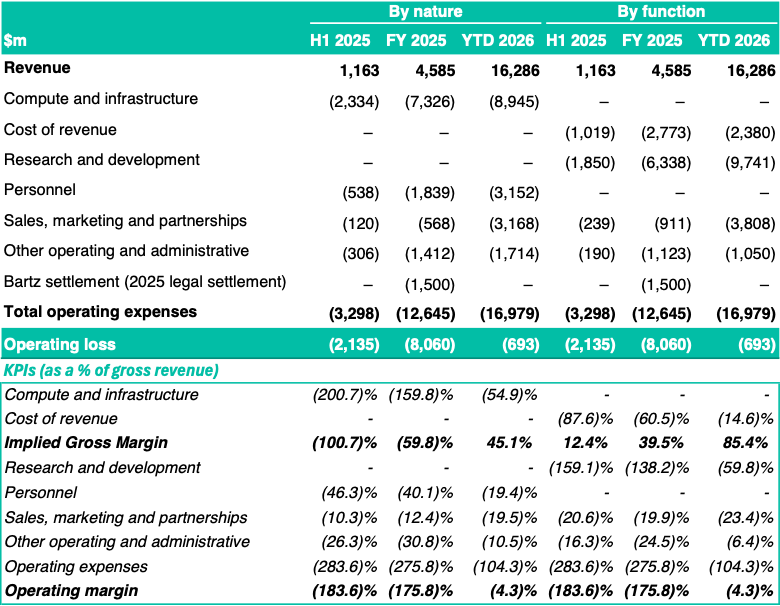
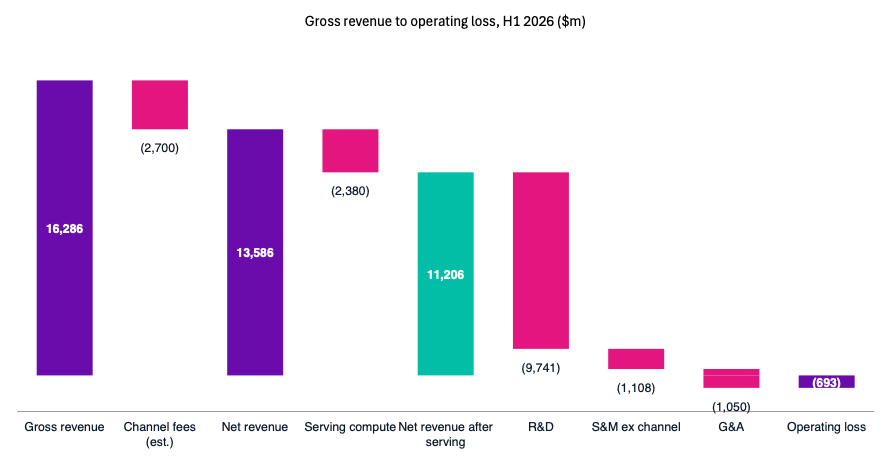
The functional split survives in Note 8, and with the disclosed $2.7bn channel fee increase, we can restate the half-year. It lets us estimate the cost of serving customers, though it is still Anthropic’s allocation. The company says substantially all cost of revenue consists of compute for customer-serving workloads, but the figure also includes personnel costs and allocated overhead.
From that view, cost of revenue fell from 88% of revenue in the first half of 2025 to 60% for 2025 as a whole, and to 15% in the first half of 2026. In that latest half, revenue was $16.3 billion and cost of revenue was $2.38 billion, implying a gross margin of about 85% on the disclosed allocation. That is on gross revenue; on net revenue, after the estimated channel fees, it is closer to 82%. On either basis, and on the company’s own allocation of a shared pool, serving Claude earns a software margin.
Research and development was $9.74 billion - more than four times cost of revenue - and Anthropic says that category primarily includes compute for model development, research and internal use, alongside personnel, software and overhead. This is where the business departs from software. Research took 60% of revenue in the half; in a software company, a research share above 40% would already be considered lofty.
Sales and marketing was $3.81 billion. Gross revenue was $16.3 billion, and 48% was billed through cloud marketplaces, up from 47% in 2025. The filing reports only the increase in fees paid to channel partners, $2.7 billion year on year, but the full sales line a year earlier was $120 million, so the first-half fee sits between $2.7 billion and about $2.8 billion. Net revenue, the money Anthropic retains after its distributors, was therefore about $13.6 billion on this estimate. On the same arithmetic, the fee per marketplace dollar was about 16 cents in 2025 and about 35 cents in the first half of 2026, and the filing does not say whether the terms changed or the line now carries other partners.
The restated statement says three things the filed one does not:
On today’s allocation, serving Claude earns a software margin before research, and the allocation reached that point in a year.
The model calendar sets the research bill: when a generation lands, compute moves from research to serving, the margin appears, and when the next training run starts, it moves back. The filing provides evidence of that dependence: model versions released in the previous six months accounted for more than 80% of September-quarter revenue.
And the gap between gross and net revenue tracks the share of sales customers route through a cloud marketplace, which the filing puts at 48% of revenue for the first half of 2026. The quarterly income statement will therefore swing with where the pool was pointed rather than with demand, and the company says as much: operating margin will “fluctuate over time, particularly in periods when substantial incremental compute is delivered to us“.
Two other items complicate the picture.
First, the offering triggers stock compensation for restricted stock units. As of June 30, Anthropic reported $26.6 billion of unrecognized expense related to these RSUs. If the offering had closed on that date, the company would have recognized $2.9 billion cumulatively—enough to more than erase the June quarter’s operating income. The remaining $23.7 billion was expected to be recognized over 2.1 years.
Second, first-half interest income was $1.11 billion, more than the $693 million operating loss. That income came from cash and short-term investments. It was not revenue from selling Claude.
The balance sheet
As of June 30, Anthropic reported $117.5 billion of liabilities, including $108.6 billion in convertible notes payable. The principal is $6.2 billion, all of it non-interest-bearing notes held by Amazon under its 2023 and 2024 agreements. The company carries them at the value of the shares they will convert into, at $2.09 and $5.05 a share after the split or the public price if lower, and as the valuation rose through each round, the carrying value rose with it.
The fair-value line recorded a $34.3 billion loss in 2025 and a $72.4 billion loss in the first half of 2026. That line includes changes in the value of convertible notes, derivative liabilities, and SAFEs, and the filing says the increase was driven primarily by the notes’ higher fair value as Anthropic’s valuation rose. It was a non-cash accounting charge when recorded, not $113.2 billion paid to investors. It, together with a further $9.4 billion of remeasurement on the note purchase agreements, is why the net loss for six months was $80.7 billion against an operating loss of $693 million, and why the accumulated deficit of $132.9 billion includes $113.2 billion of non-cash fair-value changes on the convertible notes and related derivatives since 2023. The charge stops at conversion, so future quarters lose it; the past losses stay in the deficit.

In contrast, while the implications of these financial instruments appear up front, the details of the compute commitments that shape Anthropic’s operating obligations are buried much further down in the notes.
Digging into these notes, you can see that the leases hit the balance sheet only as each facility begins, between 2026 and 2028, after the offering prices. Purchase commitments generally remain in the notes until the related capacity or goods are delivered. That means the statements reveal these obligations in stages, rather than presenting one consolidated schedule of future compute payments.
The filing leaves that aggregate schedule blank in both its summary and its MD&A. The filing leaves the total committed spend as of and after September 30 blank, as well as the amount expected before the end of 2030 and the amount due in the next 12 months. The filing says substantially all remaining commitments are expected between 2031 and 2045. That is the horizon investors can see, without the total dollars attached.
The contrast is stark: 80% of Anthropic’s revenue in the first half of 2026 was consumption-based, while the commitment schedule extends to 2045. The company’s own risk factors warn that customers may reduce usage while compute commitments run for years.
The S-1 does not provide one complete schedule showing what is fixed, when payments begin, what can be canceled, and what financing is available to meet them.
As of June 30, cash and short-term investments totaled $131.7 billion, with another $2.5 billion restricted, and since September, the filing also describes a $15 billion revolving credit facility with a $5 billion minimum-liquidity covenant.
Separately, it lists up to $77 billion in potential financing capacity: $20 billion through Google, $15 billion through Amazon, and $42 billion through Broadcom or a designated financing partner. None of that capacity was outstanding as of June 30, and the facilities are subject to their own conditions. They are financing pathways, not cash already on hand.
The strategic notes carry no coupon on the $6.2 billion Amazon balance outstanding, 8% to 9% on the undrawn Google and Amazon facilities, and 9% paid in kind on the Broadcom notes, rising to 13% if revenue conditions are not met. They were priced for conversion rather than interest, and the cost of that capital shows up in the $113.2 billion fair-value changes in the deficit, settled in shares, not in an interest line.
That distinction matters because defaults under commercial agreements could trigger cross-default provisions in the credit facility and certain notes, potentially accelerating debt and cutting off access to critical data-center infrastructure. Anthropic’s largest cloud partners also serve as distributors, investors, and competitors. The contracts are not debt in accounting terms, but the filing makes clear that missed payments or lost access could affect both financing and the ability to serve customers.
The balance sheet records a conversion right at $108.6 billion and the credit structure nowhere. The credit agreement treats the compute obligations as a class apart rather than ranking them: the $15 billion revolver excludes compute leases and compute financing from Total Debt without a cap, keeps financed compute hardware out of the collateral, and leaves the compute subsidiaries out of its cross-default triggers. Broadcom’s rent is “absolute and unconditional”.
I used the schedule-as-term-structure reading on Oracle in September and on CoreWeave in October: what is fixed, what falls due when, what can be canceled and by whom, and what has to be refinanced in the meantime. That lens separates the parts of the AI build-out that resemble 2000 from the parts that don't. Anthropic’s filing provides the pieces of the schedule. Its most important totals are still blank.
Kuhn’s accounting paradigm meets Anthropic’s compute model
Thomas Kuhn’s point was not that one surprising result overturns a scientific framework. A paradigm guides which problems scientists tackle, what counts as evidence, and which instruments they use. Anomalies matter when they accumulate, and the existing framework can no longer solve important problems. A new framework can change the questions scientists ask and the tools they use to answer them. Lavoisier’s chemical work, for example, depended on balances precise enough to track mass through gas-involved reactions.
The analogy here is narrower: a reading can be accurate and still fail to answer the question an investor needs to ask.
Corporate accounting is a paradigm in that sense, built for firms that buy assets, depreciate them, and match revenue to cost in the period both occur. Software investors added measures such as recurring revenue, retention, and the Rule of 40 to understand growth and customer behavior that quarterly profit alone could not show. Those measures remain useful, but they work best when revenue duration and renewal terms are visible.
Anthropic’s filing produces an anomaly on every one of these points. Compute is contracted ahead of availability, shared across workloads, and expensed as capacity arrives. Much of the revenue is consumption-based and can fluctuate with customer usage. The statements accurately record what has been recognized. They do not, on their own, show whether capacity contracted years ahead will generate enough revenue and cash to cover its commitments.
The retention figure, “approximately 900%“, compares this quarter’s revenue from every customer that paid at least $1 a year earlier (Pro and Max subscribers aside) with what they paid then, so it records a year of growth from a small base. The sales line is a distribution fee. The company’s own replacement instrument, compute efficiency, is revenue growth of 1,368% against compute cost growth of 300% in the June quarter, which sets revenue that moves with each model launch against a compute bill that moves with each delivery step; it will look worse in the quarters when the company is investing hardest, which the company concedes.
Anthropic acknowledges that the timing and scale of its investments can change materially over short periods, and that cash used in operating and investing activities may rise even if financial performance improves.
The income statement records costs as they arrive. It does not fully capture commitments made before they arrived.
Once the blank schedule is filled, you can build a better measure from the filing, and it is one ratio with four readings behind it. The ratio is “compute coverage”: liquidity, plus the cash the business is expected to generate over the next twelve months before compute payments, plus financing that can actually be drawn, divided by the compute payments due in those twelve months. It asks the only question that matters for a business that buys capacity a decade ahead and sells it a month at a time: whether cash on hand, cash the business will generate, and capital it can draw cover the next year of the bill.
How compute tests my 2027 forecast
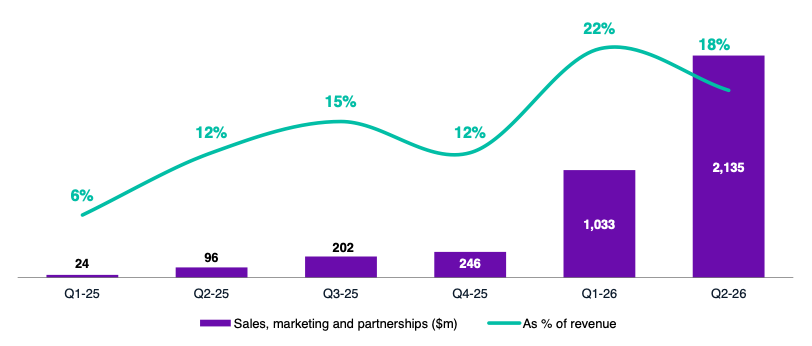
The market will look to the sales line first, because that is where the SaaS apparatus forecasts revenue. Sales, marketing and partnerships went from $246 million in the December quarter to $1.0 billion in March, and $2.1 billion in June, and the company calls the result “a structurally efficient approach” with revenue per employee of $6.6 million across 5,300 staff. For comparison, Palantir, one of the most efficient companies of the software era, generated about $1.0 million in revenue per employee in 2025, according to its 10-K. The contrast between the new species and the old is sixfold.
Those figures are striking, but the expense line combines channel-partner fees with marketing and other sales costs. It cannot, on its own, tell us what it costs to acquire a customer.
The magic number shows why the familiar toolkit does not transfer cleanly.
The magic number is the SaaS test of sales efficiency: new annualized revenue won in a quarter, divided by the previous quarter’s sales and marketing spend. For a well-run software company, it comes out near one. Run it on Anthropic’s June quarter, and it comes out near 26: about $27 billion of annualized net new revenue against about $1.0 billion of sales and marketing spend in the March quarter. Strip out the channel-partner fees, which make up most of that line and are a percentage of revenue rather than a cost of selling, and, if the fees’ share of the March-quarter line matched the roughly 85% they were of the half-year line, the direct selling effort behind the $27 billion was perhaps $150 million, an illustrative ratio above a hundred. No sales force in history has produced a hundred dollars of new revenue for every dollar spent, so the number doesn't tell us that Anthropic sells well. It tells us the growth didn't come from selling. It came from capacity that arrived and a model generation that shipped,
It also came from customers who found the product before anyone called them, notably through the “Coding Wedge”: 40 million of them below $100,000 a year, and most of the large ones through developers already inside the company.
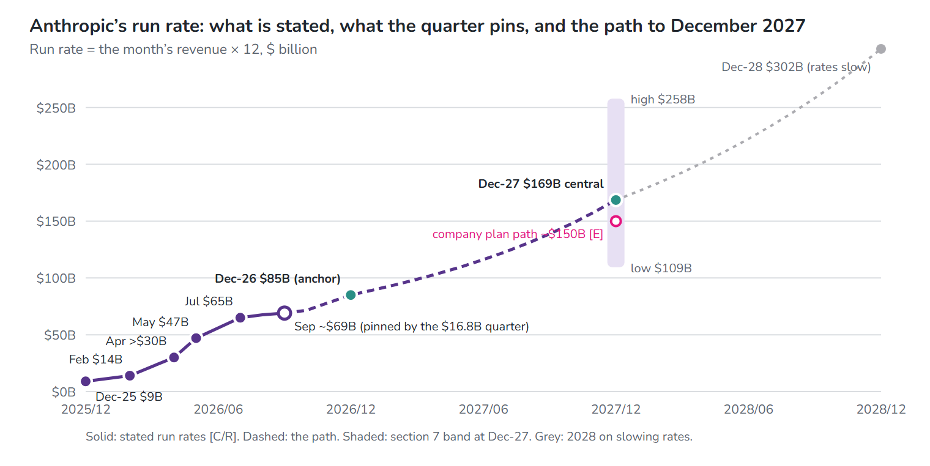
Rather, the arithmetic that carries information runs through compute. Last week, I published an analysis outlining a potential path for Anthropic’s revenue: a run rate of $85 billion at December 2026 and a range of $160-$180 billion at December 2027, with 2027 revenue of about $123 billion, along with a set of dated tests. The filing is the first public source that lets us test those assumptions.
In addition, one of the tests I set for the prospectus was the share of usage revenue generated by Anthropic’s own agent products. The filing does not split revenue by product. Its nearest proxy is adoption: more than half of customers above $100,000 used both Claude Platform and at least one first-party application in September, up from about 30% in December. That is the direction my path requires, but it does not tell us how much paid work those applications generated.
The next observations have dates. The filing’s October 31 run-rate figure is blank. Microsoft’s minimum-spend period begins in November; full SpaceXAI delivery is scheduled for December; and the $5 billion liquidity covenant is tested at each quarter-end. The SpaceXAI notice windows open in early 2027, when either party can give 90 days’ notice. Whether the agreement is extended, resized or allowed to lapse will be an early public test of how a frontier compute commitment behaves when demand, capacity and price no longer move together.
The next two high-bandwidth-memory price reports may show whether supplier pricing is tightening, but they are not a direct read-through to Anthropic’s costs: the filing discloses uncapped pass-throughs for fuel under certain power contracts, not for memory. A report after a major training run may show compute moving between research and customer-serving costs in Note 8, though it still will not give model-level unit economics. And an updated marketplace share will not reveal the revenue Anthropic retains unless the company also discloses total channel fees.
The June quarter’s operating profit and the $131.7 billion of cash and short-term investments are real readings. They answer questions about that quarter and that balance-sheet date.
The question going forward is whether paid work, sold largely through consumption, can cover compute contracted years in advance. The filing leaves its aggregate commitment schedule blank while disclosing pieces of the stack elsewhere.
That makes the timing and coverage of future payments harder to read from the prospectus.
At the beginning, I said the central question is whether delivered compute can generate enough revenue, at the prices customers will pay, to support those commitments. After the S-1, the honest answer is that it cannot yet be known, and that the absence is itself the finding: the one schedule no valuation can do without is the one it has chosen to file last. The amended filing will fill it. Until then, every multiple quoted on this listing is a multiple of a run rate against a bill that nobody outside the company can add up.
Disclosure: Decoding Discontinuity is the research behind the author’s investing. The author holds no position in Anthropic or OpenAI. The author manages a fund that may hold long or short positions in listed companies discussed in or affected by this essay. This essay uses only published sources and is not an offer, solicitation, or recommendation regarding any security, including any offering by Anthropic.