


This is Part 1 of my new series: “Laws of Value in the Agentic Era.” In the Agentic Era, competitive advantage migrates from owning systems of record to controlling where user intent originates. The closer you are to capturing user goals in natural language, the more valuable you become. Salesforce’s Dreamforce 2025 strategy - securing Slack as an intent gateway and launching Agentforce 360 - illustrates this shift perfectly. But this isn’t just about Salesforce. It’s about an inversion in software architecture: moats now form upstream at intent origin, not downstream at data storage. Whoever orchestrates the work wins; everyone else becomes an API call.
The First Law is developed as Chapter 8 of the AGNT Manifesto: Proximity to Intent Captures Value.
Part 2 will explore the Second Law: Context compounds faster than data and creates defensible memory moats. The Second Law is developed as Chapter 9 of the AGNT Manifesto: Context Builds Moats.
Part 3 will explore the Third Law: Workflow integration power. The Third Law is developed as Chapter 10 of the AGNT Manifesto: Workflow Intelligence Secures Control.
A later essay tests this framework against a single company. Palantir’s moat is real at the context layer, which is what makes it the sharpest test of whether value accrues to orchestration instead.
When Salesforce announced earlier this year that it would restrict AI companies’ access to Slack data, the tech world erupted. Anti-competitive! Defensive! Fear-driven! The narrative was familiar: legacy incumbent panics, throws up walls, inevitably loses to nimble, open competitors. That seemed to be how the AI world was going.
At that time, I saw the move as smart positioning, a calculated play to protect data moats. After analyzing Dreamforce 2025 and the Agentforce 360 launch, I believe it’s strategic genius. Not because Salesforce blocked competitors from data, but because they understood something critical: In the agentic era, competitive advantage doesn’t come from better models or more data. It comes from controlling where user intent gets expressed.

There’s a moment in every technology transition when the old rules stop working and new ones haven’t yet been written. We’re in that moment now. Dreamforce just screamed it out loud. The agentic revolution isn’t just changing how software works. It’s fundamentally rewriting where value accumulates and how moats get built.
For the past two decades, enterprise software moats were constructed downstream. You won by owning the system of record — the database where critical business data lived, surrounded by workflows that made switching painful. Hence the power of Gross Retention Rate (GRR) when assessing a tech company to ensure that your revenue is “sticky” and that you are able to retain your customers.
Salesforce built an empire on this principle. So did Workday, ServiceNow, and SAP.
That world is ending. Not software, but that world.
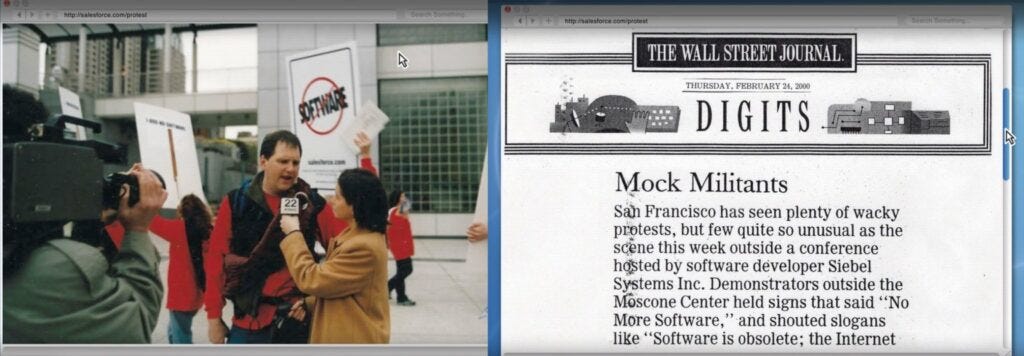
Just as Salesforce proclaimed "No Software" in 1999, it's time for a new rallying cry: "Long Live Orchestration Platforms!"

In an agentic world, moats don’t form where data sits. They form where intent originates. This is the moment a user expresses a goal and an agent takes the first action. This isn’t a minor repositioning. It’s a complete inversion of software architecture and a wholesale migration of economic value. Companies that understand this shift will build the platforms of the next decade. Those that don’t will find themselves relegated to API endpoints in someone else’s orchestration layer.
This is the First Law of Value in the Agentic Era: Power accrues to whoever captures user intent and orchestrates the work from there.