


Palantir reported the best quarter in enterprise software history. Revenue was up 70%. Operating margins are at 57%. Rule of 40 at 127%. Free cash flow of $791 million in a single quarter. Every metric that matters accelerated for the tenth consecutive quarter. The stock trades at 71x trailing revenue. And the architecture - (the celebrated Ontology, the agent runtime, the MCP protocol support) - is genuinely excellent. Technically, Palantir may be the most agent-ready enterprise platform in existence. But technical readiness and strategic positioning are not the same thing. They are, in fact, the precise distinction that separates the companies that will orchestrate the agentic economy from the companies that will be orchestrated by it. Two developments in the past ten days (OpenAI’s launch of Frontier and the continued ascendance of Claude Code) have made this distinction concrete in ways that Palantir’s Q4 earnings obscured. The implications extend far beyond a single stock.
The analytical framework I have been developing across the laws of value in the Agentic Era rests on a distinction that traditional financial analysis lacks: the difference between where you sit in the technology stack and where you sit in the value chain. A company can have exceptional architecture (API-first, microservices, model-agnostic, protocol-compliant) and still occupy a layer that agents treat as a commodity input. I call this the “Excellent Tool Trap”: technical excellence that is structurally insufficient to capture the value of orchestration.
Palantir is the most consequential test case for this thesis. Because if the “Excellent Tool Trap” can ensnare a $318 billion company posting 70% revenue growth with 57% margins, it can ensnare anything.
What Is Palantir’s Moat?
This essay should not be read as a tactical call on Palantir’s near-term performance, but as a structural test of my core thesis. Value does not accrue to the most technically excellent company, but to the layer that controls orchestration. I have argued that discontinuities, such as the one we are experiencing with generative and agentic AI, trigger a migration of value up the stack, from tools to control points, from depth to distribution, from context to coordination.
The Palantir case operationalizes that framework. It asks a different question from traditional equity analysis: in the agentic economy, who captures intent, who directs workflow, and who becomes a callable function within someone else’s system?
In the case of Palantir, its execution (for now) is not in dispute. Neither is the existence of its moat (for now). But not all moats are alike. Not all moats are durable, especially as we move into the Agentic Era. So, my goal here is to reframe valuation through the lens of Orchestration Economics, arguing that the market is pricing Palantir as a control layer rather than a context substrate.
In that sense, this analysis is not just about Palantir, but also about the inversion underway in enterprise software: architecture no longer determines power; intent, proximity, and workflow control do.
Palantir’s Execution Is Not the Problem: 70% Growth, 139% NDR
Palantir's execution is not the problem. The problem is that the market has priced this execution as though it constitutes an orchestration moat. It does not. Let me be precise about what Palantir has accomplished, because the case I am about to make does not rest on dismissing execution. The execution is extraordinary:
Q4 2025 revenue of $1.407 billion grew 70% year-over-year, accelerating for the tenth consecutive quarter from 21% in Q1 2024.
Full-year 2025 revenue reached $4.475 billion with GAAP net income of $1.625 billion, a 36% margin at scale.
The U.S. commercial segment hit $507 million in Q4 alone, up 137% year-over-year, transforming what was once a government-dependent contractor into a dual-engine growth story.
Total contract value booked in Q4 was $4.3 billion, up 138%.
The remaining deal value stands at $11.2 billion.
Net dollar retention hit 139%, up 500 basis points in a single quarter.
Forward guidance for 2026 shattered consensus: $7.18–7.20 billion in revenue versus Street expectations of $6.22 billion, implying 61% growth.
Adjusted free cash flow guidance of $3.93–4.13 billion means the company will generate roughly its entire 2025 revenue in 2026 cash flow alone.
The company has $7.2 billion in cash and no debt.
These numbers are not debatable. They are SEC-audited, organically driven, and without precedent at this scale in enterprise software. The boot camp go-to-market model converts approximately 70% of participants into paid contracts within one quarter. Customer expansions are documented and dramatic: $7 million to $31 million in ACV, $4 million to $20 million-plus in a year, and Lear Corporation expanding from 100 to 16,000 users across 280 use cases. Revenue per employee of roughly $1 million is among the highest in the industry.
Palantir Ontology: A Context Moat, Not an Orchestration Moat
A context moat is not an orchestration position. Context is what you know. Orchestration is what you direct. To understand why Palantir’s architecture, genuinely impressive as it is, does not equate to an orchestration position, you need to decompose the value chain that the agentic economy is constructing.
In the framework I have developed, four dimensions determine whether a platform captures orchestration value or is captured as a tool within someone else’s orchestration:
Intent proximity: where the user intent originates.
Workflow control: whether the platform directs the sequence of agent actions or merely executes within a sequence directed by others.
Technical readiness: the architecture’s compatibility with agent-native paradigms.
Palantir scores exceptionally on two of these dimensions, and poorly on the two that matter most for orchestration.
The Ontology is the genuine article. It is not a database or a dashboard. It is a semantic, decision-centric digital twin of the enterprise that maps real-world entities to data objects with defined properties, relationships, and executable actions. Three layers of defensibility emerge:
a semantic layer that creates shared business language across data sources
a kinetic layer that enforces validation, approvals, and audit trails on actions
a dynamic layer that enables real-time execution with governance
Once critical workflows are encoded in the Ontology, migration becomes prohibitively complex. Thomas Kavanaugh Construction reported that 97% of employees use Foundry daily and that Ontology replaced third-party software entirely.
The Ontology also functions as precisely the kind of multi-scale memory system that autonomous agents require. It includes working memory for real-time operational state, episodic memory for historical decision patterns, semantic memory for entity relationships, and procedural memory for validated action sequences. This is architecturally significant. It is the decision substrate, not the UI layer. Agents interact with the Ontology directly, not through a browser that could be bypassed. Palantir’s confirmed implementation of Anthropic’s Model Context Protocol means external agents can autonomously design, build, and edit applications within the platform through standardized interfaces. The OSDK serves over one billion API gateway requests per week.
This is a genuine context moat. Deep, proprietary, accumulating, and defensible. In government and defense, where the $10 billion Army contract consolidates 75 systems, where the Navy’s ShipOS reduced submarine scheduling from 160 hours to 10 minutes, and where MAGE has completed live-fire exercises with autonomous UAV coordination, no competitor can replicate what Palantir has built. Apollo’s ability to deploy across on-premises, classified networks, edge environments, and multi-cloud is a capability that ServiceNow, Salesforce, and Databricks simply lack.
The distinction between the two is what OpenAI’s Frontier just made explicit.
OpenAI Frontier: Model Providers Climb the Enterprise Stack
OpenAI is not building a better model. It is building the orchestration layer that sits above models and above enterprise platforms like Palantir. On February 5, OpenAI launched Frontier: an enterprise platform for building, deploying, and managing AI agents across business systems. The nomenclature is instructive. OpenAI described Frontier as “a semantic layer for the enterprise that all AI coworkers can reference to operate and communicate effectively.”
Read that sentence again. A semantic layer. For the enterprise. Where agents operate and communicate.
That is Palantir’s pitch. Verbatim.
Frontier connects siloed data warehouses, CRM systems, ticketing tools, and internal applications to provide agents with shared business context. It provides agent identity and access management. It includes evaluation and optimization loops so agents improve over time. It supports agents built on OpenAI models, third-party models, and custom models. It deploys across local environments, enterprise cloud infrastructure, and OpenAI-hosted runtimes. Initial customers include Uber, State Farm, Intuit, Oracle, HP, and Thermo Fisher Scientific. OpenAI is assigning Forward Deployed Engineers to help enterprises operationalise agent architectures.
Fortune reported that the combined rollout of OpenAI’s and Anthropic’s enterprise agent systems has already spooked investors in traditional enterprise SaaS companies (Salesforce, ServiceNow, Workday, SAP, Microsoft) because AI-native upstarts could disintermediate the relationships those providers have with their customers.
But the market has not yet extended this logic to Palantir, perhaps because Palantir is perceived as being on the AI side of the disruption rather than the disrupted side.
This perception is analytically lazy.
The question is not whether you use AI. The question is whether you orchestrate AI or are orchestrated by AI. Frontier answers that question for OpenAI’s ambitions with uncomfortable clarity.
The strategic implications are severe. Frontier’s premise is that the agent execution environment (the layer that coordinates which agent does what, with which permissions, across which systems) is the value capture point. The model is the commodity input from below. The enterprise platform is the data substrate at the bottom. The orchestration layer is the control point.
This is what I described in the Coding Wedge analysis: foundation model providers are climbing from intelligence toward orchestration, commoditizing the layers beneath them as they ascend. OpenAI’s trajectory from ChatGPT (chat interface) to API (model access) to Frontier (agent orchestration platform) follows this logic with remarkable consistency.
The model is the wedge. The platform is the prize.
Anthropic is executing the same strategy from a different angle.
Claude Code and the Autonomous Software Layer
Claude Code is not a coding assistant. It demonstrates what happens when the model provider owns the execution surface.
SemiAnalysis reported that 4% of GitHub public commits are now authored by Claude Code, with projections reaching 20% by year-end 2026.
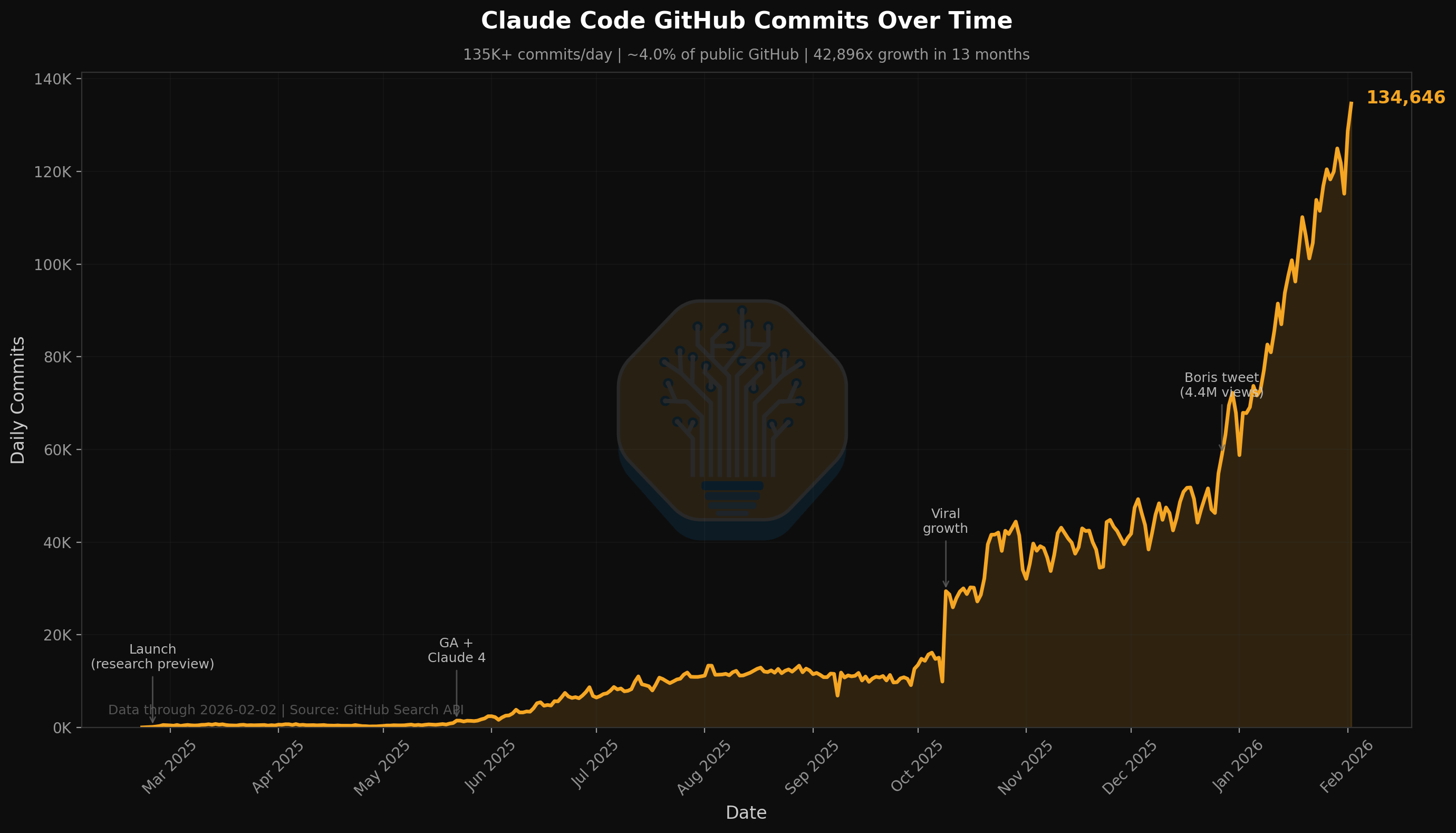
Anthropic disclosed $2.5 billion in run-rate revenue from Claude Code alone, achieved in less than 18 months. Cowork, the non-developer version, was built in under two weeks by four engineers using Claude Code. Boris Cherny, head of Claude Code at Anthropic, described how Cowork handles project management, Slack coordination, spreadsheet monitoring, and cross-system automation. These are not coding tasks, but orchestration tasks.
Apple’s Xcode 26.3 now integrates Claude Code’s Agent SDK natively. Claude Code has an agent teams mode where multiple agents work in parallel and coordinate autonomously. The pattern is unmistakable: the model provider is becoming the agent execution layer, and the agent execution layer is becoming the orchestration platform.
This creates a structural problem for Palantir that no amount of revenue growth resolves.
If the orchestration layer is owned by the model providers, if OpenAI’s Frontier and Anthropic’s agent products become the surfaces through which enterprises deploy, manage, and coordinate AI agents, then Palantir’s Ontology becomes the context substrate that those orchestrators call into. Not the orchestrator itself. The deep, valuable, essential database that the orchestrator queries when it needs operational context.
In the terminology of my SaaSpocalypse analysis, the question is whether Palantir is a system of action or a system of storage. Its architecture is designed for action: agent runtimes, MCP support, and model-agnostic orchestration.
But architecture is not destiny. Market position is destiny. The market position is determined by where user intent originates.
Intent Proximity: The Dimension That Architecture Cannot Solve
The difference between capturing intent and being deployed by intent. Palantir is deployed by intent. Microsoft, Salesforce, and now OpenAI’s Frontier capture it. This is the structural weakness that Palantir’s financial performance obscures. In a world where autonomous agents execute workflows on behalf of users, the platform that captures the user’s original intent (the natural language goal, the business objective, the task specification) is the platform that orchestrates everything downstream. The platform that receives instructions from the orchestrator is the tool.
Microsoft captures intent where over one billion users work daily via Outlook, Teams, Word, and Excel. When an enterprise employee types “prepare the quarterly budget analysis” into Copilot, that intent flows through Microsoft’s orchestration layer, which routes to the appropriate agents, data sources, and execution systems.
If Palantir’s Ontology contains relevant operational data, a Microsoft-orchestrated agent might query it. But the orchestration control point, the layer that decides which agent to invoke, which data source to consult, and in what sequence, lives with Microsoft.
Salesforce captures customer interaction intent across 150,000-plus companies. ServiceNow captures IT, HR, and operational requests at the point of employee need across 8,700-plus customers. These platforms are embedded in the daily workflow of enterprise employees. They are the first application opened, the natural language interface for expressing goals, and the surface through which agents are invoked.
Palantir has 954 customers. It must be deliberately deployed for specific operational use cases. It does not capture ambient enterprise intent. No user opens Foundry to ask a vague question. They open it because someone has already decided that Palantir is the right tool for a specific, defined operational workflow.
The consequences are structural, not cyclical. You cannot solve an intent proximity deficit with better technology. You solve it with distribution, with being the surface through which hundreds of millions of enterprise users express what they want done. Palantir’s 954 customers, however deep the engagement within each, represent an intent surface that is orders of magnitude smaller than the platforms competing for the orchestration layer.