


TL;DR: Neither OpenAI nor Anthropic has ARR. Each headline is the sum of five streams that renew differently, and the market is paying a recurring-revenue multiple on the sum.
The $70 billion was investors grossing OpenAI up onto Anthropic’s basis, not an OpenAI figure. The $50 billion is the company’s own number, net of partner sales.
Of the three business streams, the model call billed by the lab is a monthly tenancy, the call billed by a cloud is a tenancy on someone else’s shelf, and only the agent, the lab’s harness around its own model, can turn rent into ownership.
The 2025 numbers describe the chat-and-API era; agents earned the run rate the market is pricing. Neither lab has published retention, backlog, or the share of its revenue under a floor.
The ranking inverts the headline: the faster grower has the more exposed mix, with 47 percent of 2025 revenue billed by two clouds that sell its rivals.
That is why Codex against Claude Code matters more than whose run rate is bigger, and why the S-1’s split by stream and channel is the disclosure to read first.
The controversy over the Financial Times’s story last week about OpenAI’s revenue would be almost comical if it wasn’t so terrifying.
On October 8, the FT reported that OpenAI’s investors had been told by the company that its annualized revenue was approaching $50 billion, well below the $70 billion figure that had circulated just a couple of weeks earlier. A $20 billion revenue gap is substantial, so the market naturally sent the stock of companies like Nvidia, Oracle, and CoreWeave plunging. I even got a call from a colleague asking, “Did you see that?”
Yes, I did. But the reasons I found it shocking differed from most observers'.
The two numbers were never the same number. The $50 billion was OpenAI’s own figure: its annualized revenue at the end of September, on its own basis, which counts only the money it keeps. The $70 billion was not OpenAI’s figure (though the company has not publicly commented on either figure). As Axios noted, OpenAI’s investors grossed the company up to Anthropic’s basis, which books the full price of every sale made through Amazon or Google as Anthropic’s own revenue. The investors did it, no doubt, so that the two labs could be compared. By coincidence, the $70 billion is also close to OpenAI’s reported year-end target.
But $50 billion? $70 billion? Or $65 billion in ARR for Anthropic? It doesn’t matter, because none of those numbers are ARR.
Annual recurring revenue was invented for subscription software to describe one specific thing: a contract to pay a fixed amount for access to a product, known in advance, renewing by default, at a stable price. Those four properties are why a dollar of ARR earned a premium: the dollar came back on its own. The metric is an artifact of the SaaS Glory Days, and we've pressed it into service to describe businesses that bear almost no relation to what came before.
That is a classic mistake in a period of Discontinuity. Such periods, like the current generative and agentic AI Discontinuity, represent a clean break from the past, rendering historical precedents, traditional spreadsheets, and old benchmarks obsolete and meaningless. As I explain in Orchestration Economics, relying on old frameworks is dangerous because they interpret fresh evidence as confirmation of the regime that is ending.
In the case of the SaaS-era ARR benchmark, the labs’ revenue has almost none of those properties. Most of it is metered: customers pay by the token and can use more, less, or nothing next month. Where a commitment exists, it is a monthly spending floor for the term of a renewal, not a year of contracted revenue. You can replace the product behind the call by changing a string, so you re-win the revenue above the floor every month, call by call. And nearly half of Anthropic’s 2025 revenue was billed by Amazon and Google, which own the customer relationship and sell competing models from the same shelf.
Multiply that by twelve months to measure scale and momentum. It does not measure what revenue comes back to Anthropic. That is the difference between a run rate and ARR, and the market has been pricing the first as if it were the second.
This is why I use the metaphor “two tenants” to describe OpenAI and Anthropic. Their revenue is rent, paid month by month by customers who can switch. Their compute is a lease, signed for years with landlords who also sell to their rivals.
Analysts, investors, and markets understand this gap so poorly that it deeply troubles me. OpenAI and Anthropic are two of the most important companies for anyone trying to understand the next decade of business, and a market that has financed hundreds of billions of dollars of compute against their growth does not know how to read their revenue. That would be disturbing enough with Anthropic moving toward a potentially historic IPO in November. But the stakes are larger than a single listing.
The two labs sit at the center of a vast web of interconnected deals, the well-documented circular financing between infrastructure companies and suppliers such as Nvidia. If you can't read how they make money, you can't size the systemic risk around them. The market is beginning to sense this: debt anxiety around Oracle, SB Energy's delayed IPO, Firmus's withdrawn IPO, and the astronomical revenue projections floated to justify the spending. Without clarity, markets overreact, as we saw with the SaaSpocalypse earlier this year.
To be clear, I am not an AI alarmist writing to tell you that we are doomed. I have followed these two companies closely for two years, first in due diligence for clients and then as an investor building my own frameworks, and I remain extremely bullish on the long-term value of generative and agentic AI. But one of my fundamental goals with Decoding Discontinuity is to help people navigate a moment when the old models and benchmarks no longer serve them.
In that spirit, this article is the first of a three-part series designed to pierce some of these misunderstandings and clarify the nature of these businesses:
Part I: What the numbers mean: I examine what OpenAI and Anthropic’s headline ARR and run-rate figures measure, and how much of their revenue is durable.
Part II: What comes next: I model how AI work grows, how much still requires frontier models, and whether the labs or other platforms capture that work. That lets me estimate December 2027 run-rate revenue for OpenAI and Anthropic.
Part III: What it is worth: I value each revenue stream and trace the long-term compute commitments built around the labs, asking what happens if growth or control of the agent layer falls short.
First, look past the headlines and unpack the businesses inside them. Despite the obsessive comparisons between OpenAI and Anthropic, the two have very different customers, which means very different contracts and renewal prospects.
Is a run rate the same as ARR?
A run rate is a recent period of usage multiplied by twelve; it says nothing about what customers have committed to. While ARR gets thrown around loosely, Anthropic does not use it in its own announcements. Instead, its announcements use “run-rate revenue.” OpenAI does use ARR. Sarah Friar, its chief financial officer, wrote on the company’s site in January 2026: “$2B ARR in 2023, $6B in 2024, and $20B+ in 2025.” The press applies the label to both: CNBC and Axios both headlined OpenAI’s figures as “annual recurring revenue”, and the trackers behind every chart carry an ARR column.
The FT story split readers into two camps. One says the race is over, because Anthropic’s $65 billion July run rate placed it ahead of OpenAI. The other says Anthropic’s revenue is grossed up because every dollar sold through Amazon or Google is booked as Anthropic’s revenue, while OpenAI counts only what it keeps.
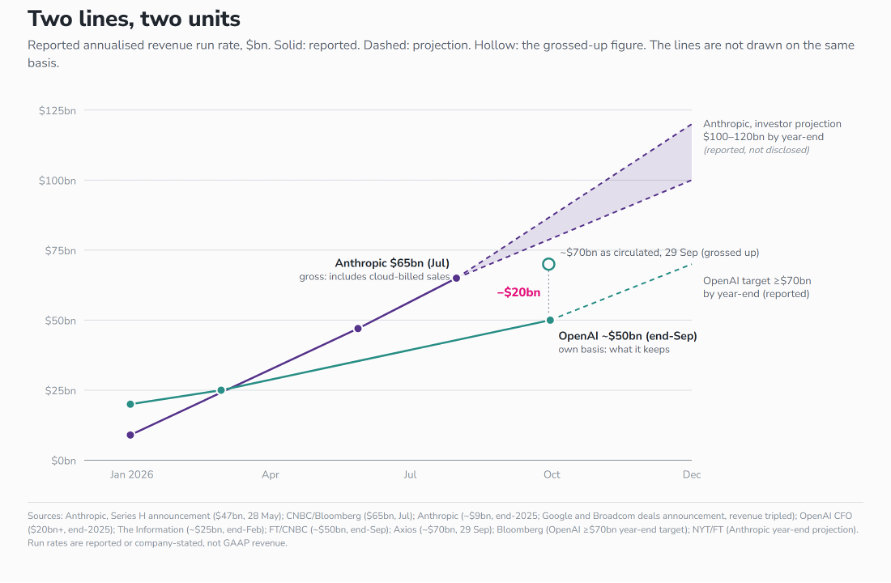
The label, either label, tells us how the number is presented, not what kinds of business it contains, how much is committed, or how likely customers are to keep spending. To answer that, we must unpack the streams inside each figure.
What businesses are inside the headline number?
To break down a headline figure, we need to know what the customer is buying and who bills them. That gives five kinds of business that renew differently, retain differently, and grow at different speeds:
The first is consumer subscriptions: ChatGPT Go, Plus and Pro, Claude Pro and Max, from $8 to $200 a month. Customers pay for access to a general-purpose assistant, usually at a fixed monthly price.
The second is the model call billed by the lab itself, the API as developers know it (“1P”). A developer or company pays by the token; the lab invoices the customer and owns the relationship.
The third is the same model call billed by a cloud (“3P”): Claude on Amazon Bedrock, Google Vertex or Microsoft Foundry, where the cloud bills the customer and remits to Anthropic less its cut; and OpenAI’s models on Azure, where the sale is Microsoft’s under an IP license and, since April, nothing flows back to OpenAI. Same product; the customer, the contract and the commitment belong to the cloud.
The fourth is the agent: the lab’s own harness around its own model, the runtime that holds the tools, permissions, memory, and a record of what the agent did. Claude Code, Cowork and Managed Agents at Anthropic; Codex, the ChatGPT Enterprise workspace and Frontier at OpenAI. The customer buys a working environment, not access to a model, billed as tokens plus a seat or the hour an agent session runs.
The fifth is advertising, so far OpenAI’s alone: a $1 billion run rate in under 200 days. The buyer is the advertiser, paying to reach the lab’s users. It is a different business from selling AI access or usage.
Two distinctions in that list do most of the work in this series. The first is who bills. When a cloud bills, it owns the customer, the procurement, the compliance stamp, and the committed-spend contract the lab’s revenue draws against, and it keeps a commission that ran at about 16 cents on the dollar in 2025, which this series assumes settles at 10 to 15 percent as the channel scales. Anthropic’s draft prospectus shows the scale: 47% of 2025 revenue was billed by Amazon and Google, up from 32% in 2024 and 11% in 2023.
The second is who owns the harness, and it decides which stream a dollar lands in. When Cursor or Devin builds an agent on Anthropic’s API, Anthropic books a model call, 1P, and that dollar moves easily: Cursor owns the harness, chooses the model, and can swap it in a line of code. When the harness is Anthropic’s own, Claude Code, the dollar is agent revenue, and the customer who leaves has to move the work with it. Count each dollar once by who bills the tokens: Claude Code billed by Anthropic is agent revenue; Claude Code pointed at a Bedrock endpoint is 3P.
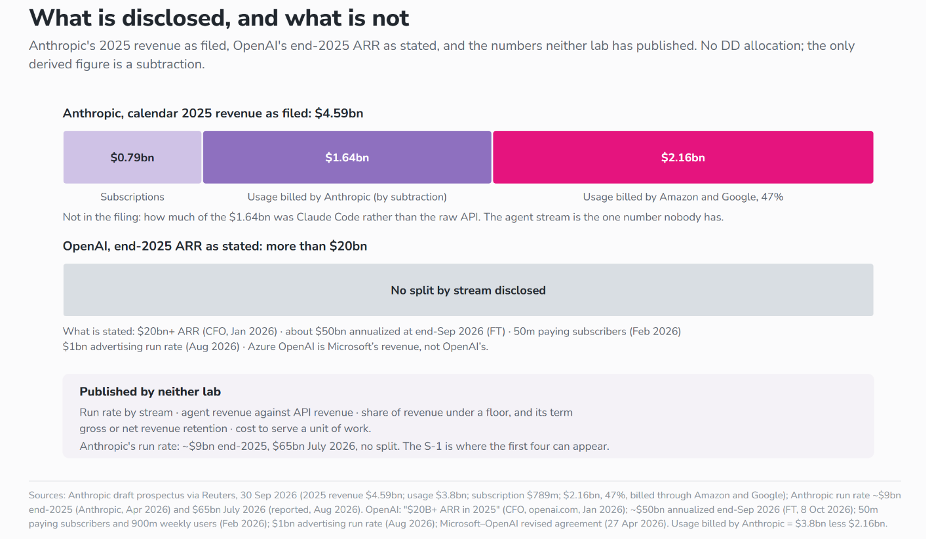
To compare the companies, we have to hold the date and categories constant and acknowledge how little is disclosed. At the end of 2025, OpenAI’s CFO said the company had more than $20 billion in ARR; Anthropic described its run rate as about $9 billion. Neither figure comes with a split by stream.
Anthropic’s draft prospectus is the one hard decomposition: $4.59 billion of 2025 revenue, of which $789 million was subscription and $3.8 billion usage, and of that usage, $2.16 billion was billed by Amazon and Google. So the 3P stream is sized, and by subtraction, the usage Anthropic billed itself was about $1.6 billion. What the filing does not say is how much of that was Claude Code rather than the raw API.
OpenAI has published no breakdown. What is known: more than $20 billion of ARR at the end of 2025, about $50 billion annualized by September, 50 million paying subscribers in February, a $1 billion advertising run rate by August, and an Azure channel that is Microsoft’s revenue, not OpenAI’s.
Why the 2025 numbers cannot carry the weight
Every number in that decomposition is a photograph of a business that no longer exists in those proportions. Calendar 2025 was the last year before the agents: Claude Code, Managed Agents, Cowork, Codex, and the Frontier platform all scaled in 2026. Anthropic’s run rate rose roughly 7x on that work. The 2025 split, subscriptions at 17% and the clouds billing 47%, describes the chat-and-API era. The market is pricing in a run rate earned in the agent era. Reading the second through the first is a mistake.
Agents change what a unit of revenue is, and that is why the old lenses fail. Software sold a seat: a person, a license, a year, and ARR measured the people who stayed. The API sells a token: a call at a price, and the run rate measures the calls. An agent sells work: a task run to completion, billed by the tokens it consumed, the hours it ran, and, where there is one, the seat that supervised it. Work has three properties a seat and a token do not. It scales without headcount, so revenue per seat, the benchmark every software multiple was built on, stops meaning anything. It carries state- the tools, permissions, memory, and record of what was done- so it can be owned, which a token never could. And it is priced against a falling cost of intelligence, so the same task earns less each year unless more of the work moves inside the harness.
So, the questions change with it. Not how many seats were renewed, but how much of the customer’s work runs inside a harness the lab owns. Not net revenue retention on a seat base, but retention of work: whether the tasks come back, and at what price. Not ARR, but the share of revenue under a floor, the term of that floor, and the cost of serving a unit of work.
Which streams pass the ARR test?
On paper, the agent is the best revenue stream either lab has, because leaving means moving the work; 1P is in the middle; 3P is the weakest for the lab, but it’s the stickiest for the cloud. A revenue dollar is not durable because someone has multiplied it by twelve. The test ARR used to pass automatically is the revenue contracted, and for how long; who owns the customer; how hard is it to switch; what does retention show; and what is left after distribution and compute. Stream by stream:
Consumer subscriptions: the closest thing either lab has to recurring revenue at scale. Plus, Pro and Max renew monthly at a fixed price, which gives more visibility than a stream of API calls. But subscribers can cancel, and the flat price leaves the lab paying for heavy users. OpenAI’s 50 million paying users in February show scale, not how many stay after a price rise or a stronger free alternative.
Advertising: a different test. A $1 billion run rate in under 200 days shows how fast OpenAI can sell access to its audience, not a contracted year of spending. Durability depends on repeat advertiser budgets, user attention, and how much advertising the product can carry before it becomes less useful.
The model call billed by the lab (1P): the lab owns the customer and the bill, but the revenue is tied to usage, and a customer can use more, use less, or route work to another model. Anthropic said in April that more than 1,000 customers spend over $1 million a year with it, showing a broad buyer base, not how often they renew. The revenue above any floor is re-won every month. In practice, a switch is weeks of evals, prompts, and compliance re-clearance, not a line of code; but it is a project, not a contract. The lab is a tenant at the frontier, paid for as long as the frontier is worth renting.
The model call billed by a cloud (3P): the same exposure to changing demand, and the lab is a tenant twice over, of the customer’s work and of the cloud’s shelf. A customer’s commitment to its cloud isn't a commitment to one lab, and the 16 cents the cloud keeps says nothing about inference or training costs. Andy Jassy told investors in July that AWS can be wildly successful without its own frontier model, because no single model will rule the world, even as Amazon builds its own. That is a sentence about Bedrock’s menu, and Anthropic is one item on it.
How much of that API revenue recurs? Three things would tell us, and neither lab has published any of them:
- The first is a floor. The only floor Anthropic has described sits on its Enterprise plan, rebuilt in April: a seat, usage on top at API rates, and a monthly minimum on an annual term. That plan is the agent stream, not the raw API. For the API itself, Anthropic hasn't said what share of the run rate sits under any floor, and its prospectus says many of its largest customers lack long-term commitments and that two customers accounted for 12 percent of 2025 revenue each.
- The second is retention: neither lab has published gross or net retention for API customers, so nobody outside can see whether the dollar that arrived in January was still there in July.
- The third is price. As cheaper models catch up, the same work moves down the price ladder, so flat usage means falling revenue, and the run rate holds only if volume grows faster than price falls. On 3P, the same tests apply at one remove, because the floor and the retention are the cloud’s, and that is also the bull’s case: a multi-year committed-spend agreement with AWS or Google, burned down by buying Claude through Bedrock, procurement and compliance cleared once, the cloud’s sales force co-selling. On that reading, Anthropic’s cloud-billed 47 percent is its most enterprise-grade revenue, not its most fragile. Sticky, that is, to the cloud: any model on Bedrock burns the commitment down at the same rate, and the customer can change tenants without changing the contract. The channel is durable; the tenant on it is fungible.The first-party agent: the strongest switching-cost story. The lab’s agent holds the tools, permissions, memory, and state of the customer’s work, and the only floor Anthropic has described sits here, on the Enterprise plan’s annual minimums, so the agent stream is metered too, with a year of minimums under it. Claude Code reached a $2.5 billion run rate by February, more than half of it enterprise, the last figure Anthropic has disclosed, and Managed Agents charges 8 cents for each hour an agent runs on top of tokens. Those figures show adoption and a way to bill for the agent’s work, not retention: for that I would want cohort retention, renewal and churn, how much work customers keep inside the agent, and the cost of serving it. The harness is an argument to test, not a retention statistic. But it is the one business stream from which true ARR could emerge: revenue that recurs because the work and its state live in the lab’s runtime, billed for the hour and the seat beside the tokens. That ARR would carry a different gross margin than software’s, because the lab pays for every token the agent consumes, and I don't yet know whether that is better or worse. The platforms have read it the same way: Satya Nadella argued on 10 October for separating the model from the harness that runs it, and Alex Karp calls the models “commodity cognition”.
Margins complicate every comparison. A flat subscription exposes the lab to its heaviest users; API and agent revenue rise with usage, but so does compute. The public estimates aren't on a common basis: about 40 percent for Anthropic in a 2025 projection excluding training, and above 80 percent in a 2026 figure before partner payments and training, so the headline cannot say which stream produces the most durable profit.
So the streams rank, and the ranking inverts the headline. Neither lab has published agent retention, and if agent cohorts churn like API cohorts, the ranking collapses. Anthropic has the largest first-party agent revenue anyone has disclosed and the largest share of the weakest stream. OpenAI has less business revenue and almost none in 3P, because Azure’s resale is Microsoft’s sale. The faster grower has the more exposed mix, and the agent is the one business stream from which true ARR could emerge, at a gross margin nobody can yet state.
Why business revenue is the game
The next two essays estimate business revenue: 1P, 3P, and the agent, because that is where the premium is and where the growth comes from.
Consumer, with advertising on top, is not a footnote. At 900 million weekly users, ChatGPT is already one of media's largest audiences, with 50 million paying. Meta earned $57 per daily user in 2025, $201 billion across 3.58 billion people; the same yield on ChatGPT’s weekly audience, a looser measure than Meta’s daily one, would be about $50 billion a year, a Meta-scale media business in its own right. I set it aside for a reason, not out of dismissal: it is priced on a different axis, attention, ad load, and household willingness to pay, at a media margin minus the cost of serving the heaviest users for free. If it becomes Meta-scale, it will deserve a media multiple, in a different essay.
How strong is the case that usage revenue can persist?
The strongest counterargument is that usage revenue survives an optimization cycle, and that for now new use more than offsets any customer trimming its bill: Anthropic’s run rate rose roughly sevenfold in seven months.
Snowflake is the precedent investors reach for. After the pandemic spending wave, customers scrutinized their cloud bills and Snowflake’s net revenue retention fell from 178 percent in January 2022 to the mid-120s, where it has sat since 2025. It did not collapse because existing customers still spent more in aggregate than a year earlier, and Snowflake today discloses $9 billion in remaining performance obligations, consumption its customers have contracted to buy.
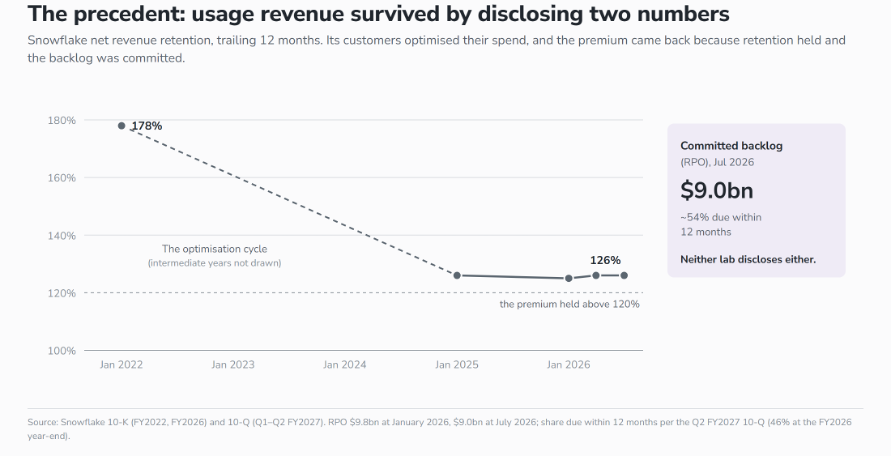
Snowflake showed investors how much existing customers expanded or contracted and how much consumption they committed to buying. Anthropic has disclosed neither.
The expense side differs even more. Snowflake carried $2.7 billion in purchase commitments in January and added a five-year, $6 billion cloud commitment in April, against $6.07 billion in product revenue guidance for the year: call it a year of revenue, committed over five. Anthropic has committed at least $518 billion, four-fifths of it non-cancellable or payable whether or not the capacity is used. That $65 billion run rate is many years of revenue, not one, and the filing doesn't date it all. One is a customer backlog. The other is a promise to buy supply.
So, Snowflake shows that usage revenue can endure optimization, not that Anthropic’s already does. The test is whether customers keep using it, renew their floors, and expand their commitments; even then, it doesn't say whether the revenue can cover the compute the lab has promised to buy.
What does today’s price assume?
A rough comparison of private valuations with annualized revenue shows what investors may be underwriting. OpenAI’s March financing valued it at $852 billion, about 17 times its roughly $50 billion current annualized revenue. Anthropic’s $965 billion valuation in May was about 15 times its $65 billion July run rate. The bases differ, net for OpenAI and gross for Anthropic, so read these as orders of magnitude.
The reported prices now being discussed depend on a much larger denominator. OpenAI's reported $1.4 trillion valuation is about 20 times the $70 billion year-end projection. Anthropic’s reported $2 trillion listing valuation would be about 17 to 20 times investors’ $100 billion to $120 billion year-end run-rate expectation. These are reported discussions, not settled prices; Anthropic’s executives have set no IPO valuation target.
These are rough price-to-run-rate comparisons, not enterprise-value multiples on audited revenue. But the pattern is clear: the higher prices look ordinary only if revenue grows quickly into them and most of it endures, and the headline multiple treats a subscription, a metered call, a cloud-billed sale and an agent embedded in a workflow as if they carried the same renewal prospects.
What I conclude
OpenAI and Anthropic are the two tenants. Their revenue is rent: five streams, most of it metered and re-won month by month. Their costs are leases: Anthropic alone has committed at least $518 billion of compute, four-fifths of it payable whether or not it is used. The market has priced the rent as if it were the lease, an ARR multiple on a run rate, and neither lab has shown the retention or the backlog that let Snowflake keep its premium, nor how much of its revenue sits under a floor. The one stream that can turn rent into ownership is the agent, because leaving it means moving the work, and it is the one place Anthropic has put a floor. Its margin is unknown. That is why Codex vs. Claude Code comes down to which run rate is bigger. Three S-1 disclosures can change that verdict: revenue by stream and channel, the amount and term of customer commitments, and how much usage runs through the agent.
What will Part II estimate?
Part II estimates the two labs’ combined business run rate in December 2027 from four questions. How much AI work will arrive? What share of it will still need a frontier model? What price can those models command? And who will capture the revenue: the labs directly, a cloud channel, or the company that owns the agent harness?
An Anthropic S-1 could sharpen that estimate. Part III will ask what each stream is worth and what the labs have committed to build around it.
DISCLAIMER: The views and opinions expressed here are those of the author alone and are based on publicly available information. They do not constitute investment advice, a solicitation, or a recommendation to buy or sell any security or financial instrument. The author may hold positions in the securities of companies mentioned. Past performance is not indicative of future results. Readers should conduct their own independent due diligence and consult a qualified financial advisor before making any investment decision.