


TLDR: SpaceX claims a $22.7 trillion opportunity in enterprise applications, but the post-IPO analyst models overwhelmingly underwrite compute rental rather than software, customers or switching costs. Cursor, Sand, and Grok now give SpaceX a credible mechanism to pursue that market: the coding-to-orchestration playbook that Anthropic used to enter the enterprise. But SpaceX is beginning after Claude, OpenAI, and Microsoft have already occupied the field, with no shipped general-purpose agent or demonstrated external adoption. The enterprise thesis has therefore moved from unsupported to plausible, but remains a time-sensitive option. SpaceX’s valuation ($1.8T as of July 14th) prices that option as though the playbook had already been executed.
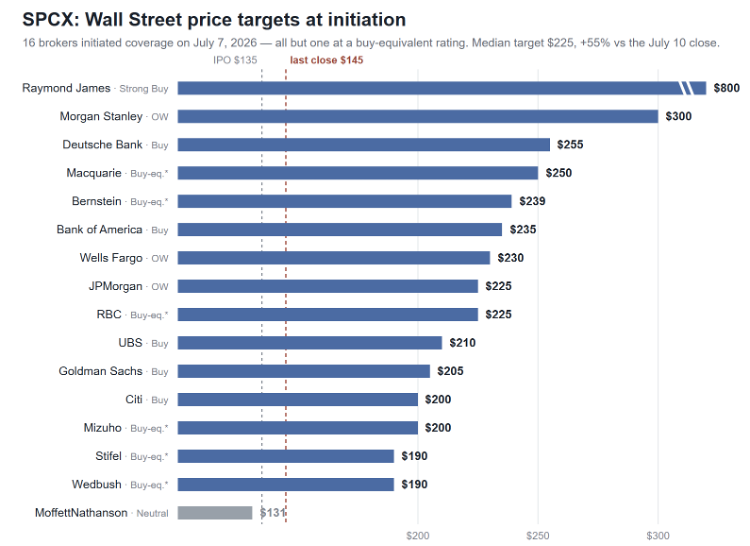
Last week (6–12 July 2026), the SpaceX valuation debate was compressed into five days. On Tuesday, July 7, the quiet period (the 25-day post-IPO window during which underwriters cannot publish research) lifted, and the lips of more than a dozen brokers were finally unsealed as they publicly initiated coverage, all but one at a buy-equivalent rating (the lone Neutral carries a $131 target). On the same day, Anthropic extended Claude Cowork, its general work agent, to mobile and web.
On Wednesday (8 July 2026), SpaceX’s AI division released Grok 4.5, its bid for the model frontier. A day later, OpenAI unveiled ChatGPT Work, an enterprise agent powered by GPT-5.6. Then, that same afternoon, The Information reported that Cursor - the coding company SpaceX is acquiring for $60 billion - was developing a general-purpose work agent codenamed Sand and had begun testing it internally in late June. It remains unnamed, unpriced, and unlaunched. One week: the research, the model, the rivals’ agents, and the leak of SpaceX’s own, while the stock traded below its first-day close. If you want to judge the largest TAM number ever printed in a prospectus, the evidence is now on the table. Or should be.
Instead, that number remains the $800 billion black hole I wrote about before the IPO and now approaches $900 billion at the company’s current price.
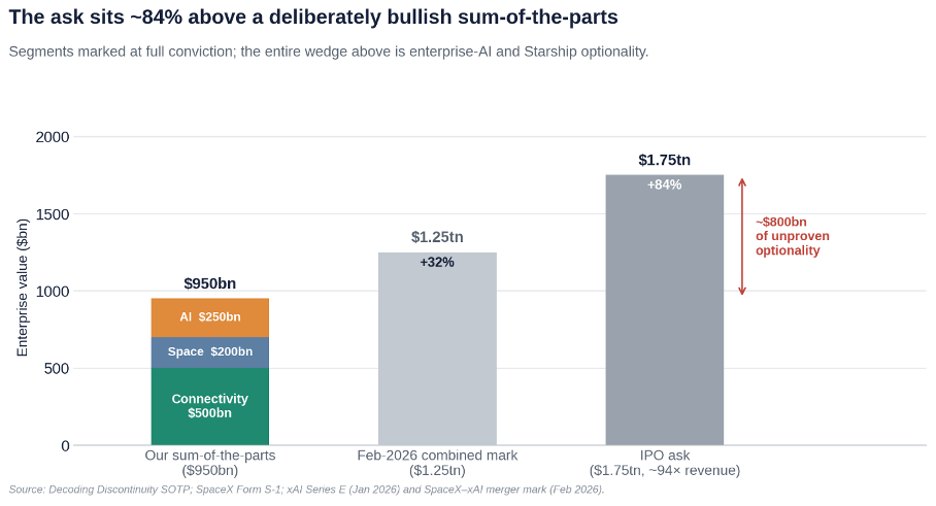
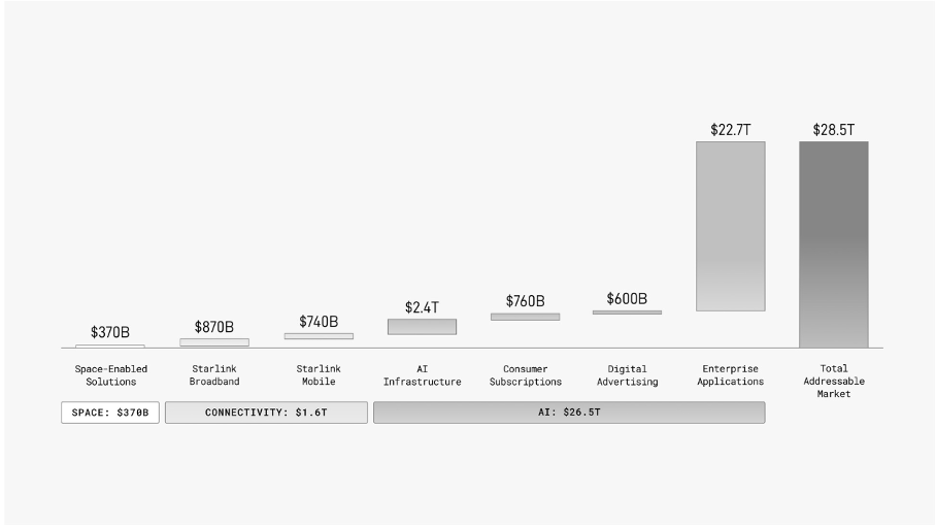
The force creating that black hole was the S-1’s $22.7 trillion “enterprise applications” claim: 86% of the AI opportunity, supported by one sentence and no visible bridge from SpaceX’s actual compute, data, and model assets to enterprise workflows, customers or switching costs. Except for references to the “Macrohard” product whose work has stalled at xAI per the same The Information article.
One month later, that conclusion deserves refinement, but not reversal. The Cursor acquisition, the emergence of its general-purpose agent Sand, Grok 4.5, and SpaceX’s vertically integrated compute stack now supply a credible valuation mechanism. The black hole is no longer entirely empty. It has become an option.
Yet the banks that initiated coverage have not underwritten that option as an applications business. They have mostly underwritten capacity, while allowing the applications narrative to carry the multiple, while effectively dodging this issue.
One can now see SpaceX/xAI assembling parts of the mechanism that Anthropic already demonstrated with resounding success: enter the enterprise through coding (the “Coding Wedge”), where output can be verified; expand into general work; then occupy the orchestration layer where a company’s context and workflows compound around the agent. SpaceX now has real ingredients for a version of that playbook and a cost structure Anthropic does not.
What it does not have is Anthropic’s head start, a shipped general-purpose enterprise agent, external adoption or an uncontested field in frontier capabilities. Nor would winning the orchestration layer make the filing’s $22.7 trillion revenue pool real at face value. The same automation that expands the addressable work also lowers its price as I develop it later.
The Enterprise Applications business of SpaceX has moved from an unsupported assertion to a credible but time-limited option, while the valuation prices the playbook as though it had already been run. In this article, I want to explore what Wall Street actually modeled, whether SpaceX can execute the Anthropic path, and what remains when the option is separated from the infrastructure business.
The banks priced the small bucket and sold the large one
The ratings tell one story: all but one initiation at a buy-equivalent, with targets running from $131 at the lone Neutral to $800 (!) at the most exuberant. The models beneath them tell another, and it is the same story at every bank that published one.
Across the initiations, the projected AI revenue is overwhelmingly compute monetization - capacity built and sold or rented to third parties. Enterprise software and agents, the business that is supposed to justify the $22.7 trillion, survive as a residual: on the order of a tenth of the modeled AI revenue, standing in for 86% of the stated opportunity in the S-1, inside segments projected at the margins of a data-center landlord rather than a software empire.
The tell is not the estimates. It is the unit of account. The street’s frameworks for SpaceX’s AI segment are built in dollars of revenue per gigawatt of capacity: anchor the addressable market to global cloud infrastructure spending - a figure more than an order of magnitude smaller than management’s $22.7 trillion - sort every use of a gigawatt into workload categories, and apply a blended capacity yield, on the logic that SpaceX will steer its compute toward whichever use pays best in a given quarter. In that arithmetic, an enterprise application is not a business with customers, seats, and switching costs. It is a higher-yielding use of a gigawatt - a premium tenant for the same capacity.
Nobody has ever valued Salesforce in dollars per gigawatt. The choice of denominator tells us everything: what the street can underwrite is capacity, flexed toward whichever meter runs hottest. What it cannot underwrite - what no initiation even attempts - is an applications franchise.
The frameworks are candid about one more thing. Today’s hosting economics reflect scarcity, not steady state: the flagship compute deals are structured, by Musk’s own public description, with mutual cancellation on 90 days’ notice, at rates the street broadly expects to normalize lower as supply arrives.
In every credible model, then, the revenue comes from the small bucket: infrastructure, 9% of the company's stated opportunity by its own arithmetic. The narrative and the multiple come from the large one. A dozen reports in one week, and not one names the seam.
So, the question the sell side declined to answer falls to us: is there a credible path from a compute business to the $22.7 trillion? There is. We know it because someone has already walked it.