
Stripe’s $10 Billion OpenRouter Bid: The Race to Control the Machine Economy
A Stripe–OpenRouter deal would fuse AI model routing with payments, giving Stripe a shot at capturing the transaction layer for a machine economy run by autonomous agents.

TLDR - Stripe is reportedly in talks to buy OpenRouter for around $10 billion, about 8× its most recent valuation. Nobody pays that for a take-rate API aggregator. Open-weight models are multiplying, and intelligence is getting cheap; what stays scarce is the choice of which model to use, weighed on price, task-fit, latency and jurisdiction, and then turned into an enforceable transaction. OpenRouter sits at the moment of selection and sees what the whole market is buying. Stripe sits at the moment of settlement and supplies the operating context: wallets, metering, mandates, finality. Together they could be the transaction layer of the machine economy, where agents hire minds the way humans hire freelancers. Orchestration control points like that don't move often.
Last week, the Wall Street Journal reported that online payment giant Stripe, currently valued at around $159 billion, is in talks to acquire OpenRouter, a company of a few dozen people that routes developer requests across hundreds of AI models, in a deal reportedly worth close to $10 billion.
OpenRouter raised its Series B in May at a valuation of $1.3 billion, with investors including Databricks, which also then reportedly made its own bid to buy the company, according to The Information. A repricing of almost 8 times suggests that Stripe is not simply valuing OpenRouter as an API aggregator that collects roughly 5 percent of the inference spending passing through it. [Note: The talks remain unconfirmed and may collapse or close on different terms].
But even if the deal with Stripe should fall through, the valuation and the intense interest in the routing layer raises a fascinating question: what could a payments company see in an AI router that the router’s current income statement cannot quite justify?
The answer ties directly back to the larger shift that has dominated AI discourse in recent weeks: the open-source inflection point is no longer approaching. It has arrived, and the past three weeks have removed any lingering doubts.
As I wrote last week, the string of open-weight model releases culminating with the release of Kimi K3, which became the first open-weight model to beat the closed frontier on an independently run leaderboard, demonstrated how quickly Chinese labs are compressing the frontier release cycle.
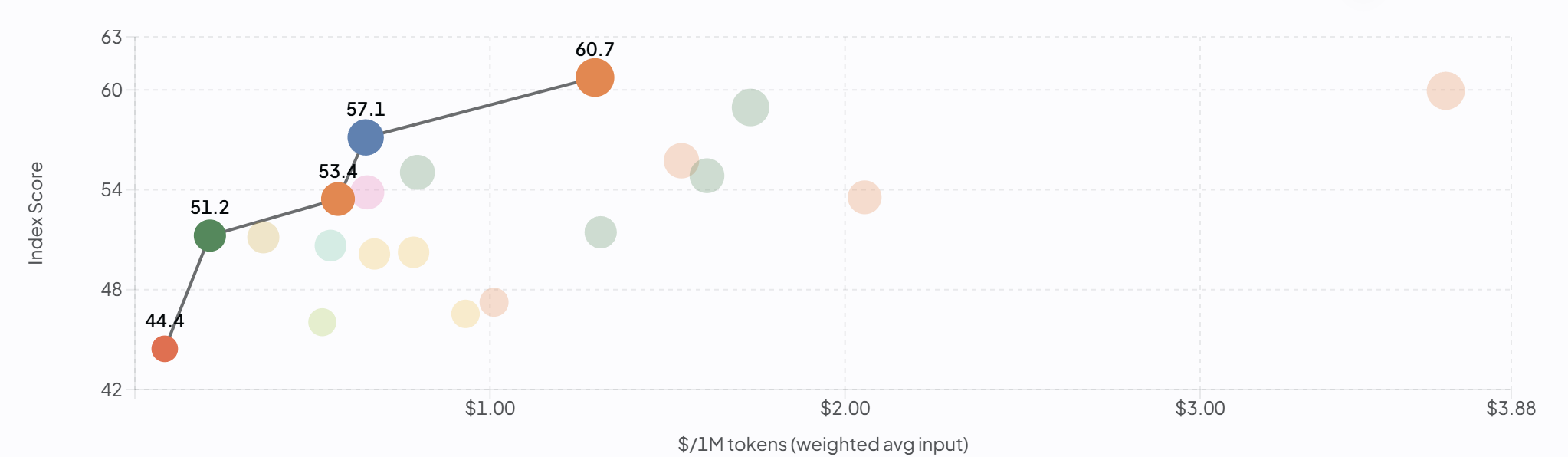
Suddenly, a debate over open source and open weights went from thoughtful ponderings of theoretical situations to overtones of a crusade. Anthropic’s leadership accused Chinese companies of IP theft, and the U.S. government seemed to hint at some possible action to limit access to open-source models. This prompted a remarkable industry counter-attack led by Nvidia CEO Jensen Huang, who used his first post on X to share an open letter defending open weights as a foundation of American AI leadership.
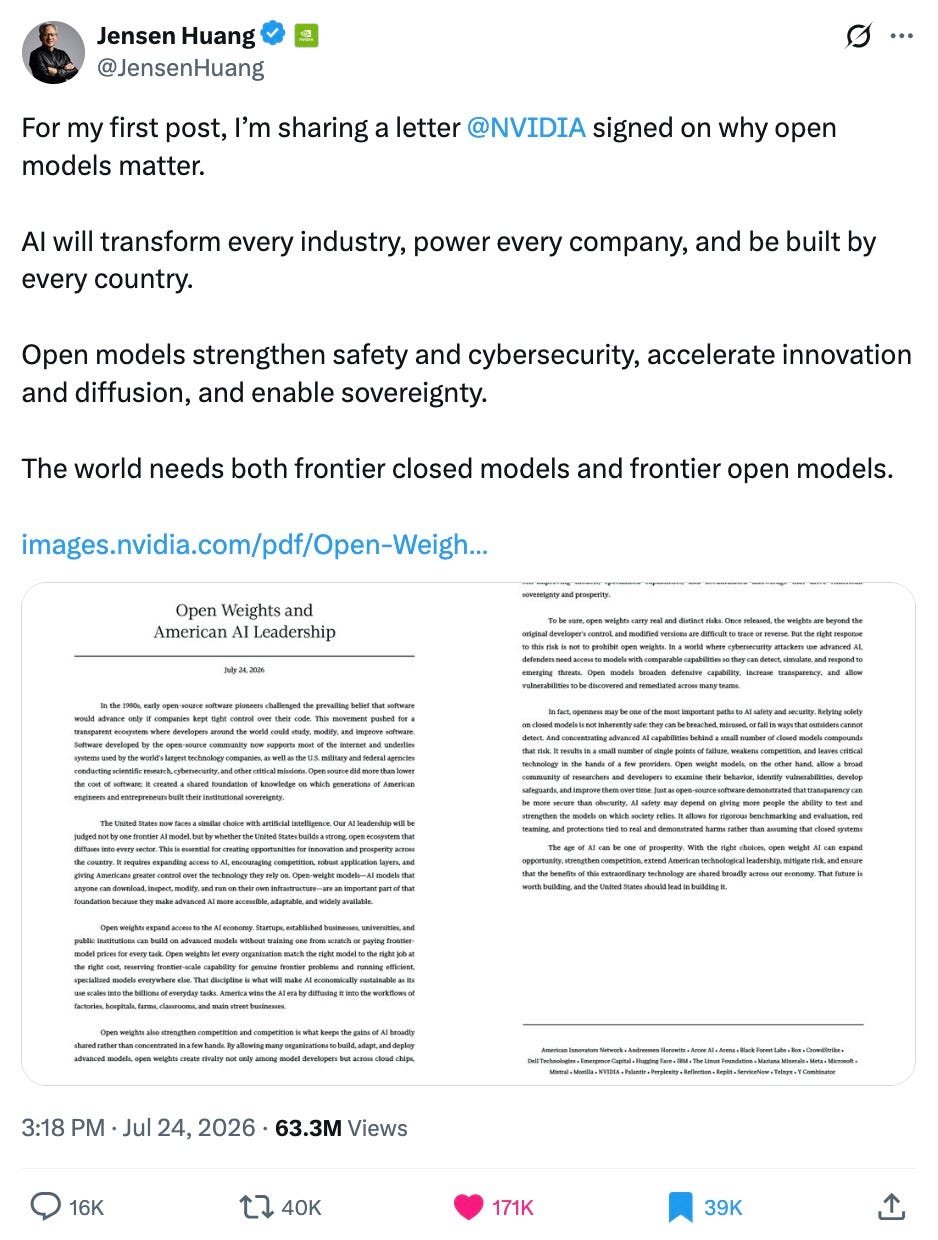
The letter has since been signed by some twenty-five companies including Microsoft, Meta, IBM, OpenAI, and Google. Anthropic was initially conspicuous by its absence. On Monday, Anthropic CEO Dario Amodei published a statement emphasizing that the company had never sought an open-source ban while explaining his reasons for not signing the statement: “I don’t agree with the letter’s assertions that open-weights models necessarily make it easier to develop safeguards or that broad access to capabilities necessarily helps defenders more than attackers. It seems at least as likely to me that the opposite will be true.”
Lost amid the protests and counterprotests is the reality on the ground that can be tracked on OpenRouter: Chinese-origin open models have gone from less than 2 percent of traffic in late 2024 to a weekly peak of 46 percent by mid-2026. During the same period, US models’ share of that same traffic fell from roughly 70 percent to 30 percent.
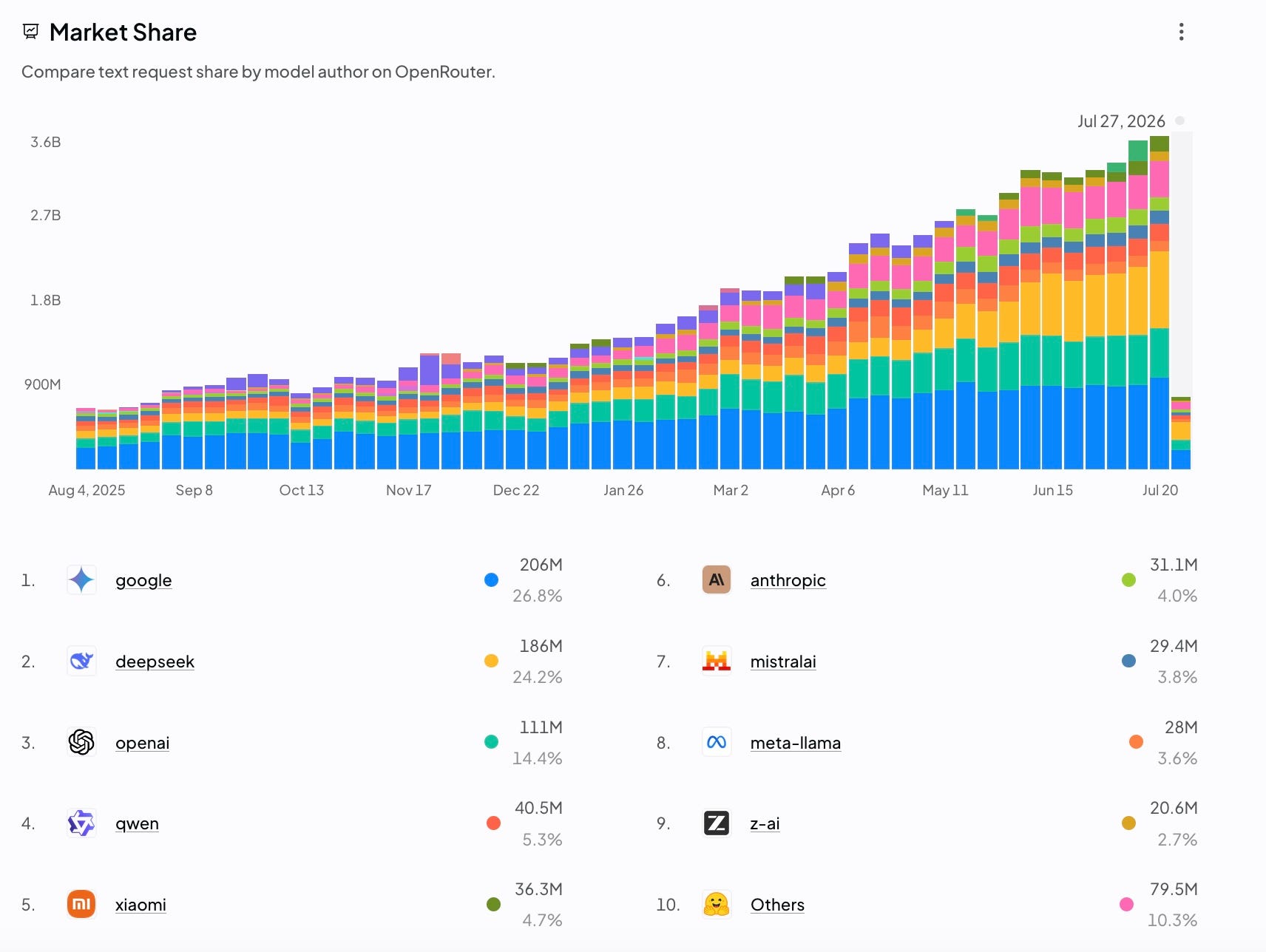
For OpenAI, Anthropic and Google, the threat is not that open models replace the frontier everywhere, but that routers increasingly reserve their expensive models for the hardest tasks while diverting the far greater volume of routine work toward cheaper alternatives.
This inversion goes beyond denoting a change inside the competitive ranking of AI models to the entire economic architecture around intelligence. As capable models proliferate and inference prices fall, scarcity migrates away from producing intelligence and toward deciding which intelligence to use, under which constraints, and how to turn that choice into an accountable economic transaction.
In other words, scarcity may be migrating toward the things a company like OpenRouter does. But whether that position is worth anything depends on a key question: can model selection eventually be reduced to commodity plumbing, or does it remain a defensible judgment? If the market settles and prices stabilize, model capabilities become predictable, and the optimal choice for each task can be written into a fixed set of rules, then routing becomes a feature that can be replicated, open-sourced, or bundled away. OpenRouter would be useful infrastructure, but hardly a $10 billion company.
That valuation makes sense only as a bet that the model market will remain volatile enough to prevent the optimal choice from becoming fixed. And thanks to the rise of open source and weights, we now see hundreds of models improving and repricing at different speeds, with their relative performance changing across different tasks, latency requirements, and jurisdictions. The present volatility means the potential advantage lies in the accumulated evidence of which models users choose and why. The more OpenRouter observes, the better situated it becomes to route the next request.
But it still does not explain why Stripe would pay such a premium to own it.
To understand that, we must turn to the core thesis of Orchestration Economics, which holds that AI demand will increasingly come from machines that are becoming actors, eventually leading to agents purchasing cognition on behalf of other machines. Picture millions of small, continuous decisions in which model quality, price, latency, jurisdiction, and spending authority must be reconciled in real time. In that economy, model selection becomes the margin.
In this Agentic Era scenario, Stripe doesn’t simply view OpenRouter as a thin bit of API plumbing that will add a 5 percent toll on rapidly deflating inference to the income statement. Instead, it’s more likely that Stripe sees an opportunity to fuse the moment an agent chooses which mind to hire with the infrastructure that completes the transaction. OpenRouter supplies the market-wide flow required to make the routing decision. Stripe supplies the operational context that makes its consequences enforceable and monetizable.
This combination may point toward a new control point in the AI stack: a transaction layer where cognition is discovered, priced, and cleared in a single motion. Whoever owns that layer could become one of the principal orchestrators of the machine economy.
In this article, I want to examine why routing becomes strategically valuable as intelligence grows abundant, whether OpenRouter’s view across a volatile model market can form a defensible position, and why Stripe may be uniquely placed to monetize it. The larger question is whether connecting the selection of intelligence directly to the payment infrastructure behind it creates the control point through which the emerging machine economy will operate.
What routing is, and why it matters
OpenRouter is one API endpoint, compatible with the interface every developer already knows, standing in front of four hundred models from sixty inference providers. When you send a request, the router selects where it runs, handles failover when a provider degrades, compares price and latency across the field, and consolidates the whole mess into a single bill.
Eight million developers use OpenRouter. Volume has grown from five trillion to roughly twenty-five trillion tokens a week in six months, a pace that annualizes to a quadrillion tokens. The business model charges roughly 5 percent on the inference flowing through. The company owns no GPUs and trains no models, and is purely an intermediary.
Described that way, routing sounds like a handy tool. And in 2023, it was. Open source redefined that role by changing the supply of intelligence. The simplistic explanation that “open models caught up” misses the larger structural transformation.
Open source caused one axis of variance to converge while detonating three others:
First, price variance exploded. Near-equivalent capability now trades across a 10x–40x range: self-hosted open-weight inference at a few cents per million tokens against $30 at the proprietary frontier, repricing weekly. When quality was scarce, price dispersion didn’t matter. You paid what the capable model cost. Now that quality is abundant, price dispersion is the entire game.
Then, task variance persisted along a predictable axis. The convergence is real but not uniform. Open models match or beat proprietary systems wherever verification is cheap: code that compiles, math that checks, and retrieval that grounds. The proprietary premium survives where verification is expensive: long-horizon reasoning, multi-turn business judgment, the weakly-verifiable professional work where Fable 5 still reigns. Distance-to-verifier, not benchmark scores, now governs which model wins which task. Nobody publishes that mapping, task by task, week by week. It has to be learned from live traffic.
Finally, jurisdictional variance has become a major factor. Which model may legally serve which customer, in which jurisdiction, with which data. Two years ago, that question did not exist as a routing input. After the release of Kimi K3, the furious open-model debate, the open letter, the hints at restrictions, and the long-term traffic migration toward open models, it is a first-order constraint that changes with the news cycle. Routing has acquired a foreign policy variable that has an economic cost.
None of this makes models commodities, and the argument doesn’t require them to be. What a router commoditizes is procurement, the act of buying intelligence, rather than capability itself. Quality, reliability, and enterprise trust still carry a premium, which is exactly why the choice is hard. The inflection made quality abundant and the choice space four-dimensional: price, task-fit, latency, jurisdiction, across four hundred models whose relative positions never stop moving.
In this framing, the deal would potentially be a merger of two routers.
OpenRouter routes intelligence across models and inference providers. Stripe routes money across businesses, customers, and financial networks. Combined, they would form one interface that selects the model, observes consumption, meters the tokens, prices the call, and settles the transaction. Whether that interface is worth $10 billion depends on whether the selection it performs remains defensible or gets commoditized.
When routing becomes valuable
OpenAI’s first large-scale study of Codex usage gives an early view of how quickly agentic demand can multiply. More than 10 percent of users now operate at least three agents concurrently during a typical week, while OpenAI’s most intensive users generate approximately 71 cumulative hours of agent runtime in a single day by running multiple workflows in parallel.

The study does not yet describe an autonomous machine economy, but it shows the transition that makes one economically consequential: AI demand expanding from discrete human prompts into continuous, concurrent streams of machine work.
Yet as this agentic demand is beginning to explode, the strategic value of routing depends on who is buying the intelligence. Inference demand is splitting into two economies with radically different unit economics:
The first economy is human-priced: agents drafting equity research, adjudicating claims, and resolving tickets. This is work that displaces labor billed by the hour. The empirical record here is blunt. The first large-scale study of agents in production [See: Mapping Agents in Production; Revised June 4, 2026], which we have repeatedly used as a key datapoint in this publication, found teams overwhelmingly defaulting to the most capable proprietary models, because inference cost is a rounding error against the expert the agent augments. Only three of twenty case studies used open models at all, and those under cost or regulatory duress. In the human economy, model selection is close to a solved problem: use the most capable model available. Cost is usually noise.
The second economy is machine-priced: This one is new. In late January, Moonshot shipped swarm orchestration trained into the weights of K2.5. Days later, Moltbook, a social platform for autonomous agents, registered over a million agents within seventy-two hours. A subsequent investigation concluded that most of those accounts were scripted shells, and skeptics declared the episode theatre. They corrected the sociology and missed the economics. Fake or not, the accounts burned real compute, and the serious evidence was never the spectacle anyway. It is the infrastructure going in beneath it. Amazon now wires programmable agent wallets, with session-level spending limits, directly into its agent runtime. The infrastructure is being assembled for agents to become economic actors, even if the scale and timing of that demand remain uncertain.
In the agent world, the unit economics invert, because nobody’s salary anchors the value of a machine-to-machine interaction. Compute is not noise against labor. Compute is the cost of goods sold for every orchestrated workflow. At $30 per million tokens, a million-agent swarm is an impossibility. At open-weight prices, it runs continuously. Agent populations can double in days, with no evenings and no weekends. The open-source inflection is not simply a supply-side event that changed how routing works. It is the demand-side event that created the economy in which routing matters. In the human economy, model cost is often noise. In the machine economy, it is the margin.
The question is whether this makes routing a defensible position or just a useful feature. The open-model inflection has transformed model selection from a quality question (which model can do this at all?) into a portfolio decision: which point on a shifting four-dimensional frontier is optimal for this call, now, under these constraints? If that frontier eventually stabilizes, the answer can be encoded into a routing table and bundled into infrastructure. OpenRouter becomes valuable plumbing, but plumbing nonetheless.
The case for defensibility rests on the opposite possibility: that the frontier keeps moving too quickly for any static map to remain useful. In that environment, the better analogy is not indexing but market-making. The market-maker’s advantage does not lie principally in an algorithm that competitors can reproduce. It lies in seeing the flow. Whoever observes more activity across the market can respond more quickly as prices and preferences change.
OpenRouter sees twenty-five trillion tokens a week, providing a broad view of how the market purchases intelligence. Each lab sees demand for its own models. The router sees activity across the distribution. Its public rankings have already become something resembling the industry’s tape: a source of price discovery watched by the labs themselves. Routing policies refined against that flow should improve with volume. A system that has routed a quadrillion tokens has evidence that a new entrant does not.
OpenRouter’s position therefore depends on sustained volatility across the model frontier. Four hundred models are changing price and position across multiple dimensions, and every shift causes yesterday’s routing map to depreciate. That depreciation is both the weakness and the potential moat: the map never stays valuable for long, but only platforms with continuous, market-wide flow can keep it current. Stripe, in other words, would be buying an asset that is long model-frontier volatility. Judging by the release calendar that produced K3 and GLM-5.2, that volatility is currently well supplied.
Two things could break this thesis. First, meta-harnesses like Databricks’ newly open-sourced Omnigent could absorb model selection as a bundled feature, and workflows arrive at the router as pre-decomposed calls made upstream. The router would then slide toward invisible infrastructure.
Second, the model frontier could stabilize. If release cycles slow, prices converge, and performance by task becomes predictable, model positions settle into a printable table, and OpenRouter’s live information advantage loses much of its value. The two signals to watch are therefore where the routing decision originates and how quickly the frontier continues to move.
Even if routing is still valuable, however, that does not necessarily make it a good business. The machine economy runs, by construction, on the cheapest tokens available. A router earning 5 percent of prices deflating tenfold a year, on traffic selected for costing as little as possible, could win the intellectual argument and still lose the income statement. On OpenRouter today, a single proprietary provider accounts for roughly an eighth of tokens but nearly half of revenue, and that is exactly the traffic most able to go direct. Five per cent of nothing is nothing.
Answering that objection requires conceding its premise: the inference take may not be the real business.
What the routing position holds is the origination point: the moment a machine-demand workflow begins, where the agent chooses which mind to hire. Many of those workflows will ultimately produce an economic transaction whose value does not decline in lockstep with token prices. The larger opportunity is therefore not simply to collect a percentage of inference spending, but to link the purchase of cognition to metering, authorization, and settlement.
Which is where Stripe comes in.
The absorption: how Stripe becomes an orchestrator
Routing may be strategically valuable without being sufficient, on its own, to support a durable business. OpenRouter can identify the moment at which an agent chooses which intelligence to use. Extracting the full value of that position requires the operational context to authorize the purchase and enforce its consequences.
To analyze OpenRouter’s position, we can see where it is situated along the Three Rings of the Agentic Enterprise.
Ring One is intelligence: That includes the models, which are now converging and commoditizing, with K3 being the clearest evidence yet.
Ring Two is the harness: This is where routing, memory, delegation, and coordination live. This ring is thinning, too, as swarm orchestration ships inside open weights and meta-harnesses bundle what a thousand startups pitched as moats.
Ring Three is orchestration proper: This is the position held by whoever wraps intelligence and harness in an irreplaceable operational context and delivers outcomes neither layer can produce alone.
OpenRouter, standing alone, is a Ring Two asset of unusual quality. It has genuine proximity to the machine-demand moment of choice and benefits from a flow advantage that compounds as more traffic passes through it. But its data-driven edge remains market context: a continuously updated picture of model demand that depreciates as the frontier moves and could theoretically be replicated by another player able to replicate a similar flow. It is a remarkable position that is also structurally exposed. The bear case described in the previous section is what valuable routing without a stronger mechanism for capturing that value looks like on an income statement. Each tremor pushes scarcity one ring outward, leaving a standalone router on the layer being compressed.
Stripe, standing alone, occupies the opposite position. It sits downstream of intent, executing instructions issued by upstream orchestrators, yet controls a Ring Three asset of the first rank: the operational context through which internet commerce becomes enforceable.
This is not passive data exhaust from which patterns must be inferred. Money moves through Stripe only when Stripe’s logic permits it. Radar’s fraud rules, spending mandates, KYC determinations, and dispute adjudications apply policy at the moment of transaction, across millions of merchants, linking each charge to an observable and often legally final outcome: charge, fraud outcome, chargeback, resolution, or recovery. The result is fifteen years of transaction-and-outcome history, tested in production against live adversaries and impossible to synthesize from training data. Stripe’s context is not a description of internet commerce. It is the enforced definition of what a legitimate transaction is.
Seen through this lens, Stripe’s acquisitions and product launches over the past two years no longer look eclectic. They resemble the components of a deliberately assembled machine-commerce stack. Metronome, acquired for roughly $1 billion, provides the infrastructure for usage-based billing, while Stripe’s backing of Tempo points toward sub-cent settlement at machine speed. Privy brings 100 million wallets, already connected to Amazon’s agent runtime, and Shared Payment Tokens and the Machine Payments Protocol—an open standard co-authored by Stripe and Tempo—give agents the authority and infrastructure to transact across payment methods.
In an indication of Stripe’s bullishness on the emerging potential for machine-to-machine payments, founder Patrick Collinson tweeted a progress report:

Stripe has begun bringing these pieces together through its AI Gateway, which provides access to multiple models, tracks usage for downstream billing, and is being developed to support real-time machine-to-machine payments. OpenRouter already uses Stripe for payment processing, invoicing, and tax, so the relationship is operational rather than hypothetical. An acquisition would turn that existing foothold into a market-scale routing position, adding the developer demand and cross-provider flow that Stripe could not quickly manufacture on its own. The machine-commerce layer described here is therefore not only an interpretation of Stripe’s assets. It is a product strategy the company has already begun to execute.
Yet connecting routing to payments does not, by itself, produce a coherent machine-commerce system. Settlement can prove that money moved, but not that the purchased inference was any good. Their connection emerges at the level of the individual transaction. Once each all is metered, bound to an authorized wallet, and settled in sub-cent increments, an inference call becomes an economic event that can be priced and cleared on its own.
This points to a new pricing model native to machine demand. Software evolved from seats to subscriptions and then to usage, progressively narrowing the distance between consumption and payment. Machine commerce could close that distance entirely: billing collapses into settlement, and cognition clears at the moment it is consumed. The thirty-day invoice belongs to a period when humans bought software on annual budgets. Machines purchase by the call, requiring the router to discover the price and the ledger to clear it within the same motion. The ledger cannot verify whether the model produced the right answer. It can verify that the agent was authorized to buy it, at an approved price and within a defined mandate, with explicit recourse if something goes wrong. Stripe does not eliminate the uncertainty surrounding inference quality. It makes that uncertainty economically governable by containing it within enforceable spending authority.
This is where the combination becomes more valuable than either component alone. OpenRouter contributes proximity to machine demand, while Stripe supplies the operational context needed to authorize and monetize it. That also explains the direction of the transaction: Stripe possesses the Ring Three context capable of absorbing OpenRouter’s Ring Two position and capturing the value that currently leaks away. The combined entity is something this framework has identified exactly once before, in a very different sector: an emerging orchestrator born holding an incumbent’s context moat.
A startup’s position with an incumbent’s memory
Orchestration positions are always contested as a pincer, the substrate climbing up and cognition climbing down toward the durable middle. The card networks are climbing from the rails with agentic protocols of their own. The labs are descending from the harness with wallets and commerce surfaces. Stripe–OpenRouter sits between them: above the networks, which move money but cannot route cognition. Below the harness, which expresses intent but cannot supply verified settlement, and which, as a player in the game, can never be its referee.
Cursor offers an early demonstration of how that contest may unfold. Its new router, trained on more than 600,000 live requests, uses the context of each coding task to select among models and claims savings of 30–50 percent for early enterprise customers, rising to 60 percent during broader A/B testing. This confirms that live flow can make routing valuable but also reveals the weakness in OpenRouter’s position: a vertical platform such as Cursor sees the task at its point of origin, with richer context than a horizontal router may ever receive.
In the language of market-making, Cursor is internalizing the order flow. OpenRouter may retain the wider tape across models and domains, but it runs the risk of losing the most valuable routing economics to the platforms where demand begins. Its stronger answer, and the logic of the Stripe combination, lies in the machine demand that originates outside any single vertical and in the settlement layer that Cursor does not control.
If intelligence becomes a metered input, who becomes its Visa, its Bloomberg terminal, its control plane? Three franchises, historically three different companies. Stripe’s answer is Stripe: the settlement rail through OpenRouter’s checkout, the tape through its rankings, the control plane through the mandates and metering already assembled around them.
Closing the loop: the second wedge
A year ago, in a different market, I argued that coding was the wedge into orchestration. The labs’ obsession with code was more than a go-to-market tactic. The Coding Wedge is an entry point for building a harness that could eventually extend into every domain. The evidence since (Claude Code’s share of global public commits, agent teams building compilers, the harness generalizing from code to finance to law) has strengthened that claim.
It has also clarified why coding became the wedge. Code offers the cheapest verifier in the knowledge economy. It compiles, or it doesn’t. The test suite passes, or it fails. That feedback loop made autonomous capability demonstrable rather than asserted, enabled reinforcement learning against verifiable rewards, and allowed the labs to gain credibility in one domain and export the harness into others. The more general principle is that wedges into orchestration emerge where the distance between action and verification is shortest.
Outside code, few systems offer a verifier as powerful as money. A payment clears, or it does not. The ledger reconciles, or it does not. A dispute ends in a resolution that is observable and enforceable. Payments have the shortest distance-to-verifier of any domain outside code, arguably shorter, because finality is defined in law rather than in a test suite. The loop closes here.
The economy contains exactly two maximally verifiable substrates: code and money. The labs took the first and used it to build the harness for work. Stripe is taking the second to build the harness for machine commerce. Coding became the wedge into orchestrating machine work. Settlement could become the wedge into orchestrating machine commerce. The same structural move is unfolding one ring outward. And it could work because Stripe owns the mechanism that makes the outcome final.
The reported valuation is the clearest signal of Stripe’s ambition. If the reports hold, Stripe is considering paying nearly eight times OpenRouter’s valuation from ten weeks earlier, after spending two years and several billion dollars assembling the infrastructure for metering, wallets and settlement.
OpenRouter would connect that stack to the moment an agent selects which intelligence to purchase. Its current income statement cannot explain the price: a 5 percent take on inference spending becomes less attractive as token prices decline. The strategic value lies in the option to connect machine demand directly to an economic transaction, at the level of each individual call.
Whether this particular deal closes matters less than what the reported number has already reclassified. It suggests that the market is beginning, crudely and perhaps prematurely, to price a future in which selecting intelligence and paying for it collapse into a single motion. OpenRouter could determine where machine demand goes. Stripe could authorize the purchase and make it final.
Whoever succeeds in joining those two moments would provide the infrastructure for the machine economy. But more crucially, it would occupy one of the positions through which that economy is governed. That’s a potential combination that provides a durable advantage in the Agentic Era.
DISCLAIMER: The views and opinions expressed here are those of the author alone and are based on publicly available information. They do not constitute investment advice, a solicitation, or a recommendation to buy or sell any security or financial instrument. The author may hold positions in the securities of companies mentioned. Past performance is not indicative of future results. Readers should conduct their own independent due diligence and consult a qualified financial advisor before making any investment decision.


