


Update, September 2026: the repricing described here has since reached the distribution layer — see Nvidia’s $12.9 billion bid for Hugging Face — and the routing layer, where Stripe agreed to acquire OpenRouter.
TLDR: K3, unveiled on Thursday (16 July 2026), is the largest open-weight model ever announced: 2.8 trillion parameters, with the weights themselves pledged for July 27. The model now ranks No. 1 on the Frontend Code Arena coding leaderboard, above Anthropic’s most powerful model, Claude Fable 5. Chinese labs have claimed parity all year, and the claims kept dying on standardized harnesses. This one did not. The consequences run through every layer of the stack: the capability premium has retreated to the top two models; everything beneath them now competes with a self-hostable peer at task-cost parity; and, most counterintuitively, frontier-scale open weights re-centralize inference into the datacenter rather than dispersing it to the edge. Within forty-eight hours of launch, demand had outrun Moonshot’s own compute.
With the release of Kimi K2 Thinking last November, I asked whether the industry was getting the fundamental economics of compute and infrastructure costs all wrong.
The model had matched GPT-5 on key reasoning benchmarks at a reported $4.6 million in training costs. Yet unlike the DeepSeek moment of early 2025 that sent markets temporarily into a tailspin, almost nobody seemed to notice the implications of Kimi K2 at that time. I called it a “neutron bomb” that failed to detonate.
The detonation has now happened.
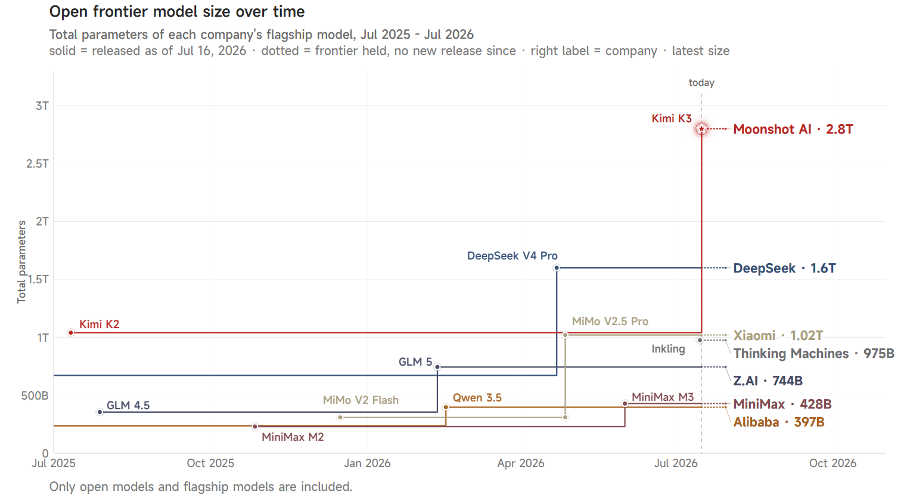
On July 16, Moonshot AI released Kimi K3, a 2.8-trillion-parameter sparse mixture-of-experts model that became the first open-source LLM to top any of the frontier benchmarks, even topping Anthropic’s Fable 5 in Arena’s Frontend Code rankings. The previous day, Thinking Machines shipped Inkling, Mira Murati’s first model: 975 billion parameters, open-weight under Apache 2.0. And on Sunday, Alibaba disclosed that Qwen3.8, with 2.4 trillion parameters, is now available in preview only and open-weight soon.
Unlike last year, Kimi K3 has provoked a dialogue over the past few days that frames this moment as almost existential, igniting fierce debates on some of the most central ideas at the heart of the current wave of AI transformation: East vs West; Governments vs Markets; Open vs Closed; Immigration vs Sovereignty. There are already rumors that the White House may move to curb access to open Chinese models, even as talk continues that it might also demand approval of any frontier models. And at a time when China is calling for openness!
With so much to unpack about this moment, I want to focus on the aspect of K3 that transcends these debates and may have the biggest impact going forward.
The significance of K3 is not that another laboratory has reached the frontier. It is that the economic boundary of the frontier has moved and the markets are finally recognizing this reality after being warned this moment was probably inevitable for the past two years.
Despite the obvious signs, investors and enterprises continued to assume that meaningful differentiation existed across a broad tier of proprietary foundation models. They have invested historic amounts of equity and Capex around that thesis.
K3, Thinking Machines, and Qwen challenge that assumption. Once a frontier-adjacent model survives independent verification and becomes freely self-hostable, scarcity no longer resides in intelligence alone. It retreats to the handful of models that remain genuinely ahead. Everything below that level begins competing with an open substitute whose economics improve every time another cloud provider chooses to host it. Indeed, in just a few days, Moonshot had to limit access to the new Kimi due to overwhelming demand.
This shift will force a repricing across the entire AI stack. The immediate question is no longer whether open models can match the frontier. It is where value migrates once they nearly can.
The Orchestration Economics Manifesto maps this shift as geology, tracking six tremors between September 2024 and early 2026, each a phase shift in one layer of the stack that amplified the others, all moving along a single fault line. The shift from tools to goal-seeking agents. Intelligence and the Harness (routing, memory, orchestration code) are commoditizing fast and becoming self-improving, but real scarcity, which defines durable value and moats, migrates to the two true bottlenecks: scarce compute and operational context (the real-world data, outcomes, and judgment that labs can’t automatically generate or own). Last month, Anthropic’s disclosure of recursive self-improvement supplied the seventh tremor that showed where scarcity migrates once models start building models.
K3 is the eighth tremor: the moment the capability premium compresses to the top two frontier labs, while margin shifts outward toward inference infrastructure, orchestration, enterprise context, and the operational systems that turn intelligence into reliable outcomes. That is why K3 is not simply another model release. This is the point at which the competitive landscape, the economics of AI, and the location of durable advantage all begin to change simultaneously.
What Moonshot Actually Shipped: Kimi K3’s Architecture, Benchmarks, and Price
Let’s start with the technical aspects of Kimi K3 and how it differs from K2.6.
K3 is a 2.8-trillion-parameter sparse mixture-of-experts model, which includes 16 of 896 experts active per token. It has native vision and a one-million-token context window. And it also boasts a new attention mechanism Moonshot calls Kimi Delta Attention, designed to keep decoding fast at million-token depths. Two variants ship: K3 Max and K3 Swarm Max. The API went live on July 16, OpenAI-SDK-compatible and available through OpenRouter. The company has pledged publicly to release the weights by July 27, reportedly under a Modified MIT license, though Moonshot had not confirmed the terms at the time of writing.
Now the benchmarks.
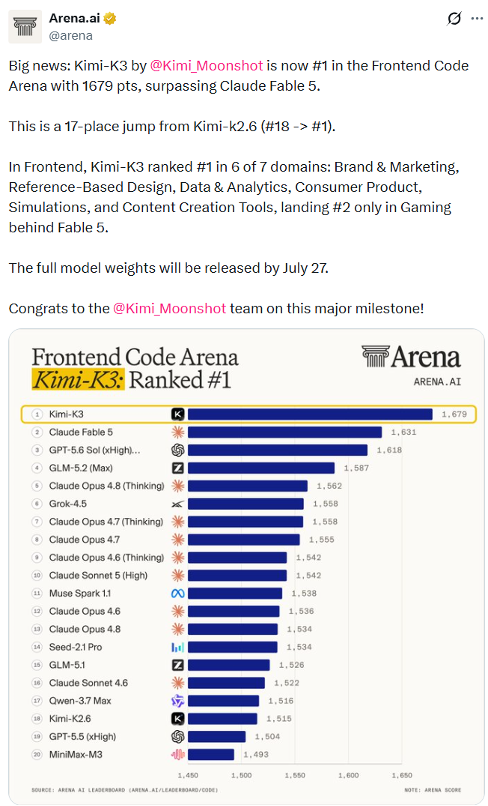
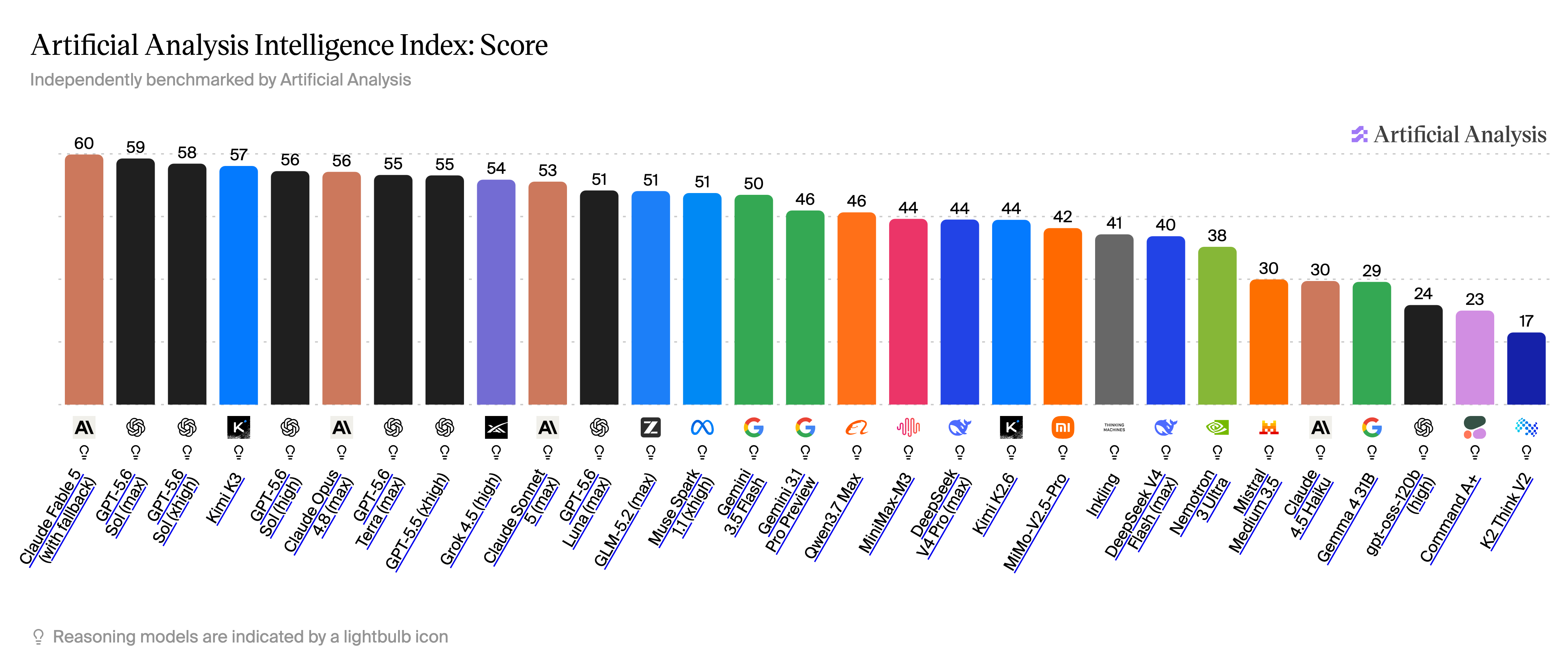
On Artificial Analysis’s Intelligence Index, K3 scores 57: 4th of 189 models, behind Fable 5 at 59.9 and two configurations of GPT-5.6 Sol, and ahead of Opus 4.8. On LMArena’s Frontend Code Arena, it debuted first with a 1679 Elo, finishing ahead of Fable 5 and taking six of seven categories. The caveats are real: fewer than two thousand votes, preliminary results, and leaderboards that can shift quickly. Even so, no open-pledged model has ever debuted above the closed frontier in blind human evaluations of working code.
The head-to-head record is more revealing than the composite. K3 beats both Fable 5 and GPT-5.6 Sol outright on SWE Marathon (42.0 against 35.0 and 39.0), on BrowseComp (91.2 against 88.0 and 90.4), on OmniDocBench, and takes first place on AutomationBench, the agentic SaaS-workflow evaluation. One detail buried in the BrowseComp run matters more than the score: it was executed at the full one-million-token window, with no context compaction. I will return to why that matters.
Where does K3 lose? Where winning is hardest. It loses the overall index. It loses GDPval, the evaluation closest to economically valuable knowledge work, where its 1668 Elo beats Opus 4.8 but sits well behind Fable 5’s 1760. It loses FrontierSWE, 81.2 against 86.6. It loses DeepSWE Datacurve, scoring 67.5 against Fable’s 70 and Sol’s 73. This contamination-resistant coding benchmark is built from held-out tasks precisely because public GitHub benchmarks leak their answers into training data.
Yet even that defeat reinforces the argument. When DeepSWE launched in late May, it revealed a sixteen-point moat between GPT-5.5 and the field below it. By mid-July, that gap had narrowed to roughly five points, with an open-pledged model now inside the frontier band.
Reliability remains the more consequential weakness. Although K3 improved on K2.6 in accuracy, its measured hallucination rate rose from 39% to 51%. That’s still slightly below Grok 4.5’s 54%, but far too high for many enterprise use cases. Moonshot itself concedes a user-experience gap against Fable and Sol, along with what it calls “excessive proactiveness”: a tendency for the model to do more than the user asked. Then there is the price. This is the part of the K3 story I believe is being most widely misunderstood.
At $3 per million input tokens and $15 per million output tokens, K3 is priced at the Sonnet tier, with an output rate nearly four times that of K2.6. It is the most expensive model any Chinese lab has ever shipped. The “fraction of the cost” framing that has followed every Chinese release since DeepSeek simply does not apply. The reality is more nuanced.
On Artificial Analysis’s cost-per-task measure, K3 completes a benchmark task for $0.95. That is essentially GPT-5.6 Sol’s $1.04, and roughly half the $1.80 cost of Opus 4.8. Parity at the task level against the flagship tier, driven by improving token discipline: K3 used 21% fewer output tokens than K2.6 across the full benchmark run while scoring thirteen points higher.
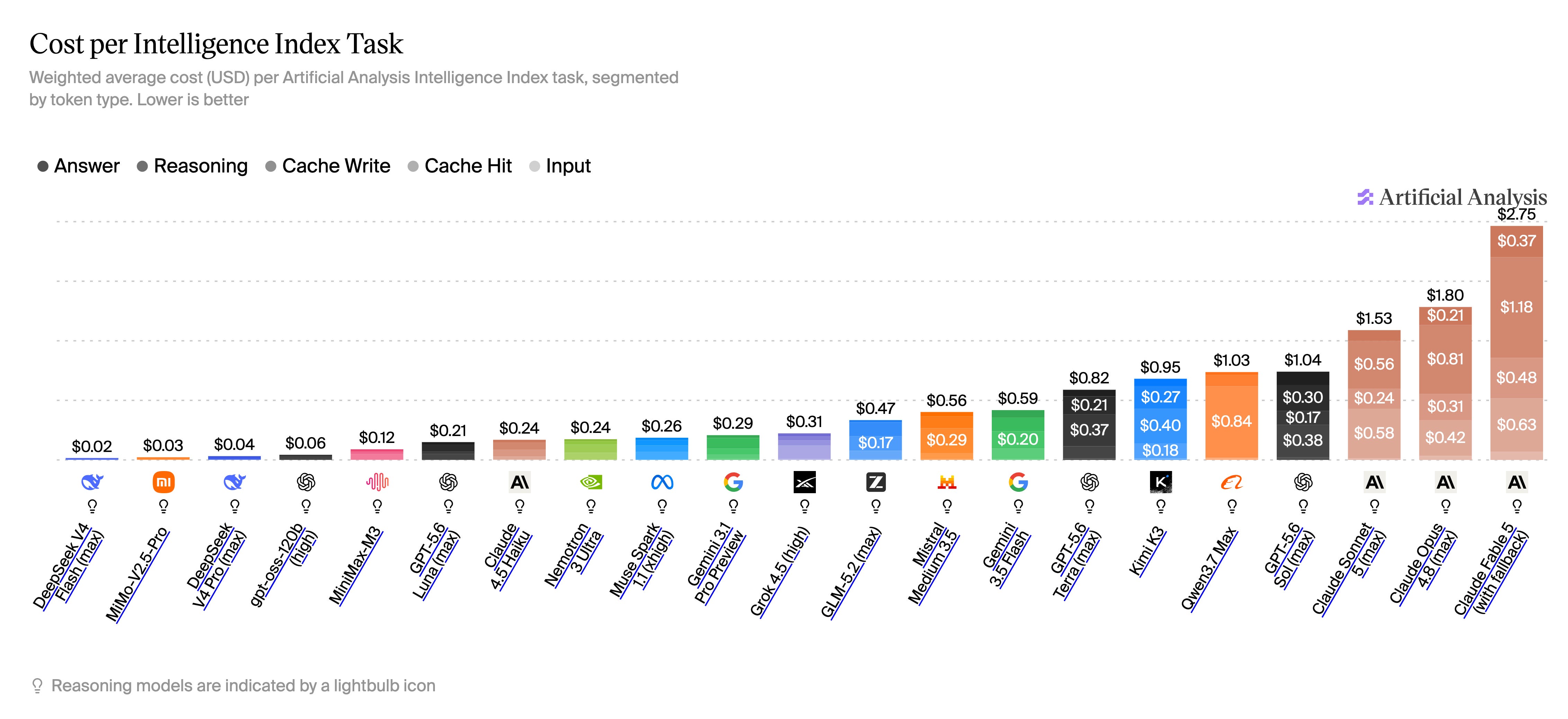
But improved is not the same as efficient. K3 generated roughly 130 million tokens across the Intelligence Index evaluation, nearly twice the median verbosity of the models Artificial Analysis tracks. That is why OpenAI’s efficiency tiers, GPT-5.6 Terra and especially Luna, still beat it on cost per task even as the flagship Sol does not. K3 matches the frontier tier on task economics and loses to the tiers built for volume. A verbose model with a low sticker price is a different animal from an efficient one, and anyone modeling K3 for high-volume production should price the verbosity.
The cheap story, in other words, lies not in K3’s current API pricing but in what comes next. It begins when the weights are released, and third-party hosts start competing away the margin on inference.
Moonshot also claims that K3 delivers roughly 2.5 times the scaling efficiency of K2, which translates into more capability per unit of training compute. The technical report is forthcoming. Until it lands and replicates, that is a vendor claim, and I will treat it as one. Even so, it was likely this claim, more than the benchmark rankings themselves, that unsettled markets when the model was released.
Why Kimi K3 Is a Tremor, Not a Headline
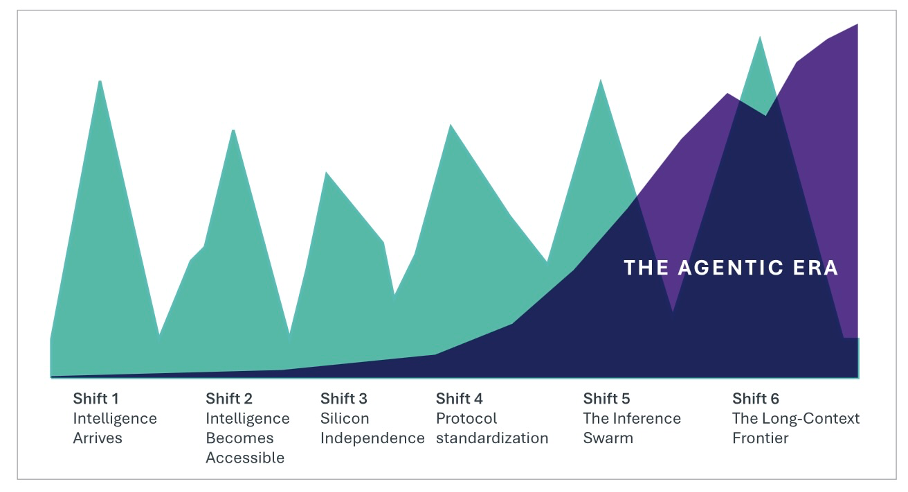
A tremor, in this framework, is a phase shift in one layer that amplifies the others. K3 sits on three of the original axes at once:
Accessibility crosses a regime boundary. The framework I laid out after the Fable shutdown holds that the frontier creates capability, diffusion spreads it, and orchestration captures it. Epoch measures the open-weight lag at three to four months behind the closed frontier. DeepSeek’s moment in January 2025 was the second tremor. It established near-frontier capability, cheap, one generation behind: last year’s intelligence at a twentieth of the price. When I wrote about K2 Thinking in November, the gap had narrowed to months. K3 compresses the lag toward zero for everything below the top two: frontier-adjacent, verified, open, self-hostable within days. The commoditization line has climbed from “yesterday’s intelligence, discounted” to “this cycle’s intelligence, one notch down, yours to run.”
Swarm coordination moves into the weights. K3 Swarm Max coordinates an orchestrator and up to roughly 300 sub-agents across some 4,000 steps. The capability first shipped with K2.6 in April. What matters is where it now lives. Not in a harness bolted around the model but trained into the model itself. The Claude Code leak laid the stakes bare. The harness includes routing, memory, delegation, and policy. This is where a thousand companies have pitched their moats, but it is now much more vulnerable.
The million-token agent becomes real. Long context has been advertised for over a year and trusted by almost no one who runs agents in production. That’s because of a phenomenon known as “context entropy.” This describes the degradation that caps most production agents at ten steps or fewer. It worsens with window size rather than improving. K3’s BrowseComp result, beating both frontier models at the full million-token window without compaction, is the first independently run public evidence that the million-token agent is a working tool rather than a specification.
Now the counterweight. Fable 5 and GPT-5.6 Sol still win the overall index, the hardest software-engineering evaluations, and the evaluations closest to real economic work. A 51% hallucination rate is disqualifying for large classes of enterprise deployment. The closed frontier has not yet fallen.
Clearly, with the Kimi K3 release, the capability premium has retreated to the top two models. Everything below that tier, Opus-class capability included, now competes with an imminently self-hostable peer at task-cost parity.
The Geography Flipped: From Llama to Kimi, Qwen, and GLM in Eighteen Months
K3 did not arrive alone. It arrived as the crest of a wave: DeepSeek R1 in January 2025; Kimi K2, the first trillion-parameter open release, in July 2025; K2 Thinking in November; the Qwen line; GLM-5.2 in June, MIT-licensed at roughly a sixth of Western frontier pricing; MiniMax M3 at a twentieth; DeepSeek V4.
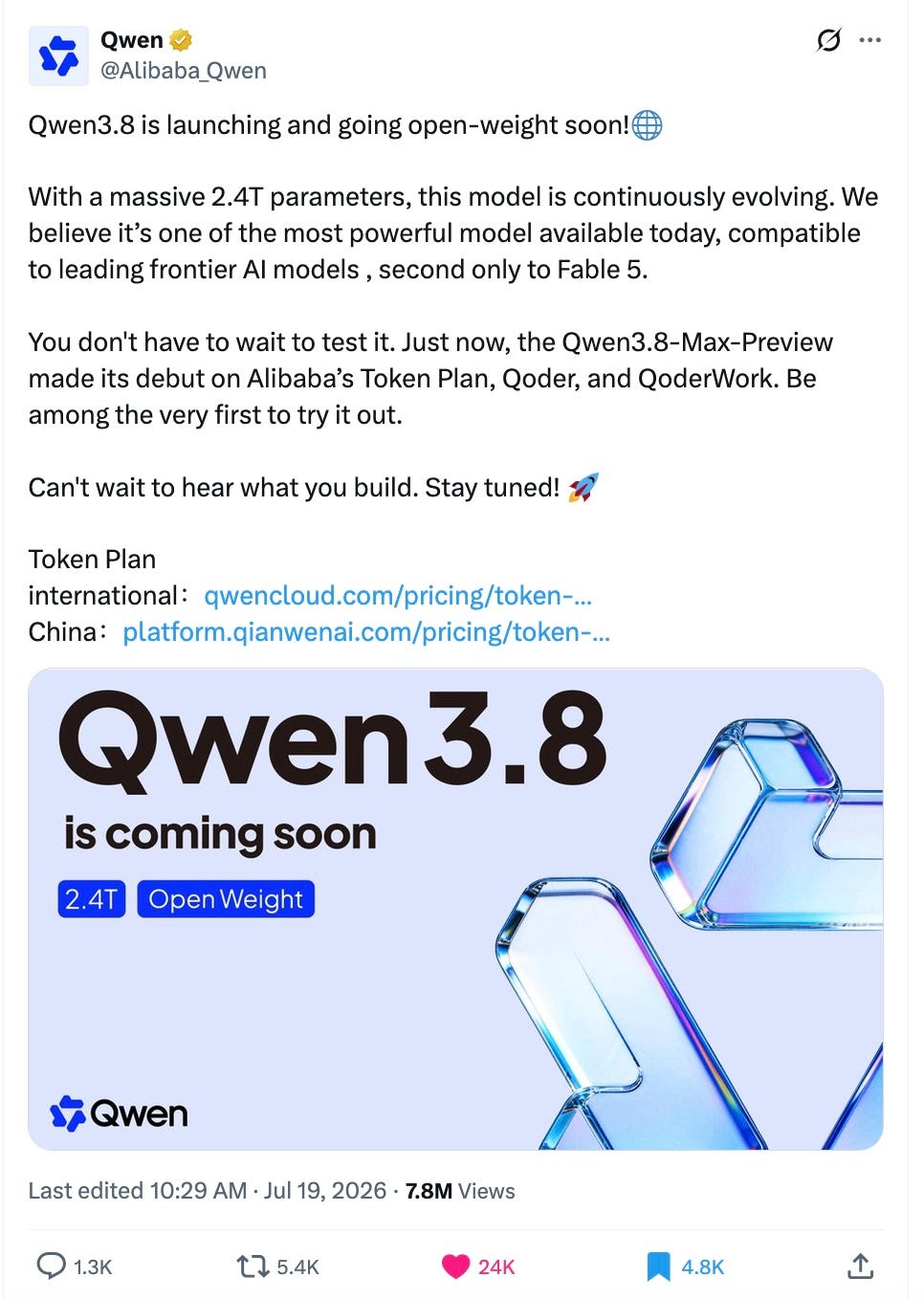
There is an important point to consider in this string of releases. All year, open-weight “parity” was vendor-reported, and all year the claims took a documented seventeen-to-twenty-one-point haircut when re-run on standardized independent harnesses. GLM-5.2 came closest. When Zhipu shipped it in June, I called it the first open model to break into the closed frontier cluster. It scored 51 on the same index where K3 now scores 57. Yet I still counseled caution, because Epoch’s independent evaluation was pending and open models flatter public benchmarks. K3 is the first release to clear the independent bar outright, at a higher tier, on the strictest harness available. Qwen 3.8-Max, three days later, is a reassertion of the pattern: a 2.4-trillion-parameter frontier claim with no independent run behind it yet.
The lineage carries a family trait. GLM-5.2 was the least token-efficient open model in its class, spending 43,000 tokens where MiniMax spent 24,000, effectively buying its capability with verbosity. K3 inherits the habit, but one tier higher. The open-weight wave keeps reaching the frontier by outspending it on tokens, which is exactly why the efficiency frontier, not the capability frontier, is where the next battle sits.
Meta, which carried the US open-weight banner for three years, stepped back from the Llama line this spring. Now its Superintelligence Labs flagship model is proprietary. The largest American platforms no longer field an open-weight strategy at all.
That has left a vacuum that Thinking Machines is hoping to fill.
Co-founded by Mira Murati, former CTO of OpenAI, the startup last week released Inkling. It represents a very different bet from anything Silicon Valley ever shipped: 975 billion parameters, Apache 2.0, paired with the startup’s Tinker fine-tuning platform, and positioned explicitly as not the strongest model available, but rather the best foundation for building your own.
Consider what Murati is wagering. She is betting against one-size-fits-all intelligence. Instead, she is wagering that the layer where durable value accumulates will be built around customization, context, and orchestration. The executive who helped build the closed system is now building the exit ramp.
The market is pricing the bet, not the benchmark. Thinking Machines raised $2 billion at a $12 billion pre-product valuation, with reported talks at $50-60 billion for a model sixteen points off the frontier. Inkling debuts at 41 on the same independent index where K3 scores 57. That means the best American open model is sixteen points behind the Chinese open frontier it answers. Its mixture-of-experts design, by Thinking Machines’ own account, largely follows DeepSeek-V3’s recipe, and its post-training was bootstrapped on synthetic data generated by Kimi K2.5. So, the American open-weight standard-bearer is built on Chinese architecture and finished on Chinese data, a dependency Thinking Machines says its next generation will shed.
Where Inkling does lead is revealing: 25,000 output tokens per task against GLM-5.2’s 43,000 and K2.6’s 38,000.
Put the pieces together, and the map has redrawn itself. In eighteen months, open source’s center of gravity moved from Menlo Park to Beijing and Hangzhou, and the American response is now carried by startups and sovereignty vendors, not platforms.
The Reversal: Why Kimi K3’s Open Weights Re-Centralize the Datacenter
At first glance, K3 appears to threaten the largest capital commitments in economic history. On closer inspection, it does something more interesting.
If Moonshot’s scaling-efficiency claim holds, frontier-adjacent capability is becoming cheaper to train per unit of intelligence. That does not invalidate the trillion-dollar capex thesis, but it does introduce a discount factor into its simplest assumption: that more compute is the only route to more capability. One datapoint does not overturn a scaling law. Call it a crack in the premise, not a break.
Now ask the more important question: where does a model like this actually run?
The open-weight wave was supposed to push inference toward the edge: smaller, distilled models running on laptops and phones, intelligence dissolving into devices. K3 reverses that vector. A 2.8-trillion-parameter mixture-of-experts model whose weights alone occupy roughly 1.4 terabytes, even under four-bit quantization, is not an edge model. It runs on datacenter accelerators with enormous memory requirements, regardless of who hosts it or where.
To “self-host” a K3-class model is therefore to buy or rent substantial accelerator and HBM capacity—inside a neocloud, a sovereign cloud, or an enterprise facility, but inside a datacenter all the same. Frontier-adjacent open weights do not disperse inference to the edge. They re-centralize it inside the data center.
The net effect on compute demand, I suspect, is therefore positive, but compositionally different. Demand migrates away from closed-lab training Capex and toward distributed inference hosting. It is also unusually memory-intensive demand: expert weights and context caches, multiplied across large numbers of concurrent agents, create a memory problem as much as a FLOPs problem.
Jevons does the rest. At no point in this discontinuity has cheaper capability per token produced fewer tokens.
When Cerebras filed to go public, I argued that the Inference Economy—an economy in which inference, rather than training, becomes the center of gravity—was the layer against which AI infrastructure should be valued. K3 delivers a demand shock directly into that layer.
And then there is memory. The reflex trade is easy to imagine. Kimi Delta Attention reduces the KV cache by roughly fourfold relative to standard attention, according to Moonshot. A smaller cache appears to mean less HBM per deployment, which in turn appears bearish for memory manufacturers.
That interpretation gets the causality backward. Cache efficiency is not a demand destroyer. It is a demand detonator.
The binding constraint on agentic AI has not been intelligence itself. It has been the cost of sustaining intelligence across long-context tasks. Million-token agents have existed on specification sheets for more than a year, but few organizations have run them in production because the cache economics made them prohibitive.
Kimi Delta Attention relaxes that constraint. And that relaxation is precisely what makes K3’s headline results possible: the BrowseComp run across the full million-token context window, and the 300-sub-agent swarm operating across 4,000 steps.
Cheaper long-context tokens do not mean fewer tokens. They mean elastically more of them. HBM freed at the level of the individual agent is redeployed into larger batches, longer contexts, and more concurrent agents—not smaller infrastructure bills.
This is the DeepSeek lesson replayed almost note for note. The efficiency panic of January 2025 was followed not by collapsing compute demand, but by record demand. The analysts who treated efficiency as a substitute for infrastructure spent the rest of the year discovering that it was an accelerant.