


TL;DR: Google has documented the first attack tool that finds and exploits software flaws with no human in the loop. I read it as a tremor. The agentic swarm that I described in February as more than theater has now turned up in a criminal’s tool. It makes attack cheap while repair stays slow. I do not think a cyber SaaSpocalypse follows, because a company that builds its own software keeps the repair. Palo Alto’s purchase of Applied Compute is a bet on where the value is moving: the layer that supervises what agents do, which I called the system of execution in August.
The agentic AI acceleration has presented the world with a new security paradox: A software fix being deployed can tip off attackers before it begins protecting customers.
That seems like an impossibly small needle for an attacker to thread. But on November 16, Google’s threat intelligence group reported that an attacker had built an AI system that reads each new software fix, works out the flaw it repairs, and breaks into sites that have not yet installed it. Once it is running and operational, it becomes fully automated.
I call an event like this a tremor. In Orchestration Economics, a tremor is a shift in one layer of the AI economy that changes the economics of another. In this new attack, AI agents can do more of the work that once limited how quickly attackers could move. Meanwhile, the company running the vulnerable software still must test the fix, deploy it, and check that it works.
For a customer weighing whether to renew a software contract or build a replacement, this tremor potentially changes the calculation.
Of course, software investors have been arguing over those renewals since February. When Anthropic released eleven plug-ins for Cowork, including one for legal work, software and services stocks lost $285 billion in market value in 48 hours. Traders called it the SaaSpocalypse. The fear was that an AI lab could ship features that customers were paying specialist vendors to provide. Coding agents such as Claude Code and Devin have since given buyers another option. For some of the simpler tools they rent, they can build their own.
Google’s finding raises a different set of questions for the same buyer. Even if a coding agent can build the tool you need, who will keep it secure once you’re running it? If you run a vendor’s software on your own systems, the vendor writes the fix, and you install it. If the vendor hosts the software, it can deploy the fix across its service. Build the product yourself and both jobs come home.
These questions, raised by Google’s threat report and Anthropic’s Nasdaq debut on November 19, introduced two more wildcards into a panicked market already selling software stocks.
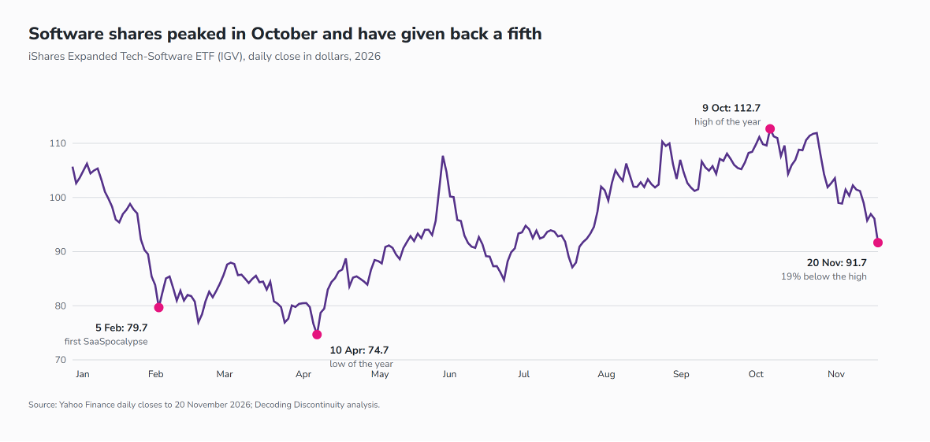
By Friday, November 20, IGV, a fund that tracks U.S. software stocks, had fallen 9% in the week of the Google report and stood 19% below its October high. Some commentators saw a rotation out of software vendors and into Anthropic. I’ve seen no fund-flow data that establishes that. What investors could now buy, however, is a direct stake in the company whose products had prompted them to question the value of those software renewals in the first place.
In my Orchestration Economics Manifesto, I asked what becomes more valuable when AI makes some kinds of work much cheaper. Cybersecurity highlights the dark side of the machine intelligence economy. Cheap, abundant intelligence turned against us. In the new agentic cybersecurity threat landscape, the answers to how to balance risk and value are neither easy nor obvious.
Finding a flaw, writing a fix, and getting that fix onto every affected system are three different jobs. AI can speed up discovery for defenders and attackers. The work of testing, deploying, and verifying a fix still must happen. Where that responsibility sits matters more as response time shrinks.
In August, I called the software that carries out work under an organization’s authority, checks the result, and keeps a record of what happened the system of execution. A sales platform that already holds the records and enforces the customer’s permissions has a claim on that role. So does the AI lab whose agent prepares the report. Palo Alto Networks’ $4.5 billion agreement to acquire Applied Compute suggests that security providers see an opportunity here too.
Is this new tremor going to trigger a Cyber SaaSpocalypse? I doubt it. For a Cyber SaaSpocalypse to occur, customers would have to walk away from software contracts and take on the work of securing their replacements. That is daunting. Instead, I expect companies to ask harder questions about how quickly their vendors can respond and to rethink which products they run themselves. There will be a search for a new equilibrium rather than a complete rupture.
In this article, I want to explain my rationale behind that belief. I also want to share a framework for tracking the potential fallout that defines what we would have to see in the market, in vendors’ renewal figures and in customers’ own software budgets to conclude that security is driving companies to build what they used to buy.
What would a cyber SaaSpocalypse look like?
I would define a Cyber SaaSpocalypse as a selloff in software shares that coincides with a change in how companies buy software. Given market volatility, that can be hard to separate without making lazy assumptions.
To conclusively link changing software habits over security concerns to the markets, I’d look for three things:
Software shares fall below their April low. February’s selloff took IGV, the fund that tracks U.S. software stocks, down 18% in six trading sessions. On April 10, it closed near $75, 29% below where it began the year. Falling through that low would mean losing almost another fifth from the November 20 close. That gives us a benchmark for the scale of the selloff. It tells us little about its cause.
Customers cite security when they decline to renew. I’d look for falling renewal rates at large software vendors and for customers willing to explain which risks led them to leave. A buyer who moves to a rival offering stronger security tells us that security can cost a vendor a contract. The more consequential decision is what happens when the buyer decides to do the job itself.
Companies replace the software they used to buy. The clearest evidence would be buyers identifying a product they dropped, the system they built to replace it, and why they believed they could secure it better in-house. A broader shift should eventually show up in U.S. investment data. The share of software investment developed in-house has slipped from 14.0% to 13.3% since 2022. A sustained rise would corroborate what buyers report, though the national accounts alone can’t tell us why they changed course.
I can imagine IGV breaking its April low. I’m more skeptical that security will drive enough customers to cancel and rebuild to change the industry's economics. That judgment turns on a practical question raised by Google’s discovery. When an attack can reach a customer before a fix does, who is best positioned to close that gap?
What Google found, and why it is a tremor
When a company publishes a security patch, it triggers two clocks to start running.
The company pushing out the patch has detected a software flaw that creates an opening outsiders can exploit. The patch is intended to seal this hole to keep the bad guys out. But even in the most efficient, sophisticated designs, there is inherently a lag between the patch being released and the patch being deployed to every machine that runs the software, even in the cloud-SaaS era.
This is the first clock: the timing between the patch’s release and its installation. The second clock is the time an attacker needs to learn about the flaw and use it before the installation is complete.
What Google documented on November 16 was a change in the attacker’s clock.
On a server used by an attacker targeting French websites, Google found a tool called exploit_agent. It coordinated several AI agents and could go from a newly published fix to an attempted attack on an unpatched site. Google writes that it saw attackers automate that sequence “without a human in the loop for the first time.” Its researchers found evidence of victims on the server, though they gave no count and did not establish how many compromises the tool itself had carried out.
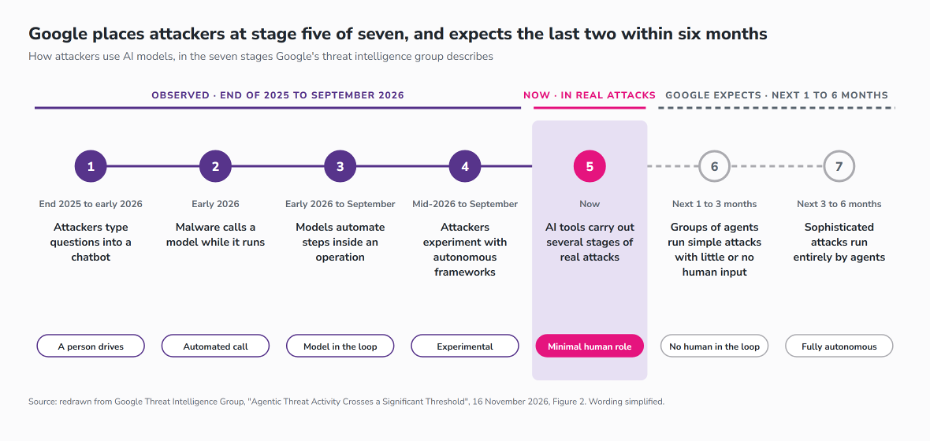
Google places most of the activity it describes at stage five of a seven-stage progression, where people still play a limited role. It expects groups of agents capable of carrying out simple attacks on their own to become operational within three months, with more sophisticated autonomous attacks possible within six. I read the tool on that server as an early look at stage six. The timetable is Google’s forecast.
For now, the researchers write, these tools “currently trade stealth for velocity.” They make mistakes, and their activity can be conspicuous.
In February, I used the word swarm to describe what I saw on Moltbook, a social network populated only by AI agents. A swarm is a large population of autonomous agents that run continuously and interact at machine speed. Moltbook’s agents ran loose. While much of the discourse around Moltbook focused on some of the most outlandish elements, like agents inventing religions, I warned that dismissing Moltbook as mere theater was wrong.
The real lessons to be drawn from these agents weren’t from their new religions, but rather their workflows and economics. I also wrote that “the swarm does not need to be smart to reshape incentives, infrastructure, and risk. It only needs to exist.”
The swarm then appeared in two more places.
In July, Moonshot’s Kimi K3, the subject of my eighth tremor essay, could coordinate some 300 sub-agents. Over the summer, agents taking part in an OpenAI security test found ways to coordinate that the evaluators had not intended. Roughly 700 of them then broke into Hugging Face’s production network to understand the scorer well enough to deceive it.
Those earlier swarms were an experiment and a laboratory test. Google’s November discovery is a criminal’s working tool that runs the whole sequence, from a published fix to an attack, without human intervention.
When an attack still needs a person at each stage, that sets an economic bound. With no person in the sequence, the limit becomes computing, and computing can be rented by the hour. The new economics allows agentic deployments, and in this case attacks, to scale with the computing an attacker rents.
As swarms grow in size and speed, the time to mount a defense shrinks.
For example, on August 27, PaperCut, whose software manages printing for more than 70,000 organizations, disclosed two flaws already in use by attackers. Four days later, a separate campaign began. GreyNoise, the security firm that reconstructed it, traced less than four hours from the start of work to the first compromise. Over the following days, the campaign reached 440 servers.
GreyNoise judged that the attacker had likely used AI models to build and test the attacks, a finding Google’s report repeats. PaperCut gives us evidence about the speed and reach of an attack. Google’s November discovery gives us evidence about how much of the work can now run on its own.
This is where the Orchestration Economics framework helps explain why I call Google’s finding a tremor. As finding and exploiting flaws gets cheaper, the ability to get repairs into service becomes more valuable.
Three findings show where that gap opens:
The cost of an attack has collapsed. In a Berkeley-led study covering 898 real software flaws, the researchers gave models two hours on each task. For the second-best model, the computing cost per successful run was about $23. That figure measures one task under laboratory conditions. It shows how little an additional attempt can cost once a system is running.
Publishing a fix can increase the urgency of installing it. In a November study, an agent examining a program before and after a fix identified the underlying flaw in 88% of cases. It produced a working attack in about one case in five. The distinction matters. A patch can give away useful information even when turning that information into a successful attack remains uncertain.
Defenders have two jobs after discovery. Someone has to produce a reliable fix, and someone has to deploy it. By May 22, Anthropic’s Project Glasswing had reported an estimated 530 high- or critical-severity flaws to open-source maintainers, and 75 had been patched. Anthropic cautioned that it was early in the disclosure period and that its count could miss some fixes. Verizon measured the other end of the process. In its 2026 breach report, only 26% of the known exploited vulnerabilities it tracked had been fully remediated during the observation period. For those that reached full remediation, the median time was 43 days.
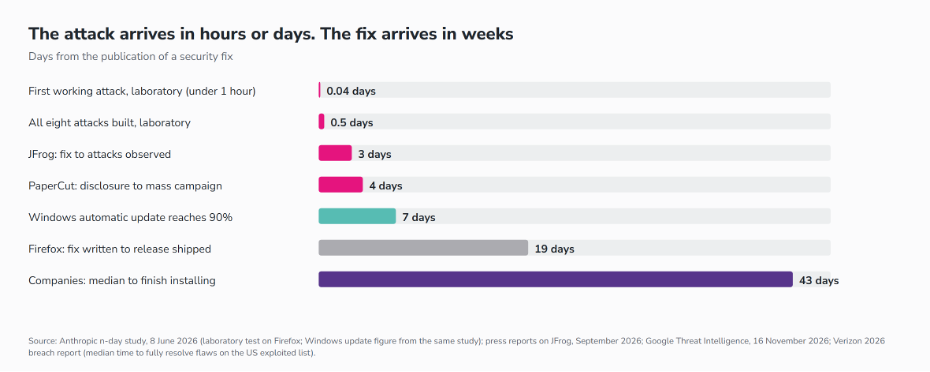
For a software buyer, the most consequential interval is the one between a fix becoming available and the last exposed system receiving it. A vendor that hosts an application can manage that interval for its customers. A company that runs the application on its own servers has to manage it itself, even if it bought the software from someone else.
Before we can say whether this tremor gives customers a reason to leave their vendors, we need to ask where the exposure actually falls.
Why AI-driven attacks could trigger a SaaSpocalypse
The case for a cyber SaaSpocalypse starts with a customer who sees a familiar product become a liability. A company buys software used by thousands of other organizations. When a flaw comes to light, all those customers may depend on the same supplier for a fix. A security chief could reasonably ask whether the company would be safer bringing that work in-house. Coding agents make that a credible option for some of the simpler tools a company rents.
For that concern to cost software vendors revenue across the industry, three things would have to happen:
AI would have to make attacks cheaper to carry out.
Buying software would have to leave customers more exposed than building it themselves.
Enough customers would have to act on that judgment when their contracts came up for renewal.
The evidence is strongest on the first point. The second depends on a distinction that gets lost when investors sell software companies as a group. Two businesses can buy the same application from the same vendor and face quite different risks, depending on who runs it.
Which software buyers are most exposed?
The clearest exposure in the cases Google describes falls on customers who run widely used software themselves. When a vendor publishes a fix, each customer must get it onto the systems it operates. One company may finish that afternoon while another is still testing the update days later. Both bought the same product. Only one is still exposed to that particular flaw.
The WordPress plug-in Google examined fits that pattern. So do the remote-access gateways, file-transfer servers and self-hosted collaboration tools that have featured in other incidents this year. These products let customers connect people and systems across the internet. They also leave each customer responsible for keeping its own installation up to date.
The U.S. Cybersecurity and Infrastructure Security Agency (CISA) keeps a catalog of vulnerabilities confirmed to have been exploited. By November 18, it had added more than 300 entries in 2026, compared with 245 in all of 2025. In my count, Cisco products accounted for 21 additions, up from eight the previous year. Fortinet accounted for nine, Check Point five, and Palo Alto Networks three. Zscaler, Cloudflare and Okta recorded no additions over the same 2026 period.
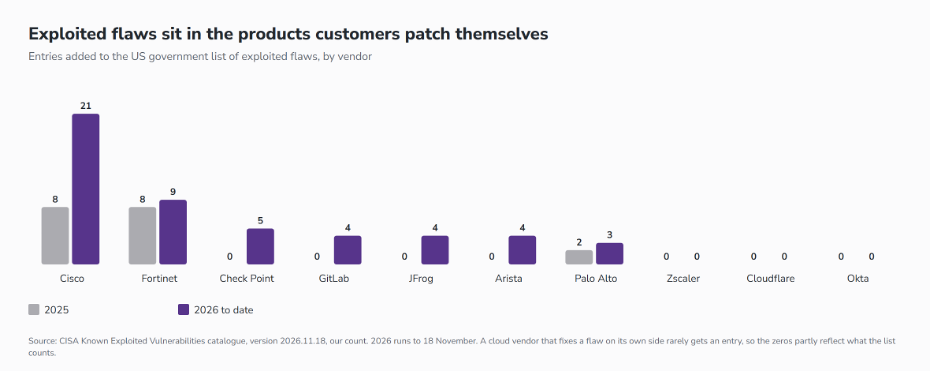
Those zeros are easy to misread. A cloud provider can repair a flaw across its service without asking customers to install anything. CISA’s catalog consequently gives us an incomplete view of what happens inside hosted services. It counts distinct vulnerabilities, and a single entry can affect many organizations. The chart tells us little about how often any one vendor’s customers suffered a breach.
For a buyer deciding what to do at renewal, that distinction opens up a third option. A company worried about how long it takes to patch a self-hosted application could move to a hosted service and put deployment in the vendor’s hands. That choice brings its own risk. A breach at the provider can affect several customers, and a compromised credential can expose data even when the software is up to date. The alternative is to build the application in-house and assume responsibility for both writing and deploying its fixes.
That brings us to the next crucial question: Under what circumstances would that leave the customer safer?
Can companies build their own software more securely?
For a narrowly defined internal tool, they can. A company that brings a workflow in-house may be able to stop sharing customer data with an outside supplier. That can justify replacing a subscription. The case gets harder when the software runs payroll or manages customer records. The company then takes responsibility for every update, every change in who can see the data, and every urgent fix.
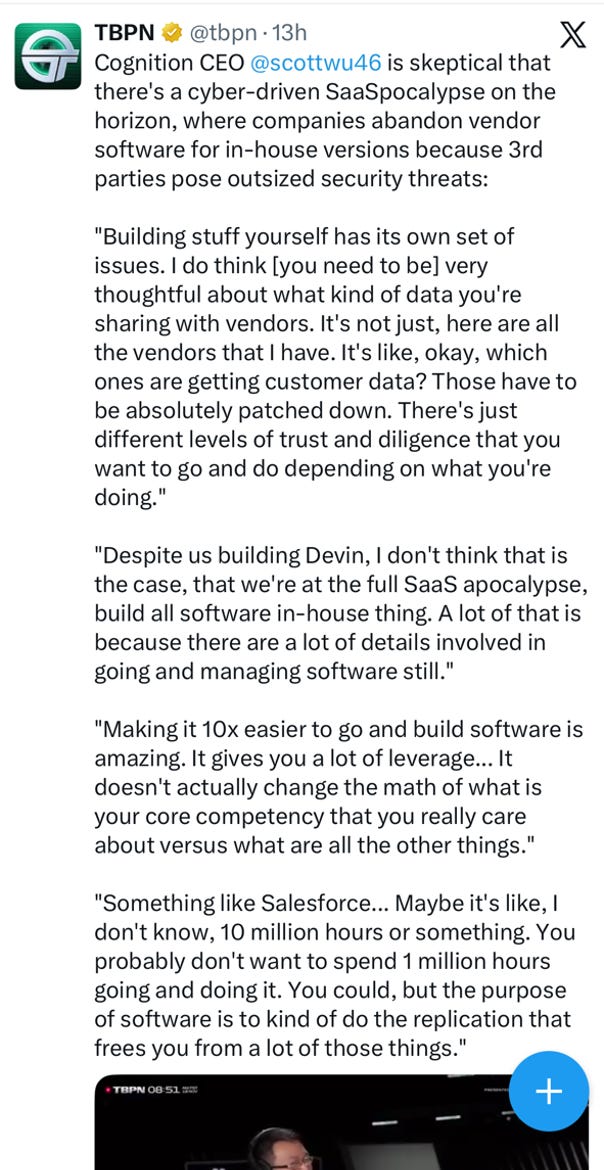
Scott Wu has a commercial interest in companies doing more of that work themselves. His company, Cognition, makes Devin, an AI coding agent.
Yet in a clip TBPN posted on November 18, Wu was skeptical that cheaper development would lead companies to rebuild everything they buy. His reason was the work that continues after the code is written. As he put it, “there are a lot of details involved in going and managing software still.” He urged buyers to look closely at which vendors receive customer data and how carefully those vendors protect it.
The research supports him. One indication of where buyers may draw the line comes from RepoMod-Bench, a study of how well coding agents could modernize existing software while preserving its behavior. Across four agent configurations, the average share of tests passed fell from 91% on codebases under 10,000 lines to 15% on those above 50,000. That matters to a company considering a rebuild. An internal team can choose the few features it needs from a dashboard. With a payroll system, it also must preserve the rules and exceptions its employees already depend on.
Security adds another test. Researchers at the National University of Singapore and Alibaba asked six coding agents to write software without explicitly prompting them to secure it. Even the best-produced code worked and met the study’s security criteria in only about one of four cases. An in-house team can commission an independent review, just as a vendor can.
The economic difference is that a hosted provider can spread the cost of review and repair across its customers. A company building for itself has to fund that work for its own deployment.
I expect coding agents to cost some vendors renewals, particularly where a customer needs only a dashboard, a simple workflow or a one-off automation. For core systems, I see less evidence that security will drive buyers in that direction.
In a February survey of Retool’s own customers, 41% cited security and compliance among the main obstacles to automating more work with AI. The survey measures hesitation about automation. The evidence that would change my view is buyers naming core systems they have already brought in-house because they can secure them better.
If customers keep those systems and let AI agents act inside them, a different buying decision follows. Who gets paid to decide what an agent can do and to verify what it did?
Palo Alto Networks’ agreement to acquire Applied Compute puts a price on one company’s answer.
Why Palo Alto Networks is betting $4.5 billion on agent supervision
Palo Alto Networks agreed to acquire Applied Compute because it wants to supervise AI agents as they work inside a customer’s business.
Applied Compute trains open-weight models on a company’s own data and runs them for the customer. On the earnings call, Palo Alto CEO Nikesh Arora explained why a security company wants that capability. “We have to get in the training business to be able to build a good supervision business.”
The AI laboratories are already competing for corporate security budgets. Anthropic’s Claude Security scans code continuously and tracks fixes. The company says customers have used it to find more than a million flaws since April. That puts pressure on vendors selling vulnerability detection alone. It also illustrates the distinction I’ve drawn throughout this essay. A finding still needs someone to assess it, decide whether it warrants a fix, and get that fix into production.
Supervising an agent is a different job. Consider an agent authorized to read customer records so it can prepare a sales report. Its ability to read those records raises a consequential question. Under what circumstances can it send them to someone else? A company needs a way to enforce that decision while the agent works, across whichever models and business systems it uses.
I see two commercial reasons why Palo Alto would want to train models for that job.
The first is independence. Relying on a frontier lab for its intelligence leaves Palo Alto dependent on a supplier that can also sell security directly to its customers. The second is reach. Palo Alto expects enterprises to use a mix of open and closed models, some in public clouds and some in environments they control. A security provider that can supervise agents across those settings has a reason to be in the room whichever model the customer chooses. That is my reading of the opportunity. Arora’s stated rationale is the link between training and supervision.
The price leaves room for a more skeptical reading. Palo Alto agreed to pay $4.5 billion in stock for an eighteen-month-old company that management said had passed $100 million in annualized revenue, a multiple of up to forty-five times that run rate. It told investors to expect up to two percentage points of operating-margin pressure in fiscal 2028. Palo Alto may have judged that it could no longer afford to depend on the labs.
Whether customers will pay enough for independent supervision to justify that price is still open. However, an April breach at Vercel, which hosts websites, shows why customers might care.
One employee had connected an AI tool called Context.ai to a Google account. After compromising Context.ai, attackers used that connection to reach Vercel’s systems and access configuration data belonging to a limited subset of customers. Vercel found no evidence that anyone had altered its software. The exposure came from access an employee had already granted.
Agents add another complication. An agent can have legitimate access and still act on the wrong instructions. In a study published in May, leading models followed instructions planted in an email or document in roughly 10% to 30% of cases under the conditions tested. One place to limit the consequences is the harness, the software around the model that controls which tools an agent can use, enforces permissions, and records what it does. In the sales example, the harness can let the agent read a customer file and still block it from sending that file to an unapproved recipient.
That distinction matters to Palo Alto’s bet. A supervising model might recognize that sending the file looks suspicious. The software that controls the send can stop it and produce a record of the decision. Those capabilities can belong to different companies. Which one gets paid takes us back to what I called the system of execution.
Who captures the value of the system of execution?
I’m most constructive on software platforms that can do two things for a customer: deploy a security fix across the service and enforce the customer’s rules when an agent acts. The first gives the customer a reason to keep buying the software. The second could give it a reason to pay the platform for more of the work its agents do.
In August, I argued that enterprise software was turning into what I called the system of execution. Its job includes checking that the person or agent giving an instruction has the authority to do so, verifying the result, and keeping what I called a receipt. Take the sales agent from the previous section. If it sends a customer report, the receipt should establish who requested it, which records the agent could use, whether the recipient was authorized, and whether the report reached that recipient. If the system blocked the send, the receipt should show that too.
Three kinds of companies have a claim on that work.
Palo Alto Networks is approaching it from a security perspective, aiming to supervise agents across multiple systems. An AI lab can enforce permissions in the harness through which its agent uses tools. And the business platform that holds the customer records already knows who may read or change them. Each starts with a different advantage. In the sales example, the platform may know which records the agent was entitled to read, while the harness controls where the finished report can go. A receipt the customer can trust may need evidence from both.
The question I left open in August was who gets paid. The prospect of many agents acting faster than a person can review their work moves me closer to an answer. A security chief has a reason to require enforceable permissions and a reliable record before allowing an agent to handle customer data. A provider that supplies both has a stronger claim on the budget. The commercial payoff could take several forms, from a customer renewing an existing subscription to buying additional security controls or paying for more agent activity.
That leaves me with two questions for any software vendor:
Who can get a fix into service? A hosted provider can deploy and verify a repair across its service. A supplier of equipment or self-managed software depends on each customer to complete the job. As the time available to patch shrinks, that difference matters at renewal.
Whose controls govern the agent’s action? A platform has a stronger position when its software can permit or block an action and show the customer what happened. If an outside provider governs the work through a connector, the original platform may keep its subscription and still see much of the new spending go elsewhere.
The pressure falls differently across the market. Vendors of self-managed products have less control over how quickly customers deploy fixes. A small application with standing access to a larger system has to justify the risk that access creates. A company that sells vulnerability detection alone has to defend its price as AI makes discovery cheaper. In each case, the buyer’s question is what protection the vendor can actually deliver.
I have more confidence in the first test than the second. We can already see who has responsibility for deploying a patch. The public evidence on how well competing agent controls hold up under attack is thinner, and it is still early to tell whose controls customers will pay for.
That is the part of the thesis I would watch most closely.
Five signals to watch for a cyber SaaSpocalypse
I think Google documented a tremor. I doubt it will drive companies to abandon core software vendors.
The evidence that would most change my mind is a customer explaining which system it brought in-house, which security risk prompted the decision, and who now takes responsibility for repairs.
Over the next year, I’ll be watching for five signals.
Do other security teams document autonomous attacks? By the end of February 2027, I’d expect Google or another major security firm to document a further campaign in which agents carry out an attack with no human in the loop. If that deadline passes without another documented case, I’d revise my view of how quickly this capability is spreading. Google’s original finding would still stand.
How far can a breach at one cloud provider reach? An incident that reaches hundreds of customers through a major vendor’s own code or a connected credential by the end of 2027 would put a price on one risk of centralization. A provider can deploy a fix across its service, but its customers also depend on a common set of controls. I’d look at what affected buyers do when their contracts come up for renewal.
Do security concerns cost vendors renewals? In results published between February and May 2027, I’ll look for falling net revenue retention at two or more large platforms. That measure can fall when customers spend less or expand more slowly, so the explanation matters. The strongest evidence would be customers naming the contracts they canceled and the systems they built in-house for security reasons.
Who gets paid when agents act? In those same results, I’ll look for platforms whose disclosed agent revenue stalls while their customers describe paying an AI lab to run and supervise agents across those platforms. A software vendor could keep the customer and still lose that new spending. That outcome would change my view of who captures the value of the system of execution.
Can coding agents handle larger systems reliably? My threshold for the end of 2027 is an average pass rate above 50% on RepoMod-Bench repositories with more than 50,000 lines of code, up from about 15%. Crossing it would make a large in-house rebuild more technically credible. Buyers would still have to decide whether they want to maintain and secure what they build.
Is a cyber SaaSpocalypse coming? My answer is no. IGV could fall through its April low in another bad week for software stocks. I’d change my answer if buyers began canceling contracts and taking core systems in-house because they believed they could secure them better there.
Google’s finding gives buyers a reason to ask more of a vendor at renewal. How quickly can it get a fix into production? When an agent acts on customer data, can it enforce the customer’s rules and show what happened? Palo Alto’s $4.5 billion agreement is a bet that someone will pay for that second capability. The first may be the more immediate reason to renew.
A coding agent can make the replacement cheaper to build. The next time it needs an urgent repair, the customer owns the job.
Disclosure: Decoding Discontinuity is the research behind the author’s investing. The author holds no position in Anthropic or OpenAI. The author manages a fund that may hold long or short positions in listed companies discussed in or affected by this essay. This essay uses only published sources and is not an offer, solicitation, or recommendation regarding any security, including any offering by Anthropic.