


Google’s Gemini 3 Pro, a frontier AI model trained solely on TPUs, outperforms competitors like ChatGPT and Claude in coding, reasoning, and multimodality benchmarks, signaling a shift from isolated model supremacy to full-stack ecosystems; this exposes OpenAI’s vulnerabilities in distribution and tokenomics amid rising Chinese open-source rivals, partly challenges NVIDIA’s hardware dominance by validating custom silicon, and redefines AI competition around orchestration, infrastructure sovereignty, and global reach in an emerging oligopoly.
In a leaked memo written a few weeks ago but widely reported just last week, OpenAI CEO Sam Altman had apparently caught wind that Google was making major progress on its artificial intelligence development.
Google’s next version of Gemini could “create some temporary economic headwinds for our company,” Altman wrote, according to The Information, adding, “I expect the vibes out there to be rough for a bit.”
His assessment proved correct.
On November 18, Google released Gemini 3 Pro. I’ll dive into some of the most critical benchmarks below in more detail and explain why they matter. In general, the new version topped the performance of GPT-5.1 and Anthropic’s Claude in several critical ways. That includes coding, and more specifically, agentic coding.
As I’ve written previously, the “coding wedge” is key to winning the enterprise market. Claude Code helped Anthropic establish an enterprise advantage, and OpenAI hoped to close that with GPT-5. Now, here comes Gemini 3 Pro, a frontier AI from a company that can bundle it into the productivity and cloud stacks already used by many developers and workforces and leverage its global consumer and enterprise distribution platforms.
With uncomfortable questions already being asked about OpenAI’s finances, news that a sleeping giant had awoken won’t help.
As it turned out, Altman and OpenAI aren’t the only ones who have something to fear from Google’s AI resurgence. Gemini 3 represents the first frontier model trained entirely on Google’s Tensor Processing Units (TPUs), not NVIDIA chips. While Google does have some partnerships with Nvidia, the company is less dependent on the chip company than many of the other members of the circular, concentrated dealmaking club that has come to define the frontier AI ecosystem.
Many of those players, including NVIDIA, are facing growing scrutiny over record CapEx spending and seemingly strong topline results over the past month. Last week, NVIDIA’s stock whipsawed after its earnings. Chip stocks are down globally. Bloomberg’s Magnificent 7 Index is down 7.6% since October 29 through November 21.
There is a notable exception to this investor skepticism: Google is up 18% over the past month.
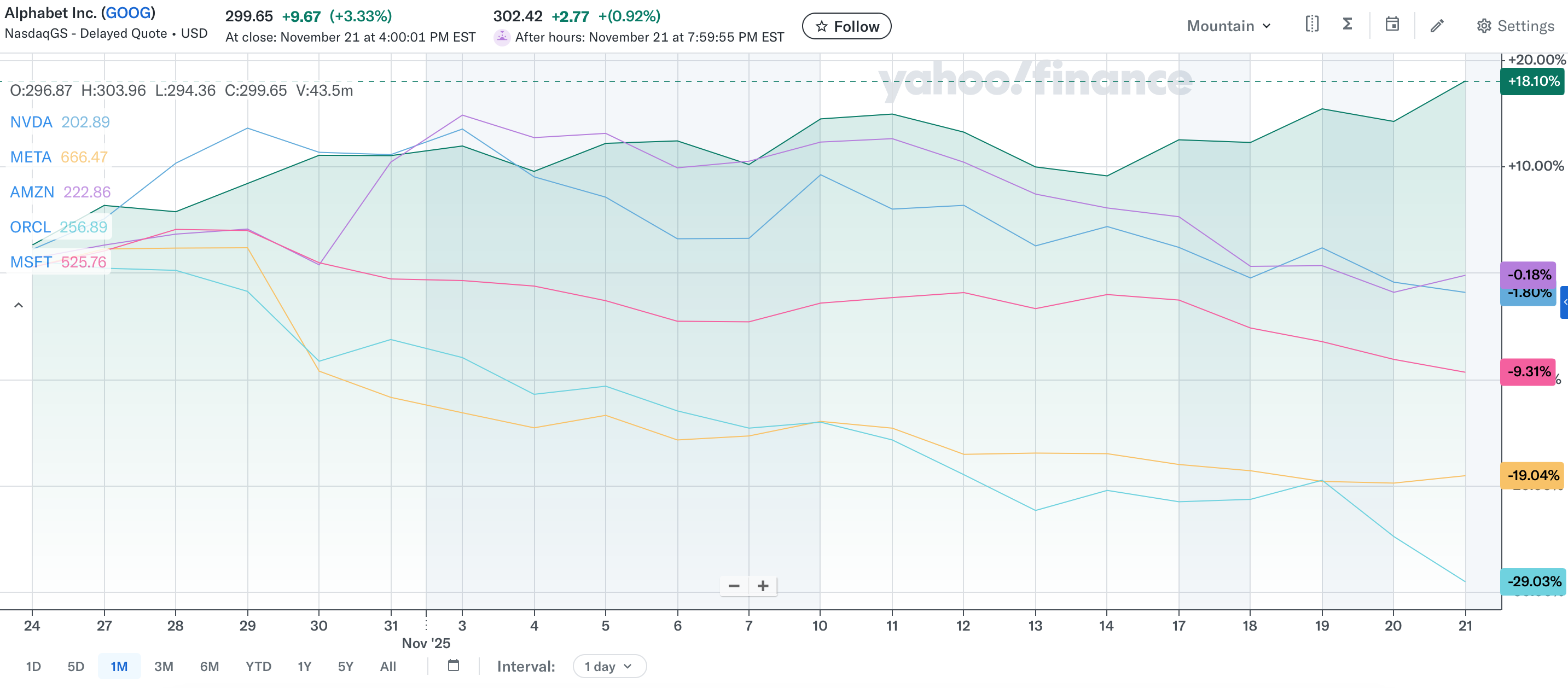
Figure 1: Yahoo stock chart comparing 30-day stock performance of Google, NVIDIA, Meta, Amazon, Oracle, and Microsoft.
Gemini 3’s arrival is confirmation of a structural shift in terms of where AI advantage and profit will come from. The winner will be determined not by who rolls out the best model this week, but rather by who controls the full stack, from the chips to the model to the distribution. That player will be able to better manage inference costs, allowing them to embed AI everywhere. In turn, intelligence will be abundant and cheaper for customers.
This discontinuity redefines competitive dynamics by redistributing value across the stack. It exposes the fragility of OpenAI’s competitive position while proving that the infrastructure layer is far from settled.
In this article, I want to explore the implications of this critical shift.