


Amid the “Bubble” and “Depreciation” debates, current financial disclosures fall short. Companies lump “AI Capex” together as if all infrastructure is equivalent - it’s not. Training hardware faces rapid 18-month obsolescence, while inference setups can deliver returns for 4-5 years. Without better transparency on workload mix, customer concentration, custom silicon, and utilization, investors are navigating $400B+ decisions with incomplete data. Those who adapt will thrive; missteps could lead to major write-downs or worse. By 2027, the divide will be clear.
Discussing the relentless compute demands driving AI’s frontier models, Anthropic CEO Dario Amodei said last week at the New York Times’ 2025 DealBook Summit that established scaling laws are here to stay.
“You put more data into AI with small modifications...And the thing that is most striking about all of it is, as you train these models in this very simple way, with a few simple modifications, they get better and better at every task under the sun. They get better at coding, they get better at doing science. They get better at biomedicine, they get better at the law, they get better at finance...That trend is going to slow down for sure, but it’s still going to be really fast. And so, I have this confidence that eventually, the economic value is going to be there.”
Even so, he acknowledged the high-wire financial planning involved when projecting the technological demands against the long-term Capex needed to build compute. Spend too little, and a big company like Anthropic or OpenAI risks not being able to serve customers in 2 or 3 years. Overspend, and the companies face revenue shortfalls that in extreme cases could threaten bankruptcy or tempt them to adopt a “YOLO” mindset and “turn that dial pretty far” in terms of rolling out products to drive usage despite safety risks.
“When the timing of the economic value is uncertain, there’s an inherent risk of under-reacting or over-extension,” he said. “And because the companies are competing with each other, there’s a lot of pressure to push things.”

Amodei spoke just days after the latest reports that Anthropic had taken steps to prepare for a 2026 IPO that could value the company at $350 billion. And just three months after raising a funding round at a $183 billion valuation.
This is what $400 billion in infrastructure investment looks like in 2025: a high-stakes game of Russian roulette where all the chambers are loaded, but some contain blanks and some contain IPOs.
I’m not going to rehash the various arguments for and against the AI bubble, and I’ve shared my own analysis on how to think about that elsewhere. I have also touched on aspects of the Capex investments by the hyperscalers, as well as the implications of Google’s Gemini 3 breakthrough and the economic implications of the full-stack provider in terms of competition with both large model builders, such as OpenAI and the leading GPU provider, Nvidia.
In this case, I want to drill down specifically into the balance sheet questions surrounding this extraordinary infrastructure spending and those technical questions about its durability because it’s clear that anxiety around this continues to spook the markets.
As I noted last week, for the first time since the 2008 financial crisis, fund managers already believe tech companies are over-investing. Those worries got amplified thanks to a dose of financial celebrity intervention in the form of Michael Burry entering the scene by arguing that the big companies buying all those Nvidia chips should be depreciating on much faster timelines.
These concerns are not exactly new. In March 2025, I highlighted in my teardown of CoreWeave’s S-1 its questionable depreciation schedules (6-year GPU useful life versus 18-month technological cycles), and $8 billion in debt collateralized by rapidly depreciating training infrastructure as a potential red flag for its IPO. The core issue: “The mismatch between asset lifecycles and debt terms represents an under-appreciated risk.”
Still, if Burry is right, not only would that mean these companies should be reporting much higher annual expenses, but more practically, it implies that this infrastructure being put into the ground does not have a long shelf life. What might otherwise sound like an esoteric accounting dispute managed to get unusually large headlines because Nvidia felt compelled to respond to Burry by writing an extensive memo to sell-side analysts, refuting his analysis, which came amid the Google Gemini 3 release that was already putting pressure on its stock.
Putting aside the public relations drama, that still leaves investors facing a fundamental puzzle they must solve: Are these companies building durable infrastructure that generates returns for 5+ years, or accumulating stranded assets that will require write-downs when workloads shift, customers internalize capacity, or technological paradigms change?
The answer is paramount for the companies and their investors, of course. But it also matters more broadly. The resources being poured into this building frenzy are already stretching supply chains and source materials thin, not to mention power grids and natural resources. It’s not clear that the core infrastructure could be replaced at scale every two to three years, either physically or financially. Valuation bubble or no, investments and expansion could hit a wall if this infrastructure has a short life cycle.
Before it comes to that, we need to know whether this AI infrastructure investment is rational. To do that, the key distinction we need to make is understanding what the money is buying. For example, training-heavy GPU clusters depreciate fast and serve a tiny, concentrated customer base, while inference-focused, custom-silicon infrastructure is more flexible, lasts longer, and serves a broadening market. So, the same capex ratio can signal strength or risk depending on the mix.
The problem is that the headline Capex spending numbers don’t tell investors whether this is smart long-lived infrastructure or a setup for future write-downs. The aggregate metrics that most companies disclose reveal almost nothing about underlying long-term fitness. Some infrastructure investments align with long-term workload evolution and customer needs. Others represent speculative bets on transient market conditions that may not persist beyond initial contract terms.
Why Did Capex per $1 of Sales Rise From $0.36 to $1.71?
The five-fold increase in capital intensity from 2015 to 2025 reflects a fundamental shift in what these companies are building.
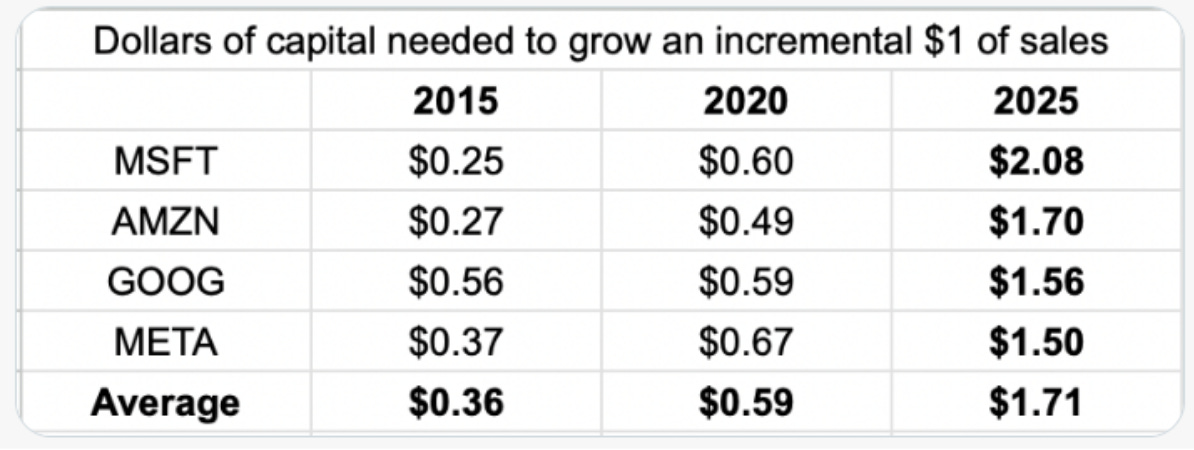
Figure 1. Dollars of capital needed to grow an incremental $1 of sales, 2015 to 2025. Microsoft $0.25 to $2.08, Amazon $0.27 to $1.70, Alphabet $0.56 to $1.56, Meta $0.37 to $1.50; average $0.36 to $1.71. Source: John Huber via XCloud computing infrastructure from 2015 supported relatively predictable workloads, such as web applications, databases, storage, and compute instances, with well-understood utilization patterns and multi-year lifecycles. AI infrastructure serves workloads with radically different characteristics.
The training burden drove the initial spike. From 2023 to 2024, the dominant narrative was frontier model training. It remains essentially the case today. Each generation of models requires exponentially more compute than predecessors. Training runs that cost $10 million in 2022 cost $100 million by 2024. The race for model capabilities continues to drive purchases of hundreds of thousands of H100 GPUs at peak prices.
How Fast Does AI Training Hardware Lose Value?
Training infrastructure has distinct economic characteristics that explain capital intensity:
Short technological cycles. Training GPUs become obsolete within 18-24 months as newer generations are deployed. The capital deployed generates returns across 18-month windows before requiring refresh, rather than the traditional 5-year cloud infrastructure lifecycles.
Dense clustering requirements. Training frontier models require homogeneous clusters of cutting-edge GPUs with high-bandwidth interconnects. You can’t mix GPU generations or repurpose last-generation training infrastructure for new workloads without massive retrofitting.
Latency-insensitive - can batch and schedule for maximum throughput.
Customer concentration. The number of organizations training frontier models globally is perhaps 15-20. When you build dedicated infrastructure for specific AI labs, your capex-to-revenue ratio reflects low utilization during buildout and concentration risk as those customers potentially internalize capacity.
This creates tension between accounting conventions and economic reality. When companies extend useful life assumptions from 4-5 years to 6 years for infrastructure that becomes technologically obsolete in 18 months, reported profits overstate economic earnings.
Critics argue this amounts to systematic earnings manipulation across the sector. However, this critique assumes all AI infrastructure faces identical obsolescence patterns. It doesn’t.
Training GPUs purchased in 2023 for frontier model development may indeed be economically worthless by 2025 as customers shift to newer generations or internalize capacity. (Side note here: While Nvidia’s full memo to sell-side analysts has not been made public, one leaked excerpt includes a statement from the company: “Older GPUs such as A100s (released in 2020) continue to run at high utilization and generate strong contribution margins, retaining meaningful economic value well beyond the 2-3 years claimed by some commentators.“
But when it comes to compute, it is essential to differentiate between training versus inference. (See my Tales of Two Compute: Training Part I & Inference Part II)
Inference accelerators deployed in 2021 for serving existing models can generate profitable returns through 2026 if they maintain cost advantages over alternatives.
The distinction matters enormously for evaluating depreciation assumptions.
How Long Does AI Inference Hardware Stay Productive?
Inference infrastructure has different characteristics:
Longer useful lives. Inference GPUs or custom accelerators remain productive for 4-5 years. The compute requirements for serving a model don’t change when newer GPU generations are released. Companies can amortize capex across traditional cloud infrastructure timelines.
Distributed deployment. Inference scales horizontally across heterogeneous infrastructure. You can mix GPU generations, deploy custom accelerators, and optimize for cost per token rather than raw performance. The capital is more flexible.
Latency-sensitive - must respond to individual user requests within strict SLOs
Customer diversification. Every enterprise application eventually needs inference. The potential customer base is millions of businesses, not 15-20 AI labs. Risk is distributed across industries and use cases.
But inference infrastructure still requires massive capital. The total compute required to serve millions of users querying thousands of specialized models exceeds the compute required to train those models. The capital intensity doesn’t disappear. It shifts from concentrated training clusters to distributed inference fabrics.
Will this AI capex intensity continue? Three scenarios for how this plays out
The scenarios below examine how infrastructure economics evolve based on workload trajectories, using 2027 as a reference point. All three scenarios share the same technical constraint: infrastructure optimized for training performs poorly for inference. They differ in how quickly this matters and who adapts successfully.
Scenario One: Inference Dominance (70% probability)
Training represents less than 20% of total AI compute demand by 2027. Model proliferation favors thousands of specialized models (and many of them open-source) over a handful of closed frontier systems. Enterprise adoption prioritizes inference APIs, not training clusters.