


TL;DR: Jensen Huang’s exit removes the second of the two men on whose word the AI build-out was financed. The first, Sam Altman, gave his word for the demand. Huang gave his for the credit. History says three things follow when a king falls:
Nvidia can miss the open-source inflection. Open-weight models already carry a growing share of AI usage, and I think the money will follow, though I cannot say when. When it does, customers will be able to run those models on other companies’ chips. Huang saw this early and spent to keep Nvidia as the platform they run on. His successor can keep that budget and still miss the turn, as Prussia kept Frederick the Great’s army and lost at Jena.
The companies around Nvidia sort by whether they hold power of their own. Marvell and Lumentum do, and are merging. The neoclouds do not, and I expect them to end up dependent on their largest customers.
Credit goes to whoever wrote the rules down. OpenAI keeps its signed guarantee, and anything beyond it now needs a new decision. Anthropic relies less on anything Nvidia has yet to decide, so on that one narrow test it is less exposed than OpenAI. It is financed by its suppliers too, and its obligations are no easier to meet.
During a wave of anxiety over a shocking series of AI financing deals a year ago, I tried to reconcile my bullishness on the technology's transformative potential with the gargantuan risk surrounding its financing.
In an article called “King Sam and AI Circularity: How Concentrated Bets on OpenAI Create Systemic Risk,” I warned that the greatest risk isn't that the technology fails or that its value isn't realized. It is that the world never gets a chance to find out, because this single company has become the financial epicenter of the AI buildout, creating the risk that its failure could trigger contagion that stalls the buildout of critical infrastructure and strands trillions in investment before the transformation is complete.
“Everything flows through Sam Altman’s company, making it the keystone upon which the entire structure depends,” I wrote in October 2025. “At the center sits OpenAI. Not just as a symbol of artificial intelligence’s potential, but as the potential single point of failure in a system where hundreds of billions of capital are flowing through self-reinforcing loops.”
One year later, a king has fallen, but not the one I had feared.
Jensen Huang’s resignation as Nvidia CEO on November 12 was seismic. In looking back on my circular financing essay, governance was one of the four triggers I named. It fired at Nvidia and not at OpenAI. But if there is one element that I may have gotten wrong, it was the AI pecking order. If Altman was AI’s King, then Huang was its Sun King, the figure around whom the industry’s ambitions, capital, and infrastructure seemed to revolve.
Like Louis XIV, Huang concentrated authority around himself and made proximity to the crown a source of influence. Founders, customers, suppliers, and investors gathered around Nvidia, seeking the chips, partnerships, investment, and backing they needed to build the AI economy. Now the figure at the center has left, and the question is which of those relationships can endure without him.
Huang’s downfall comes at a consequential moment, not just for Nvidia, but for the entire AI industry. And without exaggeration, the global economy. Tonight, Nvidia will report earnings for its fiscal third quarter of 2027, and later this week Anthropic is expected to price its IPO. Around the world, trillions of dollars of debt and equity could be riding on how these events are received and interpreted.
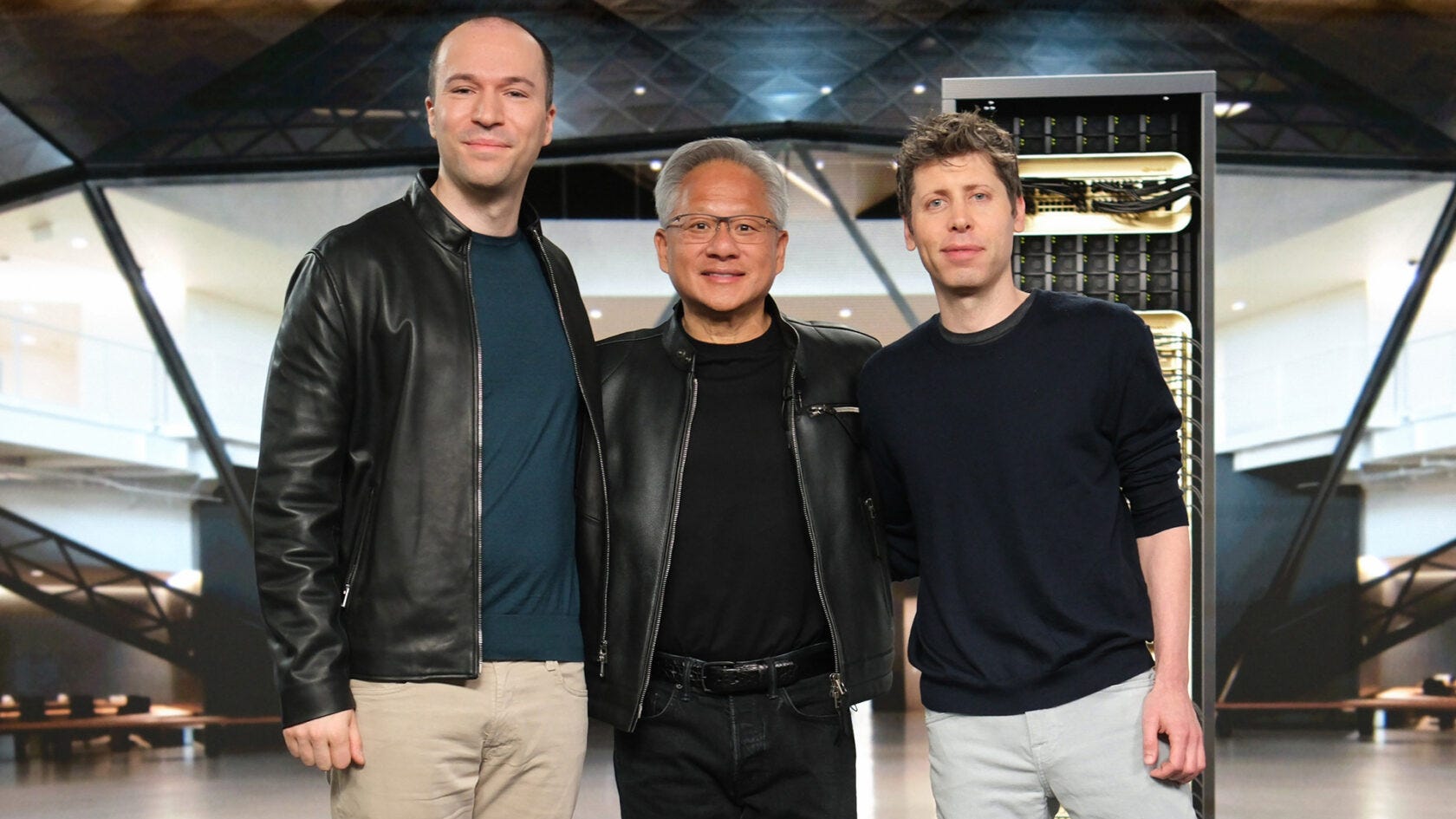
In this essay, as a sequel to the King Sam analysis, I will leave aside the circumstances of the resignation. The allegations are well known, and now we’ll wait for the results of formal inquiries. Instead, I want to explore what history says happens after a king loses the throne.
The starting point is a story about why the two kings needed each other.
Two kings on one lease
The relationship between AI’s king and its Sun King is clearest in Ohio.
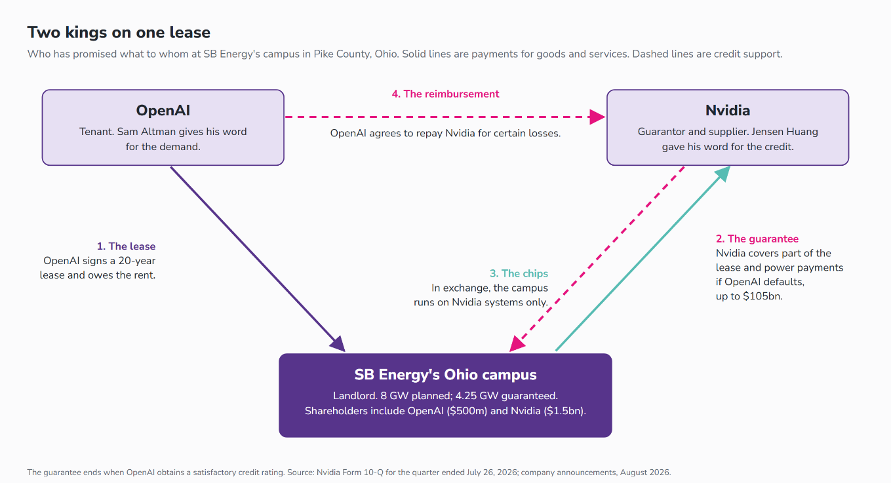
SB Energy, a SoftBank-backed data center developer, is planning to build one of the world’s largest data centers, eventually featuring 8 gigawatts of compute running on 10GW of power generation. OpenAI has signed a 20-year lease covering all 8 gigawatts (GW) of planned IT computing capacity across the site.
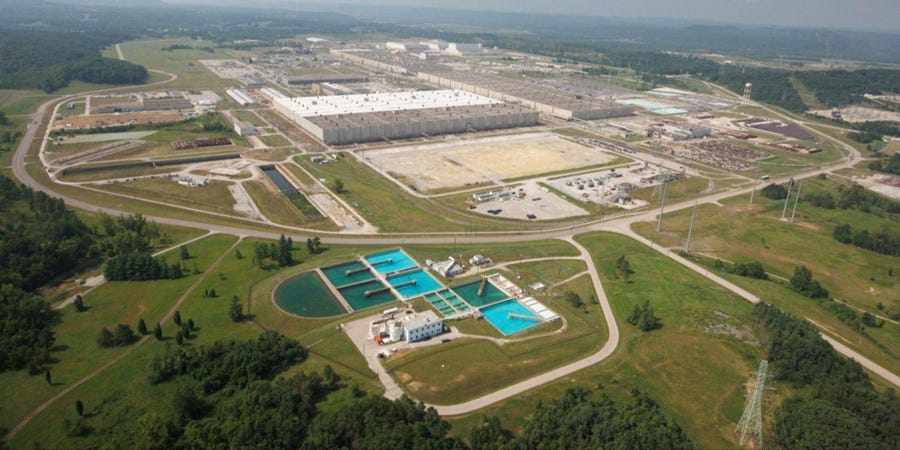
OpenAI was already an investor in SB Energy, with a $500 million equity stake, and Nvidia made its own $1.5 billion investment. Nvidia also pledged to buy $1.5 billion in SB Energy stock at its IPO, which was later postponed because investors were skittish about infrastructure valuations.
But none of that was enough to build the data center. SB Energy still needed to borrow money up front. And while OpenAI had signed those contracts, investors didn’t consider the company an investment-grade borrower. King Sam’s word about his company’s revenues only went so far. They needed more assurances.
Enter the Sun King. Again. Nvidia agreed to provide a $105 billion credit backstop for the first 4.25GW of compute to be built. In July, the Wall Street Journal reported that Nvidia was discussing a guarantee of about $250 billion. Nvidia’s shares fell on the report, and the figure signed in August was less than half that. If OpenAI’s revenue doesn’t materialize to pay the bills, and SB Energy can’t find another tenant, then Nvidia would be on the hook. The terms are narrower than a blanket guarantee. Nvidia’s filing describes guarantees capped at $105 billion that cover defined portions of the lease and power payments and are triggered only if OpenAI defaults. Nvidia could then take over the lease, have the landlord look for another tenant or start a sale. OpenAI has agreed to reimburse it for certain losses, and the exposure shrinks as OpenAI pays its rent.
This is more than benevolence. In exchange, Nvidia secured an exclusive deal to sell chips to the project. That revenue will only materialize if King Sam holds true to his word and delivers the growth he promised.
Each king had something the other needed. Altman had the ambition and demand to fill the campus, but needed a guarantor to help finance it. Huang wanted to see the campus built and filled with Nvidia chips, and could use Nvidia’s balance sheet to make that possible.
What the Sun King did
A century before Jensen Huang, J.P. Morgan demonstrated what happens when an industry comes to depend on the judgment of one man.
In the panic of 1907, J.P. Morgan sat in his library and decided which banks would be supported and which would be left to fail. Nobody had appointed him, and no rule said who qualified. When a committee of the House of Representatives asked in 1912 whether credit was based primarily on money or property, he answered: “No, sir; the first thing is character.” The United States would later create the Federal Reserve, giving an institution responsibilities that had previously fallen, in a moment of crisis, to a private banker.
The parallel is not exact, but the question is familiar: What happens when a system relies on the judgment and influence of a single person?
Huang played three roles at Nvidia that extended well beyond the company itself. He saw strategic turns before the evidence was in. He decided which companies would receive Nvidia’s support and access to its technology. And he put the company’s financial strength behind customers and partners trying to build the AI economy.
Some of that support is written into contracts. The Ohio guarantee is one example. But around those agreements sat the possibility of more. For instance, there was the proposed $100 billion investment in OpenAI that Huang later said “was never a commitment.” Nvidia still has the option to back another 3.8 gigawatts in Ohio at its “sole discretion.” And financing platforms with six lenders and asset managers, Nvidia’s own filing says, “may not lead to definitive agreements.”
These are different kinds of commitments, and they will be tested on different timetables. Nvidia’s strategic direction may take years to reveal itself. Companies that relied on its support may face their test the next time they need chips, customers, or financing. For OpenAI and the other frontier laboratories, the more immediate question is which sources of support are secured, and which will require a new decision from Huang’s successor.
Of course, the royal metaphor only goes so far; even if Huang was famously hands-on, he put as many as 60 people in direct reports. Nvidia is a public company with a board. Its guarantees carried ceilings and were disclosed. What made Huang the Sun King was not that he stood above those rules. It was the influence he exercised through the decisions, relationships, and expectations that surrounded them.
Nvidia: the tech turn it could miss
The first thing a king does is see the turn before the evidence is in. One of Jensen Huang’s great strengths was seeing where computing was headed before the market fully understood it.
Huang did it in 2006 with CUDA, the free software that made Nvidia’s chips the default for a field that did not yet exist. Two decades later, Huang was positioning the company for another technological turn: the rise of open-weight AI models.
I have been writing about that turn for a year. In November 2025, I argued that open source had “caught up to the closed frontier.” In July, when Kimi K3 became the first open-weight model to beat the closed laboratories on an independent frontend-coding board, I argued the inflection had arrived.
The usage is beginning to show it. On Vercel’s model gateway in July, open-weight models accounted for 36% of tokens but just 8.6% of spending. They were carrying more of the work without yet capturing a comparable share of the money.

On Monday, November 16, Databricks published its AI Index, which suggested these trends are accelerating. According to Databricks, open-weight models’ share of token traffic rose from 7.3% in July to 30.9% in early November among the Databricks-hosted models measured through Unity Gateway. That is an increase of 23.6 percentage points, or more than fourfold, in less than four months. However, the surge primarily occurred from July to September and then leveled off. Databricks did not provide a direct spending comparison between open and proprietary models.
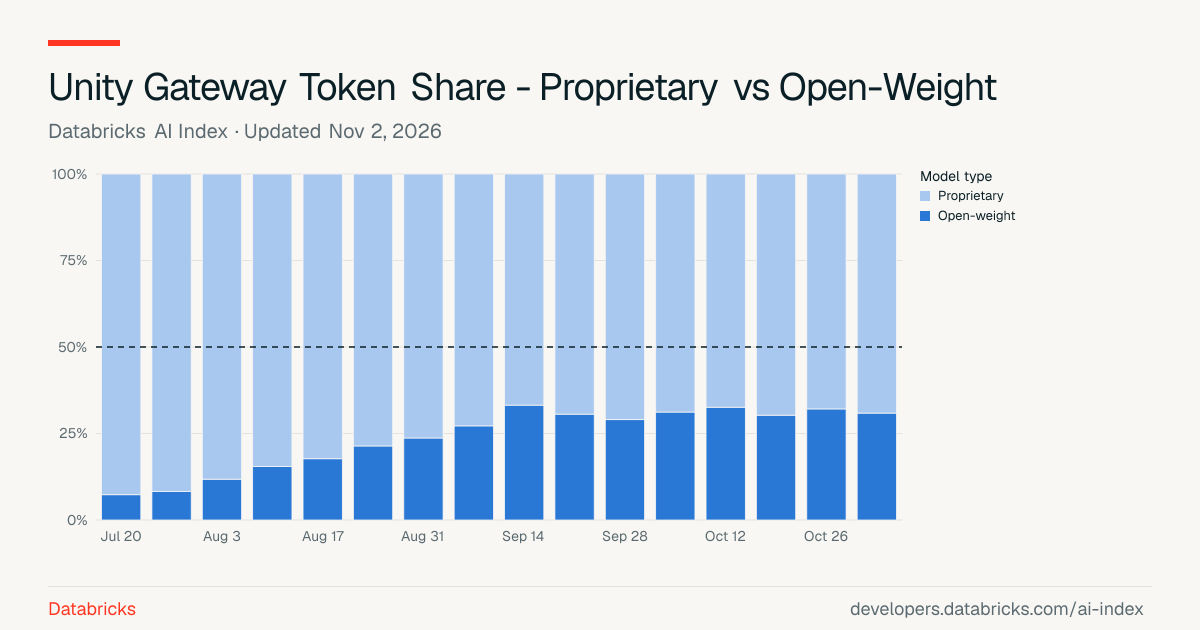
The timing is uncertain. A survey of technology chiefs at large companies this year found that open models’ share of AI spending had fallen from 19% to 11%. That is a reason to be cautious about declaring victory for the open camp.
My view remains that more of the money will eventually follow the usage. Open-weight models continue to improve, and many of the strongest are coming from Chinese laboratories whose releases do not depend on the decisions of any company in California. I cannot say when that shift will arrive, or how far it will go. I do think it comes whether or not Nvidia helps it.
None of this contradicts Anthropic’s growth, which rests on the frontier. In my assessment of Anthropic’s IPO last week, I set out the beliefs its valuation depends on, and the fourth is that the frontier can keep its price. The price of a fixed capability keeps collapsing, and that is the ground open models are taking. The price of the best available model has held: a Menlo Ventures survey I cited there found frontier models taking 63% of enterprise spending on 42% of the tokens. So the two can be true together. Open models can win the volume, and eventually more of the money, in the work the frontier has left behind, while Anthropic grows on the work only the frontier can do. The open-source inflection becomes Anthropic’s problem only if its models stop staying ahead.
What Nvidia can influence is whether it remains the platform on which those models run. If AI computing spreads from a relatively small number of frontier laboratories to thousands of companies deploying open weights, those customers have more opportunity to choose competing chips.
Huang understood that possibility and built a strategy around it. In March, I called his open agent toolkit the second act of the CUDA playbook: give away a layer of software so that whatever is built on it needs Nvidia underneath. In September, I wrote about his $12.9 billion agreement, retention payments included, to buy Hugging Face, the registry where open models are published, and concluded that “value may migrate away from the model layer without leaving the Nvidia stack.” Between the two, he published a letter defending open weights to Washington. “Free AI should be great for chips,” he told Axios.
I still think that strategy is right. What I underweighted is the difficulty of ensuring that value stays in Nvidia’s stack. I had written as much myself. After DeepSeek, in January 2025, I said Nvidia’s case depended on its ability to play offense. In my March 3 essay on OpenAI at $730 billion, I wrote: “When it comes to inference, Nvidia is not a monopolist. It is one competitor among several in a market where positions are far from established.” Open models are an inference market.
Playing offense here means doing three things that each cost Nvidia something today. It gives models and tooling away. It owns the registry and keeps it open to rival chips, which its filing on the Hugging Face deal says it “has committed to” doing in terms nobody outside the company can enforce. And it undercuts, with free models, the closed laboratories that are among its largest customers.
Huang’s approach required Nvidia to make choices whose benefits might take years to appear. The question is whether Nvidia’s next leadership team will make the same choices when the financial trade-offs become uncomfortable.
The money is not what is at risk. Nvidia has $29 billion of computing under contract through fiscal 2032 to support, in its filing’s words, “our open models, such as NVIDIA Nemotron, Cosmos, and GR00T,” along with its autonomous-vehicle software. TechCrunch asked on the day he left whether Nvidia’s support for open source would survive him. I think the budget will. The danger is a company that keeps the budget and runs it as a sales program for its own chips: a Hugging Face registry tilted toward Nvidia hardware, weights released more slowly, and the argument in Washington allowed to lapse.
None of those decisions would necessarily be announced as a change in direction. Each could look reasonable on its own. Together, they could leave Nvidia less central to the next phase of AI. Nvidia has told its shareholders what the cost could be. Its quarterly filing warns that if open models “are primarily deployed on competitors’ platforms, they could reduce demand for our offerings.” I cannot put a number on that because Nvidia does not report how much of its revenue comes from inference. However, the direction is clear enough. The advantage that CUDA built over twenty years would erode from the open side while the hyperscalers build their own chips on the other.
History has a close case in another realm: everything its king built, and he lost his judgment.
Frederick the Great died in 1786 and left Prussia the most admired army in Europe. His successors preserved his methods as doctrine. They kept his drill and officer corps, but none of his willingness to change them when war changed. Twenty years later, on October 14, 1806, Napoleon’s army destroyed the Prussian one in a single day at Jena and Auerstedt. A letter of 1808 attributed to Queen Louise says that Prussia had fallen asleep on the laurels of Frederick the Great.
The semiconductor industry has seen its own version of this. In 2013, departing Intel CEO Paul Otellini recalled turning down the opportunity to make the chip for the first iPhone because Apple’s price was below Intel’s forecast cost. The forecast was wrong, and the volume turned out to be a hundred times what anyone had projected. His instinct had told him to say yes.
That does not mean Nvidia will make the same mistake, and two objections are fair. Some historians date Prussia’s stagnation to Frederick’s own last decades, and the equivalent would be that Huang’s bet was wrong and his successor will be right to trim it. And Nvidia may choose well: the engineer who created CUDA is among the internal candidates reported for the job. The danger I see is a company that keeps Huang's investments but loses sight of why he made them.
At the end of this essay, I suggest two early indicators to watch: how consistently Nvidia releases open weights and whether Hugging Face, if the acquisition closes, continues to serve rival chips on equal terms. Neither will settle the question on its own.
Together, they should tell us something about whether Nvidia still intends to shape the turn, or merely protect the position it already holds.
The ecosystem: who can stand on their own?
The second thing a king does is decide who rises and who is protected. Jensen Huang’s influence extended far beyond Nvidia. His decisions about chip allocations, investments, and financial support helped shape an ecosystem of companies building the infrastructure for AI.
But those companies do not all depend on Nvidia in the same way. Some have assets or customers that give them bargaining power. Others rely more heavily on Nvidia’s continued support. Huang’s departure will test the strength of those relationships.
Consider Marvell and Lumentum.
Lumentum makes the lasers used in the optical links that connect AI systems, and it has said its capacity is sold out. In March, Nvidia paid $2 billion for a stake in the company together with a multi-year commitment to buy its components. It did the same with Coherent, another laser maker. In the same month, it put $2 billion into Marvell, a partner of Nvidia’s that also designs custom chips for the hyperscalers. These investments helped Nvidia secure access to scarce components. They also showed the leverage held by the companies supplying them.
On November 2, Marvell announced that it would buy Lumentum for $115 billion including debt, paid for in its own shares. The agreement was signed eleven days before Huang resigned, so it cannot be read as a response to his departure. But it illustrates a shift already underway. Both companies took Nvidia’s money in March, and they are using the position it helped them build to need Nvidia less. If regulators approve the deal, the combined company will bring together valuable capabilities and sell to Nvidia and its rivals. Huang’s successor could inherit a larger, more powerful counterparty in which Nvidia holds minority stakes.
Now consider the specialist AI cloud providers, or neoclouds.
I have long questioned whether independent GPU clouds are a durable business model. I wrote about them in September 2025 and called the independent GPU cloud “a transitional phenomenon rather than a permanent fixture.” This June, I described how their financing works: “The same dollar is counted as demand by the chip maker, revenue by the neocloud, and collateral by the lender.”
Nvidia has been central to their growth. By CNBC’s account, Huang decided where companies stood in the chip queue. Nvidia has agreed to buy capacity that these clouds cannot sell, $36 billion in total. CoreWeave’s agreement, signed in 2025, is for $6.3 billion and runs to 2032. Nvidia owns more than a tenth of CoreWeave and was an anchor investor when its listing struggled.
That backing hasn't made neoclouds cheap to finance. In August, I cited the FT’s finding that data-center projects backed by Google borrowed at a median 7.1%, against 9.3% for neoclouds building around Nvidia. Last week, CoreWeave’s 2031 bond yielded 14.8%, after its strong results brought it down from 16.7%. That is a distressed price, and it was a distressed price before Huang left. So the level says little about his exit. What his departure adds will show in the terms of the next refinancing.
The signed agreements remain in place. The uncertainty concerns what happens when a company needs more: another allocation of chips, a new capacity agreement, or support for its next round of financing. Nvidia’s next leadership team will make those decisions, but it may not do so in the same way Huang did.
Machiavelli explains why that matters more for some than for others.
The fourth chapter of The Prince separates two kinds of kingdom. In one, everyone who governs is a servant of the prince and holds office by his favor. In the other, the prince rules alongside barons who hold their rank by their own lineage and have subjects who follow them. Servants have no following of their own, so the kingdom passes whole to whoever takes the prince’s place. Barons make their own terms.
The hyperscalers are barons. They bought more than half of Nvidia’s data-center revenue last quarter; they borrow in their own names, and they design their own chips. They are leveraged barons, as I argued on November 3 when I showed their combined free cash flow staying negative until 2030, but the leverage is their own.

The neoclouds are servants. They cannot choose their next master. They wait to learn who it is. It may be Nvidia’s next chief executive. I think it is more likely to be their largest customers, the hyperscalers, even if those put their own capacity first.
By the end of 2027, I expect at least one listed neocloud to have sold itself or to have taken a hyperscaler’s guarantee on its debt. For now, nothing has broken. The test comes when the neoclouds next need to refinance and discover how much of their business can stand on its own.
OpenAI and Anthropic: promises, contracts and credit
The third thing a king does is give credit on his word. When that ends, credit goes to whoever has put itself under written rules.
And that leads back to the company at the center of my original analysis: OpenAI.
A year after I described it as the keystone of the AI financing system, OpenAI has not failed. OpenAI set out last month to raise up to $30 billion and, by Bloomberg’s account, had closed about $11 billion of it by November 6. Meanwhile, S&P cut Oracle, OpenAI’s largest contracted supplier of computing capacity, to the lowest investment-grade rating in July, citing its concentration on OpenAI.
The Ohio guarantee is signed and remains intact. That commitment belongs to Nvidia, and its successor leadership inherits it. But future support that was discussed and never committed will require a new decision.
OpenAI has a way to reduce its dependence on that support. The Ohio guarantee can fall away if the company obtains the required credit rating. Getting there would give OpenAI greater ability to finance its ambitions on the strength of its own balance sheet.
For now, Altman keeps his throne. But the other king who helped him finance it has left.
Anthropic under the same test
Anthropic faces financing pressures of its own. It also relies heavily on companies that supply the infrastructure it needs to build and run its models.
It leases its chips from Broadcom under five-year agreements carrying about $161 billion of rent. Broadcom, Google, and Amazon have agreed, before the offering, to lend it up to $77 billion. In August, I wrote that “diversifying among your two largest shareholders, both of whom are competitors, is less independent than the counterparty count suggests.” Its prospectus shows about $900 billion of committed spending against $146.6 billion of liquidity, and against revenue of $33.2 billion in the first nine months of 2026.
Anthropic also faces exposure to the shift toward open models. It took roughly 65% of the spending on Vercel’s gateway in July. So a meaningful migration of spending toward open alternatives would put pressure on an important source of demand. And Anthropic has financial ties to Nvidia, which has subscribed for approximately $10 billion in a private placement alongside the offering.
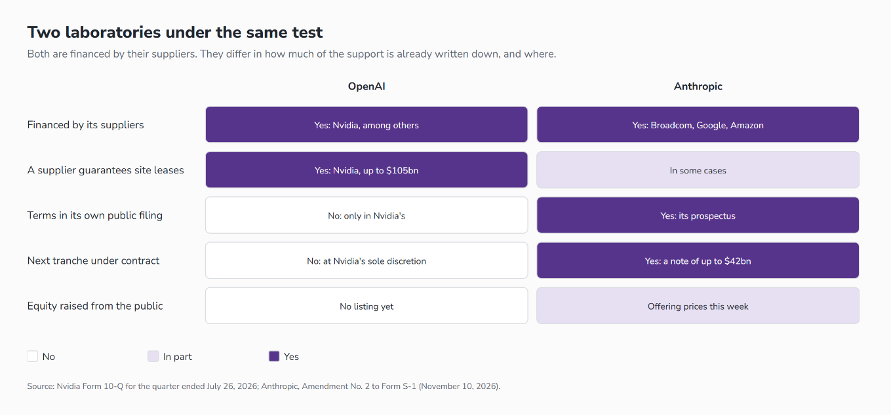
I also need to revise a distinction I drew in August. I contrasted the guarantee Nvidia was then discussing for OpenAI with Anthropic’s use of commercial bank credit, and called one circular and the other merely leveraged. Anthropic’s prospectus shows that more of its support comes from suppliers than that distinction allowed.
Both companies depend on financing relationships with businesses that have a commercial interest in their success. Both have substantial commitments to meet. And both need to show that their revenue and access to capital can support those commitments over time.
What is written down, and what comes next
The distinction I would draw today is narrower. On exposure to Huang’s departure, what matters is which commitments are already in place and which still require a decision.
OpenAI has the signed Ohio guarantee, but other potential Nvidia support remained discretionary. Anthropic has disclosed supplier financing agreements in its prospectus, including a note facility of up to $42 billion, as well as Nvidia’s signed subscription alongside the offering. Those commitments have their own terms and conditions, but they do not rest solely on an expectation that Huang will approve them in the future.
On that specific test, I think Anthropic is better placed to navigate the immediate transition at Nvidia, simply because it relies less on Nvidia. Its own points of dependence are Broadcom and its two shareholder clouds, which this test does not examine. That is not the same as saying it is financially independent, or that its obligations are easier to meet.
The proposed public offering could help Anthropic take a further step. A listing would bring regular public reporting and access to public investors. The company says in its prospectus that it wants financing “from independent sources on our own credit.” That is an objective, not yet an achievement. The more meaningful test will be whether it can borrow at scale from lenders that are neither its suppliers nor its shareholders.
History offers a useful, if imperfect, parallel. After England’s Glorious Revolution of 1688, Parliament gained a greater role in overseeing public finance. The Crown could no longer borrow on the king’s word. Its debts were voted by Parliament and secured on taxes that Parliament controlled. Economists Douglass North and Barry Weingast associated those institutional changes with an improvement in the government’s ability to borrow over time: the rate on its long-term loans fell from 14% in 1693 to 3% by the 1730s.
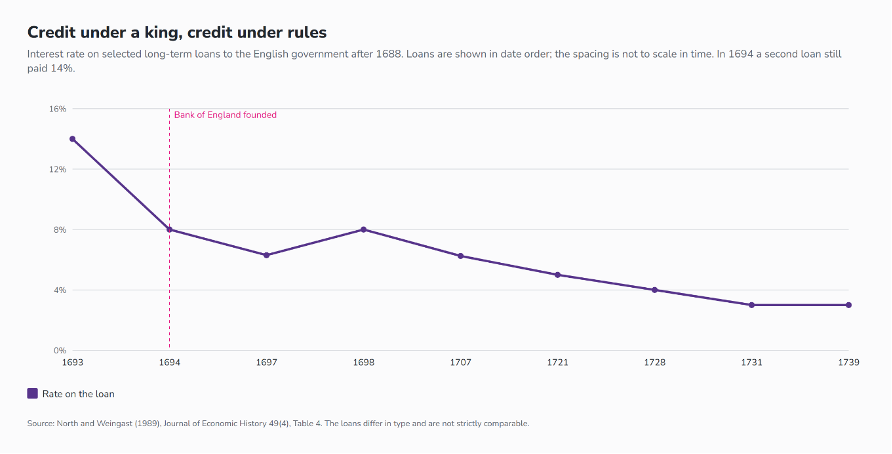
While historians debate how much the institutional changes explain the fall in borrowing costs, the broader point applies: creditors need reasons to trust the borrower’s ability to meet its obligations, and transparent, credible rules can help provide them. That is what both laboratories are now trying to buy. The corporate equivalents of a vote in Parliament are a public listing, a published financing program and an investment-grade rating.
A listing alone does not create that trust. CoreWeave is a public company, and its bonds still carry a high yield, which shows how far that transition still has to go. Nor does borrowing from a shareholder necessarily provide independence. Anthropic’s challenge is to turn the visibility of an IPO into access to credit that does not depend on the companies supplying its infrastructure. For OpenAI, the equivalent milestone is the credit rating that could release Nvidia from the Ohio guarantee.
For both laboratories, the longer-term question is the same: can they finance their ambitions on their own credit, or will they keep relying on the companies that stand to profit from their spending?
What Would Prove Me Wrong?
These are arguments about what may happen after Jensen Huang’s departure. The contracts have not disappeared, Nvidia remains a formidable company, and the AI buildout continues. So I want to be clear about what I will be watching and what would make me reconsider my conclusions.
First, will Nvidia honor the commitments already made? Nvidia’s subscription to the Anthropic placement closes with the offering this week. I expect it to be honored. This is the weakest of the five tests, since a signed subscription by a solvent company is very likely to close. A withdrawal outside its stated conditions would mean contracts are not surviving the king.
Second, how will Nvidia make new financing decisions? The test is the annual report Nvidia files around late February 2027. A new guarantee or backstop for an unrated customer, issued outside a published program with a ceiling and a fee, would show credit still being given at someone’s discretion. So would an exercise of the 3.8-gigawatt Ohio option, or a first loan closed under the six lender platforms, without such a program. A published program would show the rule arriving faster than history suggests.
Third, will Nvidia stay the course on open models? By its July 2027 quarter, I will look at two things: whether Nvidia is releasing open weights at least as often as it did this year, and whether Hugging Face, if the purchase has closed, still serves rival chips on equal terms. If both hold, my worry is misplaced.
Fourth, can the neoclouds refinance on their own strength? By the end of 2027, at least one of the listed neoclouds (CoreWeave, Nebius or IREN) has sold itself or taken a new hyperscaler guarantee on its corporate debt. Backstops that exist today do not count. If none has, and they are refinancing in their own names at narrower spreads than today, I am wrong about them.
Finally, can the frontier laboratories earn independent credit? By the end of 2027, Anthropic has raised an unsecured bond or bank facility of at least $10 billion with no supplier guarantee behind it. If OpenAI obtains the rating that releases Nvidia’s guarantee before that happens, I am wrong about which of the two is better placed.
King Sam asked whether the AI financing architecture could survive the failure of its keystone. That is not what has happened here. OpenAI remains in place, and Nvidia remains responsible for the commitments it made under Huang.
What has changed is the person at the center of a network of decisions, relationships, and expectations. The Sun King has left, but the system built during his reign remains.
The first question is whether Nvidia’s new leadership honors its existing commitments. The harder questions will take longer to answer: whether the neoclouds can finance themselves, whether Nvidia can remain central as open models advance, and whether the frontier laboratories can borrow on their own credit.
The Sun King’s departure has not brought the AI kingdom down, and I expect the signed contracts to hold. The harder tests come in order: the neoclouds at their next refinancing, Nvidia when open models start to take the money, and OpenAI when it next needs more than its contract allows. By the end of 2027, we will know how much of it can stand without him.
Disclosure: Decoding Discontinuity is the research behind the author’s investing. The author holds no position in Anthropic or OpenAI. The author manages a fund that may hold long or short positions in listed companies discussed in or affected by this essay. This essay uses only published sources and is not an offer, solicitation, or recommendation regarding any security, including any offering by Anthropic.